
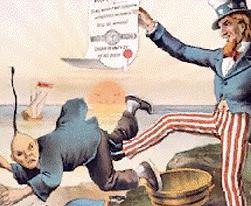
 (Courtesy: Wikimedia Commons)
When I give my talks at Ellis Island I tell the story of America’s immigration history warts and all. Anything less would be hagiography not history, and the twelve million brave souls who passed through Ellis Island from 1892-1954 deserve better than that. For the most part the story is one of conscientious public servants and health officials working hard and well under difficult circumstances. Processing 5,000-6,000 incoming immigrants day-after-day, year-after-year—all without the help of today’s technology—was a herculean and uniquely American endeavor for which we are rightfully proud. Today, however, is the anniversary of one of the darker moments of that history. It was on this date in 1882 that Congress passed the Chinese Exclusion Act. Chinese laborers had been in the United States for decades, working in mines and building the transcontinental railroad that was completed in 1869. With that project done, there was great fear that these workers might take away American jobs. The National Archives explains:
In the spring of 1882, the Chinese Exclusion Act was passed by Congress and signed by President Chester A. Arthur. This act provided an absolute 10-year moratorium on Chinese labor immigration. For the first time, Federal law proscribed entry of an ethnic working group on the premise that it endangered the good order of certain localities.
The Chinese Exclusion Act required the few nonlaborers who sought entry to obtain certification from the Chinese government that they were qualified to immigrate. But this group found it increasingly difficult to prove that they were not laborers because the 1882 act defined excludables as “skilled and unskilled laborers and Chinese employed in mining.” Thus very few Chinese could enter the country under the 1882 law.
Not a proud moment in our nation’s history, but one to remember.
 The Strawfoot