
I hope everyone’s Labor Day weekend is going well. After the grind that was the first full week of the academic year I consciously stepped away from anything work-related on Saturday and Sunday. Today I’ll do laundry, clean the house, and send some emails. I’m in the midst of a project this semester that has proven more complicated and time-consuming than I’d originally envisioned. I’m trying to learn a few new skillsets on the fly, which to put it mildly has been a challenge. I’m trying to control what I can and pace myself for the remainder of what will be a challenging term. Yesterday I went to the Brooklyn Museum of Art. It was a gorgeous late summer day. Prospect Park was full and Eastern Parkway lined with vendors.
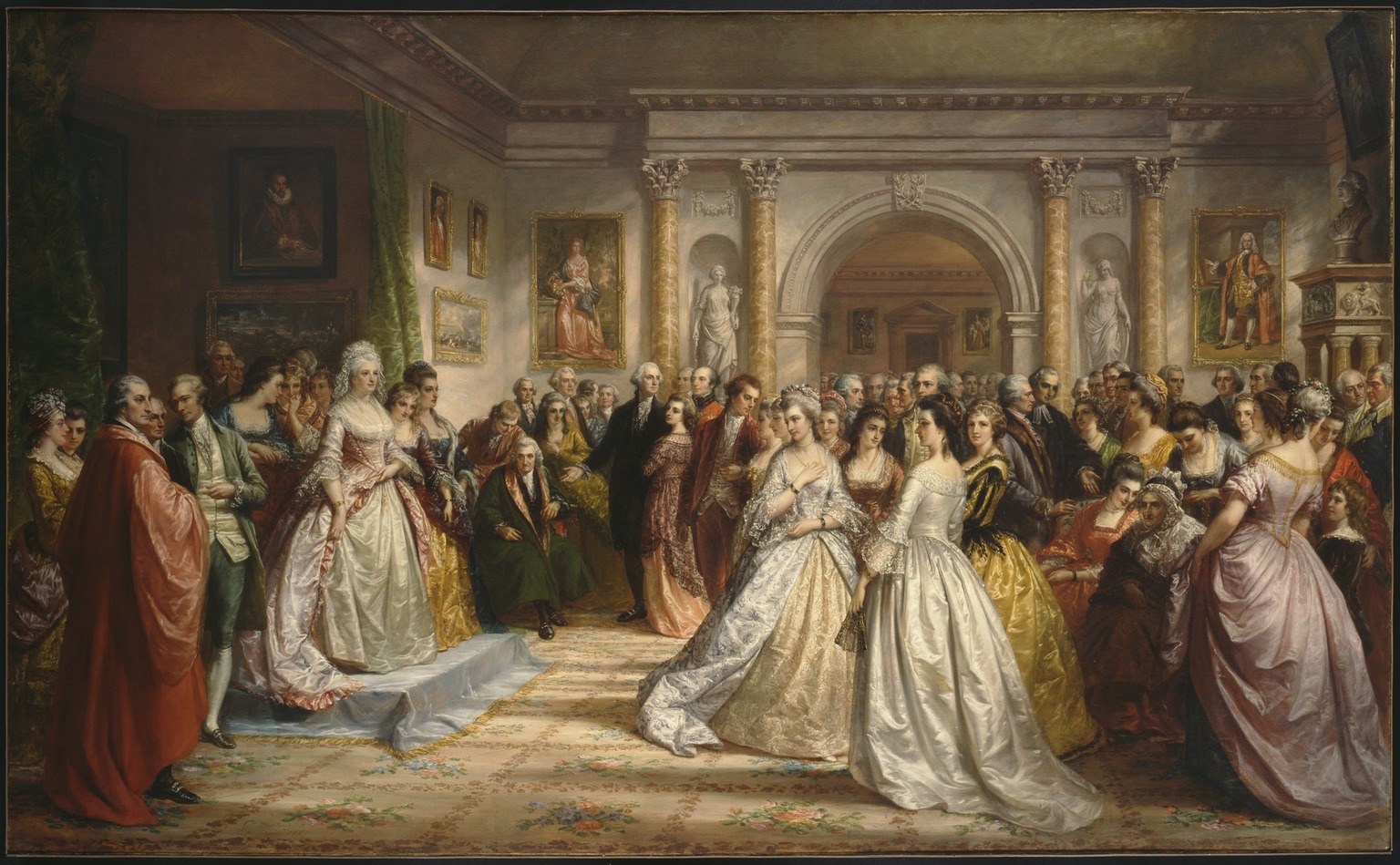
One of my favorite spots in the Brooklyn Museum is the visible storage facility. I’ve seen similar layouts at the New-York Historical Society, Metropolitan Museum of Art, and Smithsonian National Portrait Gallery/American Art Museum. Apparently the Henry Luce Association funded these and similar facilities, most if not all of which have names mentioning Luce . Visible storage, sometimes called open storage, is a way for museum visitors to view items not on display in the galleries. Strolling through I noticed Daniel Huntington’s “The Republican Court (Lady Washington’s Reception Day).” It portrays one of First Lady Martha Washington’s fêtes at the Presidents House in Philadelphia in the 1790s. It’s actually quite large, about six feet tall and twelve feet across. The year if came out—1861—is significant. The Mount Vernon Ladies’ Association had been founded in 1853, and they opened Washington’s home as a museum in 1860. As the secession crises was heating up both sides were claiming the Founders as their own. Huntington produced this work the year of Fort Sumter and First Bull Run.
A quick dive into the Brooklyn Daily Eagle informs us that Latham Avery Fish purchased “The Republican Court (Lady Washington’s Reception Day)” for $3,300 from the A.T. Stewart collection in 1887 and sold it for that same value to the Alexander Hamilton Club at Clinton and Remsen Streets. The Union League Club of New York also coveted the painting but fell short in the bidding. Years later, President Theodore Roosevelt, a devout Hamiltonian, tried to purchase the artwork for $50,000—upwards of $1.5 million in today’s dollars—for the Library of Congress. That fell through. The Hamilton Club eventually merged with the Crescent Club and when the Hamilton clubhouse was torn down in the mid-1930s this and other pieces ended up moving to the Crescent clubhouse at Clinton and Pierrepont Streets. It became a fixture of Washington’s Birthday commemorations. Crescent-Hamilton Athletic Club members were generous with the painting, lending it to the Brooklyn Museum in 1932 for a big exhibit coinciding with the George Washington bicentennial. It really is one of the most iconographic pieces of Washingtonia, which is saying a lot. As I have been able to gather, the Crescent-Hamilton Athletic Club donated “The Republican Court (Lady Washington’s Reception Day)” to the Brooklyn Museum in 1939. I’m glad it has remained in the borough.
 The Strawfoot
k, Nice piece for the Labor Day weekend!! B.
Thanks, Bob. Had a great time at the Old Stone House last weekend. Maybe we’ll all get one final day trip in sometime in early fall.
This is an important painting, and I get why you are proud of its Brooklynite ties. Because of its connection with nation-building, it really should be in a national repository of art, though.
Being painted in the late antebellum period, this work tells us more about “the cult of the Washingtons” than it does about the true look of official social life in their time. If only a contemporary painting of Martha’s gatherings survived–now that would be a treasure!
Susan, thanks for the comment. Yes, had it gone to the Library of Congress’s collection like President Roosevelt had attempted it might have been for the best. I could totally see it at the Smithsonian National Portrait Gallery as well. I agree that it says more about the late antebellum than the Federal period. Northerners and Southerners alike used the cult of the Washingtons for their own purposes. And yes, it is unfortunate that we have few if any contemporary renderings from the period of Washington’s presidency. Oh to have sketches or paintings of George and Martha’s fetes and levees.
Keith, I know you have done extensive work researching Theodore Roosevelt Sr. The Indiana Chapter of the TRA will host the 2024 natioanl meeting and I’m working on a panel for discussing TR’s father. Can you contact me to discuss? My email is lowmarg1@frontier.com. Thanks!
Margaret, good to hear from you. I hope you have been well. I’ve gotten a bit away from the Roosevelt but would love to return to the topic. There is so much still to explore. I’ll email you and we’ll talk.