• About

The Strawfoot

~ a New Yorker's American History blog

The Strawfoot

Category Archives: Clarence D. McKenzie

Brooklyn’s Little Drummer Boy: last in a series

15 Friday Jun 2012

Posted by Keith Muchowski in Civil War sesquicentennial, Clarence D. McKenzie

≈ Comments Off on Brooklyn’s Little Drummer Boy: last in a series

Here is the conclusion of the story. (For the rest, go here: one, two, three, four.)

Americans understood the significance of the Civil War even as it was unfolding and were anxious to record it for posterity.  This was the most literate generation of Americans up until this time; during the war they had read newspapers such as the New York Herald and periodicals such as Harper’s Weekly and Frank Leslie’s Illustrated News voraciously.  They also had written reams of letters to and from the front.  Now they turned their attention to the second draft of history.  Seemingly every regiment had to publish its official history of where it was and what it did during the War of the Rebellion.  McKenzie’s 13th New York published two monographs, its official history and an account of its 1879 trip to Canada in honor of Queen Victoria’s 60th birthday.  In the 1880s The Century Magazine published nearly one hundred battlefield accounts written by Union and Confederate officers that proved wildly popular with Northerners and Southerners alike.  Inevitably the magazine published a multi volume hardcover edition with expanded content which sold over 75,000 copies.  The most successful publishing endeavor was Grant’s Memoirs, published in 1885 by Mark Twain.  Justifiably considered a masterpiece of American letters, Grant’s biography captivated Americans and restored the general’s family fortune.

At the time of Grant’s death in 1885 interest in the Civil War was never higher.  Tensions between the sections were starting to cool.  The war had been over twenty years and the veterans, now in full middle age, were increasingly aware of their own mortality and their place in history.  Civil War veterans, especially Union veterans, were an exceptionally powerful block.  Organizations such as the Grand Army of the Republic (GAR) were part fraternal club, part political action group protecting veterans’ interests, especially pension benefits.  The GAR, however, was not just about camaraderie and securing privileges; its members took their role as defenders of the Union seriously.  They were equally serious about preserving that memory for future generations  The men of the 13th New York were part of this phenomenon.  When the GAR formed in 1866 the men named Camp 399 named themselves the Clarence D. McKenzie Post.

A nondescript  grave in a common field, even a common field in one of the country’s most prestigious garden cemeteries, was no place for the individual who had become the human face of the regiment and its sacrifices.  Memorialization was an increasing phenomenon.  The monuments and memorials that veterans literally built to themselves were quite consciously an attempt to stand in their place after they were gone.  Almost immediately after its founding in 1879, the 13th Regiment Veteran Association began raising funds for an appropriate memorial.  Commemorating individual soldiers was increasingly common in the late Victorian America.  Advertisements for the construction and maintenance of statuary were ubiquitous in regimental histories (including the 13th’s) and in the magazines geared toward veterans and their families.  The Monumental Bronze Company of Bridgeport, Connecticut advertised a generic soldier for $450 in 1880s dollars; for an additional $150 the likeness of the specific individual could be had.  The 13th chose the latter option.
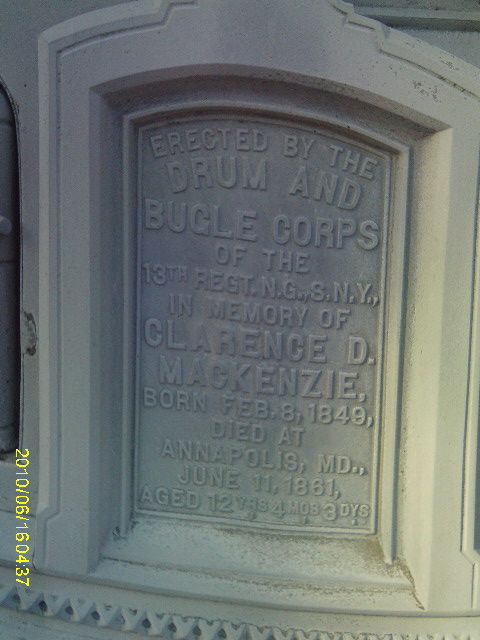
On November 25, 1886, a quarter century after Clarence McKenzie was senselessly killed in an Annapolis encampment, a contingent of veterans paraded from the Thirteenth Armory down Flatbush to Green-Wood.  As the rain fell heavily John B. Woodward, once an officer in the 13th and now a prominent Brooklynite, gave the oration.  Speechmaking was considered a show in the years before electronic entertainment, with audience expecting a combination of entertainment, humor, and moral uplift.  Woodward did not disappoint.  After, the drape was pulled and the monument to the Little Drummer Boy unveiled.

Brooklyn’s Little Drummer Boy: 4th in a series

14 Thursday Jun 2012

Posted by Keith Muchowski in Civil War sesquicentennial, Clarence D. McKenzie

≈ Comments Off on Brooklyn’s Little Drummer Boy: 4th in a series

Here is the penultimate chapter in the Clarence McKenzie story. (One, two, and three here)

The hagiography was immediate.  First came the viewing in Annapolis.  After the body was returned to his parents home there were several additional weeks of observances by clergy, military and civil officials.  Then came the funeral attended by the children of Public School Number 8, Sunday Schoolers, friends, neighbors, and thousands of others.  Reverend Guion emphasized the justness of the Union cause, the traitors responsible for the war, and the importance of putting down the rebellion.  Next came Reverend McClelland.  In the finest Victorian oratory McClelland reminded the audience of how, “We loved the boy for his sweet and genial disposition, for the noble patriotism that fired even his young bosom.”  He mentioned the Bible, its Moroccan leather, gilt edges, and brass clasp.  It had been made in England and purchased, with another, in Manhattan years earlier.  It was almost providential, he averred, that he did not give the Bibles away after initially purchasing them, but had waited for a proper time, the moment coming two years later when the little drummer boy left with his regiment.  Finally, almost anti-climactically, the boy was taken to the cemetery and buried in a modest grave.

That was not all.  Almost immediately a small book entitled, The Little Drummer Boy, Clarence D. McKenzie, the Child of the Thirteenth Regiment, N.Y.S.M., and the Child of the Mission Sunday School appeared.  Something of an oral history of the young boy’s life the slim monograph, published by the Reformed Protestant Dutch Church, recounts the boy’s life from the working class neighborhoods of Brooklyn to his salvation and eventual martyrdom.  In a representative passage Reverend Luther G. Bingham, the books compiler, the states that “Among the many heart stirring incidents of “the war” now waged between those, who ought to be friends, perhaps none has created more deep and wide spread sympathy in New York and Brooklyn, than the sudden and accidental death of the youngest drummer boy of the Thirteenth Regiment..”

The reason for such sympathy was the timing.  If McKenzie had died six weeks later no one would have noticed, and certainly the would not have turned out by the thousands for his funeral or written books in his honor.  Thee country no longer had the luxury.  Seven days after  the funeral the Battle of Bull Run took place in Virginia.

There had began some skirmishes, even minor battles, prior to First Manassas but nothing on the scale of what took place on the the shores of Bull Run creek on July 21st.  All told 5,000 men, North and South, were killed, missing, or wounded that day.  And the casualties continued from there.  The following spring came the even bloodier Battle of Shiloh in Tennessee, soon to be eclipsed by the even the even more ghastly Seven Days’ Battles in Virginia.  Death was now so plentiful that massed, ritualized grieving for any one individual was not a luxury.  All officers could do was bury the dead on the battlefields where they fell or, perhaps, in a local cemetery.  Eventually even this proved insufficient.  On July 17, 1862 Lincoln signed legislation creating the national cemeteries.  By the end of the year there were fourteen facilities across the nation, including one in Brooklyn.  When the last army surrendered in May 1865 there were more cemeteries, and they would be needed.  Four full years after the accidental death of Clarence McKenzie 750,000 other Americans had also been killed.

Tomorrow: part five

Brooklyn’s Little Drummer Boy: 3rd in a series

13 Wednesday Jun 2012

Posted by Keith Muchowski in Civil War sesquicentennial, Clarence D. McKenzie

≈ Comments Off on Brooklyn’s Little Drummer Boy: 3rd in a series

Here is part three in the story of Clarence McKenzie .(See also: one, two)

The 13th performed essential if unromantic tasks in Maryland.  Its Engineering Corps constructed a railroad hub between the Annapolis warehouse and the docks.  The unit participated in minor raids that and captured some Confederate cannon and muskets.  There was also guard duty in Baltimore, a hotbed of Confederate sympathizers where several Massachusetts troops had been killed in April on their way to Washington.  Eventually the rest of the outfit would arrive, including Clarence brother William who was also a drummer in Company D, and the regiment would be at full strength.  The only thing missing was the coveted opportunity to defend the capitol itself.

By all accounts Clarence was settling in well.  He wrote frequently to his family and offered insights into what he saw and heard around him.  In a May 10th letter he described a guest visit by the Eighth Regiment Band, whose musical talents entertained the men of the 13th NewYork.  He also mentioned the Bible given to him before his departure and added quickly that he attended the following night’s prayer meeting.  He ended asking his parents if they received the dollar he had sent.  In another letter he told his parents about the food served in camp and promised with bemusement to mail them a “cracker,” the tasteless, impenetrable staple of the Union soldier’s diet also known as hardtack.  William arrived on the 12th and was met by Clarence at the dock.  In William’s letters home he proudly describes his younger brother’s popularity in camp and boasts of the musical ability of the drummers of the regiment.  There was drill every day and parade each evening from 5:00 to 7:00.

Part mascot, part soldier, the drummer boy has a long martial tradition.  Though too young to carry arms he nonetheless performs essential tasks such as calling troops to formation, providing the cadences that make marching more endurable, and instilling courage into the hearts of men about to endure combat.  It is not uncommon for such boys to be killed on the battlefield in defense of the cause.  Clarence McKenzie’s death, however, came accidentally and stupidly.

He was killed on June 11, 1861.  That day Clarence and his brother William ventured from their encampment in Company D and to another company’s quarters to socialize.  While the boys were playing in the corner a soldier of Company B, one William L. McCormick, was practicing the manual of arms with a rifle not his own.  Had he bothered to check properly McCormick would have noticed that the gun was not only loaded and half-cocked.  He did not notice and when his hand touched the hammer the rifle discharged.  The ball ricocheted off the wall and hit Clarence in the back, mortally wounding the twelve year old.  He died two hours later.  Such carelessness was common among the young, poorly trained Civil War soldiers in the early stages of the war.  Not yet having experienced hard fighting, too many men failed to take the situation seriously.  The war was still all marching and parading.  Earlier that same week a man in the regiment accidentally discharged his own weapon killing himself instantly.  The day after the McKenzie shooting another soldier, in McKenzie’s own company, had his gun mistakenly discharge, though no one was maimed or killed.

The boy’s remains were taken back to company headquarters.  News spread quickly and a group of Annapolis womenfolk soon arrived with flowers to arrange around the deceased.  The body was packed in ice that evening and the following day a fife and drum corps led the coffin to the railroad hub followed by a sizable contingent of the 13th New York.  Captain Henry Balsdon, William, and four others accompanied the remains to Brooklyn.

Tomorrow: part four

Brooklyn’s Little Drummer Boy: 2nd in a series

12 Tuesday Jun 2012

Posted by Keith Muchowski in Civil War sesquicentennial, Clarence D. McKenzie

≈ Comments Off on Brooklyn’s Little Drummer Boy: 2nd in a series

Last night I posted the first in what will be a multi-part series about Clarence McKenzie, the young boy who became the first Brooklynite to be killed in the American Civil War. Here is part two:

The war had begun two months earlier.  Fort Sumter officially surrendered on April 14th.  The next day President Lincoln called for 75,000 volunteer troops to suppress the rebellion and the 13th Regiment, N.G.S.N.Y., was one of the first units to answer the call.  The 13th was no novice unit; its roots traced back to the American Revolution.  It fought the British yet again during the War of 1812.  The 13th New York was similar to other regiments across the young country, part military unit, part social club, part networking association.  In times of peace the men of the unit were more likely to be found playing rounders or the new game of baseball than drilling and shooting.  In 1858 the unit standardized its uniform; borrowing heavily from the U.S. Military Academy it adopted the somber palette of the West Point cadets.  They were known colloquially thereafter as the National Greys.  In their crisp new uniforms they marched that August in celebration of the just completed Transatlantic Cable.  In a small irony the unit that had fought the Redcoats and helped sever the umbilical cord between the the Colonies and the British Crown now marched to commemorate a new cord tying America and Britain together via this scientific and engineering feat.  In April 1859 the13th marched to observe the introduction of another technological marvel–running water–into the country’s third largest city, Brooklyn.

Young Clarence McKenzie joined the regiment around this time.  He enlisted on July 9, 1860, perhaps inspired by a 4th of July display of pomp and circumstance.  The easy camaraderie of the soldiers was no doubt equally alluring.  The country was fracturing but still at peace.  Abraham Lincoln’s election victory would not come until November, South Carolina’s secession until December.  That fall the boy, all of eleven, drummed in his first parade; on October 12th he and the rest of the regiment marched for the Prince of Wales.

When the conflict came the following April New Yorkers and Brooklynites were swept with war fever just like most Americans.  And like their fellow citizens those who lived in what are now the five boroughs of New York City believed that the war would be a quick one.  This is why Lincoln initially called for a mere 75,000 men, and these to serve only for three months.  Certainly the war would be over by mid summer.  The 7th Regiment, based in Manhattan and comprised of the sons of Gotham’s wealthy elite, were the first New York unit to ship out, marching down Lower Broadway to wild applause on April 19th and embarking for the defense of Washington.  The following day a crowd of 100,000 crammed Union Square to hear the mayor and others  deliver patriotic speeches encouraging young men to enlist.  The 13th also volunteered immediately, though a frustrating  paperwork snafu in Albany delayed their passage.  On 23 April, 486 men, approximately half of the regiments strength, boarded the steamer Marion for Annapolis, Maryland.  With them was Clarence McKenzie, who literally banged the drum to which the regiment marched off to war.

Tomorrow: part three

Brooklyn’s Little Drummer Boy: 1st in a series

11 Monday Jun 2012

Posted by Keith Muchowski in Civil War sesquicentennial, Clarence D. McKenzie

≈ Comments Off on Brooklyn’s Little Drummer Boy: 1st in a series

Today is the 151st anniversary of the death of Clarence D. McKenzie, the young drummer boy from Brooklyn who was killed so far from home. Last year for the sesquicentennial of this event I pitched the idea of writing about young Clarence for an online magazine. The article did not quiet fit into the scope of the periodical but I plowed ahead knowing full well that the piece may or may not get published. Nothing ventured, Nothing gained. The article was eventually not picked up, but I did have a good exchange with the editor who was honest and forthright. It was a good experience and I enjoyed writing the piece. Now, in tribute, I am posting this in a series over the next several days. Here is part one:

The funeral procession left Brooklyn’s St. John’s Church late in the afternoon.  It was July 14th, just over a month after the boy was killed in his encampment in Annapolis, Maryland.  His body had made a circuitous route home, first being on display within camp for the men of regiment, 1,000 strong, to view before being transported by ship back to Brooklyn.  His remains were taken to his parents home, where his parents, older brother, and younger sister grieved privately.  It was time for the funeral.  A military escort carried his remains to St. Johns, while local schoolchildren, public officials, neighborhood friends, and the plain curious observed the solemn affair.  Three thousand persons crammed into the church to listen to the Reverend Dr. Guion of St. Johns and Reverend Mr. McClelland offer sermons.  It was a mixture of the earthly and the spiritual.  First, Reverend Guion discussed the gravity of the war now underway; next Reverend McLelland offered solace and inspiration to the schoolchildren in attendance.  He mentioned the Bible he had given to young Clarence just prior to his embarkation with the 13th Regiment.  How it was one of just two presentation bibles purchased by the church two years earlier to be given only on the most special occasions to the most worthy individuals.  The Bible was here now atop the casket, a symbol of the boy’s sacrifice.  After the orations the schoolchildren and others walked past the open casket for a final viewing.  A contingent from Company D carried the boy to the accompaniment of a funeral march played by four drummers to Green-Wood Cemetery.  He was buried in a modest grave, a small wooden headboard marking the grave of the Little Drummer Boy Clarence David McKenzie, the first Brooklyn casualty of the American Civil War.

Tomorrow: part two

Enter your email address to subscribe to this blog and receive notifications of new posts by email.

Join 258 other subscribers

Categories

Archives

  • November 2023 (1)
  • October 2023 (3)
  • September 2023 (3)
  • August 2023 (4)
  • July 2023 (7)
  • June 2023 (10)
  • May 2023 (8)
  • April 2023 (6)
  • March 2023 (5)
  • February 2023 (4)
  • January 2023 (4)
  • December 2022 (4)
  • November 2022 (8)
  • October 2022 (2)
  • September 2022 (4)
  • June 2022 (1)
  • May 2022 (1)
  • April 2022 (13)
  • January 2022 (1)
  • December 2021 (2)
  • November 2021 (1)
  • October 2021 (3)
  • September 2021 (3)
  • August 2021 (5)
  • July 2021 (1)
  • June 2021 (1)
  • May 2021 (4)
  • April 2021 (3)
  • March 2021 (4)
  • February 2021 (7)
  • January 2021 (4)
  • December 2020 (4)
  • November 2020 (3)
  • October 2020 (4)
  • September 2020 (7)
  • August 2020 (5)
  • July 2020 (7)
  • June 2020 (11)
  • May 2020 (7)
  • April 2020 (9)
  • March 2020 (9)
  • February 2020 (7)
  • January 2020 (6)
  • December 2019 (7)
  • November 2019 (9)
  • October 2019 (4)
  • September 2019 (6)
  • August 2019 (10)
  • July 2019 (8)
  • June 2019 (6)
  • May 2019 (9)
  • April 2019 (8)
  • March 2019 (6)
  • February 2019 (8)
  • January 2019 (5)
  • December 2018 (10)
  • November 2018 (6)
  • October 2018 (9)
  • September 2018 (11)
  • August 2018 (11)
  • July 2018 (17)
  • June 2018 (10)
  • May 2018 (8)
  • April 2018 (9)
  • March 2018 (8)
  • February 2018 (5)
  • January 2018 (7)
  • December 2017 (11)
  • November 2017 (8)
  • October 2017 (9)
  • September 2017 (11)
  • August 2017 (12)
  • July 2017 (14)
  • June 2017 (18)
  • May 2017 (11)
  • April 2017 (10)
  • March 2017 (9)
  • February 2017 (11)
  • January 2017 (14)
  • December 2016 (7)
  • November 2016 (8)
  • October 2016 (8)
  • September 2016 (9)
  • August 2016 (6)
  • July 2016 (12)
  • June 2016 (8)
  • May 2016 (9)
  • April 2016 (6)
  • March 2016 (12)
  • February 2016 (10)
  • January 2016 (9)
  • December 2015 (9)
  • November 2015 (11)
  • October 2015 (8)
  • September 2015 (9)
  • August 2015 (13)
  • July 2015 (14)
  • June 2015 (11)
  • May 2015 (11)
  • April 2015 (18)
  • March 2015 (10)
  • February 2015 (8)
  • January 2015 (8)
  • December 2014 (12)
  • November 2014 (13)
  • October 2014 (16)
  • September 2014 (11)
  • August 2014 (16)
  • July 2014 (12)
  • June 2014 (13)
  • May 2014 (10)
  • April 2014 (10)
  • March 2014 (11)
  • February 2014 (12)
  • January 2014 (10)
  • December 2013 (11)
  • November 2013 (14)
  • October 2013 (14)
  • September 2013 (14)
  • August 2013 (13)
  • July 2013 (17)
  • June 2013 (9)
  • May 2013 (13)
  • April 2013 (13)
  • March 2013 (16)
  • February 2013 (15)
  • January 2013 (15)
  • December 2012 (18)
  • November 2012 (18)
  • October 2012 (21)
  • September 2012 (14)
  • August 2012 (16)
  • July 2012 (21)
  • June 2012 (22)
  • May 2012 (24)
  • April 2012 (20)
  • March 2012 (23)
  • February 2012 (22)
  • January 2012 (15)
  • December 2011 (23)
  • November 2011 (22)
  • October 2011 (23)
  • September 2011 (18)
  • August 2011 (19)
  • July 2011 (20)
  • June 2011 (29)
  • May 2011 (25)
  • April 2011 (18)
  • March 2011 (21)
  • February 2011 (11)

Meta

  • Create account
  • Log in
  • Entries feed
  • Comments feed
  • WordPress.com
Creative Commons License
This work is licensed under a Creative Commons Attribution-NonCommercial-ShareAlike 4.0 International License.

Enter your email address to subscribe to this blog and receive notifications of new posts by email.

Join 258 other subscribers

Categories

Archives

  • November 2023 (1)
  • October 2023 (3)
  • September 2023 (3)
  • August 2023 (4)
  • July 2023 (7)
  • June 2023 (10)
  • May 2023 (8)
  • April 2023 (6)
  • March 2023 (5)
  • February 2023 (4)
  • January 2023 (4)
  • December 2022 (4)
  • November 2022 (8)
  • October 2022 (2)
  • September 2022 (4)
  • June 2022 (1)
  • May 2022 (1)
  • April 2022 (13)
  • January 2022 (1)
  • December 2021 (2)
  • November 2021 (1)
  • October 2021 (3)
  • September 2021 (3)
  • August 2021 (5)
  • July 2021 (1)
  • June 2021 (1)
  • May 2021 (4)
  • April 2021 (3)
  • March 2021 (4)
  • February 2021 (7)
  • January 2021 (4)
  • December 2020 (4)
  • November 2020 (3)
  • October 2020 (4)
  • September 2020 (7)
  • August 2020 (5)
  • July 2020 (7)
  • June 2020 (11)
  • May 2020 (7)
  • April 2020 (9)
  • March 2020 (9)
  • February 2020 (7)
  • January 2020 (6)
  • December 2019 (7)
  • November 2019 (9)
  • October 2019 (4)
  • September 2019 (6)
  • August 2019 (10)
  • July 2019 (8)
  • June 2019 (6)
  • May 2019 (9)
  • April 2019 (8)
  • March 2019 (6)
  • February 2019 (8)
  • January 2019 (5)
  • December 2018 (10)
  • November 2018 (6)
  • October 2018 (9)
  • September 2018 (11)
  • August 2018 (11)
  • July 2018 (17)
  • June 2018 (10)
  • May 2018 (8)
  • April 2018 (9)
  • March 2018 (8)
  • February 2018 (5)
  • January 2018 (7)
  • December 2017 (11)
  • November 2017 (8)
  • October 2017 (9)
  • September 2017 (11)
  • August 2017 (12)
  • July 2017 (14)
  • June 2017 (18)
  • May 2017 (11)
  • April 2017 (10)
  • March 2017 (9)
  • February 2017 (11)
  • January 2017 (14)
  • December 2016 (7)
  • November 2016 (8)
  • October 2016 (8)
  • September 2016 (9)
  • August 2016 (6)
  • July 2016 (12)
  • June 2016 (8)
  • May 2016 (9)
  • April 2016 (6)
  • March 2016 (12)
  • February 2016 (10)
  • January 2016 (9)
  • December 2015 (9)
  • November 2015 (11)
  • October 2015 (8)
  • September 2015 (9)
  • August 2015 (13)
  • July 2015 (14)
  • June 2015 (11)
  • May 2015 (11)
  • April 2015 (18)
  • March 2015 (10)
  • February 2015 (8)
  • January 2015 (8)
  • December 2014 (12)
  • November 2014 (13)
  • October 2014 (16)
  • September 2014 (11)
  • August 2014 (16)
  • July 2014 (12)
  • June 2014 (13)
  • May 2014 (10)
  • April 2014 (10)
  • March 2014 (11)
  • February 2014 (12)
  • January 2014 (10)
  • December 2013 (11)
  • November 2013 (14)
  • October 2013 (14)
  • September 2013 (14)
  • August 2013 (13)
  • July 2013 (17)
  • June 2013 (9)
  • May 2013 (13)
  • April 2013 (13)
  • March 2013 (16)
  • February 2013 (15)
  • January 2013 (15)
  • December 2012 (18)
  • November 2012 (18)
  • October 2012 (21)
  • September 2012 (14)
  • August 2012 (16)
  • July 2012 (21)
  • June 2012 (22)
  • May 2012 (24)
  • April 2012 (20)
  • March 2012 (23)
  • February 2012 (22)
  • January 2012 (15)
  • December 2011 (23)
  • November 2011 (22)
  • October 2011 (23)
  • September 2011 (18)
  • August 2011 (19)
  • July 2011 (20)
  • June 2011 (29)
  • May 2011 (25)
  • April 2011 (18)
  • March 2011 (21)
  • February 2011 (11)

Meta

  • Create account
  • Log in
  • Entries feed
  • Comments feed
  • WordPress.com
Creative Commons License
This work is licensed under a Creative Commons Attribution-NonCommercial-ShareAlike 4.0 International License.

Enter your email address to subscribe to this blog and receive notifications of new posts by email.

Join 258 other subscribers

Categories

Archives

  • November 2023 (1)
  • October 2023 (3)
  • September 2023 (3)
  • August 2023 (4)
  • July 2023 (7)
  • June 2023 (10)
  • May 2023 (8)
  • April 2023 (6)
  • March 2023 (5)
  • February 2023 (4)
  • January 2023 (4)
  • December 2022 (4)
  • November 2022 (8)
  • October 2022 (2)
  • September 2022 (4)
  • June 2022 (1)
  • May 2022 (1)
  • April 2022 (13)
  • January 2022 (1)
  • December 2021 (2)
  • November 2021 (1)
  • October 2021 (3)
  • September 2021 (3)
  • August 2021 (5)
  • July 2021 (1)
  • June 2021 (1)
  • May 2021 (4)
  • April 2021 (3)
  • March 2021 (4)
  • February 2021 (7)
  • January 2021 (4)
  • December 2020 (4)
  • November 2020 (3)
  • October 2020 (4)
  • September 2020 (7)
  • August 2020 (5)
  • July 2020 (7)
  • June 2020 (11)
  • May 2020 (7)
  • April 2020 (9)
  • March 2020 (9)
  • February 2020 (7)
  • January 2020 (6)
  • December 2019 (7)
  • November 2019 (9)
  • October 2019 (4)
  • September 2019 (6)
  • August 2019 (10)
  • July 2019 (8)
  • June 2019 (6)
  • May 2019 (9)
  • April 2019 (8)
  • March 2019 (6)
  • February 2019 (8)
  • January 2019 (5)
  • December 2018 (10)
  • November 2018 (6)
  • October 2018 (9)
  • September 2018 (11)
  • August 2018 (11)
  • July 2018 (17)
  • June 2018 (10)
  • May 2018 (8)
  • April 2018 (9)
  • March 2018 (8)
  • February 2018 (5)
  • January 2018 (7)
  • December 2017 (11)
  • November 2017 (8)
  • October 2017 (9)
  • September 2017 (11)
  • August 2017 (12)
  • July 2017 (14)
  • June 2017 (18)
  • May 2017 (11)
  • April 2017 (10)
  • March 2017 (9)
  • February 2017 (11)
  • January 2017 (14)
  • December 2016 (7)
  • November 2016 (8)
  • October 2016 (8)
  • September 2016 (9)
  • August 2016 (6)
  • July 2016 (12)
  • June 2016 (8)
  • May 2016 (9)
  • April 2016 (6)
  • March 2016 (12)
  • February 2016 (10)
  • January 2016 (9)
  • December 2015 (9)
  • November 2015 (11)
  • October 2015 (8)
  • September 2015 (9)
  • August 2015 (13)
  • July 2015 (14)
  • June 2015 (11)
  • May 2015 (11)
  • April 2015 (18)
  • March 2015 (10)
  • February 2015 (8)
  • January 2015 (8)
  • December 2014 (12)
  • November 2014 (13)
  • October 2014 (16)
  • September 2014 (11)
  • August 2014 (16)
  • July 2014 (12)
  • June 2014 (13)
  • May 2014 (10)
  • April 2014 (10)
  • March 2014 (11)
  • February 2014 (12)
  • January 2014 (10)
  • December 2013 (11)
  • November 2013 (14)
  • October 2013 (14)
  • September 2013 (14)
  • August 2013 (13)
  • July 2013 (17)
  • June 2013 (9)
  • May 2013 (13)
  • April 2013 (13)
  • March 2013 (16)
  • February 2013 (15)
  • January 2013 (15)
  • December 2012 (18)
  • November 2012 (18)
  • October 2012 (21)
  • September 2012 (14)
  • August 2012 (16)
  • July 2012 (21)
  • June 2012 (22)
  • May 2012 (24)
  • April 2012 (20)
  • March 2012 (23)
  • February 2012 (22)
  • January 2012 (15)
  • December 2011 (23)
  • November 2011 (22)
  • October 2011 (23)
  • September 2011 (18)
  • August 2011 (19)
  • July 2011 (20)
  • June 2011 (29)
  • May 2011 (25)
  • April 2011 (18)
  • March 2011 (21)
  • February 2011 (11)

Meta

  • Create account
  • Log in
  • Entries feed
  • Comments feed
  • WordPress.com
Creative Commons License
This work is licensed under a Creative Commons Attribution-NonCommercial-ShareAlike 4.0 International License.

Blog at WordPress.com.

  • Subscribe Subscribed
    • The Strawfoot
    • Join 229 other subscribers
    • Already have a WordPress.com account? Log in now.
    • The Strawfoot
    • Subscribe Subscribed
    • Sign up
    • Log in
    • Report this content
    • View site in Reader
    • Manage subscriptions
    • Collapse this bar
 

Loading Comments...