• About

The Strawfoot

~ a New Yorker's American History blog

The Strawfoot

Category Archives: Great War centennial

Discovering Grosvenor Phillips Cather

09 Thursday Nov 2017

Posted by Keith Muchowski in Great War centennial, Memory, Theodore (Ted) Roosevelt

≈ Comments Off on Discovering Grosvenor Phillips Cather

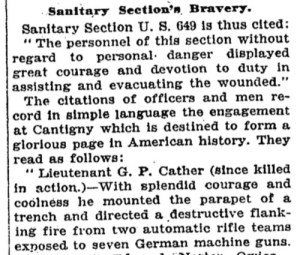
A clip from the 25 June 1918 New York Times article mentioning Lieutenant Cather’s death at Cantigny. Cather served under Ted Roosevelt in the 26th Infantry Regiment.

We wrapped up the second of our two sections yesterday for the Library of America World War One module with two English classes. I will have more on that in future posts but for now wanted to share a small part of it. For the module students read excerpts from The Library of America anthology “World War I and America.” One of the readings was itself an excerpt from “Roll Call on the Prairies,” a piece that Willa Cather wrote for The Red Cross Magazine in July 1919. In my prep work for the session I learned that the novelist had a cousin who was killed in the Great War. This turned out to be one Lieutenant Grosvenor Phillips (G.P.) Cather. I did a bit more digging and it turns out that Lieutenant Cather was killed at the Battle of Cantigny on 28 May 1918.

I intend to do a deeper dive on G.P. Cather next spring on the 100th anniversary of his death. With the classes still fresh on my mind however, I wanted to share a few details about the young officer. Cather not only served in the Great War but fought in the First Infantry Division. Even wilder it turns out that Lieutenant Cather served not only in the Big Red One, but in the 26th Regiment under the command of Major Theodore (Ted) Roosevelt Jr. Major Roosevelt was gassed at Cantigny and the following month received the Silver Star for his actions there. Cather was not so fortunate and was one scores of Americans killed on the 28th of May 1918. He was posthumously award a Silver Star and Distinguished Service Cross. Lieutenant Cather was buried in France but  re-interred in Nebraska in the early 1920s. His cousin never forgot him. Willa Cather used her G.P. as the inspiration for her novel One of Hours, for which she won the Pulitzer Prize in 1923. Again, I will have more on this next spring but for now wanted to share this brief vignette.

(image/New York Times)

Hemingway the Vulnerable

03 Friday Nov 2017

Posted by Keith Muchowski in Ernest Hemingway, Great War centennial, Writing

≈ Comments Off on Hemingway the Vulnerable

Ernest Hemingway, still a teenager, as he was upon his return to Oak Park, Illinois in late 1918 or early 1919. Note the cane. He had just spent the previous six months recuperating in a Milanese hospital from injuries incurred in Italy in July 1918. It was there that Hemingway fell in love with the nurse Agnes von Kurowsky, his muse for A Farewell to Arms and several short stories.

I am sorry for the lack of posts in recent days. With the semester in full swing things have been hectic. Enjoyable and busy. Yesterday the English professor and I wrapped up with one class the World War One module in which students watched our film and then read passages from the Library of America WW1 anthology edited by A. Scott Berg. Next week we continue and conclude in the other English 101 section. I will talk more about the readings after we totally finish. On the first day for each English section students read Ernest Hemingway’s “Soldier’s Home.” Hemingway has proved to be a strong thread running through the module. It worked out neatly that the class sessions ran concurrently with the writer’s stint at the Kansas City Star in 1917-18. Students were duly impressed by Hemingway’s conviction that all he needed to know as a writer he learned from the Kansas City Star style sheet. I always stress to students the importance of keeping one’s writing as simple as possible. The irony is that the reader does not see the hard work that goes into making it look effortless. Duke Ellington often spoke about this very thing as a composer. The listener doesn’t see the effort. A student came up to me after class and said she was going to read The Star Copy Style and incorporate its ideas into her own writing. I warned that, while it still has much to offer, the writing guide was written a century ago and so is a bit dated. Still, there is still much there to go on.

Earlier in October I was doing a bibliographic session for another English class with a different instructor that was also studying Hemingway. The instructor mentioned in the class that the Hemingway scholarship used to emphasize Hemingway as a masculine figure. The drinking, boxing, womanizing, war corresponding, hunting, fishing, and the rest of it. Today it is the inverse. Hemingway scholars concentrate more on Hemingway as a vulnerable figure. The family suicides, including his own. The automobile and airplane accidents that damaged him physically. The drinking, now seen from a different perspective than half a century ago. The depression. The struggle with familial relationships. Messy divorces. And love both requited and unrequited. I came across a recent article the other day in which a doctor speculates that Hemingway may have suffered from Chronic Traumatic Encephalopathy (CTE), the degenerative brain disease increasingly found in football players due to repeated head trauma. I suppose the intellectual shift in the Hemgingway scholarship is indicative of how every generation must interpret its historical and cultural figures for its own needs and purposes.

(image/Hemingway collection, JFK Presidential Library)


The Dirty Secret of War

28 Saturday Oct 2017

Posted by Keith Muchowski in Ernest Hemingway, Film, Sound, & Photography, Great War centennial, Vietnam War, Woodrow Wilson

≈ Comments Off on The Dirty Secret of War

This past week we showed to a class the first cut of our World War One film. For homework the students are now reading a series of excerpts from the Library of America’s World War I and America: Told by the Americans who Lived It. Historian A. Scott Berg, the author of a 2013 biography of Woodrow Wilson, edited the work. For Thursday the students read Hemingway’s “Soldier’s Home,” which appeared originally in Hemingway’s 1925 collection In Our Time. While preparing for the class I came across an essay by Philip Caputo that appeared this month in the online journal Literary Hub. Caputo was a marine who in 1965 landed at Da Nang during Lyndon Johnson’s escalation of American involvement in Vietnam. In 1977 he published his seminal memoir A Rumor of War. That book secured Caputo’s reputation as a writer. Now in his seventies he has written many more works since the publication of Rumor forty years ago. He published a new novel just this year.

Ernest Hemingway in an American Red Cross ambulance, Italy 1918. Though he spent just two weeks at the front, the intensity of the experience influenced Hemingway deeply.

The reason I say all this is because Caputo makes an interesting point in his essay: many of the best war writers actually spent only a small amount of time in combat. The reason these are the writers who write most eloquently about the combat experience, Caputo speculates, is because warfare is just that intense. Endure it too long and it becomes too much a part of you. Caputo uses Ernest Hemingway as the most striking example. For all we associate him with war, Hemingway spent just two weeks on the front lines during the Great War. He graduated high school in June 1917, wrote for the Kansas City Star from that October to April 1918, quit the paper and volunteered for ambulance duty that spring, sailed in May, worked in war torn Paris for much of June, was wounded in Italy on July 8, coalesced in a Milanese hospital for six months, and was home in Oak Park, Illinois by January 1919.

Chronologically the time may have been short, but the intensity of it led to his incredible output over the next decade. A husband and father by the early 1920s, he paid the bills as a foreign correspondent in Europe for the Toronto Star, where among other things he covered the Genoa Conference in 1922; met leaders such as David Lloyd George, Benito Mussolini, and Georges Clemenceau among others; covered the rise of Fascism and Bolshevism; and witnessed the general anomie of European society in the wake of the Great War. In this same decade he published In Our Time (1925), The Sun Also Rises (1926), and A Farewell to Arms (1929), all of which draw to greater or lesser extent on what he witnessed and experienced during his short time in the war zone.

(image/Ernest Hemingway Photograph Collection, JFK Library)

The Vietnam War: a learnable moment?

24 Tuesday Oct 2017

Posted by Keith Muchowski in Film, Sound, & Photography, Great War centennial, Historiography, Vietnam War

≈ Comments Off on The Vietnam War: a learnable moment?

Lions led by donkeys? Despite many worthwhile books and public programs in recent years, the conventional understanding of the Great War has remained surprisingly static even during the Great War centennial.

An interesting article appeared in the New York Times a few weeks back about the Ken Burns/Lynn Novick Vietnam War documentary. Its authors, Andrew Wiest and Susannah Ural, wonder if the eighteen hour documentary will be a historiographical turning point in our understanding of the war in Southeast Asia. Or, they continue, will it be the culmination of the narrative we have been telling ourselves for the past four–five decades? The answer to that doesn’t lie with Burns and Novick, who with their colleagues have already done their part by giving us the film. As they themselves have said, the documentary’s ultimate purpose is to ask more question than provide answers.

Wiest and Ural draw an interesting comparison, arguing that the documentary might do for Vietnam what historians did for World War One historiography in the early 1990s. Others are better positioned than I am to make the call, but personally I don’t see the needle as having having moved that much over the past 20-25 years. Yes, some archives have opened up and that sort of thing, but our understanding of the Great War remains much as it has since at least the 1960s. The current narrative is still very much the “lions led by donkeys” story line that has been with us for at least half a century. Perhaps a better comparison for The Vietnam War might be The Sorrow and the Pity, the 1969 documentary that nearly thirty years after the fact led the French to more closely examine their role in the Second World War.

Wars often lead citizens to question their societies, often vehemently. Americans examined their country during and immediately after the Great War, which led Prohibition, Women’s Suffrage, and the New Negro Movement in the 1920s. The same thing happened in different ways in the 1960s and early 1970s. Civil Rights, Women’s Rights, Gay Rights, and much more all came out of the social upheaval. In addition it led to rifts that have yet to heal. So many of our current political and cultural divisions have their roots in the Vietnam War Era. Even militarily there is much that remains to explore regarding the Vietnam War. Time will tell over the next few years if we reach any new consensus on that turbulent period. Wiest and Ural make a strong case that this is the opportune time.

(image by Clara E. Laughlin from Foch: The Man)

The Great War in Broad Outlines continues

03 Tuesday Oct 2017

Posted by Keith Muchowski in Great War centennial, Libraries

≈ Comments Off on The Great War in Broad Outlines continues

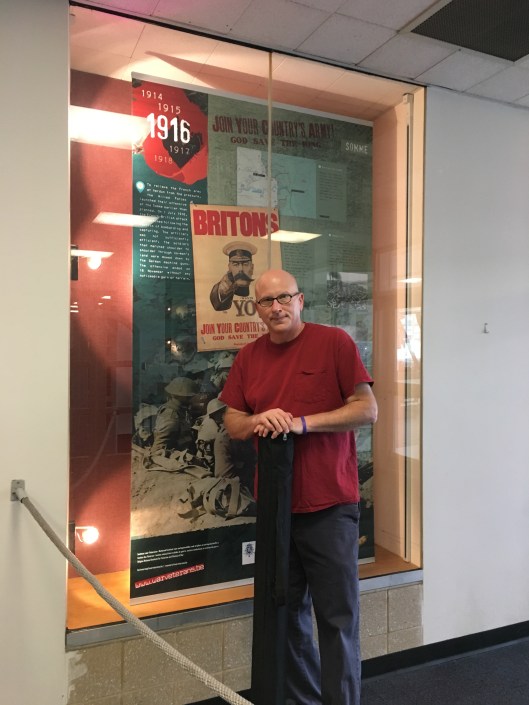
The other day I donned a t-shirt to work with my colleagues in installing part three of the “Great War in Broad Outlines” exhibit we are hosting over September and October. The exhibit is on loan to us from the Belgian Embassy in Washington. This was Part 3, which will be on display through October 10. The event is open to the public during regular library hour. These panels focus on the contributions of colonial troops fighting on the Western Front and the war in Africa.

The Living Room War

28 Thursday Sep 2017

Posted by Keith Muchowski in Great War centennial, Memory

≈ 3 Comments

Couple watching Vietnam War on television, 13 February 1968

Lynn Novick and Ken Burns’s The Vietnam War was again the topic of discussion today, some of it in person and some via email. I had a talk with someone who recounted to me their relative’s experience with the local draft board. When the Wilson Administration and Congress established the Selective Service in May 1917 they intentionally placed draft boards under the jurisdiction of local civilians. The idea was to avoid what had occurred just over fifty years earlier during the Civil War with the draft riots. Gone were the military head-counters, who were henceforth replaced with local leaders. These local officials sometimes knew the people about whom they would be making life-altering decisions. I suppose both systems had their benefits and drawbacks. The doughboy from Yonkers who is the subject of the documentary we are making for the Great War centennial served on his local draft board during the Second World War.

Another conversation I had was with an old friend of mine who told me a story I had never heard before. This person is in his mid-50s, about six years older than me, and thus with more first-hand memories of the Vietnam War Era. After he shared this with me I asked if I could post it here and he said yes. Here it is:

My first job was when I was about 10 or 11 and my family was living in New Jersey. It had to be either ’72 or ’73. A guy would pick up a bunch of us kids in a van and we would be dropped off in communities trying to sell subscriptions to the New York Times. One night, as I started my sales pitch, the man at the door cut me off and invited me into the townhouse as he and his wife were eating TV dinners and staring at the TV. The wife was crying the whole time I was there (not long) and they were watching the evening news hoping to catch a glimpse of their son or hear anything about his unit. In between the husband trying to console his wife he was explaining to me that he really wasn’t interested in signing up for the newspaper but asked me to stay until there was a commercial so he didn’t miss anything. I can only imagine that they ate dinner like that every night their son was oversees. That was a very profound and frightening moment for me and I am surprised that it had slipped into the recess of what’s left of my memory about the war.

(image/Warren K. Leffler, U.S. News & World Report via Wikimedia Commons)

Barbara Tuchman’s Vietnam War

27 Wednesday Sep 2017

Posted by Keith Muchowski in Great War centennial, Historiography

≈ 2 Comments

William Shirer (left), Barbara Tuchman, and John S.D. Eisenhower at the Conference on Research and World War II and the National Archives, 14-15 June 1971. Tuchman was actively engaged in the discourse about the Vietnam War throughout the 1960s-70s. Tuchman gave her commencement address at Williams College the year after this photograph was taken.

These past two weeks I have been watching the Lynn Novick/Ken Burns documentary abut the Vietnam War. I have a few friends who have been watching as well. Usually in the mornings we email with a few thoughts on the previous night’s episode. For each of us, watching has been draining. Earlier today I was searching the New York Times database for some things relating to the war in 1967. The headlines read like a history lesson. Some of the names I came across in my very cursory search included Dwight Eisenhower, Harry Truman, Martin Luther King Jr., Secretary-General of the United Nations U Thant, Charles De Gaulle, William Fullbright, Senator Albert Gore Sr. of Tennessee, Averell Harriman, and John Kenneth Galbraith. Needless to say all of these figures are now long gone, though Galbraith did not pass away until 2006.

During the Cuban Missile Crisis in 1962 President Kennedy turned to historian Barbara Tuchman’s The Guns of August for inspiration. Five years later, for the 5 March 1967 edition of the Times, Tuchman wrote an extended piece about America’s entry into the First World War. Remember, there were still hundreds of thousands of living doughboys alive at this time just fifty years after Wilson asked Congress to declare war on Germany. I remember seeing historian Gordon Wood on television several years ago expressing his admiration for Tuchman, though he added that she often saw her work as a historian as offering “lessons” for current times. History indeed can offer guidance, but Wood seemed to be arguing that Tuchman thought history offered a stronger template than Wood believes it does.

I knew that Tuchman’s work was often anthologized and so when I showed up at work today I searched the catalog and found a book titled Practicing History: Selected Essays, published by Knopf in 1981. Sure enough, it contains that New York Times article from 1967 that I had come across in the Times database. The anthology also contains a 1966 address to the Chicago Historical Society titled “Is History a Guide to the Future?”, in which she lays out her ideas on that subject. Her thesis, in a nutshell, is that History is more craft than science but that through due diligence it can guide and inform a way forward, at least to a degree. Practicing History includes articles about the Vietnam War that Tuchman wrote for New York Newsday in early March 1968, in the middle of the Tet Offensive; and the New York Times in May 1972. Tuchman advocated for withdrawal and explained ways the United States might have done that. In June 1972 she gave the commencement address at Williams College. Her topic that day was the war. While she was personally against it, she emphasized that people should demonize neither the military nor the soldiers. She explained why the military remained important, even when led poorly by its civilian overlords. She was particularly against the movement underway to ban the Reserve Officers Training Corps (ROTC) from college campuses.

(image.National Archives)

Rededicating the Merle Hay monument

19 Tuesday Sep 2017

Posted by Keith Muchowski in Governors Island, Great War centennial, Monuments and Statuary, National Park Service

≈ 2 Comments

Merle Hay monument rededication, Governors Island: 17 September 2017

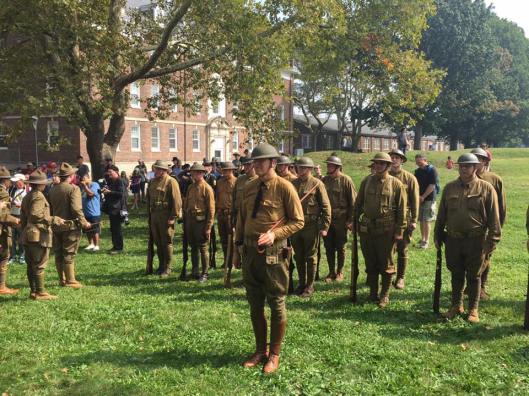
One of the most poignant moments at Camp Doughboy this past weekend was the rededication of the Merle Hay monument on Sunday morning. The color guard you see here are active service personnel currently serving in the First Division’s 16th Infantry Regiment. They had come from Fort Riley in Kansas and are the same men who had been in Paris this past July for the ceremonies there. The men in uniform behind them are living historians who had set up camp on the island for the weekend. I snapped the image of the new tablet a few minutes after the unveiling. I thought I would re-up the video we produced a few summers ago about Private Merle B. Hay. It is so good to see that the Hay tablet is back where it belongs.

Private Merle Hay tablet, Governors Island National Monument


Sunday morning coffee

17 Sunday Sep 2017

Posted by Keith Muchowski in Governors Island, Great War centennial, Heritage tourism

≈ 1 Comment

Camp Doughboy, Governors Island: September 16, 2017

It was a great day on Governors Island yesterday at Camp Doughboy. I’m having my coffee and listening to Bill Evans before I prepare to head out for today’s events. If you are in the New York City area, come on out for day two. There is much to see, including author talks, monument rededications, and the campground with living historians manning their quarters and speaking about their subject expertize. I visited a good many of them yesterday before and after my lightning talk and found all of the historians to be well-informed and eager to engage. Whether they have restored a period ambulance, built a doughboy’s kit through painstaking research and perseverance, or recount the story of a nurse, to a person they have created a thread that allows us to connect to the people who lived through the Great War. Seeing it al in one place make it that much more extraordinary.

It is the last weekend of summer 2017. Go get some of that sunshine.

(image/World War I Centennial Commission)

Sunday morning coffee

10 Sunday Sep 2017

Posted by Keith Muchowski in Governors Island, Great War centennial

≈ 1 Comment

Good morning, all. I am sorry about the lack of posts this week. It has been a busy time at work with the new academic year underway. I wanted to remind everyone that Camp Doughboy is taking place next weekend, September 16-17, at Governors Island.  There is a lot to see and do. Author Kevin Fitzpatrick has been the great driving force behind the event and has done incredible work bringing it all together. You can check out the entire schedule here. Note that on Saturday at 1:30 a guy with my initials will be speaking about the Preparedness Movement. If you are in the Greater New York City area, try to come out for what should be an exciting two days with lots to see and do.

← Older posts
Newer posts →

Enter your email address to subscribe to this blog and receive notifications of new posts by email.

Join 258 other subscribers

Categories

Archives

  • November 2023 (1)
  • October 2023 (3)
  • September 2023 (3)
  • August 2023 (4)
  • July 2023 (7)
  • June 2023 (10)
  • May 2023 (8)
  • April 2023 (6)
  • March 2023 (5)
  • February 2023 (4)
  • January 2023 (4)
  • December 2022 (4)
  • November 2022 (8)
  • October 2022 (2)
  • September 2022 (4)
  • June 2022 (1)
  • May 2022 (1)
  • April 2022 (13)
  • January 2022 (1)
  • December 2021 (2)
  • November 2021 (1)
  • October 2021 (3)
  • September 2021 (3)
  • August 2021 (5)
  • July 2021 (1)
  • June 2021 (1)
  • May 2021 (4)
  • April 2021 (3)
  • March 2021 (4)
  • February 2021 (7)
  • January 2021 (4)
  • December 2020 (4)
  • November 2020 (3)
  • October 2020 (4)
  • September 2020 (7)
  • August 2020 (5)
  • July 2020 (7)
  • June 2020 (11)
  • May 2020 (7)
  • April 2020 (9)
  • March 2020 (9)
  • February 2020 (7)
  • January 2020 (6)
  • December 2019 (7)
  • November 2019 (9)
  • October 2019 (4)
  • September 2019 (6)
  • August 2019 (10)
  • July 2019 (8)
  • June 2019 (6)
  • May 2019 (9)
  • April 2019 (8)
  • March 2019 (6)
  • February 2019 (8)
  • January 2019 (5)
  • December 2018 (10)
  • November 2018 (6)
  • October 2018 (9)
  • September 2018 (11)
  • August 2018 (11)
  • July 2018 (17)
  • June 2018 (10)
  • May 2018 (8)
  • April 2018 (9)
  • March 2018 (8)
  • February 2018 (5)
  • January 2018 (7)
  • December 2017 (11)
  • November 2017 (8)
  • October 2017 (9)
  • September 2017 (11)
  • August 2017 (12)
  • July 2017 (14)
  • June 2017 (18)
  • May 2017 (11)
  • April 2017 (10)
  • March 2017 (9)
  • February 2017 (11)
  • January 2017 (14)
  • December 2016 (7)
  • November 2016 (8)
  • October 2016 (8)
  • September 2016 (9)
  • August 2016 (6)
  • July 2016 (12)
  • June 2016 (8)
  • May 2016 (9)
  • April 2016 (6)
  • March 2016 (12)
  • February 2016 (10)
  • January 2016 (9)
  • December 2015 (9)
  • November 2015 (11)
  • October 2015 (8)
  • September 2015 (9)
  • August 2015 (13)
  • July 2015 (14)
  • June 2015 (11)
  • May 2015 (11)
  • April 2015 (18)
  • March 2015 (10)
  • February 2015 (8)
  • January 2015 (8)
  • December 2014 (12)
  • November 2014 (13)
  • October 2014 (16)
  • September 2014 (11)
  • August 2014 (16)
  • July 2014 (12)
  • June 2014 (13)
  • May 2014 (10)
  • April 2014 (10)
  • March 2014 (11)
  • February 2014 (12)
  • January 2014 (10)
  • December 2013 (11)
  • November 2013 (14)
  • October 2013 (14)
  • September 2013 (14)
  • August 2013 (13)
  • July 2013 (17)
  • June 2013 (9)
  • May 2013 (13)
  • April 2013 (13)
  • March 2013 (16)
  • February 2013 (15)
  • January 2013 (15)
  • December 2012 (18)
  • November 2012 (18)
  • October 2012 (21)
  • September 2012 (14)
  • August 2012 (16)
  • July 2012 (21)
  • June 2012 (22)
  • May 2012 (24)
  • April 2012 (20)
  • March 2012 (23)
  • February 2012 (22)
  • January 2012 (15)
  • December 2011 (23)
  • November 2011 (22)
  • October 2011 (23)
  • September 2011 (18)
  • August 2011 (19)
  • July 2011 (20)
  • June 2011 (29)
  • May 2011 (25)
  • April 2011 (18)
  • March 2011 (21)
  • February 2011 (11)

Meta

  • Create account
  • Log in
  • Entries feed
  • Comments feed
  • WordPress.com
Creative Commons License
This work is licensed under a Creative Commons Attribution-NonCommercial-ShareAlike 4.0 International License.

Enter your email address to subscribe to this blog and receive notifications of new posts by email.

Join 258 other subscribers

Categories

Archives

  • November 2023 (1)
  • October 2023 (3)
  • September 2023 (3)
  • August 2023 (4)
  • July 2023 (7)
  • June 2023 (10)
  • May 2023 (8)
  • April 2023 (6)
  • March 2023 (5)
  • February 2023 (4)
  • January 2023 (4)
  • December 2022 (4)
  • November 2022 (8)
  • October 2022 (2)
  • September 2022 (4)
  • June 2022 (1)
  • May 2022 (1)
  • April 2022 (13)
  • January 2022 (1)
  • December 2021 (2)
  • November 2021 (1)
  • October 2021 (3)
  • September 2021 (3)
  • August 2021 (5)
  • July 2021 (1)
  • June 2021 (1)
  • May 2021 (4)
  • April 2021 (3)
  • March 2021 (4)
  • February 2021 (7)
  • January 2021 (4)
  • December 2020 (4)
  • November 2020 (3)
  • October 2020 (4)
  • September 2020 (7)
  • August 2020 (5)
  • July 2020 (7)
  • June 2020 (11)
  • May 2020 (7)
  • April 2020 (9)
  • March 2020 (9)
  • February 2020 (7)
  • January 2020 (6)
  • December 2019 (7)
  • November 2019 (9)
  • October 2019 (4)
  • September 2019 (6)
  • August 2019 (10)
  • July 2019 (8)
  • June 2019 (6)
  • May 2019 (9)
  • April 2019 (8)
  • March 2019 (6)
  • February 2019 (8)
  • January 2019 (5)
  • December 2018 (10)
  • November 2018 (6)
  • October 2018 (9)
  • September 2018 (11)
  • August 2018 (11)
  • July 2018 (17)
  • June 2018 (10)
  • May 2018 (8)
  • April 2018 (9)
  • March 2018 (8)
  • February 2018 (5)
  • January 2018 (7)
  • December 2017 (11)
  • November 2017 (8)
  • October 2017 (9)
  • September 2017 (11)
  • August 2017 (12)
  • July 2017 (14)
  • June 2017 (18)
  • May 2017 (11)
  • April 2017 (10)
  • March 2017 (9)
  • February 2017 (11)
  • January 2017 (14)
  • December 2016 (7)
  • November 2016 (8)
  • October 2016 (8)
  • September 2016 (9)
  • August 2016 (6)
  • July 2016 (12)
  • June 2016 (8)
  • May 2016 (9)
  • April 2016 (6)
  • March 2016 (12)
  • February 2016 (10)
  • January 2016 (9)
  • December 2015 (9)
  • November 2015 (11)
  • October 2015 (8)
  • September 2015 (9)
  • August 2015 (13)
  • July 2015 (14)
  • June 2015 (11)
  • May 2015 (11)
  • April 2015 (18)
  • March 2015 (10)
  • February 2015 (8)
  • January 2015 (8)
  • December 2014 (12)
  • November 2014 (13)
  • October 2014 (16)
  • September 2014 (11)
  • August 2014 (16)
  • July 2014 (12)
  • June 2014 (13)
  • May 2014 (10)
  • April 2014 (10)
  • March 2014 (11)
  • February 2014 (12)
  • January 2014 (10)
  • December 2013 (11)
  • November 2013 (14)
  • October 2013 (14)
  • September 2013 (14)
  • August 2013 (13)
  • July 2013 (17)
  • June 2013 (9)
  • May 2013 (13)
  • April 2013 (13)
  • March 2013 (16)
  • February 2013 (15)
  • January 2013 (15)
  • December 2012 (18)
  • November 2012 (18)
  • October 2012 (21)
  • September 2012 (14)
  • August 2012 (16)
  • July 2012 (21)
  • June 2012 (22)
  • May 2012 (24)
  • April 2012 (20)
  • March 2012 (23)
  • February 2012 (22)
  • January 2012 (15)
  • December 2011 (23)
  • November 2011 (22)
  • October 2011 (23)
  • September 2011 (18)
  • August 2011 (19)
  • July 2011 (20)
  • June 2011 (29)
  • May 2011 (25)
  • April 2011 (18)
  • March 2011 (21)
  • February 2011 (11)

Meta

  • Create account
  • Log in
  • Entries feed
  • Comments feed
  • WordPress.com
Creative Commons License
This work is licensed under a Creative Commons Attribution-NonCommercial-ShareAlike 4.0 International License.

Enter your email address to subscribe to this blog and receive notifications of new posts by email.

Join 258 other subscribers

Categories

Archives

  • November 2023 (1)
  • October 2023 (3)
  • September 2023 (3)
  • August 2023 (4)
  • July 2023 (7)
  • June 2023 (10)
  • May 2023 (8)
  • April 2023 (6)
  • March 2023 (5)
  • February 2023 (4)
  • January 2023 (4)
  • December 2022 (4)
  • November 2022 (8)
  • October 2022 (2)
  • September 2022 (4)
  • June 2022 (1)
  • May 2022 (1)
  • April 2022 (13)
  • January 2022 (1)
  • December 2021 (2)
  • November 2021 (1)
  • October 2021 (3)
  • September 2021 (3)
  • August 2021 (5)
  • July 2021 (1)
  • June 2021 (1)
  • May 2021 (4)
  • April 2021 (3)
  • March 2021 (4)
  • February 2021 (7)
  • January 2021 (4)
  • December 2020 (4)
  • November 2020 (3)
  • October 2020 (4)
  • September 2020 (7)
  • August 2020 (5)
  • July 2020 (7)
  • June 2020 (11)
  • May 2020 (7)
  • April 2020 (9)
  • March 2020 (9)
  • February 2020 (7)
  • January 2020 (6)
  • December 2019 (7)
  • November 2019 (9)
  • October 2019 (4)
  • September 2019 (6)
  • August 2019 (10)
  • July 2019 (8)
  • June 2019 (6)
  • May 2019 (9)
  • April 2019 (8)
  • March 2019 (6)
  • February 2019 (8)
  • January 2019 (5)
  • December 2018 (10)
  • November 2018 (6)
  • October 2018 (9)
  • September 2018 (11)
  • August 2018 (11)
  • July 2018 (17)
  • June 2018 (10)
  • May 2018 (8)
  • April 2018 (9)
  • March 2018 (8)
  • February 2018 (5)
  • January 2018 (7)
  • December 2017 (11)
  • November 2017 (8)
  • October 2017 (9)
  • September 2017 (11)
  • August 2017 (12)
  • July 2017 (14)
  • June 2017 (18)
  • May 2017 (11)
  • April 2017 (10)
  • March 2017 (9)
  • February 2017 (11)
  • January 2017 (14)
  • December 2016 (7)
  • November 2016 (8)
  • October 2016 (8)
  • September 2016 (9)
  • August 2016 (6)
  • July 2016 (12)
  • June 2016 (8)
  • May 2016 (9)
  • April 2016 (6)
  • March 2016 (12)
  • February 2016 (10)
  • January 2016 (9)
  • December 2015 (9)
  • November 2015 (11)
  • October 2015 (8)
  • September 2015 (9)
  • August 2015 (13)
  • July 2015 (14)
  • June 2015 (11)
  • May 2015 (11)
  • April 2015 (18)
  • March 2015 (10)
  • February 2015 (8)
  • January 2015 (8)
  • December 2014 (12)
  • November 2014 (13)
  • October 2014 (16)
  • September 2014 (11)
  • August 2014 (16)
  • July 2014 (12)
  • June 2014 (13)
  • May 2014 (10)
  • April 2014 (10)
  • March 2014 (11)
  • February 2014 (12)
  • January 2014 (10)
  • December 2013 (11)
  • November 2013 (14)
  • October 2013 (14)
  • September 2013 (14)
  • August 2013 (13)
  • July 2013 (17)
  • June 2013 (9)
  • May 2013 (13)
  • April 2013 (13)
  • March 2013 (16)
  • February 2013 (15)
  • January 2013 (15)
  • December 2012 (18)
  • November 2012 (18)
  • October 2012 (21)
  • September 2012 (14)
  • August 2012 (16)
  • July 2012 (21)
  • June 2012 (22)
  • May 2012 (24)
  • April 2012 (20)
  • March 2012 (23)
  • February 2012 (22)
  • January 2012 (15)
  • December 2011 (23)
  • November 2011 (22)
  • October 2011 (23)
  • September 2011 (18)
  • August 2011 (19)
  • July 2011 (20)
  • June 2011 (29)
  • May 2011 (25)
  • April 2011 (18)
  • March 2011 (21)
  • February 2011 (11)

Meta

  • Create account
  • Log in
  • Entries feed
  • Comments feed
  • WordPress.com
Creative Commons License
This work is licensed under a Creative Commons Attribution-NonCommercial-ShareAlike 4.0 International License.

Blog at WordPress.com.

  • Subscribe Subscribed
    • The Strawfoot
    • Join 229 other subscribers
    • Already have a WordPress.com account? Log in now.
    • The Strawfoot
    • Subscribe Subscribed
    • Sign up
    • Log in
    • Report this content
    • View site in Reader
    • Manage subscriptions
    • Collapse this bar
 

Loading Comments...