• About

The Strawfoot

~ a New Yorker's American History blog

The Strawfoot

Category Archives: WW1

Anthony Frederick Wilding, 1883-1915

12 Sunday Jul 2015

Posted by Keith Muchowski in Those we remember, WW1

≈ Comments Off on Anthony Frederick Wilding, 1883-1915

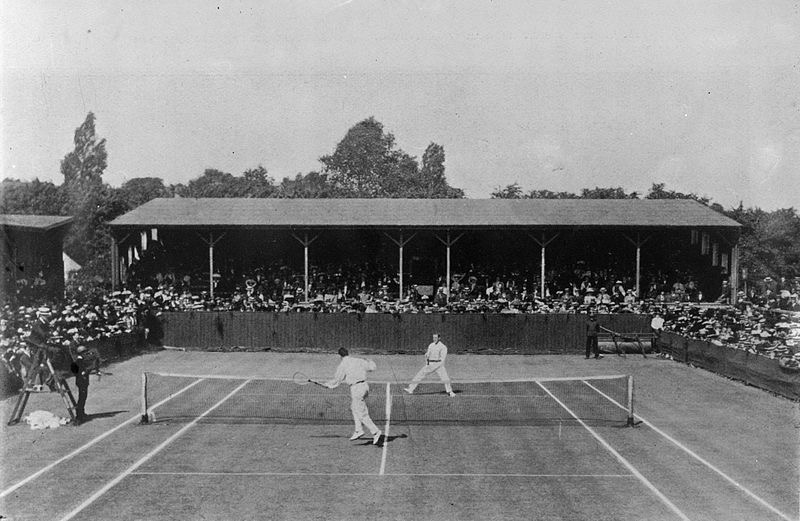
Anthony Wilding (far court) defeated fellow tennis hall-of-famer Beals Wright in the 1910 Wimbledon final. Note the all-white uniforms.

Anthony Wilding (far court) defeated fellow tennis hall-of-famer Beals Wright in the 1910 Wimbledon final. Note the all-white uniforms.

With this year’s Wimbledon final between Roger Federer and Novak Djokovic slated for this morning, it seems appropriate to look back at one of the greatest figures in the history of the All England Club. Anthony Frederick Wilding may not be familiar to contemporary audiences—especially outside the British Commonwealth—but, years before Bill Tilden and René Lacoste, there was Tony Wilding; this New Zealander won consecutive Wimbledon singles titles from 1910-13. To give some perspective, that feat was not surpassed again until Björn Borg won five consecutive titles from 1976-80. Wilding also reached the 1914 Wimbledon final, which coincided with the assassination of the Archduke Ferdinand and Europe’s Last Summer.

Wilding was a frequent winner in the Davis Cup as well; as late as August 1914 he led Australasia to victory in the finals of that event. The headline of the August 14, 1914 Brooklyn Daily Eagle mentions Wilding’s Davis Cup victory over Richard Norris Williams, below which in smaller type is a photograph and an article about British troops making their way to London’s Victoria Station. Wilding’s tennis career ended soon after that Davis Cup victory, however; he joined the Royal Marines and served as an officer on the Western Front.

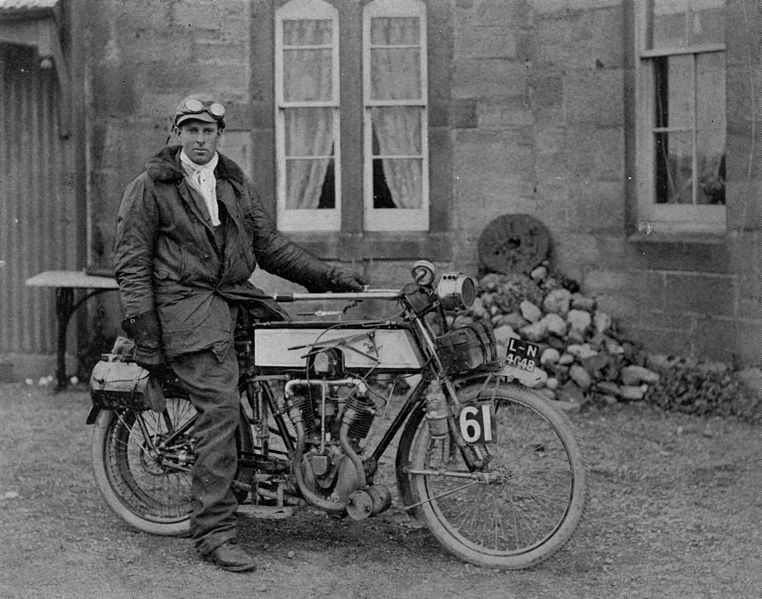
Lawyer, cricketer, motor enthusiast and tennis champion Anthony Frederick (Tony) Wilder as he was in 1908, seven years before he was killed on the Western Front.

Lawyer, cricketer, motor enthusiast and tennis champion Anthony Frederick (Tony) Wilding as he was in 1908, seven years before he was killed on the Western Front.

Anthony Wilding was born in Christchurch in 1883. His father was a lawyer and he too studied for the bar, reading law at Cambridge’s Trinity College before becoming both a solicitor and a barrister. It was as a sportsman however that Wilding made his reputation in the early 1900s. A star athlete with dashing good looks, he enjoyed London’s Edwardian society and seems to have a hit with the ladies. And why not?

Wilding also had a yen for mechanical things, especially motorcycles, automobiles, and aeroplanes. It is not surprising therefore that he quickly moved from the Royal Marines to the Royal Naval Air Service and eventually the Armoured Car Force. Among other duties he drove Rolls Royce vehicles to the front. He made captain in April 1915, but did not survive the spring. Wilding was killed in a bombardment at the the Battle of Aubers Ridge in Neuve-Chappelle on 9 May 1915. Tony Wilding is buried at the Rue-des-Berceaux Military Cemetery at Pas-de-Calais.

(top image by London: Methuen and bottom image of unknown origin, both via Wikimedia Commons)


Remembering VE Day

08 Friday May 2015

Posted by Keith Muchowski in Lusitania, WW1, WW2

≈ Comments Off on Remembering VE Day

Danes in Copenhagen read of the end of the Second World War, 8 May 1945

Danes in Copenhagen read of the end of the Second World War, 8 May 1945

At the reception after the Lusitania ceremony yesterday a few of us got to talking about the anniversary that would take place the following day. Today, 8 May 2015, is the 70th anniversary of the end of the Second World War in Europe: VE Day. After more than thirty years of war and bitter peace, the fighting was finally over.

There were many excellent speakers at yesterday’s program. One of the most poignant was Bernd Reindl, the Consulate General of the Federal Republic of Germany. Mr. Reindl’s eloquent words, even his very presence, were a reminder of how far things have come over the past seven decades. He reminded the audience of the current strength of the Atlantic alliances and how much Europe and the United States share in common. These are lessons and words of comfort that can get lost when one looks at all the strife and crises facing our world today.

Consul Mr. Bernd Reindl speaks at the ceremony in New York remembering the Lusitania, 7 May 2015

Consul Mr. Bernd Reindl speaks at the ceremony in New York remembering the Lusitania, 7 May 2015

(top image/National Museum of Denmark, uploaded by palnatoke; via Wikimedia Commons)

The Burning of the World: a Strawfoot interview

23 Friday Jan 2015

Posted by Keith Muchowski in Interviews, WW1

≈ Comments Off on The Burning of the World: a Strawfoot interview

burning of the world cover.inddBéla Zombory-Moldován was a soldier in the Austro-Hungarian Army during the Great War. His grandson, Peter Zombory-Moldovan, spent the past few years carefully and lovingly translating the written account his grandfather left behind. The Burning of the World: A Memoir of 1914 was released last year by New York Review Books. This week Mr. Zombory-Moldovan took time from his busy schedule to answer some questions.

The Strawfoot: Your grandfather, Béla Zombory-Moldován, was a soldier in the Austro-Hungarian Army in the Great War. What was his experience?

He was called up on 28 July 1914, the day that Austria-Hungary declared war on Serbia. An artist aged 29, he was a junior officer in the reserve, having done a year’s military service after graduation. He reported for duty on 4 August in Veszprém, in the west of Hungary, with the 31st infantry regiment of the Royal Hungarian Army, the Honvéd.

His battalion was sent to Galicia on 2 September 1914, where they were immediately thrown into action against the Russians at the battle of Rava-Russka – the climax of a titanic clash of four Austro-Hungarian and five Russian armies around what is now the Polish-Ukrainian border. The Russians had broken through, and Béla’s unit was ordered into a last-ditch attempt to hold up their advance. Hopelessly ill-prepared, poorly equipped, outnumbered, and comprehensively out-gunned, the Hungarians were pinned down in open ground by enemy artillery, without cover or prepared positions. Standing orders forbade the digging of fox-holes, on the grounds that these “undermined discipline and led to cowardice”; nonetheless, Béla – determined to survive – dug himself in, as best he could, with a discarded tin-lid, telling his men to do likewise. Between dawn and dusk on 11 September, under a relentless barrage of shrapnel and high-explosive shells, Béla’s company were cut to pieces. He was the only officer in the company to survive that day unscathed. Continue reading →

“Pearl Harbor? Who’s she?”

07 Sunday Dec 2014

Posted by Keith Muchowski in Memory, WW1, WW2

≈ Comments Off on “Pearl Harbor? Who’s she?”

Veterans Day, 2014: Bombardier Herman "Whitey" Lykins approaching 100

Veterans Day 2014: WW2 Bombardier Herman “Whitey” Lykins going strong at nearly 100

Longtime readers will recognize the two pieces below. The first is from 2011 and the follow-up is from 2012. I was a little surprised the 75th anniversary of the start of the Second World War in Europe did not get more coverage than it did. I guess people were so focused on the Great War 100th. The passing of the WW2 generation is something I am quite conscious of, in part because I was a little too young to remember the passing of the Great War generation in a deep way. Still, they were there. I remember seeing them on television sitting together in the stands at Wimbledon during the Borg, McEnroe, Connors years. They were not yet totally anachronistic but their numbers were dwindling fast. The world became a little smaller when Frank Buckles died in February 2011. And now we are getting there with the Second World War. Anyways, from 2012 and 2011….

I wrote the piece below for the 70th anniversary of the Pearl Harbor attack and am posting it again. As I said last year, I will always remember  anniversaries such as December 7, June 6, and May 8 though they no longer resonate in the way they once did. I have been watching Eric Sevareid’s magnificent Between the Wars over the past several days.The sixteen part documentary, produced in 1978, provides a remarkable overview of the 1918-1941 period. What I find most striking is how recent the war, even the lead-up to the war, was as late as the 1970s. (One gets the same impression watching Lawrence Olivier narrate A World at Arms as well.) The Second World War was almost still current events in a way it obviously is not today. The highest leadership had died off by this time, but the majority of the people who fought in the war were now in full blown middle age and in the prime of their careers. Now those people have pretty much died off, or have aged considerably. I couldn’t help but think about this when I learned about the death of Congressman Jack Brooks earlier in the week. Maybe it is my own sense of aging, but I am not sure how I feel about this. Anyways, from Pearl Harbor Day 2011 . . .

Pearl Harbor 2011

Pearl Harbor 2011: the final gathering of the Pearl Harbor Survivors Association

A few years ago the father of a good friend of mine happened to be in the food court of a shopping mall on Memorial Day. This is a man, now in his eighties, who served in the Air Force and later played semi-professional football. He still has his leather cleats. Lou is the essence of Old School. Like shopping mall food courts throughout the country, this one was full of teenagers. Striking up a conversation with the 4-5 at the neighboring table he asked them if they knew what Memorial Day was. After the blank stares, one offered that it was a day off from school. My friend’s dad was not impressed.

When I was in school in the seventies and eighties a visit from a World War 2 vet was a HUGE deal, even in the most cynical of times just after Vietnam. (I graduated high school just a decade after the Fall of Saigon.) One vet recounted today that during a recent school visit a girl asked who Pearl Harbor was and why he was there to talk about her.

I offer these stories not to blame our country’s historical amnesia on young people, but to emphasize the educational crisis we face.

I have written about the significance to me of D-Day and aging veterans before. Personally, Pearl Harbor Day 2011 is the end of something tangible, akin to the 75th anniversary of Gettysburg in July 1938 when aged veterans turned out for one final gathering. President Roosevelt was in attendance; three years after dedicating the Eternal Peace Light Memorial in front of the 1,800 veterans and 150,000 citizens that summer day he would tell the country that December 7 would forever live in infamy. Today in Hawaii the Pearl Harbor Survivors Association held its final gathering. There are just too few Pearl Harbor survivors left seventy years later to justify a seventy-first. There will be more World War 2 anniversaries between today and the commemoration of V-J Day in 2015, but for me they will no longer seem the same. By 2015 there will be fewer WW2 veterans, and those remaining will likely be too infirm to participate in any meaningful fashion. Time moves on. It was ever thus.

(bottom image/U.S. Navy)

The CRB begins its work

22 Wednesday Oct 2014

Posted by Keith Muchowski in Theodore Roosevelt Birthplace (NPS), WW1

≈ Comments Off on The CRB begins its work

A Belgian relief soup kitchen

A Belgian relief soup kitchen

Last night I mentioned that the Commission for Relief in Belgium was founded on 22 October 1914. Such humanitarian relief was all new in 1914, at least on this scale. Even more incredible were the diplomatic, logistical and other obstacles the CRB overcame. And oh yes, they were doing it in a war zone amidst chaos and mass slaughter on a scale never before seen in history. Decades later Hoover described the feeling of crossing from Holland into occupied Belgium as “entering a land of imprisonment.” If he had known how hard it would be he might not have taken the job; Hoover was convinced the war would be over by summer 1915.

Herbert Hoover was a forty-year-old mining engineer who had made his fortune and was now yearning for something more. He was in London when the war began and his first task was to facilitate the return of Americans stranded in Europe when the fighting commenced. He managed to ensure the safe passage back to America of nearly 150,000 persons. The Belgian crisis was next. Belgium was especially vulnerable. It was a small, highly urbanized nation hit hard by the German offensive. Allies such as Britain were suspicious because they believed any food stuffs sent to Belgium would ends up in the stomachs of the German occupiers.

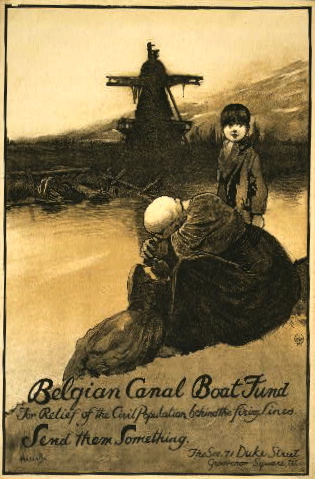
Hoover was adept at public diplomacy and used advertising to make sure the Belgian famine stayed in the public consciousness.

Hoover was adept at public diplomacy and used advertising to make sure the Belgian famine stayed in the public consciousness.

Hoover began working even before the official founding of the CRB, placing orders in the Chicago commodities markets for 10 million bushels of wheat. Over the next four years they also imported rice, peas, cereals, milk, sugar, potatoes and other items. Relief committees were established in nearly American state and in countries around the world, including Japan, India, Australia, and Argentina. Hoover even wrangled fifteen Rhodes scholars to think out the box on how to solve the problem of Belgian starvation. In four years the CRB transported five million tons of food.

It is an incredible story and one that I am simplifying here. One can only be impressed by the task Hoover set for himself and those who worked with him. Literally millions of people owed their lives to him. Reading about it in Hoover’s memoirs however, one can understand why the public is apathetic. It wasn’t just the Depression that fueled the apathy. Hoover lived until 1964 and published his memoirs in three volumes, each one drier than the one before. There is no Undersecretary of This or Assistant to That he cannot rattle off. Hoover was like that in person as well. He had the technical capacities of an engineer but little of the common touch a true politico. It is no wonder that years later President-elect Roosevelt declined to attend the meetings Hoover was having in which he would parse the in and outs of the banking crisis ad infinitum. Hoover knew the technical details; Roosevelt knew what the people wanted and needed to hear. It is all so unfortunate because Hoover was one of the great men of the 20th century.

One group that understood was the Roosevelt Memorial Association. The RMA held its annual dinner at the Roosevelt Birthplace on 27 October 1927. This would have been Theodore’s 69th birthday. Secretary of Commerce Hoover was there that evening as one of three recipients of the Roosevelt Distinguished Service Medal. Hoover had been much in the news that year because he had again worked his magic, this time in service of those ruined by the Great Mississippi Flood. The other recipients of Roosevelt medals that year were jurist John Bassett Moore and John J. Pershing. Hoover was the only honoree who could attend the function on East 20th Street. Thankfully New Yorkers got a sense of how the evening went; WRNY broadcast the event live over the radio.

(images/Library of Congress)

The Meuse-Argonne campaign begins

29 Monday Sep 2014

Posted by Keith Muchowski in Memory, Monuments and Statuary, WW1

≈ Comments Off on The Meuse-Argonne campaign begins

This past weekend marked the anniversary of the start of the Meuse-Argonne campaign, which would continue on through the end of the war in November 1918. The American Battle Monument Commission just published this video that captures the essence of what it was all about. I cannot emphasize the quality of the work the ABMC has been doing during the Centennial, though that is no surprise given the organization’s rich history and institutional memory.

A Vanderbilt and a Roosevelt in love and war

24 Wednesday Sep 2014

Posted by Keith Muchowski in Interviews, WW1

≈ 1 Comment

Author Chip Bishop has released  a book about the relationship between Quentin Roosevelt and Flora Whitney. Quentin & Flora: A Roosevelt and a Vanderbilt in Love during the Great War may read like fiction but the story is all the more poignant for being true. Mr. Bishop tells us more in this interview.

The Strawfoot: Tell us who Quentin and Flora are.

Chip Bishop: Quentin was the youngest and favored son of Theodore Roosevelt and his wife, Edith. He is remembered best today as a heroic aviator during the Great War who lost his life in combat over German-occupied France. Flora Payne Whitney was the great-great granddaughter of the industrialist, Commodore Cornelius Vanderbilt. Quentin and Flora met in New York during their mid-teens, and began a relationship that evolved into a romance. It is revealed through their many letters. In the spring of 1917, they were secretly engaged. She went on to finance and direct the development of the Whitney Museum of Art in New York City.

1910 image of The Breakers, Newport, Rhode Island

The Breakers, Newport, Rhode Island

Flora was not only a Vanderbilt but a Whitney. Was her upbringing as gilded as one would imagine?

It was. She was brought up in multiple homes including The Breakers, her grandmother’s “summer cottage” in Newport, RI. She traveled abroad extensively and went to the posh Foxcroft School in Virginia. But Flora survived that extravagance to live and long and productive life, mostly in New York. She married twice and had four children. How did that differ from the Roosevelt children’s experience? The Roosevelts were comfortable financially but not super wealthy. Quentin grew up understanding that those who are given much are obliged to put their energy and resources to work for the benefit of others.

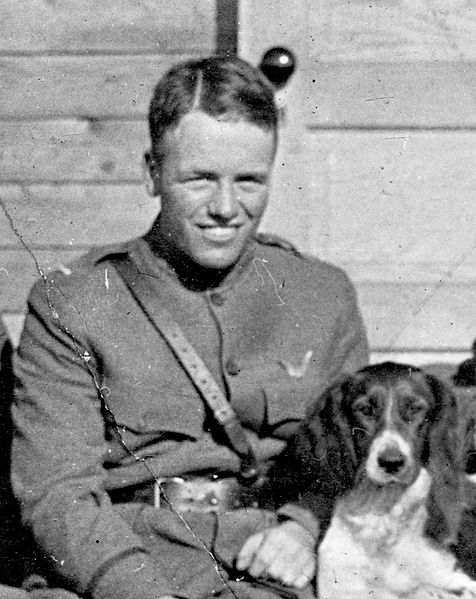
Lieutenant Quentin Roosevelt

Lieutenant Quentin Roosevelt

Quentin had a mechanical bent and always had a love for aircraft as well. His mother even took him to La Grand Semaine de l’Aviation de la Champagne, the big 1909 air show in France. Did his father encourage his interest in machinery and gadgetry?

Theodore was not a mechanic necessarily, but he marveled at his son’s aptitude for machinery. Remember that Theodore was the president with an impressive list of “firsts:” the first to fly in an airplane (Oct. 1910); the first to ride publicly in an automobile (Aug. 1902); and, the first to be submerged in a submarine. He appreciated the products of the industrial revolution and enjoyed their benefits. Of his first flight he remarked, “It was the finest experience I have ever had.”

All four of the Roosevelt sons, and even daughter Ethel, served in the Great War. What was their WW1 experience like? Was there extra pressure on Quentin as the youngest?

Ethel served early on during the Great War in Europe, as a nurse beside her surgeon husband, Dick Derby. Ted and Archie were seriously wounded in battle during the Great War. Both returned to service during World War II. Archie was injured again, and Ted was awarded the Medal of Honor for bravery during the D-Day invasion of Europe. Quentin certainly felt the pressure of being a Roosevelt; he understood his family obligation in wartime and his duty to his country. He once remarked, “After all, it is up to us to practice what Father preaches.” Gertrude, Flora’s mother, found a sense of purpose during the Great War, didn’t she? Yes, she journeyed to Europe in the early days of the war and used her own resources to organize a hospital for injured warriors in France. Not only that, she “got her hands dirty” doing the kinds of menial jobs necessary to see that soldiers had a facility where they would receive quality care for their injuries. QF-Cvr-200x300

Tell us the circumstances of Quentin’s death.

Quentin lost his life in aerial combat with German forces over occupied France on July 14, 1918, Bastille Day as it turned out. He and other members of his reconnaissance mission were attacked by enemy fighters. Quentin suffered two bullet wounds to his head while airborne. His French-made Nieuport bi-plane crashed in a farmer’s field at Chaméry where he was given a ceremonial burial by occupying German forces. He laid at Chaméry for 37 years until his remains were relocated in 1955 to the American Cemetery in Normandy where he rests aside his brother, Ted, on a bluff overlooking Omaha Beach. Quentin is the only serviceman from World War I to be buried in the American Cemetery.

What was life like for Flora after 14 July 1918? How long did she live and what civic projects was she involved in?

As you can imagine, Flora was wracked by “unspeakable grief” at Quentin’s loss, but she rebounded to marry and raise a family. She devoted much of her adult life to advancing her mother’s passion for American art at the Whitney Museum. She died peacefully in her late 80s and rests not far from her family’s former Westbury estate on Long Island.

Tell us about yourself. How were you drawn to the story of Quentin and Flora?

In researching my first book, “The Lion and the Journalist – The Unlikely Friendship of Theodore Roosevelt and Joseph Bucklin Bishop,” I was struck by how deeply Theodore was affected by Quentin’s death. He had great plans for that boy, but was himself dead within six months of Quentin’s passing, in part from a broken heart. I just knew I had to write Quentin’s tale. I was later urged by my literary agent to add his love fort Flora to the story. It was a wise recommendation. I enjoy hearing from my readers. You can reach me at www.Facebook.com/quentinandflora and on Twitter @QuentinandFlora.

(images/The Breakers, Menuett; Quentin Roosevelt, US Armed Forces)

Defense Day, 1925

07 Thursday Aug 2014

Posted by Keith Muchowski in Theodore Roosevelt Birthplace (NPS), WW1

≈ Comments Off on Defense Day, 1925

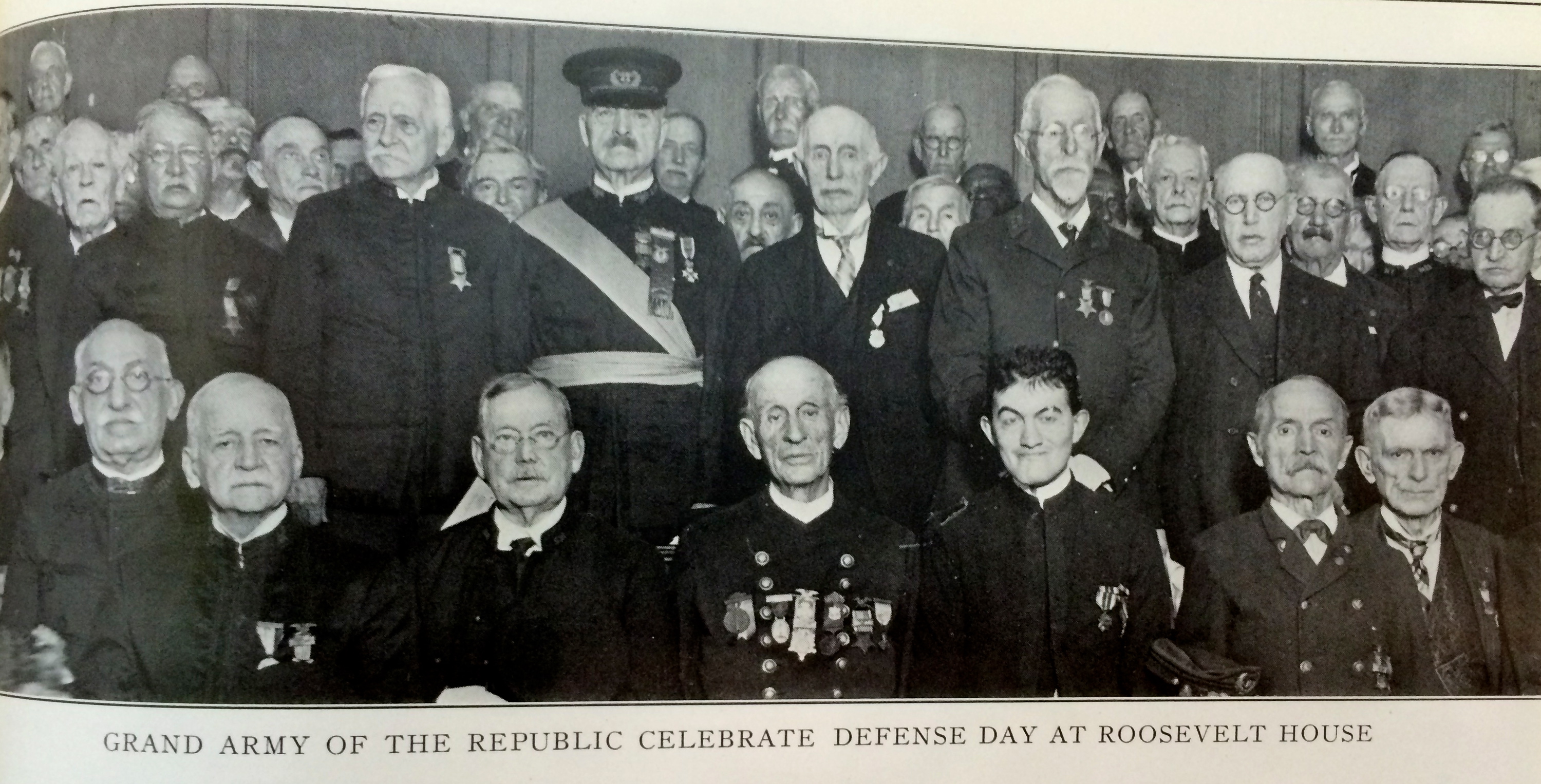
IMG_1199

Here is a photograph that is fascinating on about five different levels. It is from the Fall 1925 issue of the Roosevelt House Bulletin, the public voice of the Women’s Roosevelt Memorial Association. The photo was taken on July 4, 1925 in the auditorium of what we now call the Theodore Roosevelt Birthplace. This would have been sixty full years after Robert E. Lee’s surrender at Appomattox and, as you can see, the men are all octogenarians. A few may even be in their 90s. The General Sherman Circle, Ladies of the G.A.R. organized the event in cooperation with the WRMA. The turnout was about three hundred, though I am not certain how many were CIvil War veterans. The image is not that great because it is not the original but a photo taken on my camera.

Many of the Roosevelts were involved in veterans groups. Theodore was active in the Naval and Military Order of the Spanish American War. Son Ted was actually a founder of the American Legion. Throughout the 1920s and 1930s Ted Roosevelt also came to Governors Island regularly for reunions of the First Infantry Division.

This event on the 4th of July was in support of something called Defense Day, which one of the Civil War vet attendees equated to the old Muster Day. Defense Day seems to have been something akin to the Preparedness movement in the United States after the start of the Great War but prior to American engagement in the conflict. One of Defense Day’s biggest critics was President Calvin Coolidge. Apparently it was an initiative that never got too far off the ground, which is not surprising being that most people in America and Europe were exhausted after what had transpired less than a decade before.

It is incredible to visit the Birthplace and realize you are walking in the same steps where these people once walked.

Thinking about the war’s legacies

07 Thursday Aug 2014

Posted by Keith Muchowski in Historiography, Memory, WW1

≈ 1 Comment

Europe as it was after being redrawn in 1919

Europe as it was after being redrawn in 1919

Yesterday a friend sent me something from the Wall Street Journal. It is one of those list type things in which the Journal chronicles 100 legacies of World War One. A few of the items cannot be truly credited/blamed on the First World War. Doctors were fitting wounded soldiers of the American Civil War for prosthetic devices decades prior to 1914. It is true, however, that the science of prosthesis took a great leap forward in the 1910s and 1920s. Give the whole thing a look. Among other things the list encourages us  to think beyond the minutiae of the battles–important though they are– and ask ourselves why the events of 1914-1919 are important to us today in the 21st century. I cannot think of a better lesson as the Centennial gets underway.

(image/National Archives, United Kingdom)

Archiving the Great War

04 Monday Aug 2014

Posted by Keith Muchowski in Libraries, Media and Web 2.0, Memory, WW1

≈ 2 Comments

00046rI received confirmation late last week that the Library of Congress will be preserving The Strawfoot as part of the LOC’s Web Archiving initiative for the World War I Centennial. The Library of Congress’s goal is to collect and preserve materials born digitally during the Centennial. So much of what is online seems transitory and impermanent. I am very excited about the 100th anniversary of the Great War and think it offers all kinds of interpretive and other possibilities. That the blog will be included in the endeavor means a lot to me. Working on the website these past 3 1/2 years has been a labor of love, with equal emphasis on both words: love and labor. It was a lifestyle change. Writing the blog has its rewards; the site might not get the traffic that some others do but it does have a regular readership.

Longtime followers may have noticed a shift of emphasis in recent weeks and months. It may seem that way but to me it is all cut from the same cloth. I have never thought of myself as strictly a Civil War guy, though the events of 1861-65 have always been a source of interest and fascination for me. I have always been more interested  in the causes and consequences of the war; what came just before and after is equally important. That is why I have found volunteering at the Theodore Roosevelt Birthplace these past ten months rewarding. The Roosevelts–both side of the extended family–offer so many intellectual opportunities.

I am still plugging away on the Theodore Roosevelt Senior and Joseph Hawley biographies, still volunteering at Governors Island over the summers, still writing the content for the TRB social media platforms. There are more connections than might be apparent. For starters, General/Senator Hawley and Theodore Roosevelt knew and admired each other. I find it fascinating that the young Franklin Delano Roosevelt lost a power struggle with his boss, the unreconstructed Secretary of the Navy Josephus Daniels, over the naming of a new ship in 1917. Instead of Roosevelt’s choice, the destroyer was christened in honor of Confederate naval officer Matthew Maury. These types of things fall under what we now call Memory Studies, which I suppose is broader and more encompassing than just historiography. More of these types of things are going to come out here at The Strawfoot in the coming months.

(image: Theodore Roosevelt at Washington’s Union Station during the First World War, LOC)

← Older posts
Newer posts →

Enter your email address to subscribe to this blog and receive notifications of new posts by email.

Join 258 other subscribers

Categories

Archives

  • November 2023 (1)
  • October 2023 (3)
  • September 2023 (3)
  • August 2023 (4)
  • July 2023 (7)
  • June 2023 (10)
  • May 2023 (8)
  • April 2023 (6)
  • March 2023 (5)
  • February 2023 (4)
  • January 2023 (4)
  • December 2022 (4)
  • November 2022 (8)
  • October 2022 (2)
  • September 2022 (4)
  • June 2022 (1)
  • May 2022 (1)
  • April 2022 (13)
  • January 2022 (1)
  • December 2021 (2)
  • November 2021 (1)
  • October 2021 (3)
  • September 2021 (3)
  • August 2021 (5)
  • July 2021 (1)
  • June 2021 (1)
  • May 2021 (4)
  • April 2021 (3)
  • March 2021 (4)
  • February 2021 (7)
  • January 2021 (4)
  • December 2020 (4)
  • November 2020 (3)
  • October 2020 (4)
  • September 2020 (7)
  • August 2020 (5)
  • July 2020 (7)
  • June 2020 (11)
  • May 2020 (7)
  • April 2020 (9)
  • March 2020 (9)
  • February 2020 (7)
  • January 2020 (6)
  • December 2019 (7)
  • November 2019 (9)
  • October 2019 (4)
  • September 2019 (6)
  • August 2019 (10)
  • July 2019 (8)
  • June 2019 (6)
  • May 2019 (9)
  • April 2019 (8)
  • March 2019 (6)
  • February 2019 (8)
  • January 2019 (5)
  • December 2018 (10)
  • November 2018 (6)
  • October 2018 (9)
  • September 2018 (11)
  • August 2018 (11)
  • July 2018 (17)
  • June 2018 (10)
  • May 2018 (8)
  • April 2018 (9)
  • March 2018 (8)
  • February 2018 (5)
  • January 2018 (7)
  • December 2017 (11)
  • November 2017 (8)
  • October 2017 (9)
  • September 2017 (11)
  • August 2017 (12)
  • July 2017 (14)
  • June 2017 (18)
  • May 2017 (11)
  • April 2017 (10)
  • March 2017 (9)
  • February 2017 (11)
  • January 2017 (14)
  • December 2016 (7)
  • November 2016 (8)
  • October 2016 (8)
  • September 2016 (9)
  • August 2016 (6)
  • July 2016 (12)
  • June 2016 (8)
  • May 2016 (9)
  • April 2016 (6)
  • March 2016 (12)
  • February 2016 (10)
  • January 2016 (9)
  • December 2015 (9)
  • November 2015 (11)
  • October 2015 (8)
  • September 2015 (9)
  • August 2015 (13)
  • July 2015 (14)
  • June 2015 (11)
  • May 2015 (11)
  • April 2015 (18)
  • March 2015 (10)
  • February 2015 (8)
  • January 2015 (8)
  • December 2014 (12)
  • November 2014 (13)
  • October 2014 (16)
  • September 2014 (11)
  • August 2014 (16)
  • July 2014 (12)
  • June 2014 (13)
  • May 2014 (10)
  • April 2014 (10)
  • March 2014 (11)
  • February 2014 (12)
  • January 2014 (10)
  • December 2013 (11)
  • November 2013 (14)
  • October 2013 (14)
  • September 2013 (14)
  • August 2013 (13)
  • July 2013 (17)
  • June 2013 (9)
  • May 2013 (13)
  • April 2013 (13)
  • March 2013 (16)
  • February 2013 (15)
  • January 2013 (15)
  • December 2012 (18)
  • November 2012 (18)
  • October 2012 (21)
  • September 2012 (14)
  • August 2012 (16)
  • July 2012 (21)
  • June 2012 (22)
  • May 2012 (24)
  • April 2012 (20)
  • March 2012 (23)
  • February 2012 (22)
  • January 2012 (15)
  • December 2011 (23)
  • November 2011 (22)
  • October 2011 (23)
  • September 2011 (18)
  • August 2011 (19)
  • July 2011 (20)
  • June 2011 (29)
  • May 2011 (25)
  • April 2011 (18)
  • March 2011 (21)
  • February 2011 (11)

Meta

  • Create account
  • Log in
  • Entries feed
  • Comments feed
  • WordPress.com
Creative Commons License
This work is licensed under a Creative Commons Attribution-NonCommercial-ShareAlike 4.0 International License.

Enter your email address to subscribe to this blog and receive notifications of new posts by email.

Join 258 other subscribers

Categories

Archives

  • November 2023 (1)
  • October 2023 (3)
  • September 2023 (3)
  • August 2023 (4)
  • July 2023 (7)
  • June 2023 (10)
  • May 2023 (8)
  • April 2023 (6)
  • March 2023 (5)
  • February 2023 (4)
  • January 2023 (4)
  • December 2022 (4)
  • November 2022 (8)
  • October 2022 (2)
  • September 2022 (4)
  • June 2022 (1)
  • May 2022 (1)
  • April 2022 (13)
  • January 2022 (1)
  • December 2021 (2)
  • November 2021 (1)
  • October 2021 (3)
  • September 2021 (3)
  • August 2021 (5)
  • July 2021 (1)
  • June 2021 (1)
  • May 2021 (4)
  • April 2021 (3)
  • March 2021 (4)
  • February 2021 (7)
  • January 2021 (4)
  • December 2020 (4)
  • November 2020 (3)
  • October 2020 (4)
  • September 2020 (7)
  • August 2020 (5)
  • July 2020 (7)
  • June 2020 (11)
  • May 2020 (7)
  • April 2020 (9)
  • March 2020 (9)
  • February 2020 (7)
  • January 2020 (6)
  • December 2019 (7)
  • November 2019 (9)
  • October 2019 (4)
  • September 2019 (6)
  • August 2019 (10)
  • July 2019 (8)
  • June 2019 (6)
  • May 2019 (9)
  • April 2019 (8)
  • March 2019 (6)
  • February 2019 (8)
  • January 2019 (5)
  • December 2018 (10)
  • November 2018 (6)
  • October 2018 (9)
  • September 2018 (11)
  • August 2018 (11)
  • July 2018 (17)
  • June 2018 (10)
  • May 2018 (8)
  • April 2018 (9)
  • March 2018 (8)
  • February 2018 (5)
  • January 2018 (7)
  • December 2017 (11)
  • November 2017 (8)
  • October 2017 (9)
  • September 2017 (11)
  • August 2017 (12)
  • July 2017 (14)
  • June 2017 (18)
  • May 2017 (11)
  • April 2017 (10)
  • March 2017 (9)
  • February 2017 (11)
  • January 2017 (14)
  • December 2016 (7)
  • November 2016 (8)
  • October 2016 (8)
  • September 2016 (9)
  • August 2016 (6)
  • July 2016 (12)
  • June 2016 (8)
  • May 2016 (9)
  • April 2016 (6)
  • March 2016 (12)
  • February 2016 (10)
  • January 2016 (9)
  • December 2015 (9)
  • November 2015 (11)
  • October 2015 (8)
  • September 2015 (9)
  • August 2015 (13)
  • July 2015 (14)
  • June 2015 (11)
  • May 2015 (11)
  • April 2015 (18)
  • March 2015 (10)
  • February 2015 (8)
  • January 2015 (8)
  • December 2014 (12)
  • November 2014 (13)
  • October 2014 (16)
  • September 2014 (11)
  • August 2014 (16)
  • July 2014 (12)
  • June 2014 (13)
  • May 2014 (10)
  • April 2014 (10)
  • March 2014 (11)
  • February 2014 (12)
  • January 2014 (10)
  • December 2013 (11)
  • November 2013 (14)
  • October 2013 (14)
  • September 2013 (14)
  • August 2013 (13)
  • July 2013 (17)
  • June 2013 (9)
  • May 2013 (13)
  • April 2013 (13)
  • March 2013 (16)
  • February 2013 (15)
  • January 2013 (15)
  • December 2012 (18)
  • November 2012 (18)
  • October 2012 (21)
  • September 2012 (14)
  • August 2012 (16)
  • July 2012 (21)
  • June 2012 (22)
  • May 2012 (24)
  • April 2012 (20)
  • March 2012 (23)
  • February 2012 (22)
  • January 2012 (15)
  • December 2011 (23)
  • November 2011 (22)
  • October 2011 (23)
  • September 2011 (18)
  • August 2011 (19)
  • July 2011 (20)
  • June 2011 (29)
  • May 2011 (25)
  • April 2011 (18)
  • March 2011 (21)
  • February 2011 (11)

Meta

  • Create account
  • Log in
  • Entries feed
  • Comments feed
  • WordPress.com
Creative Commons License
This work is licensed under a Creative Commons Attribution-NonCommercial-ShareAlike 4.0 International License.

Enter your email address to subscribe to this blog and receive notifications of new posts by email.

Join 258 other subscribers

Categories

Archives

  • November 2023 (1)
  • October 2023 (3)
  • September 2023 (3)
  • August 2023 (4)
  • July 2023 (7)
  • June 2023 (10)
  • May 2023 (8)
  • April 2023 (6)
  • March 2023 (5)
  • February 2023 (4)
  • January 2023 (4)
  • December 2022 (4)
  • November 2022 (8)
  • October 2022 (2)
  • September 2022 (4)
  • June 2022 (1)
  • May 2022 (1)
  • April 2022 (13)
  • January 2022 (1)
  • December 2021 (2)
  • November 2021 (1)
  • October 2021 (3)
  • September 2021 (3)
  • August 2021 (5)
  • July 2021 (1)
  • June 2021 (1)
  • May 2021 (4)
  • April 2021 (3)
  • March 2021 (4)
  • February 2021 (7)
  • January 2021 (4)
  • December 2020 (4)
  • November 2020 (3)
  • October 2020 (4)
  • September 2020 (7)
  • August 2020 (5)
  • July 2020 (7)
  • June 2020 (11)
  • May 2020 (7)
  • April 2020 (9)
  • March 2020 (9)
  • February 2020 (7)
  • January 2020 (6)
  • December 2019 (7)
  • November 2019 (9)
  • October 2019 (4)
  • September 2019 (6)
  • August 2019 (10)
  • July 2019 (8)
  • June 2019 (6)
  • May 2019 (9)
  • April 2019 (8)
  • March 2019 (6)
  • February 2019 (8)
  • January 2019 (5)
  • December 2018 (10)
  • November 2018 (6)
  • October 2018 (9)
  • September 2018 (11)
  • August 2018 (11)
  • July 2018 (17)
  • June 2018 (10)
  • May 2018 (8)
  • April 2018 (9)
  • March 2018 (8)
  • February 2018 (5)
  • January 2018 (7)
  • December 2017 (11)
  • November 2017 (8)
  • October 2017 (9)
  • September 2017 (11)
  • August 2017 (12)
  • July 2017 (14)
  • June 2017 (18)
  • May 2017 (11)
  • April 2017 (10)
  • March 2017 (9)
  • February 2017 (11)
  • January 2017 (14)
  • December 2016 (7)
  • November 2016 (8)
  • October 2016 (8)
  • September 2016 (9)
  • August 2016 (6)
  • July 2016 (12)
  • June 2016 (8)
  • May 2016 (9)
  • April 2016 (6)
  • March 2016 (12)
  • February 2016 (10)
  • January 2016 (9)
  • December 2015 (9)
  • November 2015 (11)
  • October 2015 (8)
  • September 2015 (9)
  • August 2015 (13)
  • July 2015 (14)
  • June 2015 (11)
  • May 2015 (11)
  • April 2015 (18)
  • March 2015 (10)
  • February 2015 (8)
  • January 2015 (8)
  • December 2014 (12)
  • November 2014 (13)
  • October 2014 (16)
  • September 2014 (11)
  • August 2014 (16)
  • July 2014 (12)
  • June 2014 (13)
  • May 2014 (10)
  • April 2014 (10)
  • March 2014 (11)
  • February 2014 (12)
  • January 2014 (10)
  • December 2013 (11)
  • November 2013 (14)
  • October 2013 (14)
  • September 2013 (14)
  • August 2013 (13)
  • July 2013 (17)
  • June 2013 (9)
  • May 2013 (13)
  • April 2013 (13)
  • March 2013 (16)
  • February 2013 (15)
  • January 2013 (15)
  • December 2012 (18)
  • November 2012 (18)
  • October 2012 (21)
  • September 2012 (14)
  • August 2012 (16)
  • July 2012 (21)
  • June 2012 (22)
  • May 2012 (24)
  • April 2012 (20)
  • March 2012 (23)
  • February 2012 (22)
  • January 2012 (15)
  • December 2011 (23)
  • November 2011 (22)
  • October 2011 (23)
  • September 2011 (18)
  • August 2011 (19)
  • July 2011 (20)
  • June 2011 (29)
  • May 2011 (25)
  • April 2011 (18)
  • March 2011 (21)
  • February 2011 (11)

Meta

  • Create account
  • Log in
  • Entries feed
  • Comments feed
  • WordPress.com
Creative Commons License
This work is licensed under a Creative Commons Attribution-NonCommercial-ShareAlike 4.0 International License.

Blog at WordPress.com.

  • Subscribe Subscribed
    • The Strawfoot
    • Join 229 other subscribers
    • Already have a WordPress.com account? Log in now.
    • The Strawfoot
    • Subscribe Subscribed
    • Sign up
    • Log in
    • Report this content
    • View site in Reader
    • Manage subscriptions
    • Collapse this bar
 

Loading Comments...