Richard Gilder, 1932-2020

New-York Historical Society

I read with great interest this morning James G. Basker’s remembrance of investor and philanthropist Richard Gilder, who died on May 12 at the age of 87. Those with an interest in the study of the past might know that Mr. Gilder was one half of the partnership that founded The Gilder Lehrman Institute of American History. The work they and their teams have done over these past several decades has been crucial to the dissemination and understanding of American history. One of their wisest moves has always been to focus on primary sources. Their emphasis has always been to let the people of the past speak to us in their own words via their speeches, letters, public broadsides, and recordings. At the institution where I myself work, we have applied for and won grants provided by the Gilder Lehrman Institute which have allowed us to discuss America and its role in the world and share it with the public. The ultimate investment is in people and knowledge.

Important though all that work was–and continues to be–Gilder accomplished more than that. He was instrumental to the renovation of Central Park in the hard years of the 1970s, and the revival of the New-York Historical Society among many other things. Getting older provides perspective. I have been a New Yorker long enough now to have lived through several eras and seen certain things change and change again, from the height of irrational exuberance to our current fraught moment. Has it been more than a decade and a half the Hamilton exhibit came to the Upper West Side? That was years before the Broadway play. The N-YHS slavery and Lincoln exhibits followed soon thereafter. I remember taking my late father-in-law to see the latter well over a decade ago. He and my father are now gone but they live on in the lessons I learned from both of them, combined with the places we visited and things we saw along the way.

(image/Ajay Suresh)

Mother’s Day Morning Coffee

I hope everyone is having a relaxing Mather’s Day Sunday. Alas there is not much recourse but to shelter in place but the true spirit of the holiday is to honor or remember those who do or did so much for us, usually with such little notice or credit. If we have to do that while sheltering in place, it is all well and good. Yesterday I resumed a project that had hit a bit of a wall for a week or so. Every day out of the saddle makes it that much tougher to pick up again. It is just that easy to not do it. I wrote 400 words yesterday and am going for 450 today. It is amazing how if you sit down a write a few lines the process takes over. I have a friend to whom I text at the end of the day with my progress on these things. Yesterday he reminded me of Eleanor Roosevelt’s mantra that the way to begin is to begin.

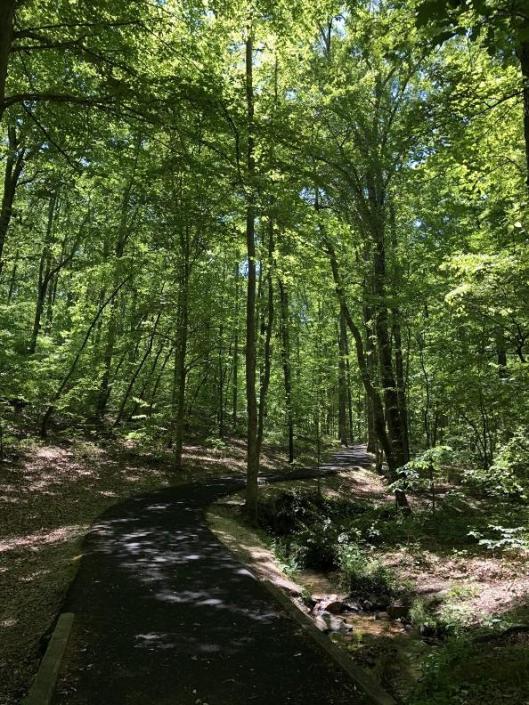
Said friend lives in the Carolina area and yesterday sent me the images your see here from King’s Mountain. He has been visiting a great deal this spring and has told me that, like Green-Wood Cemetery here in Brooklyn, visitation is way up during the pandemic. That said, there is still enough space to maintain social distancing. One of our goals it take a week-long or so road trip  to hit some of the Revolutionary and Civil War sites in Georgia and the Carolinas, which I have never seen. It seems that especially with the War of Independence the southern theater is often overlooked and misunderstood.

Happy Mother’s Day, all.

Remembering V-E Day 75 years on

Camera crews record President Harry S. Truman announcing the surrender of Germany, May 8, 1945

I spent a good portion of the evening working reference on my library’s online reference service, answering questions not just from our own students but from those around the world within the consortium to which we belong. I rarely break through the fourth wall but almost always play it completely straight, unless something humorous happens or there is some other reason to break character so to speak. You always know where the person is because they log on from their institution’s website. Today around 5:00 pm I clicked on a query from a school in London. Often the patrons on the other end do not realize they are getting the 24/7 reference service and figure, if they think about it at all, that they have gotten someone from their home site. This happened with the patron from London because they apologized for bothering me on a bank holiday. I broke through the wall immediately and told them that not only were they not bothering me but that it was not even a bank holiday here in Brooklyn, New York. I had understood immediately that their bank holiday remark was in reference to today being V-E Day.

Usually when I field questions from across the pond–and there are always a fair number of them–I like to think they’re sitting in a pub having a pint while doing their schoolwork. It was 5:00 pm here, and so would have been after at least 10:00 London time. Yes, it was a Friday but I doubt given the upside-down nature of our current moment that they were pub crawling, and no I did not ask. While looking into their reference need the two of us had a fair back-and-forth on the V-E Day commemoration, which despite being the 75th such occasion was rather subdued given the pandemic. They patron mentioned a few virtual events being held online for social distancing purposes. There were few, if any, in-person events.

This patron was one of three people (the others not being from virtual reference but people emailing and texting) who mentioned today’s Victory in Europe anniversary. It has been cold and rainy all day here in the Big Apple; anniversaries such as this are not really there for celebration but reflection, and the weather has suited the occasion. Given everything going on in our world today this year’s V-E Day has been that much more poignant. No one knows the future–just ask anyone who remains today who was there in the spring of 1945–but it seems that seventy-five years after the surrender of Germany the world is entering a new era.

(image/Truman Library Institute)


Fending Chaos: the Early Years of Rufus King

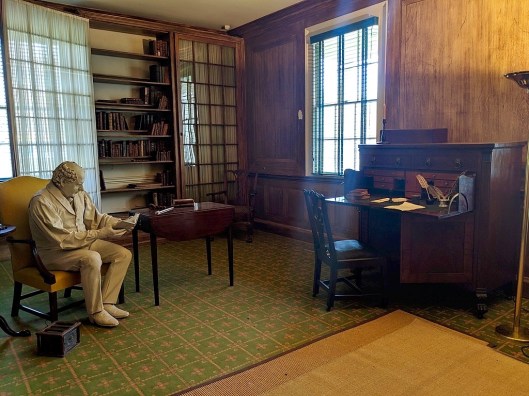
Rufus King Manor library & study, Jamaica Queens

The Journal of the American Revolution has posted my article about Rufus King. Of all the things I have written (so far), this may be the most rewarding. King is such an important figure and his story is so important to tell. This article ends in 1789, the year of the First Congress and Washington’s inaugural at Federal Hall. I am working on a part two right now that will bring King up through 1805, the year after his unsuccessful presidential bid and purchase of his Jamaica Queens home. The article is still very much in the early stages, but if all goes as planned it will get released sometime in early summer.

Now seems an opportune time to say publicly that I’ve decided my next book project will be about the King family in America. I had the Ah-ha moment this past Saturday and spent a good portion of this past weekend preparing some timelines. I intend to cover six generations from the early 1700s to the 1930s. Rufus King’s son, John Alsop King, plays a role in my yet-to-be-published manuscript “Incorporating New York” about Civil War Era New York City, so the topic is less of a digression than it might seem at first glance. In many ways, Rufus King’s sons and grandsons, and the generations of which they were a part, had to deal with the issues that the founders had put off, slavery, expansion, and other contentious things in particular. Rufus King himself returned to the Senate in the 1810s and dealt with such hot-button issues as the War of 1812 and Missouri Compromise. It is a story worth telling.

(image/CaptJayRuffins via Wikimedia Commons)

Fiorello La Guardia’s First World War

They have my article up and running about Fiorello La Guardia’s involvement in the World War I over at Roads to the Great War. In 1917-18 he flew planes and served as second-in-command of an air base in Foggia, Italy, the place of his father’s birth. At the same time he was serving in the U.S. Congress. I had wanted to write this one for a long time but other projects kept pushing it to the back burner. I find La Guardia’s early life to be fascinating. We so associate him with ethnic New York, which makes sense being that he was born in New York City to immigrant parents. It was his experience in the Old West, however, that did so much to shape who he became. His year in Italy did much the same. This piece was a lot of fun to write. Enjoy.

(image/Library of Congress)

Patriot’s Day 2020

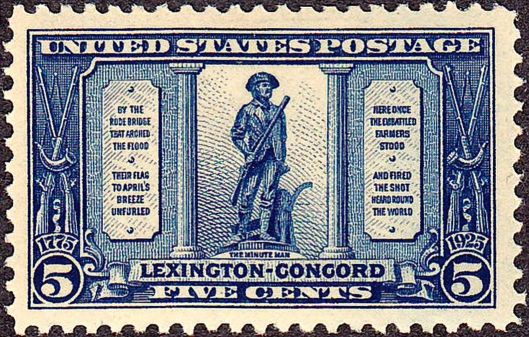
Yesterday was the 245th anniversary of the firing at Lexington and Concord. The stamp above is a commemorative, one of a three-stamp set, from the 1925 sesquicentennial. As I understand it, one of the reasons people associate Massachusetts and Virginia–but not New York–so closely with the Revolutionary War is that in the 1920s the former two states out-hustled the latter in the heritage tourism game. It is something I intend to delve into more in these next few years during the 250th, which we are already in right now. I think the role the sesquicentennial in the 1920s played in our understanding of the Revolutionary War is under appreciated.

Today is Patriot’s Day in New England. The Red Sox would have played a morning game in Fenway concurrent with the running of the Boston Marathon. Even though I have not lived in New England for more than 40 years I still have many relatives there and feel a strong connection to Patriot’s Day. My relatives usually watch the marathon from a small town outside Boston itself. Also, I ran cross-country in high school and remember Bill Rodgers and the runners of that period so vividly. Hopefully they will get the race in this coming September as they plan.


Afternoon scene, Green-Wood Cemetery

Brooklyn Green-Wood Cemetery, April 2020

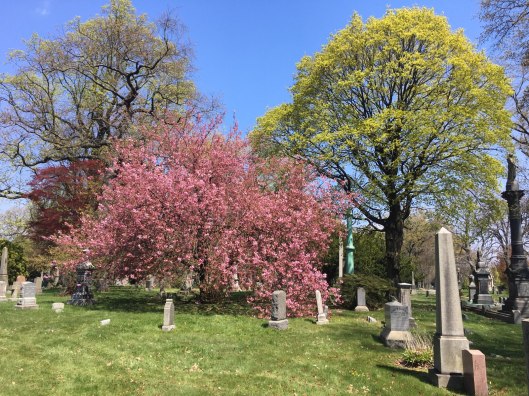
One thing I am trying to do during this period of sheltering in place is not work too much, if at all, on Sundays. This can be difficult because I usually have a few projects in various stages of development at any given time. Typically on Sundays I put in at least a few hours researching or writing in my home office, or visiting some library or archive. Nonetheless, with no physical differentiation between home and work life–and no way to visit any restaurants, baseball games, or cultural institutions–one must buffer in some way the various roles in one’s life. One place that has thankfully remained open during the pandemic has been Brooklyn’s Green-Wood Cemetery. I have been visiting the cemetery for more than twenty years now, and while the 478-acre green space always has more visitors this time of year there are many more people in the park in our current moment. I mean a ton. This is a good thing to see. Still it is not so crowded that one cannot socially distance and remain safe.

I was talking to a neighbor the other day, who told me that a few weeks ago had been his first trip to Green-Wood. I explained the nature and development of garden cemeteries, which he was surprised to learn. There is a saying that graveyards are for the dead and cemeteries for the living. This has never been truer than in our current moment. People have been visiting Green-Wood Cemetery for 180+ years now through civil war and other public crises, but the place has hardly been more relevant than right now. I, and many thousands of other Brooklynites, have been thankful to have this place to visit in these times.

History Matters (…and so does coffee!)

Coffee-House Slip, (Foot of Wall Street), drawn & engraved by H. Fossette

I was telling someone last night that yesterday was the first time since beginning to shelter in place last month that I felt hemmed in and claustrophobic. Apparently I was not the only one feeling like such; my friend replied that he left the house and went for a drive to clear his head. Las week another friend, an intelligent and thoughtful high school history educator who recently returned to school for another graduate degree, asked me if I am keeping any type of journal or diary during the health pandemic. I actually do keep a journal and while I cover events of the day and the like, it is more for where I am on certain projects at home, work, and in my writing. Of course the outside world touches on all those things, so it is a sort of chronicle of the time.

I was thinking about all these things when I was getting ready for bed last night after watching last week’s premier episode of the National Council for History Education (NCHE) series with Yale history professor Joanne Freeman History Matters (…and so does coffee!). It is a weekly online series in which Professor Freeman shares a primary resource and explains how it is relevant to today’s times. History is always relevant to current times, which the wise among us understand. Last week’s document was a letter written by Alexander Hamilton in late September 1787 a week or so after the September 17 ratification of the Constitution. Ratification at the Convention was hardly the end of the story; from there the document went to the Confederation Congress, and from there to the states for a vote. Dr. Freeman read Hamilton’s letter, in which he cast doubt that the Constitution would come to pass enough states. The title of the episode was “Contingency Matters.” Freeman was trying to show that nothing is ever a done deal or set in stone. Far from being a sure thing, the Constitution hung tenuously in the balance. That was why Hamilton, Jay, and Madison soon wrote The Federalist Papers, each article of which was printed in newspapers and other venues to be read aloud in coffeeshops and other public spaces to sway public opinion.

Closely related to contingency is agency. It is important in these trying times, with the pandemic, economic uncertainty, and seemingly failing leadership on certain levels, to realize that one has more more agency than one might believe. Nothing is set in stone and circumstances change, often when we least expect. That is where contingency and our own agency come in. This was one of the points of the episode.

Check out History Matters at the NCHE website. Each broadcast appears live Thursdays from 10:00-10:30 am Eastern time, but is also available for viewing afterward.

(image/Views in New-York and its Environs, from Accurate, Characteristic & Picturesque Drawings, Taken on the Spot, Expressly for this Work; New York: Peabody & Co., 1831.