
I have always known a fair amount about Ulysses S. Grant. What I had not known until recently finishing Joan Waugh’s U. S. Grant: American Hero, American Myth was the level of respect held for him by his contemporaries. This can be summed up in the slogan—“Washington the father, Lincoln the martyr, Grant the savior”—that appeared in print around the time of his death. Americans were so keen for news on the president’s illness that reporters staked out his Manhattan and Mount McGregor homes for months leading up to his death from throat cancer in July 1885. To give you a sense of the intensity here are select headlines from the New York Times, just one of the nearly twenty Gotham dailies of the time:
GEN. GRANT NOT SO COMFORTABLE. March 8, 1885
GEN. GRANT MUCH BETTER. March 12, 1885
GEN. GRANT’S CONDITION; THE CONTINUED PROGRESS OF THE DISEASE. THE LOCAL DIFFICULTY MARKEDLY INCREASED–BROWN, THE SPECIALIST, NOT ALLOWED TO SEE THE PATIENT. March 13, 1885
GEN. GRANT’S CONDITION.; EARNEST REMARKS BY MR. BEECHER AT THE PLYMOUTH CHURCH PRAYER MEETING. March 14, 1885
GEN. GRANT ABOUT THE SAME. March 16, 1885
GEN. GRANT’S CONDITION.; ANOTHER NIGHT OF SLEEPLESSNESS, BUT RESTING DURING THE DAY. March 18, 1885
GEN. GRANT’S WEAKNESS; A WEARISOME DAY AND NIGHT FOR THE SUFFERER. SLEEPING IN HIS CHAIR TO PREVENT A RECURRENCE OF THE PAINFUL COUGHING SPELLS–A GREAT LOSS OF STRENGTH. March 31, 1885
GEN. GRANT MUCH WORSE; ANOTHER SEVERE ATTACK YESTERDAY MORNING. April 2, 1885
OBTAINING MORE SLEEP; A QUIET NIGHT AND DAY IN THE GRANT HOUSEHOLD. April 4, 1885
PASSING A WAKEFUL DAY; STILL DESPONDENT, BUT PHYSICALLY COMFORTABLE. April 6, 1885
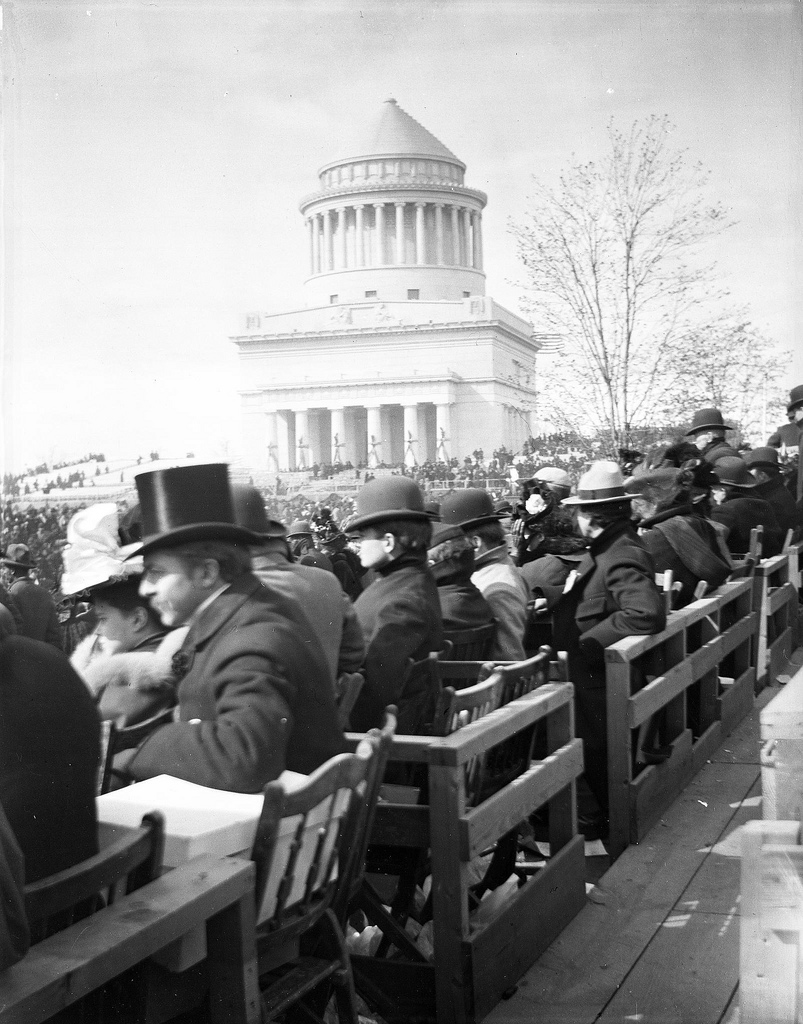 Dedication of Grant’s Tomb, April 27, 1897
Americans continued to hold Grant in high esteem until his popularity waned in the 1920s with the institutionalization of Lost Cause historiography and the public aversion to militarism after the carnage of the just-ended Great War. I think she overstates the case, but Waugh offers an analysis of Grant and his place in history at Salon. I say overstates because the reinterpretation of Grant has been underway for some time now, with Grant going from bumbling drunk to conscientious public figure in the estimation of most historians. That said, it is not clear if the general public has caught up with these changes in scholarship; when my wife and I visited his tomb this past winter I was saddened to see the paucity of visitors.
Waugh talks about the disrepair at various Grant sites across the country. Thankfully, this is no longer the case at his final resting place. Last week the new Visitor Center opened in the Overlook Pavilion at Grant’s tomb.
She concludes:
Perhaps the looming Sesquicentennial will bring many Americans to a more knowledgeable and appreciative judgment of the man. Ulysses S. Grant became the embodiment of the American nation in the decades after the Civil War. No living person symbolized both the hopes and the lost dreams of the war more fully than Grant. No living person more clearly articulated for posterity a powerful truth about the Civil War when he wrote in his “Personal Memoirs” of his feelings about Lee and the soldiers he had led and the slave republic they had defended:
“I felt like anything rather than rejoicing at the down fall of a foe who had fought so long and valiantly, and had suffered so much for a cause, though that cause was, I believe, one of the worst for which a people ever fought, and one for which there was the least excuse.”
Grant’s legacy to his own generation was deep and wide, and he became an icon in the historical memory of the war shared by a whole generation of men and women. They believed that an appreciation of Grant could only come with the recognition that he was both the heroic general that saved the Union, and the essential president who made sure that it stayed together.
Read the whole thing.
 The Strawfoot
First off, I’m really enjoying reading your blog. Keep up the great work!
I’m a huge fan of Grant’s and I was glad to see Waugh’s article, if for no other reason than to see someone discussing him, as I am always heartily disappointed by the lack of attention and honor he receives. Though scholars have done a reassessment of him in recent years, I agree with you that the American public is either largely apathetic or possessed of false impressions tainted by those with an agenda – as many of the letters in response to Waugh’s article demonstrate. It is very sad to see what a combination of ignorance, forgetfulness, and vendetta has done to the memory of a heroic man.
I have never visited his tomb, living quite a long way from New York, but I hope to pay my respects someday. I’m sad to hear about the lack of people present during your visit. I wonder if other sites relating to Grant – such as his home in Galena, Illinois – suffer from the same lack of interest?
Looking forward to reading more posts!
Sara, thank you for the kind words.
It is sad how few people visit Grant’s Tomb. I think it is due, at least in part, to its remote location in upper Manhattan and the demographics of New York City. I’m guessing, but I imagine that visitation is at least somewhat better at the Grant home in Galena and at the U.S. Grant National Historic Site in St. Louis. Still, it is unfortunate how few people visit the various Grant sites across the country.
If you enjoyed Waugh’s piece in Salon I can’t recommend her book highly enough. Also, check out Ranger Bob Pollock’s blog, Yesterday…and Today, the link to which is on my blogroll. Let’s hope that that public sentiment catches up with the Grant reevaluation underway in professional circles the past decade or so.
Thank you for the recommendations, I will definitely check out Waugh’s book and I am thrilled to discover the “Yesterday…and Today” blog. I am so glad to see that there are others who admire Grant and are working hard to correct the misinformation about him and renew interest in his legacy.
Have you visited the home where he passed away? I believe I read that it is on the grounds of a prison??
Keith,
Thanks for the mention and for putting Yesterday…and Today on your blogroll.
U.S. Grant NHS gets about 45,000 visitors a year. I’ve been giving tours there about two and a half years now. My personal opinion is that most people don’t know much about Grant or often have the common impressions – he was a good general, but not such a good president. But, many are very interested in learning more. I can’t fault people for lack of knowledge regarding Grant, after all history is such a broad topic. Even historians often concentrate on specific time periods, places, and people. I always feel that no matter how much I know there is so much more to learn!
Bob Pollock
Bob, thanks for the information about visitation at Grant NHS.
I couldn’t agree more that history is overwhelming, even for the most studious among us. I’ve been reading about the Civil War for 20+ years now and sometimes feel like I’m just beginning.
Hopefully by the bicentennial of Grant’s birth eleven short years from now public perception will have caught up with the scholarship. There’s hope. If anyone had told me fifteen years ago that Grant’s Tomb would be refurbished as it has I never would have believed it.
Reading his biography by Brooks Simpson, I was amazed at Grant’s tenacity and determination to overcome all the severe criticisms (mostly unfair)while serving during the Civil War. I am glad he recieved the recognition and respect while he was alive – it was a long time coming. Whatever his shortcomings as a president, one cannot deny his remarkable achievements as a general.
The Hayfoot
I agree. I tend to think that Grant was perhaps too softhearted and too good a man to be a good politician, but perhaps that is just my bias showing. I’m reading Horace Porter’s “Campaigning with Grant” in which he says that Grant expressed a desire to go back to Saint Louis and raise horses after the War. He probably felt an obligation to serve the country as president, but I just don’t think he was cut out for it and it is too bad it has tainted his heroic service to the nation.
Sounds like a good book. I think he would have been pretty content raising horses – he had a real gift handling them. I think that was a reason he and Julia connected too. One of America’s greatest warriors never had much of a taste for warfare.
The Hayfoot
🙂
Yes, I think Grant was too kind-hearted for his own good. I think he ran for the presidency out of a sense of obligation more than anything else. He would have loved nothing more than to return home and tend horses but the country was looking to him to heal the nation.
I have not been to Mount McGregor, but the Grant cottage is indeed on the grounds of a correctional facility. It is in a beautiful part of the state, though, near Saratoga Springs.
I intend to read the Porter book this summer. I didn’t fully understand his importance to Grant until reading the Waugh book. He was instrumental in getting the tomb completed as well.