The Nation’s Report Card corroborates what we have suspected for a while now.
Flunking History
15 Wednesday Jun 2011
Posted in Uncategorized
≈ Comments Off on Flunking History

15 Wednesday Jun 2011
Posted in Uncategorized
≈ Comments Off on Flunking History
The Nation’s Report Card corroborates what we have suspected for a while now.
14 Tuesday Jun 2011
Posted in Governors Island
≈ Comments Off on Governors Island 101
Ann L. Buttenwieser, author of Governors Island: The Jewel of New York Harbor, gives us a valuable overview of the past and present Governors Island.
In a great sidebar, Ms. Buttenwieser also happens to be the person who brought the Floating Pool to Brooklyn a few summers ago. I love New York.
13 Monday Jun 2011
Posted in Baseball
≈ Comments Off on The National: It was twenty years ago today
Over at Sports Guy Bill Simmons’s new website, Grantland, there is an oral history of the late, great National. For those too young to remember, the National was a daily sports newspaper that lasted an all too brief year and a half in the early 1990s. It would be difficult to explain to anyone under the age of thirty-five just what a national sports daily meant to us twenty years ago. Today if I want to know how many home runs Don Mattingly hit in 1986 (31), I go online and find it in seconds. It wasn’t always so. In the years before the Web was part of our daily lives, there simply was no way to follow sports as much or well as we would have liked. This was especially true where I grew up in South Florida, where so many of us came from elsewhere. If you were a high school kid from, say, Cincinnati and wanted to follow the Reds you were pretty much out of luck. Things got better a few years later when the USA Today came along. McPaper was a considerable step up from the local rag with its one-paragraph recaps of last night’s games, but even it lacked the in-depth coverage we take for granted today.
Television was not much better. Cable was still in its infancy in the 1980s and many of us, especially if we were latchkey kids from single-parent households, couldn’t afford it anyway. MLB.TV was beyond imagination. About all you could do was watch This Week in Baseball each Saturday afternoon and hope for that three minute interview with Barry Larkin, Chris Sabo, or the star of whatever team you happened to root for.
Enter the National.
Frank Deford’s paper gave you the box scores and so much more besides. It was not just good sports writing, it was good writing period. The National was very much in the spirit of the New Journalism of the 1950s and 1960s, when people like Gay Talese and Dick Schaap were writing “sports” articles as deep and thought-provoking as anything out there. And it came out every day. The only people who didn’t like the National were its accountants. After hemorrhaging money for nearly eighteen months the paper finally went under on June 13, 1991. In today’s digital world, such a newspaper is no longer necessary. Still, it is something to look back at a moment in history when a newspaper mattered to us so much.
11 Saturday Jun 2011
Posted in Civil War sesquicentennial
≈ Comments Off on Shaping the narrative
I realized, however, this anniversary is not so much for me but for the young boy or girl who is being introduced to this great portal event of American history and will likely be around for the bicentennial of the Civil War in 2061.
10 Friday Jun 2011
Posted in Governors Island
≈ Comments Off on Mark di Suvero at GOIS
The Times art critic notes that
Since the city bought it for a dollar in 2003, Governors Island has evolved from a spooky relic to a postcollegiate playground to a family-friendly weekend destination.
Art has assisted the makeover. When Creative Time staged a clever group show on the island in 2009, the place still felt haunted. The artists, intervening in former officers’ residences and decommissioned military buildings, performed a kind of exorcism.
Now, with an ambitious and entirely outdoor exhibition of sculpture by Mark di Suvero, Governors Island is one step closer to becoming a proper urban park. “Mark di Suvero at Governors Island: Presented by Storm King Art Center” is the site’s most high-profile art show to date. With 11 works spanning more than three decades, it’s also the artist’s biggest New York survey since 1975.
10 Friday Jun 2011
Posted in Libraries
≈ Comments Off on Ten Boston lives
As a librarian myself I can tell you that our nation’s libraries hold many of our country’s greatest treasures. This goes for the Library of Congress across the street from the Capitol Building to the tiny institution somewhere in Smalltown America with its Vertical File of irreplaceable local ephemera. Through December 31st one our country’s best public libraries has a cross-section of its Civil War era artifacts on display. My personal favorite (seen in the video) is the William Lloyd Garrison death mask. I have seen the Lincoln death mask at the New-York Historical Society and there is something moving about seeing such an item knowing its provenance.
09 Thursday Jun 2011
Posted in Governors Island
Okay this “immediate” press release is no longer so immediate, but I saw it for the first time today and wanted to share. I remember visiting Governors Island for the first time in 2006 when it was still something of a ghost town. One half expected to see a British redcoat galloping past on horseback. I hope you are able to visit Governors Island during the 2011 season.
“Governors Island is truly an extension of Lower Manhattan and of our great city,” said Manhattan Community Board 1 Chair Julie Menin. “I am pleased that residents of Lower Manhattan neighborhoods and all New Yorkers will be able to enjoy free cultural, sports and recreational events on the Island this season.”
“This year, Governors Island will have more public art, lots of free bikes, and for the first time will be open on all holiday Mondays,” said Leslie Koch, president of The Trust for Governors Island. “We hope that all New Yorkers will come to the Island to experience a vacation without ever leaving the city.”
“The National Park Service looks forward to welcoming visitors to the reopening of Castle Williams later this season,” said Patti Reilly, Superintendent of the Governors Island National Monument. “We invite the public to come out to the Island and take part in all of the Park Service’s programs so that they can learn about the National Park System, the Island, its history and role in New York City.”
The roof of Castle Williams will indeed open this summer, in late July. Yet one more reason to venture across the harbor. Whatever you do, enjoy your summer.
09 Thursday Jun 2011
Posted in Uncategorized
≈ Comments Off on For the collectors among us…
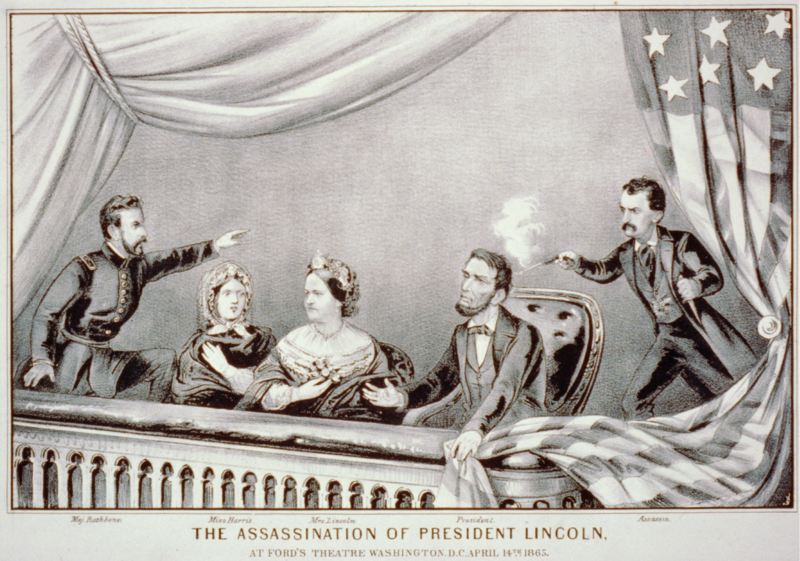 Currier and Ives; Library of Congress Prints and Photographs Division
Next week, the black and gold theater glasses Lincoln is believed to have used the night before his death are going back on the auction block, where experts think they could fetch as much as $700,000.
The glasses are part of a June 17 Sotheby’s auction in New York that will include pricey Civil War items such as a handwritten letter from Robert E. Lee discussing his resignation from the U.S. Army and a flag from the famous Confederate warship CSS Alabama.
08 Wednesday Jun 2011
Posted in Film, Sound, & Photography, Museums
≈ Comments Off on Brady’s Senate
 Senator David Levy Yulee (D-Florida); Brady Studio; Library of Congress Prints and Photographs Division
From Princeton University:
Princeton’s graphic arts collection has acquired a salt print composite of the United States Senate; one of only three known imperial prints of this historic image. To create the print, Brady and his operators photographed each member of the Senate individually, then cut and collaged the photographs and finally, re-photographed the composite.
08 Wednesday Jun 2011
Posted in Uncategorized
As we commence our sesquicentennial retrospection on the Civil War, it is worth remembering that much of the enthusiasm for the anniversary derives from Burns’ film, which first aired on public television just over 20 years ago. Over the course of nine parts and 11 hours, Burns’ camera peers into thousands of ghostly faces and pans across faded images of body-strewn battlefields guided by David McCullough’s stately baritone and Foote’s oracular drawl. All the while, the unmistakable, melancholy strains of the series’ theme, “Ashokan Farewell” ring out—at times, it seems, from the nation’s collective heartstrings. Running on consecutive nights at the height of network television’s new season in the fall of 1990 (when network television’s new season still mattered), the series became an unlikely hit. Some 40 million people chose to forego Cheers, Roseanne, The Wonder Years, and America’s Funniest Home Videos for a PBS documentary featuring nothing more than old photographs, footage of empty battle fields, and talking heads they likely had never heard of.
This Slate piece is somewhat uncharitable but it does serve to remind us to think critically about the war and how we perceive it. Burns’s film succeeds more often than not and despite its flaws the documentary holds up quite well two decades on. Moreover, much of the interest in the Civil War since the early 1990s is attributable to Burns and his work. Not such a bad thing.
 The Strawfoot