
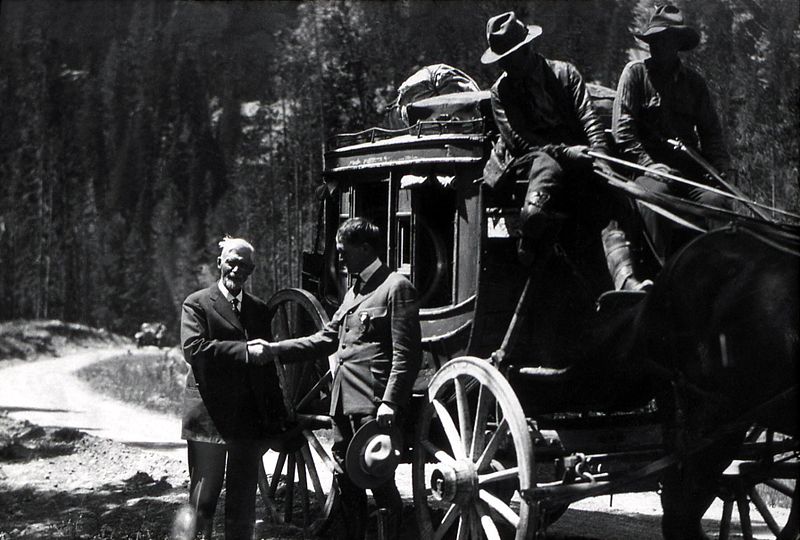
I am halfway through Horace Albright’s The Birth of the National Park Service: The Founding Years, 1913-1933. Albright was Assistant Director of the NPS at its founding and later served as the first superintendent of Yellowstone. In 1929 he replaced Stephen Mather as Park Service director. Each brought his own unique talents to the job and together they created the National Park Service as we know it. Albright published Birth in 1985, two years before he died at the age of 97. He seemed to have been aware since the 1910s that he and his colleagues were making history and he had copious resource material to fall back on when it came time to tell his story. Even better, because he outlived so many of the principals–we are going back here all the way to the Wilson Administration–he does not have to pull punches. He goes into detail of which congressman helped and which impeded the task of creating the various parks and monuments, and the various interests that lined up for and against the various NPS projects. Cattle grazing was a major bone of contention with ranchers whose spreads were adjacent to park lands. Mather and Albright were especially adept at marketing the new Park Service to public officials with political clout and wealthy potential donors such as John D. Rockefeller, Jr. Being early adopters, they were quick to use that new fangled machine the automobile to reach the faraway nooks and crannies of Yosemite, Yellowstone, and elsewhere. I have not gotten there yet, but Albright also into detail about how the Civil War battlefield, previously run by the War Department, came under the auspices of the Park Service through President Roosevelt’s Executive Order 6166 in 1933. Albright stepped down later that same year, but remained active inNPS-related work for the rest of his life, meeting, for instance, with President-elect Eisenhower at the Commodore Hotel in New York City in 1953. Jimmy Carter awarded him the Presidential Medal of Freedom in 1980. So many people think the National Parks, monuments, and other public spaces are “just there,” not realizing the time and forethought it has taken to preserve and protect them. Thankfully Albright took pen to paper near the end of his life to tell us his version of events.
(image/Albright (hat in left hand) at the 50th anniversary of Yellowstone’s founding, 1922)
 The Strawfoot