We showed our film today. I will have more to say in the coming days but for now wanted to share it. Enjoy.

15 Wednesday Nov 2017
Posted in Film, Sound, & Photography, New York City
We showed our film today. I will have more to say in the coming days but for now wanted to share it. Enjoy.
13 Monday Nov 2017
Posted in Film, Sound, & Photography
≈ Comments Off on New Yorkers in Uniform, this Wednesday the 15th
Should one happen to be in New York City this week you are invited to attend the showing of our World War One documentary. The event is being held at New York City College of Technology (CUNY), which is convenient to most public transportation. The program is being held in the Ursula C. Schwerin Library on the 4th floor of the Atrium. The event is free and runs from 1:00-2:30 pm. Lunch will be provided. Please RSVP to the email below or to me here at the Strawfoot.

28 Saturday Oct 2017
Posted in Ernest Hemingway, Film, Sound, & Photography, Great War centennial, Vietnam War, Woodrow Wilson
≈ Comments Off on The Dirty Secret of War
This past week we showed to a class the first cut of our World War One film. For homework the students are now reading a series of excerpts from the Library of America’s World War I and America: Told by the Americans who Lived It. Historian A. Scott Berg, the author of a 2013 biography of Woodrow Wilson, edited the work. For Thursday the students read Hemingway’s “Soldier’s Home,” which appeared originally in Hemingway’s 1925 collection In Our Time. While preparing for the class I came across an essay by Philip Caputo that appeared this month in the online journal Literary Hub. Caputo was a marine who in 1965 landed at Da Nang during Lyndon Johnson’s escalation of American involvement in Vietnam. In 1977 he published his seminal memoir A Rumor of War. That book secured Caputo’s reputation as a writer. Now in his seventies he has written many more works since the publication of Rumor forty years ago. He published a new novel just this year.

Ernest Hemingway in an American Red Cross ambulance, Italy 1918. Though he spent just two weeks at the front, the intensity of the experience influenced Hemingway deeply.
The reason I say all this is because Caputo makes an interesting point in his essay: many of the best war writers actually spent only a small amount of time in combat. The reason these are the writers who write most eloquently about the combat experience, Caputo speculates, is because warfare is just that intense. Endure it too long and it becomes too much a part of you. Caputo uses Ernest Hemingway as the most striking example. For all we associate him with war, Hemingway spent just two weeks on the front lines during the Great War. He graduated high school in June 1917, wrote for the Kansas City Star from that October to April 1918, quit the paper and volunteered for ambulance duty that spring, sailed in May, worked in war torn Paris for much of June, was wounded in Italy on July 8, coalesced in a Milanese hospital for six months, and was home in Oak Park, Illinois by January 1919.
Chronologically the time may have been short, but the intensity of it led to his incredible output over the next decade. A husband and father by the early 1920s, he paid the bills as a foreign correspondent in Europe for the Toronto Star, where among other things he covered the Genoa Conference in 1922; met leaders such as David Lloyd George, Benito Mussolini, and Georges Clemenceau among others; covered the rise of Fascism and Bolshevism; and witnessed the general anomie of European society in the wake of the Great War. In this same decade he published In Our Time (1925), The Sun Also Rises (1926), and A Farewell to Arms (1929), all of which draw to greater or lesser extent on what he witnessed and experienced during his short time in the war zone.
(image/Ernest Hemingway Photograph Collection, JFK Library)
24 Tuesday Oct 2017
Posted in Film, Sound, & Photography, Great War centennial, Historiography, Vietnam War
≈ Comments Off on The Vietnam War: a learnable moment?

Lions led by donkeys? Despite many worthwhile books and public programs in recent years, the conventional understanding of the Great War has remained surprisingly static even during the Great War centennial.
An interesting article appeared in the New York Times a few weeks back about the Ken Burns/Lynn Novick Vietnam War documentary. Its authors, Andrew Wiest and Susannah Ural, wonder if the eighteen hour documentary will be a historiographical turning point in our understanding of the war in Southeast Asia. Or, they continue, will it be the culmination of the narrative we have been telling ourselves for the past four–five decades? The answer to that doesn’t lie with Burns and Novick, who with their colleagues have already done their part by giving us the film. As they themselves have said, the documentary’s ultimate purpose is to ask more question than provide answers.
Wiest and Ural draw an interesting comparison, arguing that the documentary might do for Vietnam what historians did for World War One historiography in the early 1990s. Others are better positioned than I am to make the call, but personally I don’t see the needle as having having moved that much over the past 20-25 years. Yes, some archives have opened up and that sort of thing, but our understanding of the Great War remains much as it has since at least the 1960s. The current narrative is still very much the “lions led by donkeys” story line that has been with us for at least half a century. Perhaps a better comparison for The Vietnam War might be The Sorrow and the Pity, the 1969 documentary that nearly thirty years after the fact led the French to more closely examine their role in the Second World War.
Wars often lead citizens to question their societies, often vehemently. Americans examined their country during and immediately after the Great War, which led Prohibition, Women’s Suffrage, and the New Negro Movement in the 1920s. The same thing happened in different ways in the 1960s and early 1970s. Civil Rights, Women’s Rights, Gay Rights, and much more all came out of the social upheaval. In addition it led to rifts that have yet to heal. So many of our current political and cultural divisions have their roots in the Vietnam War Era. Even militarily there is much that remains to explore regarding the Vietnam War. Time will tell over the next few years if we reach any new consensus on that turbulent period. Wiest and Ural make a strong case that this is the opportune time.
(image by Clara E. Laughlin from Foch: The Man)
13 Friday Oct 2017
Posted in Film, Sound, & Photography
 I have not mentioned it in a while but my friends/colleagues and I are still plugging away on our Great War documentary. We intend to wrap up in the next 7-10 days, after which we will show it two two English classes at my college and at various other venues this fall. Today I met with our editor Tim, who interviewed me for the film and recorded my narration. I mentioned this in the summer but, again, I can’t express how much Tim has brought to the project. He has such professionalism in the technical aspects of the craft and an incredible sense of narrative as well. In addition to being a film editor, he is musician and novelist. We know we have to finish this one first, but as we were wrapping up today we were already talking about potentially working on another project. I hope that comes to pass.
We really think we’re on our way to tell a story about the Great War, contemporary veterans, and New York City all rolled into one. When our film is finally in the can, I will share it here and elsewhere. In the meantime, here are some photos from today’s effort.


30 Sunday Jul 2017
Posted in Film, Sound, & Photography, Great War centennial
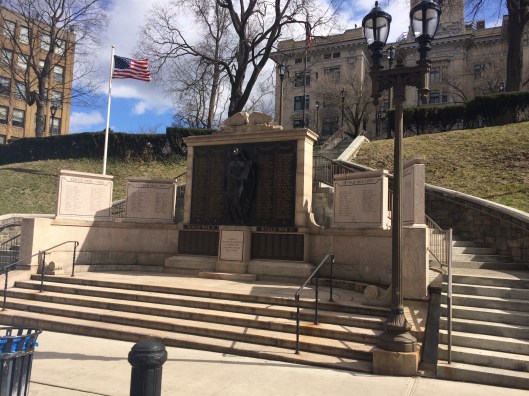
Yonkers, NY war memorial: the main subject of our film came from this town just north of New York City
If it seems like I went silent on the Great War film that I am making in cooperation with colleagues, that is because I did. We hit a snag in the production process in late spring and summer, and have gotten back on track over this past week. This past Thursday I had lunch here in Brooklyn with a friend of a friend. He was already on board with joining the project and we were meeting face-to-face for the first time to discuss it in detail, share audio and video files, and work out timelines. I had never meet him before but we hit it off immediately. He is a real professional, a musician and budding novelist who brings not just strong technical capabilities but an instinctive narrative sense to the film. I told him and others this morning as we were emailing some film-related news that it was destiny that he join the production. We will probably finish the film by Labor Day.
With that timeline in hand I have been planning and reaching out to various individuals about showing it this fall. The film will be 15-25 minutes. When I know more about where and when we will be showing the film, I will let everyone know here. I will also share more about the content itself. In keeping with the guidelines of the grant, all showing will be free and open to the public.
19 Wednesday Jul 2017
Posted in Film, Sound, & Photography, Museums, New York City
≈ Comments Off on Artists of the Sanitary Fair
 I have been off this week and am trying to write 5000 word on my book project. I came across this photograph taken at the 1864 Metropolitan Sanitary Fair and thought I would share it before I sit down for my first wave of writing. I popped a jazz cd into the record player. I find I usually can’t write when music with vocals is playing. Today is Wednesday and thus getaway day for Major League Baseball; so there will be baseball on the radio here in a few hours.
The photograph above comes from a small work, what amounts to a scrapbook, that Matthew Brady published in small quantity in 1864 called Recollections of the Art Exhibition, Metropolitan Fair, New York. Many of the leading artists of the day may various various contributions to the April 1864 Metropolitan Fair, either putting works up for sale or on display where patrons who paid the fundraising entrance fee could see them. It was at the 1864 New York sanitary fair that New Yorkers saw Emanuel Gottlieb Leutze’s “Washington Crossing the Delaware.” What I am trying to do in my book make New York City a more central aspect of the American Civil War.
Unfortunately the artists listed here are not annotated. The one we do know for certain is Brady seated in the center. It was his studio’s photographs after the battle of Antietam, which were shown in his New York studio shortly after the engagement, that brought the war “home” to most New Yorkers, who lined up to see them in fall 1862.
(image/Library of Congress)
22 Wednesday Mar 2017
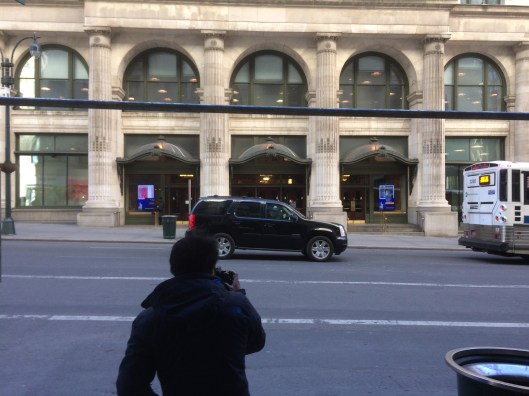
It was colder than I thought it would be when I met a colleague this morning at the CUNY Graduate Center to take some location footage for our WW1 documentary. We shot here for a bit before moving down to 30th Street to get a better angle to film the Empire State Building. I got my masters degree here over a decade ago. One thing that is so unique about the Grad Center is that it has no campus per se, You felt less detached and more connected to the metropolis that was going on just outside while you were sitting there in class. I always found that comforting and felt it gave what I studied more immediacy. People who know Old New York may recognize this building as the site of the B. Altman’s department store. I believe my grandmother took my aunts here when they would visit the city back in the day. I’m sure they followed their excursions with a trip to the Automat.

Back in Brooklyn we filmed some exteriors at our own campus. Again, the school has that urban feel with a strong energy and so much going on all around it. Speaking of our campus, I received the good news today that our library will almost likely receive a significant Great War display from a particular European organization this coming September-October. If it seems like I am being a little vague that’s because I am. I will go into greater detail when things are truly finalized. I cannot tell you how excited we are about this. The Great War is proving a timely opportunity to raise public awareness of this shared history; with various public officials unduly straining our relations with long time allies, it seems up to those interested in public history to remind the public of the historical ties that bind us to others.
03 Friday Mar 2017
Our small group was out again today, this time in Yonkers for the second film shoot in the World War 1 documentary we are making. Today was more about exterior shots than interviews. It was cold with the wind blowing off the Hudson River. As the project moves along I will talk more in depth about our doughboy himself. In the meantime I wanted to share a few images from the day.

Here are a few of us filming in from of the Yonkers City Hall.

Here is another angle. This Great War memorial was dedicated in 1922. I took more still images for eventual submission to the WW1 Memorial Inventory Project.

One of our number has a gift for choosing the best camera spots, in this case a traffic median triangle.

Again another angle. This stretch of road was the site of Memorial and Veterans Day parades for decades. Our doughboy, his five sons, and many of his grandchildren marched along this way.

Gold Star Mothers. This monument was dedicated in 2006 and stands across from the Yonkers train station.

Alas logistics got in the way of taking a group photo of our entire party of six, but here are some of us after we finished up in the afternoon. One can see how cold and windy it was. Still the sun was bright and the snow held off. Overall a fun and productive day. Thanks everyone for help making it happen.
28 Saturday Jan 2017
Posted in Film, Sound, & Photography
≈ Comments Off on The first film shoot
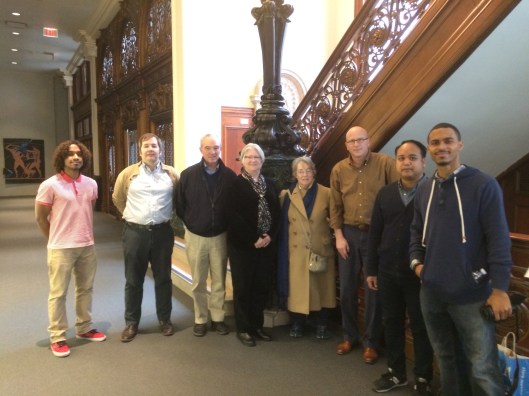
The crew posing after the session
A small group of us, some coming from Connecticut and New Jersey, were at the CUNY Graduate Center this morning for the first of our film shoots to make the WW1 documentary we are producing. We are making a 15-20 minute film in which we interview the family of a World War One doughboy and a veteran of one of our nation’s contemporary campaigns. Our subject today was Thomas Michael Tobin, an extraordinary man from Yonkers who served as a first lieutenant and was stationed at St. Nazaire for more than a year. After the war he was engaged in civic and cultural affairs for decades. He also raised five sons, all of whom went on to make their own contributions, as both soldiers and sailors in WW2 and in their professional careers. This morning we interviewed two of Lieutenant Tobin’s grandchildren on camera and spoke to a third for background. All had many insights on the man’s life and times.

Three of Lieutenant Tobin’s grandchildren
I was a little nervous going in, not knowing if we would be able to pull it off. Still, we had planned it out fairly well beforehand; it is amazing how doing the advanced prep work pays off come time. It helps also to collaborate with talented and insightful people who bring so much to what they do. I can’t tell you how much I enjoyed the session.
 The Strawfoot