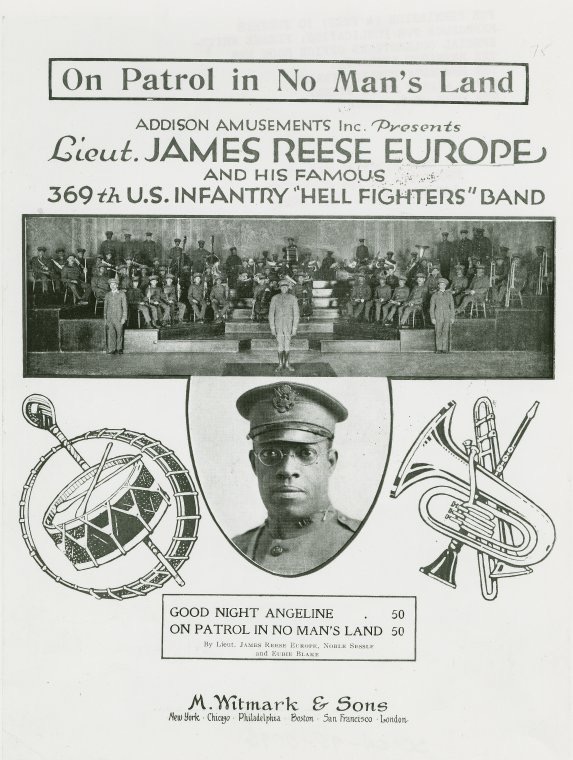
Yesterday was the anniversary of the death of James Reese Europe, the bandleader of the 369th Harlem Hellfighters. His death is an unpleasant story: after surviving the horrors of the Great War he was stabbed backstage in the dressing room at a show in Boston by the drummer in his band. I have always suspected that post traumatic stress disorder played a role in the incident. I am involved in a project regarding Europe and the 369th which, if it comes to fruition, I will discuss here on the blog. Until then, I won’t say too much. Europe’s premature death in May 1919 meant that he was not to be a fixture in the Twenties jazz scene. He very much would have been the equal of Sidney Bechet, King Oliver and even Louis Armstrong.
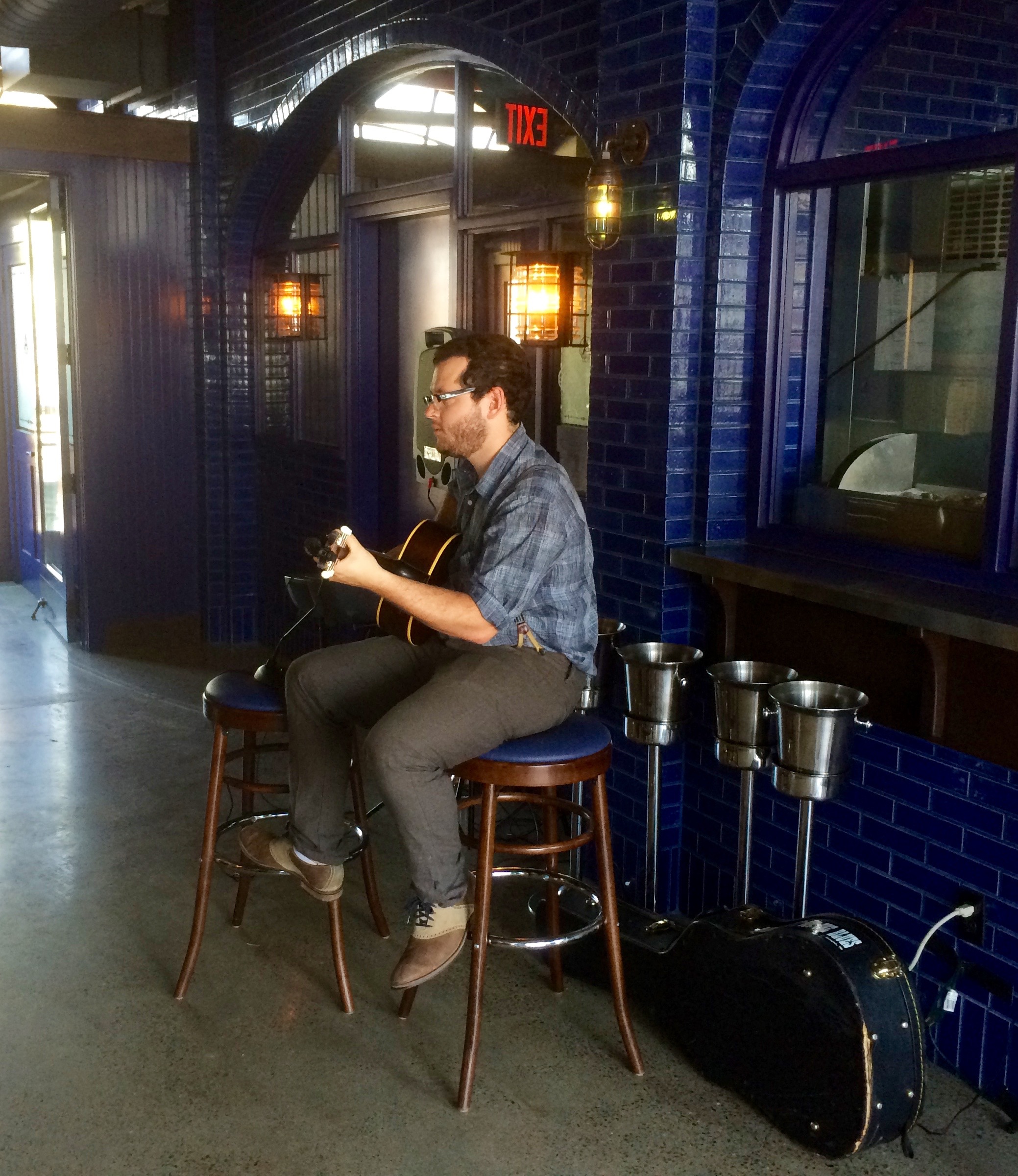
Reese grandson, great-grandson and other descendants were on hand at the Lusitania commemoration last Thursday here in New York. I spoke to them during the reception and can attest that they inherited the charisma and magnetism for which James Europe himself was known. Great grandson Rob is today a bluesman and provided the entertainment at the reception.
I was saddened to read the other day of the passing of Clark Terry. The great trumpeter was ninety-four and had been active well into his 10th decade. Just last fall he was the subject of a documentary, Keep On Keepin’ On. That film captures Mr. Terry mentoring a young protege, a role to which Terry was well suited. He was a mentor to many of the leading jazz figures of the day. Pupils included Quincy Jones and Miles Davis. Terry he had an illustrious career in his own right also. Over the decades he worked with Duke Ellington and Frank Sinatra to name two.
Terry was born in 1920. To put this in perspective: this was one year after the Harlem Hellfighters returned from France. James Reese Europe, the leader of the 369th Regimental Band that had done so much to bring jazz across the Atlantic during the Great War, died just a few months after the Hellfighters returned to the United States. During the Second World War Terry himself would play in a military jazz band, just as Europe and his men had done during the First. Terry went through basic training in Waukegan, Illinois, the site north of Chicago on Lake Michigan reserved for the training of African-American troops. He then played in bands on bases throughout the country.
After the war Terry settled in New York and was part of the jazz scene. He joined what one might call the African-American expatriate community in Corona, Queens. Corona in the 1940s-50s was an enclave of detached houses to which many black musicians moved to enjoy a quieter lifestyle away from the nightclubs of the city. Neighbors included Louis Armstrong, Dizzy Gillespie, Ella Fitzgerald, and saxophonist Cannonball Adderley.
. . . to note that Coleman Hawkins’s rendition of “Body and Soul” turned seventy-five this week.
The Hawk’s version of the song was not the first, but it was the one that literally became the standard. Ten years ago the National Recording Preservation Board of the Library of Congress added “Body and Soul” to the National Recording Registry. Other entrants that year included Hoagy Carmichael’s “Stardust,” Woodrow Wilson’s Armistice Day 1918 broadcast, and Alexander Scourby’s reading of the King James Bible.
No one–not even the Duke himself–was cooler than Bean. Enjoy.
It was a big week for John Coltrane. His son Ravi donated one of his father’s saxophones to the Smithsonian Institution’s National Museum of American History on Wednesday. At the same ceremony photographer Chuck Stewart donated twenty-five previously unseen Coltrane photographs to the Institution. The ceremony kicked off Jazz Appreciation Month. Stewart’s photographs are from the A Love Supreme sessions. Supreme was recorded fifty years ago this December. The saxophone and original score will soon be on display in the “American Stories” exhibition.
A preservation group has been working for a few years now to save the musician’s Huntington, Long Island home. When we think of jazz musicians living in New York City we think Harlem, but really many of them lived in Queens or farther out on the island. Coltrane died in 1967 and is buried in Pinelawn Memorial Park. Pinelawn is one of several cemeteries along a stretch of Long Island. When a friend of mine visits this summer we may go out there to see her grandparents interred there. If/when we do, I am going to try to visit the Coltrane site as well.
I discovered last night that pianist Marian McPartland died in August. Modern audiences will most remember McPartland for her NPR show Piano Jazz, which began broadcasting in 1978 and ran until she was well into her nineties. There was a reason why musicians loved sharing a stage and microphone with Marian; she knew everyone in the jazz world for three quarters of a century and was encyclopedia of knowledge. If you watch her scenes from the 1994 documentary A Great Day in Harlem, about the 1958 Art Kane photograph of the same name, you will see that.
One misconception of her, probably stemming from her intelligence and British accent, is that she was proper and genteel. In reality, Marian was tough as they came and could hold her own in a jazz world much different than the one we know today. It was less institutionalized, a world of dive night clubs, alcoholics, and late hours. People were tougher back in those days, less likely to speak in euphemism. They had, after all, lived through the Depression and the Second World War. Marian was unafraid to call something what it was. If feelings were hurt in the process, so be it.
The best known story of Marian McPartland is an exchange she had with Duke Ellington. Asked his thoughts after a performance, the Duke replied that “You play so many notes.” Initially she took this as a compliment to her technical prowess. Upon later reflection she realized it was an admonishment to curb her excesses. In music, as in life itself, it is what we leave out that often says the most. Thankfully for the rest of us Marian took Ellington’s advice to heart. Here is the proof.
Two of the coolest things out of the 1950s and 60s were Rod Serling and jazz man George Russell. I am not sure what the two have in common with each other–the song does not appear in the episode–but someone in France recently spliced this vignette of Twilight Zone segment “Five Characters in Search of an Exit” to George Russell’s version of “Beast Blues.” Russell played frequently at the Five Spot nightclub, which was on St. Marks Place directly across the street from Cooper Union. Maybe I’m reading too much into it, but I have always loved that the jazz club stood next to where Lincoln gave one of his most famous speeches. “Beast Blues” comes from an album pianist Russell recorded there in 1960; the existentialist “Five Characters” aired on December 22, 1961. TZ sometimes used stock footage (as it did in “Five Characters”) though it did often incorporate original music into its scores. Bernard Herrmann, who scored many of Alfred Hitchcock’s films, wrote much of the TZ music. Again, Russell’s work is not part of the original episode, though they do complement each other effectively. Enjoy.
The Baroness Pannonica de Koenigswarter–French Resistance pilot, Rothschild, patron and muse to Thelonious Monk and other jazz greats–has been in the news a fair amount in the past 4-5 years. Now her great-grandniece has published a biography of the enigmatic great-aunt who was virtually disowned by her family after she moved to New York to better provide emotional and financial sustenance to Monk, Charlie Parker, and a great many musicians of the Bebop Generation. It is important to remember that jazz in postwar America had not yet reached the institutionalized stage it has today. There was no Jazz in July, let alone at Lincoln Center, in 1950s and early 1960s America. A jazz artist then was more likely to be an alcoholic or heroin addict than the college-educated vegetarian many are today. Many aspects of the life were indeed squalid and unseemly–Charlie Parker died on her living room sofa at the age of thirty-four. The only thing worse than what Parker and his acolytes did to themselves is the the realization that it was all self-inflicted, an incredible waste and squandering of human talent. Yet, at their best, the jazz musicians of the time had a wit and worldliness the the Beatniks who clung to them could never in their wildest dreams have penetrated. Many of the Beats mistakenly believed that improvisational jazz meant that the musicians simply stepped on stage, began jamming, and produced what they did. There was an ugly whiff of the myth of the Noble Savage in the whole thing. In reality, these men–and they were mostly men–worked hard on their art, meeting regularly in small, basement apartments across Manhattan, Brooklyn, and Queens and often playing for each other after hours to hone their skills. I intend to read Hannah Rothschild’s book this summer.
The day before Thanksgiving in 2008 I had a dentist appointment in the city and swung by the Hermes store on the Upper East Side afterward to catch Three Wishes: An Intimate Look at Jazz Greats at the boutique’s upstairs gallery. The wealthy baroness used Hermes leather notebooks to mount photographs she had taken of Monk and others. We’re not talking Francis Wolff here. These are not professional photographs but images captured in relaxed and informal moments by a person taking pictures of her friends. The video below that I found is wonderful but does not quite capture the immediacy of seeing the actual, original, photos, which look no different from photos you or I might have taken except for the fact that they depict Miles Davis, John Coltrane, and others. The exhibit was called Three Wishes because the baroness liked to ask people what they would ask for if they could have any three desires fulfilled. Of course I shamelessly ordered the companion volume for the library where I work.
We are looking forward to going to the Jazzmobile at Grant’s Tomb come July and August.
Jazz has been influential beyond America’s borders from its beginnings. I had always known, of course, of the music’s role in Parisian society after the Great War in the 1920s. Later, at the height of the Cold War, Eisenhower’s State Department sent Dizzy Gillespie, Duke Ellington, and others around the world on what turned out to be highly succesful goodwill tours. An underlying theme on these trips was the shared experience of African Americans with people of color in the Third World. Most famously, Louis Armstrong toured Africa in 1957. The highlight was Satchmo’s performance celebrating Ghana’s independence that March. That the Little Rock desegregation crisis was reaching its climax at the same time was not lost on anyone. The wit and sophistication of these artists did much for America’s standing, even–especially–when they chided their country back home for not living up to its ideals.
What I did not know until the Hayfoot brought this to my attention the other was the role of jazz in India going back to the 1930s. The Raj was still going strong during these years but the movement seems to have been influential primarily on desi musicians. My favorite part is when author and narrator Naresh Fernandes mentions the jazz scene in Karachi, which is today in Paksitan due to partition.
Dizzy Gillespie was born on this day in 1917. I have always maintained that, if anything, Gillespie is an under-appreciated figure in the jazz pantheon. His discipline kept Charlie Parker at least somewhat in check, and his mentoring is what helped the young Miles Davis reach his full potential. Gillespie’s wisdom, erudition, and generosity were especially important in the bebop era, when jazz had largely left the dance halls but had not yet been institutionalized as an art form. The temptations of 52nd Street proved too much for too many promising jazzmen. We are fortunate for the measure of stability he brought to the scene, let alone his catalog. Personally I have always been partial to his Afro-Cuban period. In honor of the trumpeter’s birthday the Smithsonian tells us the tale of how it acquired one of the great man’s distinctive instruments.