• About

The Strawfoot

~ a New Yorker's American History blog

The Strawfoot

Category Archives: Theodore Roosevelt Jr (President)

Twas the night before . . .

20 Saturday Dec 2014

Posted by Keith Muchowski in Theodore Roosevelt Jr (President)

≈ 1 Comment

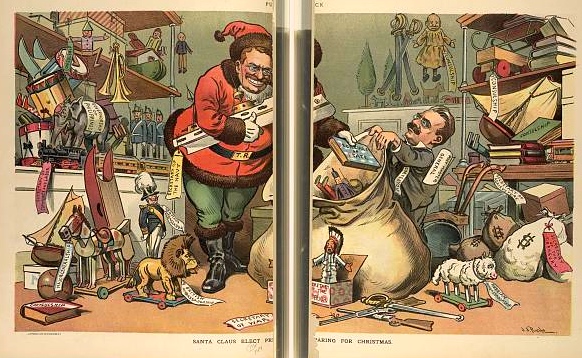
This is Puck magazine’s take on Saint Nick/Theodore Roosevelt preparing for Christmas 1904. It is a curious image. A little context: This was three weeks after he won the 1904 presidential election and four months before the March 1905 inaugural. Roosevelt desperately wanted the legitimacy that came with that election victory because he had ascended to the Executive Mansion as an accidental president after the assassination of McKinley.

Puck, 30 November 1904

Puck, 30 November 1904

(image/Library of Congress)

Decision ’56

04 Thursday Dec 2014

Posted by Keith Muchowski in Franklin Delano Roosevelt, Theodore Roosevelt Jr (President)

≈ Comments Off on Decision ’56

IMG_1748

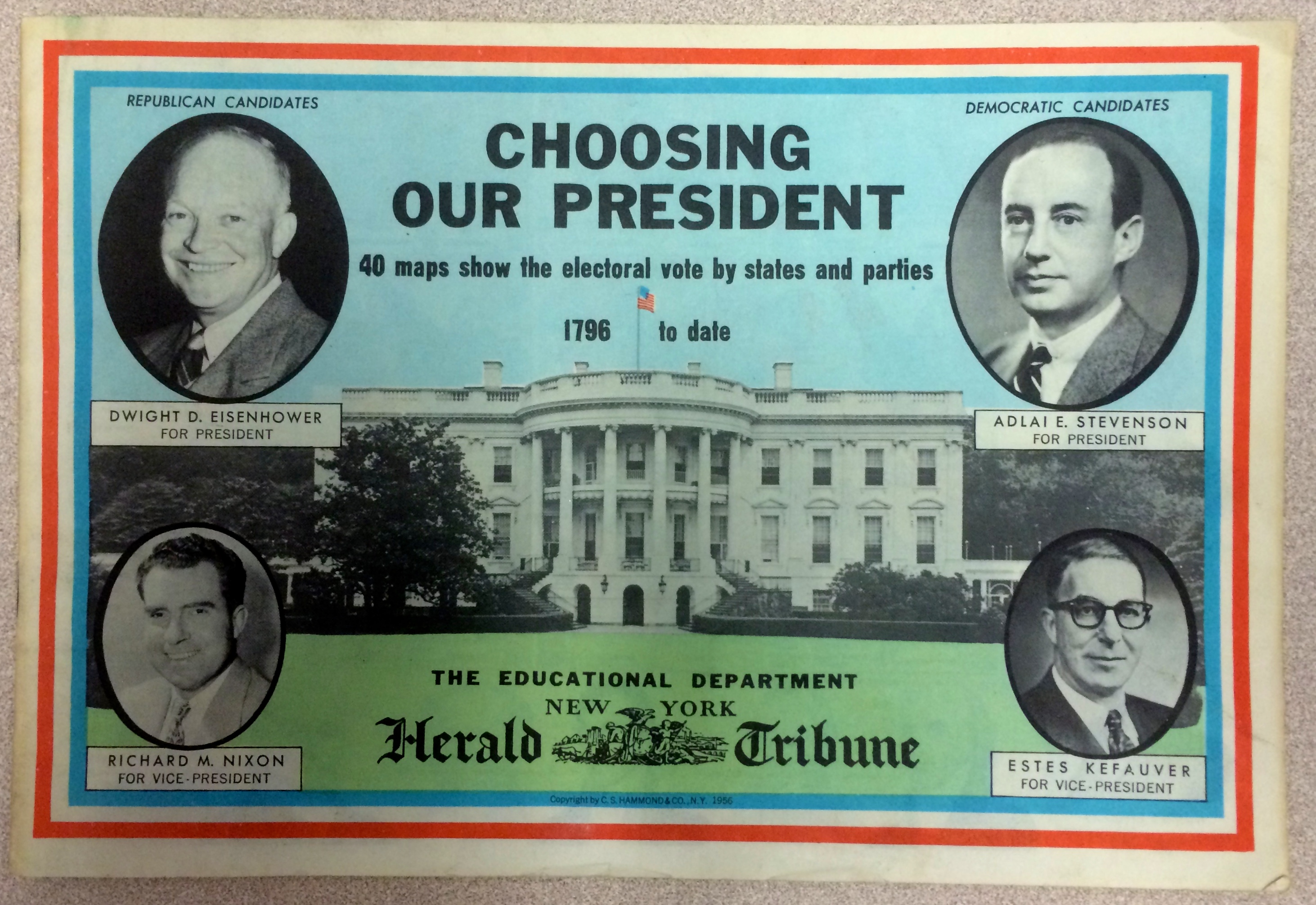
Here is an interesting little piece that fell into my hands yesterday. It is a pullout from the New York Herald Tribune printed for the 1956 presidential election. The pullout is neutral but I would imagine the Herald Tribune itself was for Eisenhower. It was Ike’s favorite newspaper.

IMG_1750

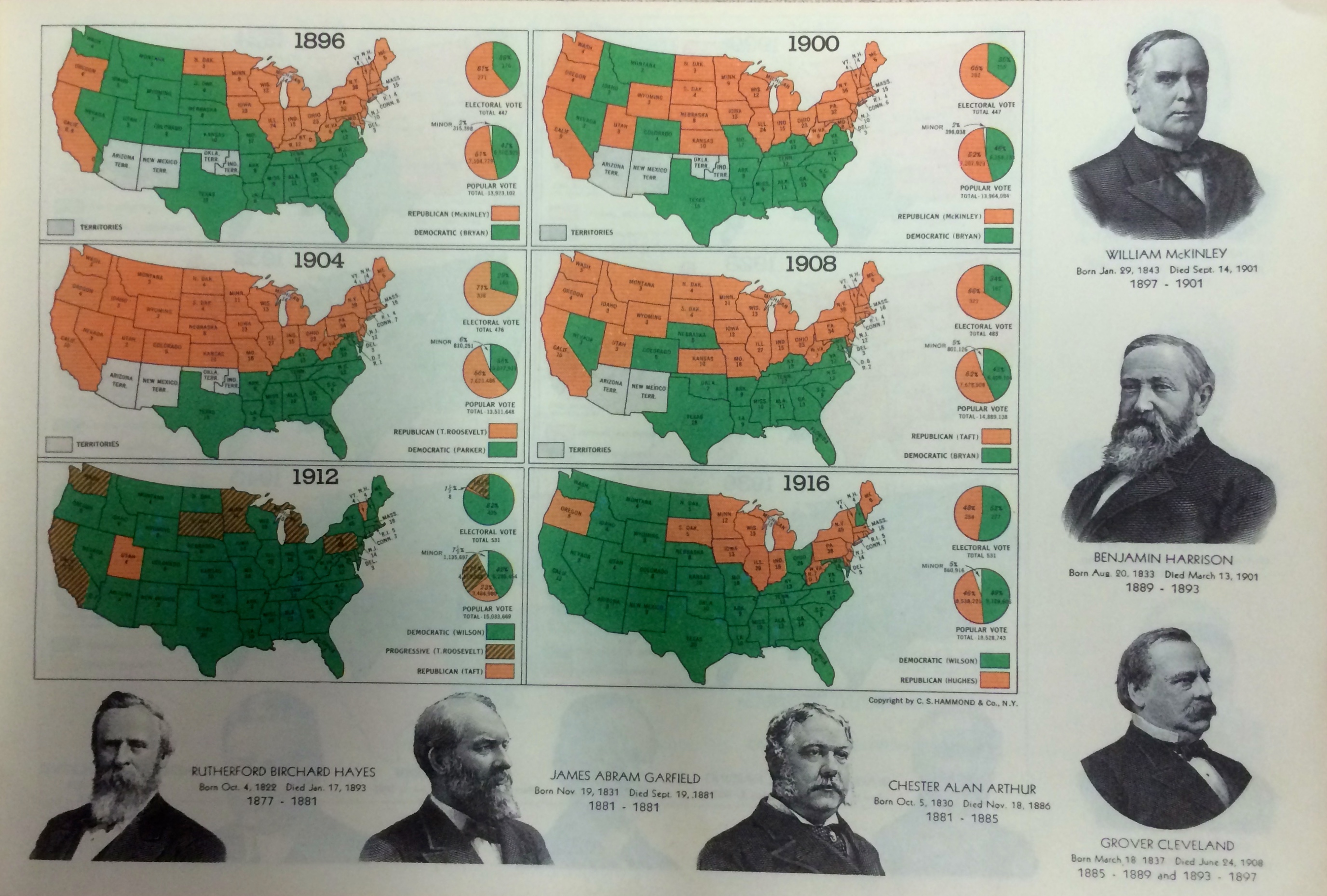
The maps break down each election quite handsomely. Now that we have that thing called the internet we pull up information at the snap of our fingers. It is easy to forget today how difficult it once was to find news and information. Even twenty years ago this was true.

The states are color coded green and orange. Today we say red state/blue state as shorthand for so many things. I wouldn’t belabor the point, but it is worth noting that these designations only entered our vocabulary in recent years.

Note how Theodore Roosevelt’s 1904 victory broke down along regional lines. Also, by 1912 Oklahoma, New Mexico, and Arizona have achieved statehood. The forty-eight contiguous states were now all part of the Union. Geography has so much to teach.

IMG_1754

It is amazing how quickly the party realignment took place. Look at the difference between Herbert Hoover’s 1928 victory and Franklin Roosevelt’s in 1932.

“As goes Maine so goes Vermont.” That’s what Alf Landon said after he lost the 1936 landslide to FDR. Your humble writer is old enough to remember Alf Landon. Really.

You can see how in 1940 Roosevelt lost the strongly isolationist Midwest.

Theodore and Franklin Roosevelt appeared on the national ticket eight time between 1900 and 1944.

They lose a little something in the snapshots I took with my phone camera, but the maps are brilliantly stunning in their simplicity. C.S. Hammond & Co. produced them. Some of the company’s papers are now in the Library of Congress. Again, these were printed on newsprint almost sixty years ago.

IMG_1752

On the back they even gave you a chart to keep track of the election results.


The protean Roosevelt

11 Saturday Oct 2014

Posted by Keith Muchowski in Theodore Roosevelt Jr (President)

≈ Comments Off on The protean Roosevelt

index.php

Staying with the Roosevelt/Joe Wheeler meme just a little longer, I though I would share this newspaper collage that appeared the day after Theodore’s 1905 inaugural. It captures various moments in the life and times of the 26th president. The image in the lower left hand corner depicts the two men in Chattanooga, presumably on the campaign trail in support of Roosevelt’s presidential candidacy. It is interesting on a number of levels. First of all everyone at the time would have understood the symbolism of the former Confederate general traversing the city where, just 41 years earlier, Grant’s forces had taken Missionary Ridge. Also Wheeler was Democrat, as were most white Southerners from the 1860s through the realignment of the 1960s. For him to campaign for and with the sitting Republican president was unusual. Wheeler likely thought of this as a reconciliationist gesture. Chickamauga/Chattanooga was the first of the Civil War national military parks, having been established by Congress in 1895.

(image/NYPL)

From Chickamauga to Governors Island

10 Friday Oct 2014

Posted by Keith Muchowski in Governors Island, Theodore Roosevelt Jr (President)

≈ 2 Comments

Back in July I posted about the construction of the second Y.M.C.A. on Governors Island in 1927. That building still stands, though it is boarded up and would need considerable work to be functional. With so many other wothwhile projects underway in the city-managed portion of the island, I don’t know when or if that would ever happen. As I mentioned in that post, the original Y.M.C.A. had its soft opening in July 1900. The ceremony was understated because those who can get out of Gotham during the dog days of summer do so. In other words, all the big shots were out of town. Well today, October 10, marks the anniversary of the grand opening of that first Governors Island Y.M.C.A.

The original Y–the first ever on a U.S. Army base–was funded by William E. Dodge Jr. No one remembers who he was today, but Dodge was a member of one of the 19th century’s great merchant families. He also co-founded the Allotment Commission with Theodore Roosevelt Sr. during the American CIvil War. It says something about how young Roosevelt was when he died in 1878 that his friends and contemporaries were still going strong at the turn of the 20th century. Dodge said a few words on that October day. So did his son, the President of the Young Men’s Christian Association Cleveland H. Dodge.

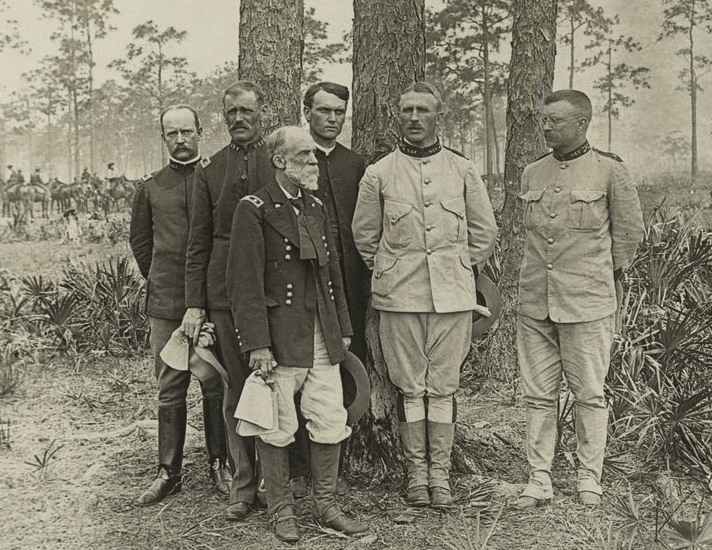
The Rough Riders: General Joseph Wheeler (front), Leonard Wood (second from right), and Theodore Roosevelt Roosevelt (far right). Three years after this photo was taken the former Confederate general would help dedicate the Governors Island Y.M.C.A.

The Rough Riders: General Joseph Wheeler (front), Leonard Wood (second from right), and Theodore Roosevelt Roosevelt (far right). Three years after this photo was taken the former Confederate general would help dedicate the Governors Island Y.M.C.A.

One of the more interesting characters on hand was Joseph Wheeler. Yes, that Joe Wheeler. Wheeler had retired from the regular Army exactly one month earlier, on 10 September. In between his 1859 graduation from West Point he managed to fight as an officer in the Confederate infantry at Shiloh, command the cavalry of the Army of Mississippi, serve eight terms in Congress after the Civil War, and accept William McKinley’s call to service in the Spanish-American War. He fought in the Philippines as well. It was during the Spanish-American War that he came to know Theodore Roosevelt. Roosevelt had risen like a meteor after San Juan Hill and by 1900 he was McKinley’s running mate. The Y.M.C.A.’s ceremony fell in the middle of the 1900 presidential election. Roosevelt was in Indiana castigating Democratic presidential candidate William Jennings Bryan the day of the Y dedication.

It is unfortunate that the original Y.M.C.A. is no longer extant. I am not even certain where it stood–the closest I have gotten to a description is that it stood on the southwest part of the island. That could be anywhere. I have not been able to find any photographs either–and I have looked, believe me. Still, it was just as well that that first Y.M.C.A.–dedicated 114 years ago today–did not last. The Army loved it so much that they outgrew it so quickly. That is why they built the second, bigger and better one in the late 1920s. All told the Y.M.C.A. served its function on Governors Island for over sixty years.

(image/NYPL)

The Amazing Birds of Theodore Roosevelt

03 Wednesday Sep 2014

Posted by Keith Muchowski in Interviews, Theodore Roosevelt Jr (President)

≈ 4 Comments

Over the summer I made the acquaintance of Margaret Porter Griffin. Ms. Griffin taught school for years and recently wrote a biography of Theodore Roosevelt that focuses on his life from ages eight to eighteen. The title tells you the book’s focus: The Amazing Bird Collection of Young Mr. Roosevelt: The Determined Independent Study of a Boy Who Became America’s 26th President. Recently she sat down to answer some questions.

Cover 2The Strawfoot: How did you get interested in Theodore Roosevelt?

Margaret Porter Griffin: I taught about the Rough Riders in fifth grade history class, and the kids loved TR’s personality. Later I read Mornings on Horseback by David McCullough and had to find out more about him.

What, if anything, surprised you the most about him?

Probably the depth of his understanding of international affairs. It began when he was very young, while traveling through Europe with his family. They spent two complete years in Grand Tours before he turned fifteen. No president before or since has had such a firsthand reference for countries, their relationships and the psychology that goes on among them. Hence the “Big Stick” diplomacy. And this was one of the reasons he was able to facilitate the peace treaty between Japan and Russia.

What was the process of writing the book?

I’d had a fellowship several years ago and chose to study TR as a naturalist. One of the end products was to be a book. I wrote a very nice outline which I never used. At first I meant to write about his whole life. Too big. Then I thought I’d write about his whole life as a naturalist. Still too big. I noticed that more than one author commented about his independent learning. As an educator, I knew that the point where a student takes off and reads to learn is massively important. So I concentrated on the influence to his education of his family, his peers, and his driven interest in the natural world. I wrote one chapter, but with the consuming schedule of teaching, didn’t get any more done until I retired two years ago. Then I got to work using all the research I had in boxes. And I’ve developed a pretty good TR library, too.

Your book focuses on Roosevelt between the ages of eight and eighteen. You yourself taught for many years. Did you classroom experience give you any insights into Theodore?

I taught eleven-year-olds for about twenty-five years, and I think it’s a great age for launching into all sorts of things. I could see how Theodore took off in his independent learning with the encouragement of those around him. My experiences provided insights for my students they wouldn’t have normally had. I used him as the subject for town hall meetings – they saw how he overcame physical frailty as a child. They learned about primary sources from sites like the Theodore Roosevelt Birthplace, Sagamore Hill, the Elkhorn Ranch, and the Houghton Library at Harvard.

His mother and father influenced him in different ways. What were they like?

Theodore Roosevelt Sr. was a great man, a moral leader, but also a fun-loving father who entirely enjoyed his children. Martha Bulloch Roosevelt was just beautiful, and her family treated her like a porcelain doll. But she was probably one of the best storytellers south of the Mason-Dixon Line (or north, for that matter), where she was born. A friend who knew the Bulloch family thought TR got his personality from his mother. The period I wrote about was before he lost either of them, and it was a very nurturing time. His immediate and extended family was very important to him as he grew.

The library at the Birthplace is clearly a place where Teedie spent much of his time growing up. What were his biggest intellectual influences as a child? What did he read?

Theodore Sr. brought him books to read, important because he was near-sighted – he could only see things close to him well until he was thirteen and got eyeglasses. As a sick little boy sitting on that red, tasseled chair in the library, he loved learning about Livingstone’s travels in Africa and looking at the exotic animal etchings. He also said more than once that the magazine Our Young Folks was instrumental in his childhood, teaching him more than he learned during college. He had several reference books on birds by Elliott Coues and Spencer Baird, which he pretty much wore out. But like all Victorian youths, he read the classics and a lot of poetry. He loved heroes and wanted to be like them. He said he’d read Plutarch’s Lives a thousand times. (I haven’t read Plutarch’s Lives – have you?). He could remember everything he read, too, for all the years he lived. His father’s friends, including John Hay and the major social reformers in New York City, were also intellectual influences.

487px-Smithsonian_Institution_Archives_-_MNH-28191Tell us about the Osborns.

Theodore’s best friend as a teenager was Frederick Sturges Osborn, who lived on Park Avenue but also in the summers at his family’s country home in Garrison, New York. Fred’s father, William, was head of a railroad; his brother, Henry, later was president of the American Museum of Natural History. Theodore and Fred loved nature and birds and had a club with their friends – they really took themselves seriously. They had a constitution and bylaws, and read reports about their expeditions. Thanks to Theodore’s cousin Emlen Roosevelt’s notes in the Houghton Library at Harvard, we know about this “band of bird-lovers and adventurers,” as Henry called them. They took taxidermy lessons and stuffed their own birds. But Fred tragically drowned in the Hudson River when he was sixteen, and Theodore remembered him fondly in his autobiography. I really, really wanted to find Fred’s letters and notebooks, hoping his family might have saved them. I contacted their descendants, who still live in Garrison, and was able to get pictures and more information, but no notebooks. I did find out that his bird collection was donated to the AMNH like Theodore’s was.

Theodore’s story during his formative years was very much a Victorian tale. In what ways did he embody the era? Was he an anomaly in any way?

The Victorians were always classifying things, especially in the natural world. Theodore had one of the greatest bird collections around. Because of his ambitious and serious nature he seemed eccentric to others, but when they got to know him, they usually loved him.

What should people most know about Theodore Roosevelt?

He “kept his eyes on the stars and his feet on the ground,” as he told others to do.

Are there any ideas for future projects?

I recently started a blog, amazingbirdcollection.wordpress.com, that sorts through topics about TR I’ve come across during the past dozen years. I really like it, because it allows me to rethink some things and present them in a different way (coincidentally, that’s a great way to retain knowledge). I hope more people will understand more about our twenty-sixth president through it. I’ve transcribed 300 letters between my grandparents during World War I, before they were married. He was a captain in the Army and she a teacher in a one-room schoolhouse. The letters are endearing, but at the same time present a picture of life in the early Twentieth Century that I think many will be interested in. I’m going to write a biography of John Joseph Pershing, General of the Armies. He’s one of the people I got off on a tangent studying when I was reading about TR.

The timing for a Pershing biography could not be better with the Great War Centennial underway. I should conclude by noting that teachers can receive the twenty page study guide you have prepared by contacting you through your blog.

(images/the top is the book’s cover and the bottom two whale-headed storks collected in Africa during the Smithsonian-Roosevelt Expedition immediately after he left the White House. Roosevelt had a lifelong interest in nature, especially birds.)

 

Another side of Theodore Roosevelt

01 Monday Sep 2014

Posted by Keith Muchowski in Theodore Roosevelt Jr (President)

≈ 4 Comments

index.php

I am about three quarters through Chip Bishop’s Quentin & Flora: A Roosevelt and a Vanderbilt in Love during the Great War. Mr. Bishop tells the story of Quentin Roosevelt and Flora Payne Whitney, who were secretly engaged prior to Quentin’s embarkation for France during the Great War. The young couple’s relationship ended before it began when the young airman was killed on the Bastille Day 1918. The book is a fascinating read and I will have more to say about it in future posts. What I wanted to share here is something Chip quotes that gives some insights into Theodore Roosevelt one does not ordinarily see. Roosevelt was notedly reluctant to discuss intimacy and yet found himself doing just that in a letter to daughter Ethel. In a letter dated August 21, 1912 Roosevelt writes:

“I have been taking Mother out to row instead of to ride; she is as charming and pretty  (in my eyes I think anyhow) as when she was the slender girl I made love to–and I can’t help making love to her now.”

It is a remarkably candid moment and one can only speculate on why he wrote it. Perhaps it was because Ethel was their only daughter and he felt freer to share such information with her and not his sons. It could be too because Ethel had turned 21 the week before and so he felt he could share this with his now fully adult daughter. Ethel herself would marry less than a year later. Whatever the reason, it is an extraordinarily human moment.

(image/Digital NYPL)


The Panama Canal turns 100

15 Friday Aug 2014

Posted by Keith Muchowski in Theodore Roosevelt Jr (President)

≈ Comments Off on The Panama Canal turns 100

I do not usually cross-post items I have written elsewhere, but a version of this appeared earlier today on the Theodore Roosevelt Birthplace Facebook page. I could not let the 100th anniversary of the opening of the Panama Canal go unnoticed here on The Strawfoot. I have been a bit surprised that there has not been more coverage of this over the past few days. I will have to check the C-SPAN listings to see if maybe there is anything over the weekend. Canals have played a an important and curiously under under underappreciated role in the world’s economic and political development. The Suez, the Erie, China’s Grand Canal. These are hugely significant feats that had, and have, important consequences. I suspect the reason for the lack of appreciation for canals is that visually they are not much to look at. Essentially a canal is a big ditch. The Brooklyn Bridge is something that poets and painters can get excited about. The Soo Locks are not.

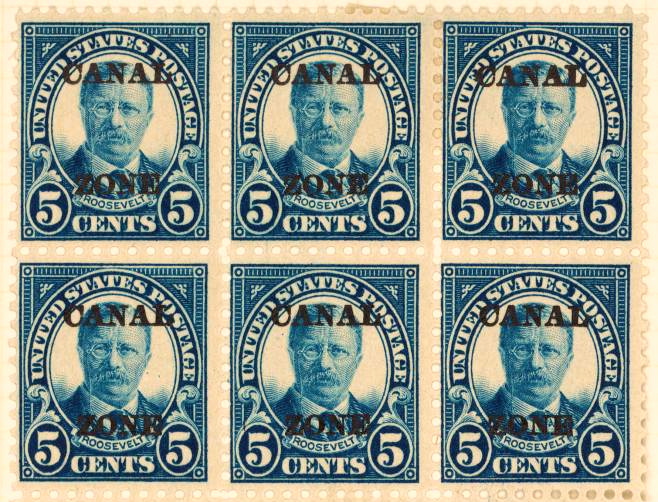
index.phpStill that does lessen the importance of the Panama Canal. This is a monumental day in the life and legacy of Theodore Roosevelt. Indeed, it was an important day in the history of science, engineering, trade, commerce, and more. The canal took so much of Roosevelt’s and John Hay’s diplomatic energies. For years everyone had understood the growing importance of navies and shipping. A canal linking the Atlantic and Pacific Oceans had been a dream for decades. Before the canal it was necessary to sail around the lower tip of South America. The canal cut 8,000 miles off that journey. Another option was to traverse the isthmus by mule, carriage, or on foot. That was as dangerous, even fatal, as it sounds.

The French had tried and failed in the nineteenth century. Construction on the American attempt began in 1903 and took eleven years. Completion of the 77 kilometer (48 mile) passageway could not have come at a better time; the Great War had begun just weeks earlier. Keeping the oceans free and accessible was now easier. I believe the canal’s role in the First World War is ripe for Interpretive possibilities, and I intend to write about it over the Centennial. It was crucial during the Second World War as well. Today the canal is busier than ever and is being expanded.

To say that there were obstacles—political, logistical, and otherwise—would be an understatement. When I worked for the public library I had a Panamanian colleague whose ancestor had worked on the project. One of the biggest problems were the disease carrying mosquitoes that took the lives of the manual laborers. Roosevelt’s visit to the canal’s construction site was the first time a sitting president left the United State. Eight years later all of that had been overcome and Roosevelt’s dream had become a reality. It took all of his skills—and yes even a little political intrigue—to make the whole thing happen. He was not in Panama 100 years ago today, but one can only imagine what he must have been thinking that day.

Cal breaks his silence

12 Tuesday Aug 2014

Posted by Keith Muchowski in Memory, Monuments and Statuary, New York City, Theodore Roosevelt Jr (President)

≈ Comments Off on Cal breaks his silence

The Mount Rushmore groundbreaking was this week in 1927. Construction was completed in October 1941.

The Mount Rushmore groundbreaking was this week in 1927. Construction was completed in October 1941.

In 1927 Al Jolson appeared in The Jazz Singer, Louis Armstrong recorded “Potato Head Blues,” and Babe Ruth and Lou Gehrig combined for 107 home runs. The Great War was over for almost a decade and life was seemingly returning to normal. That August President Calvin Coolidge traveled to South Dakota to speak at the groundbreaking of Mount Rushmore. As if channeling his inner Roosevelt, the staid Coolidge rode up the mountain on horseback. Curiously–perhaps in a nod to recent Franco-American relations?–a choir sang “The Marseillaise” in addition to “The Star Spangled Banner” and other patriotic tunes.

Rushmore literally put Theodore Roosevelt on the same level with Washington, Lincoln, and Jefferson, and the monument was a big win for Roosevelt supporters. The RMA had lost a protracted battle for a Roosevelt memorial on the National Mall just a year earlier. The spot Hermann Hagedorn and others coveted eventually went to the Jefferson Memorial.

Ironically, Mount Rushmore has skewed our perceptions of the 26th president. When many people think “Theodore Roosevelt” they think of the West. Being depicted on a granite slab in the Black Hills will do that. Still it is important to keep in mind that, while Roosevelt spent chunks of time hunting and ranching out West, he was a city slicker first and foremost. Indeed he was the only president born in Manhattan, and it was to New York City and Long Island that he returned over and over across the course of his life.

(image/National Park Service)


The Guns of August

02 Saturday Aug 2014

Posted by Keith Muchowski in Franklin Delano Roosevelt, Theodore Roosevelt Jr (President), WW1

≈ Comments Off on The Guns of August

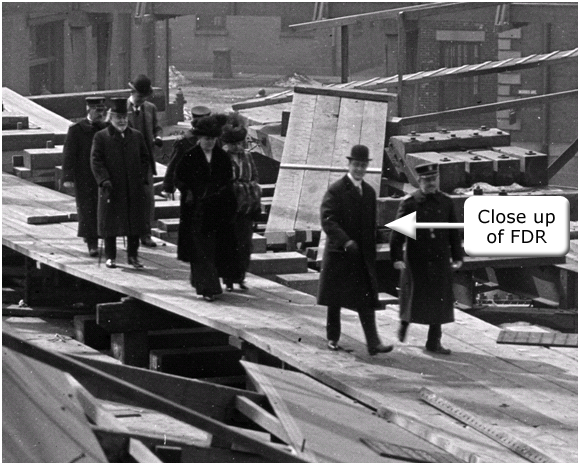
The guns of August began pounding 100 years ago this week as one by one the countries of Europe went to war. The United States would not enter the conflict for almost another three years. Two of the biggest advocates for Preparedness before and during the war were Theodore and Franklin Delano Roosevelt. Both had spent parts of their careers as Assistant Secretaries of the Navy, and Franklin was serving in that capacity when the war began. He was in a difficult spot; as a low ranking member of the Woodrow Wilson Administration he did not have the freedom to speak the way his cousin, and wife’s uncle, did. Still FDR worked indefatigably, in that way the Roosevelts had, to help modernize the U.S. Navy, much as Uncle Ted had organized the Great White Fleet and sent it around the world a few years earlier. Naval power only became more important after the opening of the Panama Canal on August 15, 1914. Throughout the war Franklin also kept Theodore informed of the palace intrigues within the State, War, and Navy Building.

FDR-Brooklyn-Navy-Yard-Close-up

Here is an incredible image from the National Archives of FDR at the laying of the keel of “Number 39,” the ship that would become the USS Arizona. (Learn more about the image’s provenance.) This was in the Brooklyn Navy Yard, March 16, 1914, exactly one full year into his assistant secretaryship. The Arizona began its sea trials in 1916. I don’t know if ironic is the word for it but, in a twist, the Arizona would be sunk at Pearl Harbor in 1941.

Hermann Hagedorn, 1882-1964

27 Sunday Jul 2014

Posted by Keith Muchowski in Historiography, Libraries, Memory, Theodore Roosevelt Birthplace (NPS), Theodore Roosevelt Jr (President), Those we remember, WW1

≈ 2 Comments

Hermann Hagedorn died fifty years ago today. The name may not ring many bells within the general populace. Hagedorn, however, was a towering figure within the world of Theodore Roosevelt memory and historiography. When the Roosevelt Memorial Association was formed weeks after the former president’s death, Hagedorn became the group’s first acting secretary. He eventually became the RMA’s executive director. Hagedorn dedicated a significant portion of his life to the Roosevelt legacy; the RMA formed in 1919 and Hagedorn was still going strong during the Roosevelt Centennial in the late 1950s.

13834Hagedorn met Theodore Roosevelt in 1916 when a small group of supporters were trying to convince him to make one final run at the White House. That of course did not come to pass. The son of a German immigrant, Hagedorn was born in New York City. Though the United States was not yet involved the Great War, the fighting was raging in Europe when Hagedorn and Roosevelt first met. One can see why they were drawn to each other. Roosevelt was advocating for Preparedness while Hagedorn was extolling the virtues of Americanism, especially with the German-American community.

The Men’s and Women’s Roosevelt Memorial Associations were responsible for rebuilding Roosevelt’s boyhood home on East 20th Street. As I often emphasize on tours this was a time before presidential libraries. In addition to the house itself there was, and is, a museum and substantial library on site. Hagedorn claimed in the August 1929 Bulletin of the American Library Association that officials from the New York Public Library had told him that the Theodore Roosevelt Birthplace’s collection was “the most extensive library built around one individual in the United States.” The library indeed includes a substantial collection of books and other materials. It is worth noting that the Birthplace library collected not just photographs but moving imagery as well. This was pioneering stuff in the 1920s.

The RMA and Hagedorn did a lot more than just the Birthplace though. They were responsible for constructing Roosevelt Island in Washington DC and transforming Sagamore Hill into the historic site it is today. These are just a few of their accomplishments.

Hagedorn wrote a number of biographies of Roosevelt written for children and adults. He authored his first Roosevelt biography, The Boys’ Life of Theodore Roosevelt,  in 1918 while the former president was still alive. In the mid 1920s Hagedorn edited Roosevelt’s Complete Works, a substantial undertaking given that Theodore Roosevelt authored over thirty books. Some people believed that Hagedorn became too involved in the Roosevelt legacy and that he sometimes stepped over the line into idolatry. Lewis Mumford and Oswald Garrison Villard were two of Hagedorn’s harshest critics. Hagedorn did sometimes lapse into hagiography but some of the criticism was shrill and unfair.

Hermann Hagedorn accomplished many things in his lifetime. There were plays, poetry, biographies of such figures as Leonard Wood and Albert Schweitzer, and other projects over his long life. Still, he is now most associated with the life and times of Theodore Roosevelt. So much of what Hagedorn did is still here today.

← Older posts
Newer posts →

Enter your email address to subscribe to this blog and receive notifications of new posts by email.

Join 258 other subscribers

Categories

Archives

  • November 2023 (1)
  • October 2023 (3)
  • September 2023 (3)
  • August 2023 (4)
  • July 2023 (7)
  • June 2023 (10)
  • May 2023 (8)
  • April 2023 (6)
  • March 2023 (5)
  • February 2023 (4)
  • January 2023 (4)
  • December 2022 (4)
  • November 2022 (8)
  • October 2022 (2)
  • September 2022 (4)
  • June 2022 (1)
  • May 2022 (1)
  • April 2022 (13)
  • January 2022 (1)
  • December 2021 (2)
  • November 2021 (1)
  • October 2021 (3)
  • September 2021 (3)
  • August 2021 (5)
  • July 2021 (1)
  • June 2021 (1)
  • May 2021 (4)
  • April 2021 (3)
  • March 2021 (4)
  • February 2021 (7)
  • January 2021 (4)
  • December 2020 (4)
  • November 2020 (3)
  • October 2020 (4)
  • September 2020 (7)
  • August 2020 (5)
  • July 2020 (7)
  • June 2020 (11)
  • May 2020 (7)
  • April 2020 (9)
  • March 2020 (9)
  • February 2020 (7)
  • January 2020 (6)
  • December 2019 (7)
  • November 2019 (9)
  • October 2019 (4)
  • September 2019 (6)
  • August 2019 (10)
  • July 2019 (8)
  • June 2019 (6)
  • May 2019 (9)
  • April 2019 (8)
  • March 2019 (6)
  • February 2019 (8)
  • January 2019 (5)
  • December 2018 (10)
  • November 2018 (6)
  • October 2018 (9)
  • September 2018 (11)
  • August 2018 (11)
  • July 2018 (17)
  • June 2018 (10)
  • May 2018 (8)
  • April 2018 (9)
  • March 2018 (8)
  • February 2018 (5)
  • January 2018 (7)
  • December 2017 (11)
  • November 2017 (8)
  • October 2017 (9)
  • September 2017 (11)
  • August 2017 (12)
  • July 2017 (14)
  • June 2017 (18)
  • May 2017 (11)
  • April 2017 (10)
  • March 2017 (9)
  • February 2017 (11)
  • January 2017 (14)
  • December 2016 (7)
  • November 2016 (8)
  • October 2016 (8)
  • September 2016 (9)
  • August 2016 (6)
  • July 2016 (12)
  • June 2016 (8)
  • May 2016 (9)
  • April 2016 (6)
  • March 2016 (12)
  • February 2016 (10)
  • January 2016 (9)
  • December 2015 (9)
  • November 2015 (11)
  • October 2015 (8)
  • September 2015 (9)
  • August 2015 (13)
  • July 2015 (14)
  • June 2015 (11)
  • May 2015 (11)
  • April 2015 (18)
  • March 2015 (10)
  • February 2015 (8)
  • January 2015 (8)
  • December 2014 (12)
  • November 2014 (13)
  • October 2014 (16)
  • September 2014 (11)
  • August 2014 (16)
  • July 2014 (12)
  • June 2014 (13)
  • May 2014 (10)
  • April 2014 (10)
  • March 2014 (11)
  • February 2014 (12)
  • January 2014 (10)
  • December 2013 (11)
  • November 2013 (14)
  • October 2013 (14)
  • September 2013 (14)
  • August 2013 (13)
  • July 2013 (17)
  • June 2013 (9)
  • May 2013 (13)
  • April 2013 (13)
  • March 2013 (16)
  • February 2013 (15)
  • January 2013 (15)
  • December 2012 (18)
  • November 2012 (18)
  • October 2012 (21)
  • September 2012 (14)
  • August 2012 (16)
  • July 2012 (21)
  • June 2012 (22)
  • May 2012 (24)
  • April 2012 (20)
  • March 2012 (23)
  • February 2012 (22)
  • January 2012 (15)
  • December 2011 (23)
  • November 2011 (22)
  • October 2011 (23)
  • September 2011 (18)
  • August 2011 (19)
  • July 2011 (20)
  • June 2011 (29)
  • May 2011 (25)
  • April 2011 (18)
  • March 2011 (21)
  • February 2011 (11)

Meta

  • Create account
  • Log in
  • Entries feed
  • Comments feed
  • WordPress.com
Creative Commons License
This work is licensed under a Creative Commons Attribution-NonCommercial-ShareAlike 4.0 International License.

Enter your email address to subscribe to this blog and receive notifications of new posts by email.

Join 258 other subscribers

Categories

Archives

  • November 2023 (1)
  • October 2023 (3)
  • September 2023 (3)
  • August 2023 (4)
  • July 2023 (7)
  • June 2023 (10)
  • May 2023 (8)
  • April 2023 (6)
  • March 2023 (5)
  • February 2023 (4)
  • January 2023 (4)
  • December 2022 (4)
  • November 2022 (8)
  • October 2022 (2)
  • September 2022 (4)
  • June 2022 (1)
  • May 2022 (1)
  • April 2022 (13)
  • January 2022 (1)
  • December 2021 (2)
  • November 2021 (1)
  • October 2021 (3)
  • September 2021 (3)
  • August 2021 (5)
  • July 2021 (1)
  • June 2021 (1)
  • May 2021 (4)
  • April 2021 (3)
  • March 2021 (4)
  • February 2021 (7)
  • January 2021 (4)
  • December 2020 (4)
  • November 2020 (3)
  • October 2020 (4)
  • September 2020 (7)
  • August 2020 (5)
  • July 2020 (7)
  • June 2020 (11)
  • May 2020 (7)
  • April 2020 (9)
  • March 2020 (9)
  • February 2020 (7)
  • January 2020 (6)
  • December 2019 (7)
  • November 2019 (9)
  • October 2019 (4)
  • September 2019 (6)
  • August 2019 (10)
  • July 2019 (8)
  • June 2019 (6)
  • May 2019 (9)
  • April 2019 (8)
  • March 2019 (6)
  • February 2019 (8)
  • January 2019 (5)
  • December 2018 (10)
  • November 2018 (6)
  • October 2018 (9)
  • September 2018 (11)
  • August 2018 (11)
  • July 2018 (17)
  • June 2018 (10)
  • May 2018 (8)
  • April 2018 (9)
  • March 2018 (8)
  • February 2018 (5)
  • January 2018 (7)
  • December 2017 (11)
  • November 2017 (8)
  • October 2017 (9)
  • September 2017 (11)
  • August 2017 (12)
  • July 2017 (14)
  • June 2017 (18)
  • May 2017 (11)
  • April 2017 (10)
  • March 2017 (9)
  • February 2017 (11)
  • January 2017 (14)
  • December 2016 (7)
  • November 2016 (8)
  • October 2016 (8)
  • September 2016 (9)
  • August 2016 (6)
  • July 2016 (12)
  • June 2016 (8)
  • May 2016 (9)
  • April 2016 (6)
  • March 2016 (12)
  • February 2016 (10)
  • January 2016 (9)
  • December 2015 (9)
  • November 2015 (11)
  • October 2015 (8)
  • September 2015 (9)
  • August 2015 (13)
  • July 2015 (14)
  • June 2015 (11)
  • May 2015 (11)
  • April 2015 (18)
  • March 2015 (10)
  • February 2015 (8)
  • January 2015 (8)
  • December 2014 (12)
  • November 2014 (13)
  • October 2014 (16)
  • September 2014 (11)
  • August 2014 (16)
  • July 2014 (12)
  • June 2014 (13)
  • May 2014 (10)
  • April 2014 (10)
  • March 2014 (11)
  • February 2014 (12)
  • January 2014 (10)
  • December 2013 (11)
  • November 2013 (14)
  • October 2013 (14)
  • September 2013 (14)
  • August 2013 (13)
  • July 2013 (17)
  • June 2013 (9)
  • May 2013 (13)
  • April 2013 (13)
  • March 2013 (16)
  • February 2013 (15)
  • January 2013 (15)
  • December 2012 (18)
  • November 2012 (18)
  • October 2012 (21)
  • September 2012 (14)
  • August 2012 (16)
  • July 2012 (21)
  • June 2012 (22)
  • May 2012 (24)
  • April 2012 (20)
  • March 2012 (23)
  • February 2012 (22)
  • January 2012 (15)
  • December 2011 (23)
  • November 2011 (22)
  • October 2011 (23)
  • September 2011 (18)
  • August 2011 (19)
  • July 2011 (20)
  • June 2011 (29)
  • May 2011 (25)
  • April 2011 (18)
  • March 2011 (21)
  • February 2011 (11)

Meta

  • Create account
  • Log in
  • Entries feed
  • Comments feed
  • WordPress.com
Creative Commons License
This work is licensed under a Creative Commons Attribution-NonCommercial-ShareAlike 4.0 International License.

Enter your email address to subscribe to this blog and receive notifications of new posts by email.

Join 258 other subscribers

Categories

Archives

  • November 2023 (1)
  • October 2023 (3)
  • September 2023 (3)
  • August 2023 (4)
  • July 2023 (7)
  • June 2023 (10)
  • May 2023 (8)
  • April 2023 (6)
  • March 2023 (5)
  • February 2023 (4)
  • January 2023 (4)
  • December 2022 (4)
  • November 2022 (8)
  • October 2022 (2)
  • September 2022 (4)
  • June 2022 (1)
  • May 2022 (1)
  • April 2022 (13)
  • January 2022 (1)
  • December 2021 (2)
  • November 2021 (1)
  • October 2021 (3)
  • September 2021 (3)
  • August 2021 (5)
  • July 2021 (1)
  • June 2021 (1)
  • May 2021 (4)
  • April 2021 (3)
  • March 2021 (4)
  • February 2021 (7)
  • January 2021 (4)
  • December 2020 (4)
  • November 2020 (3)
  • October 2020 (4)
  • September 2020 (7)
  • August 2020 (5)
  • July 2020 (7)
  • June 2020 (11)
  • May 2020 (7)
  • April 2020 (9)
  • March 2020 (9)
  • February 2020 (7)
  • January 2020 (6)
  • December 2019 (7)
  • November 2019 (9)
  • October 2019 (4)
  • September 2019 (6)
  • August 2019 (10)
  • July 2019 (8)
  • June 2019 (6)
  • May 2019 (9)
  • April 2019 (8)
  • March 2019 (6)
  • February 2019 (8)
  • January 2019 (5)
  • December 2018 (10)
  • November 2018 (6)
  • October 2018 (9)
  • September 2018 (11)
  • August 2018 (11)
  • July 2018 (17)
  • June 2018 (10)
  • May 2018 (8)
  • April 2018 (9)
  • March 2018 (8)
  • February 2018 (5)
  • January 2018 (7)
  • December 2017 (11)
  • November 2017 (8)
  • October 2017 (9)
  • September 2017 (11)
  • August 2017 (12)
  • July 2017 (14)
  • June 2017 (18)
  • May 2017 (11)
  • April 2017 (10)
  • March 2017 (9)
  • February 2017 (11)
  • January 2017 (14)
  • December 2016 (7)
  • November 2016 (8)
  • October 2016 (8)
  • September 2016 (9)
  • August 2016 (6)
  • July 2016 (12)
  • June 2016 (8)
  • May 2016 (9)
  • April 2016 (6)
  • March 2016 (12)
  • February 2016 (10)
  • January 2016 (9)
  • December 2015 (9)
  • November 2015 (11)
  • October 2015 (8)
  • September 2015 (9)
  • August 2015 (13)
  • July 2015 (14)
  • June 2015 (11)
  • May 2015 (11)
  • April 2015 (18)
  • March 2015 (10)
  • February 2015 (8)
  • January 2015 (8)
  • December 2014 (12)
  • November 2014 (13)
  • October 2014 (16)
  • September 2014 (11)
  • August 2014 (16)
  • July 2014 (12)
  • June 2014 (13)
  • May 2014 (10)
  • April 2014 (10)
  • March 2014 (11)
  • February 2014 (12)
  • January 2014 (10)
  • December 2013 (11)
  • November 2013 (14)
  • October 2013 (14)
  • September 2013 (14)
  • August 2013 (13)
  • July 2013 (17)
  • June 2013 (9)
  • May 2013 (13)
  • April 2013 (13)
  • March 2013 (16)
  • February 2013 (15)
  • January 2013 (15)
  • December 2012 (18)
  • November 2012 (18)
  • October 2012 (21)
  • September 2012 (14)
  • August 2012 (16)
  • July 2012 (21)
  • June 2012 (22)
  • May 2012 (24)
  • April 2012 (20)
  • March 2012 (23)
  • February 2012 (22)
  • January 2012 (15)
  • December 2011 (23)
  • November 2011 (22)
  • October 2011 (23)
  • September 2011 (18)
  • August 2011 (19)
  • July 2011 (20)
  • June 2011 (29)
  • May 2011 (25)
  • April 2011 (18)
  • March 2011 (21)
  • February 2011 (11)

Meta

  • Create account
  • Log in
  • Entries feed
  • Comments feed
  • WordPress.com
Creative Commons License
This work is licensed under a Creative Commons Attribution-NonCommercial-ShareAlike 4.0 International License.

Blog at WordPress.com.

  • Subscribe Subscribed
    • The Strawfoot
    • Join 229 other subscribers
    • Already have a WordPress.com account? Log in now.
    • The Strawfoot
    • Subscribe Subscribed
    • Sign up
    • Log in
    • Report this content
    • View site in Reader
    • Manage subscriptions
    • Collapse this bar
 

Loading Comments...