
Posted by Keith Muchowski | Filed under Uncategorized

25 Sunday Dec 2016
27 Thursday Oct 2016
Posted in Uncategorized
≈ Comments Off on Grand Army Plaza, 11:00 am
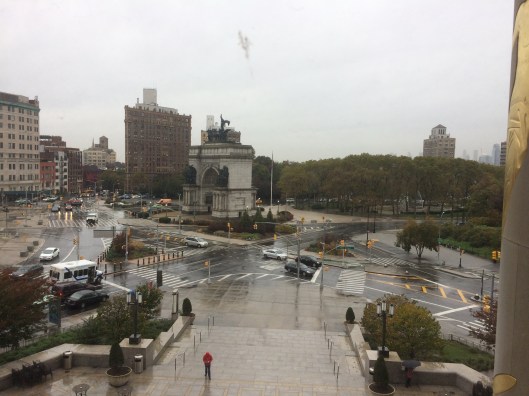 I took this picture from the third floor of the Brooklyn Public Library this morning. It got down to 37 degrees today.
18 Sunday Sep 2016
Posted in Uncategorized
Yesterday’s Doughboy Day at Governors Island National Monument drew over 12,000 visitors, a significant increase over a usual Saturday. Here with some capsule comments are a few images from the day.

The forty-eight star flag went up over Fort Jay to begin the day.

Ryan Hegg of the World War One Centennial Committee for New York City spoke of the significance of the Great War.
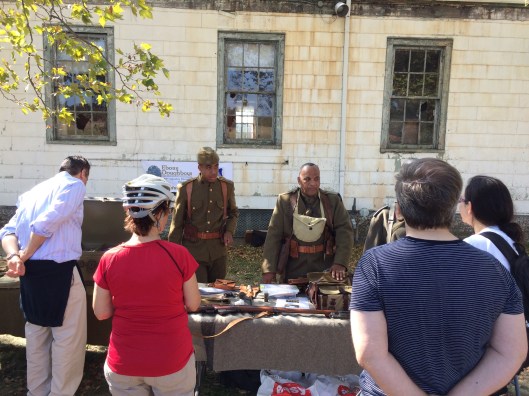
The Ebony Doughboys drew large audiences at venues throughout the island.

George King III and colleague Jeff Klinger spoke to many about Ambulance 255 and the role of the AFS in the war effort.

Neil O’Connor introduced The Lost Battalion and answered questions afterward.

Living doughboy historians of different units marched through the historic district for the closing ceremony.

Meuse-Argonne Point at the northern tip of the island was where several speakers made the closing remarks of the day.
16 Friday Sep 2016
Posted in Uncategorized
≈ Comments Off on D-Day minus 24 hours

The original Ambulance 255 tending the wounded in the Woevre, September 1916. Note the bell on the left, which was used to warn of gas attacks.
While you read these words this Friday morning George King III and his
colleague Jeffrey Klinger are loading George’s ambulance onto a
trailer and heading for Governors Island. It is a circuitous route
that will take the two from Connecticut, through White Plains, NY,
into Manhattan, and finally onto the Governors Island ferry sometime
in mid-afternoon.

George King III and his restored Ambulance 255, Paris 2014
Ambulance 255 is a 1916 Model T Ford ambulance representative of the
1,200 ambulances donated by Americans and driven by U.S. volunteers in
France prior to America’s entry in World War I. This life-saving work
was carried out by the American Field Service. Join the National Park
Service and World War One Centennial Commission tomorrow at Governors
Island National Monument in New York City tomorrow, September 17, when they host Ambulance 255, the Ebony Doughboys, film historian Neil O’Connor and others in a
commemoration of the First World War.
Images: Long journeys are nothing new for George King III and his
restored Ambulance 255. For six months in summer 2014 he and the
ambulance traveled 10,000 miles through France revisiting the places where
the American Field Service performed its life-saving work. See the
ambulance and meet George and Jeff tomorrow.
(images/contemporary image via George King III; historic image courtesy of the Archives of the American Field Service and AFS Intercultural Programs.
http://www.afs.org/archives)
10 Saturday Sep 2016
Posted in Uncategorized
≈ Comments Off on How We Used to Live
I took the afternoon off yesterday to have lunch and hang out with an old friend, an architect who moved away from the city several years ago. Though born here in New York City, his mother is French and he brings a strong strong European perspective to his worldview. We got to talking about The Beatles and how through some force–coincidence?, luck?, divine intervention?–their rise coincided with the transition from Austerity Britain to Swinging London. In the grander scheme of things Britain’s transformation was a process that began in 1914 in the chaos and destruction of the Great War and ended with Britain bankrupt and stripped of its empire in the wake of the Second World War. I often tell my students that history is all around them if they care to look. This morning, relaxing with my coffee, and came across this trailer for a 2013 British film called How We Used to Live, which I had never heard of before.
Enjoy.
26 Sunday Jun 2016
Posted in Uncategorized
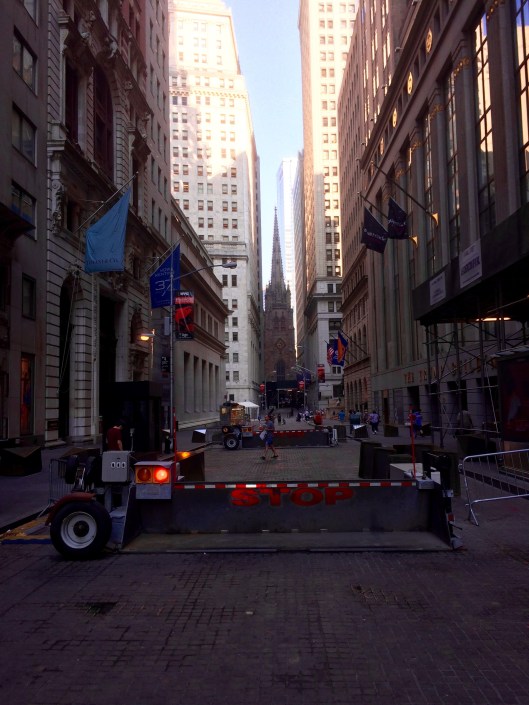 I am in a Starbucks on Lower Broadway getting ready to taking the Governors Island ferry in a few minutes. A few minutes ago I hurriedly took the photo above of Trinity Church as seen from the Wall Street stop of the 2/3 line.
30 Wednesday Mar 2016
Posted in Governors Island, Those we remember, Uncategorized

Frederick W. Seward helped found the Republican Party in New York and lived long enough to see the first nine months of the Great War.
I was home working today. I was writing about the creation of the New York State Republican Party, which formed in Saratoga Springs in August 1854 as a response to the Kansas-Nebraska Act. Young Chester Arthur was one of the delegates. In September 1904 during the heat of the presidential race between Theodore Roosevelt and Alton B. Parker–two New Yorkers–the Republicans held a 50th reunion in Saratoga Springs. TR’s running mate, Charles W. Fairbanks, was one of the speakers in Saratoga at that 50th celebration. Members of John C. Frémont’s family were on hand as well, including his son Major Francis P. Fremont who five years later would be court-martialed for a third time in the waning months of the Roosevelt administration.
What caught my eye when reading the 50th anniversary Proceedings was this photograph of the aging Frederick W. Seward. Frederick was of course the son of William H. Seward. He graduated from Union College a year after Chester Arthur and he too would be at the Saratoga Convention in August 1854. Frederick later worked as Assistant Secretary of State for his father in the Lincoln and Johnson Administrations and served in the same capacity for William Evarts for a time during the Hayes’s years, eventually succeeded by John Hay. Seward thwarted the Booth conspirator who tried to assassinate his father and a half a century later was still around to tell the tale. He helped run the Hudson-Fulton Celebration in 1909, a forgotten event today but which among other things involved Wilbur Wright flying from Governors Island, around the Statue of Liberty, and back.Even more incredibly an article in the Smithsonian Air & Space Magazine informs us that passengers aboard the Lusitania witnessed that feat.
Seward died in April 1915, fifty years after the Civil War’s end and two years prior to American involvement in the First World War.
27 Sunday Mar 2016
Posted in Uncategorized
≈ Comments Off on One family’s Battle of Brooklyn

I hope everyone had a good Easter Sunday. I was walking back from Prospect Park earlier when I came upon this sign in a front yard. I naturally stopped to read it when I noticed that sure enough they had a cannon in their front yard. Note how professional the wayward marker is. In terms of quality and appearance, the battle map looks like something one sees on the Civil War Trust website. My favorite part is the wooden pail, presumably there to imitate a sponge bucket. Color me impressed.

20 Sunday Mar 2016
Posted in Uncategorized

It’s early Sunday morning. I am sitting here for a spell before going in to work to teach a class. The week is going to be a bit of a push but next weekend I’ll be getting a longer weekend taking off Good Friday. If our early spring continues I may go to the New York Botanical Garden. I wrote about 2000 words this week on the Civil War New York book. The goal is to finish the draft in mid-summer. I spent the day with friends yesterday and then came home last night and wrote about 220 words. It’s amazing how when you just sit down and begin the process takes over. I took the above photo around 10:00 last night as I was wrapping up.
02 Wednesday Mar 2016
Posted in Uncategorized
≈ Comments Off on Wilson’s temporary Secretary of War
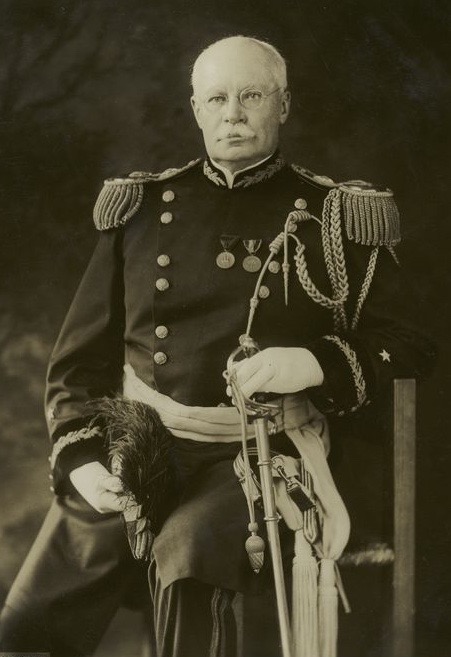
Hugh Lenox Scott (1853-1934) served briefly as both Chief of Staff and interim Secretary of War in the Wilson Administration.
A few weeks back I linked to an article I wrote for Roads to the Great War about the resignation of Secretary of War Lindley Garrison. For most of February into March 1916 President Wilson was without a civilian leader of the U.S. Armed Forces. Filling in as interim Secretary of War was the Chief of Staff, Major General Hugh L. Scott. General Scott was the archetype of a U.S. military officer who came of age in the aftermath of the Civil War. He graduated from West Point in 1876, within weeks of Custer’s defeat at Little Big Horn. It was also America’s Centennial. As a young officer Scott went on to serve in the Indian Wars, in Cuba, and the Philippines. In 1911 he was planning to come to Governors Island for social reasons when he was suddenly sent off to Arizona to settle a dispute with the Hopi Indians, one of the last campaigns between the Army and the Native Americans. It is not surprising the powers-that-be sent Scott. He had long ago acquired a reputation for solving problems through mediation, even becoming an honorary member of several Native American tribes. Scott came of age as a military officer in the age of Secretary of War Elihu Root’s reforms at the turn of the century. Theodore Roosevelt admired him greatly and appointed him Superintendent of West Point in 1906.
Scott was born in Kentucky but grew up in Princeton, New Jersey. That is probably where he came to the attention of Woodrow Wilson, another Southerner who came to make his home in the Garden State. General Scott had replaced William Wallace Wotherspoon as Chief of Staff in November 1914. (Wotherspoon seems to have been an interim choice as Army Chief of Staff while the Wilson Administration decided what to do in the aftermath of Leonard Wood leaving that position seven months earlier and returning to the Department of the East. Scott and Wood got along well.) When Lindley Garrison resigned in February 1916 Hugh Scott filled the breach for several weeks. Wilson liked Scott a great deal but the general’s best attribute at that moment was that he would do what the president wanted. How could he not as a military man serving his commander-in-chief. Still, Scott pushed for better preparedness and made clear that the Army was unprepared for involvement overseas.
When Newton Baker came in as the Secretary of War the second week of March 1916, Scott was left to focus on his military duties. In 1917 he reached mandatory retirement age and was replaced by Tasker Bliss. Still the Army had a place General Scott. He took command at Fort Dix in New Jersey and helped train men to go to France. After the war he accompanied Elihu Root to Russia to inspect conditions during the civil war there.
(image/The Miriam and Ira D. Wallach Division of Art, Prints and Photographs: Photography Collection, The New York Public Library. “Maj.-Gen. Hugh L. Scott, 1853-.” The New York Public Library Digital Collections. 1860 – 1920. http://digitalcollections.nypl.org/items/510d47db-11cf-a3d9-e040-e00a18064a99)
 The Strawfoot