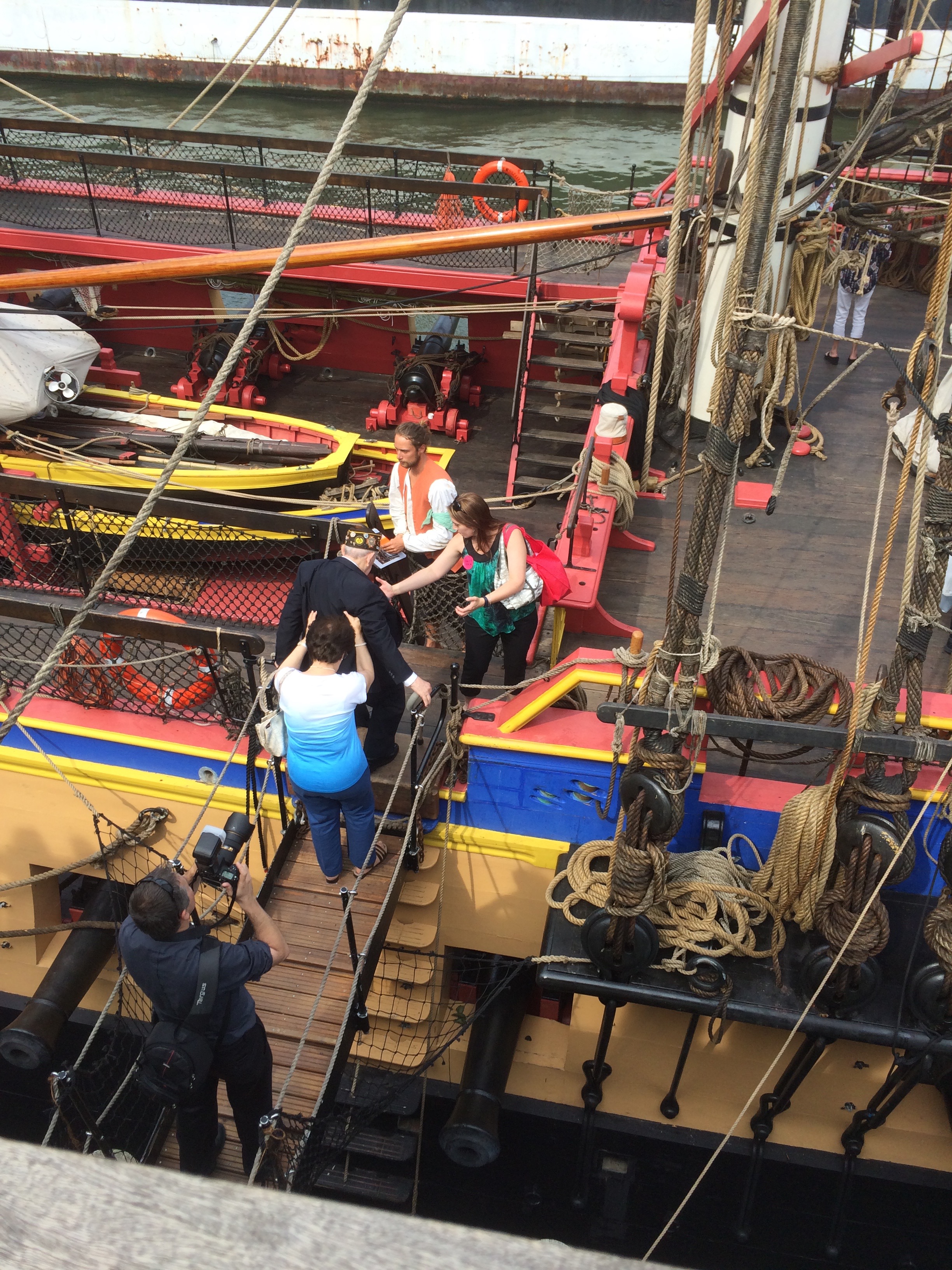
Here and below aging WW2 veterans are escorted onto the Hermione, July 3, 2015. Note the cameraman in the bottom image.
Some readers know of my fascination with aging soldiers. On Friday another volunteer and I conducted an oral history at Governors Island with a former trumpeter in the First Army Band. He told us that in the mid-1950s he and the band gigged in Vermont at a ceremony for a handful of aging Civil War veterans. This was on my mind a few hours later when I was at the South Street Seaport to see the Hermione. There were many things going on for the July 4th weekend, including something for World War II veterans. There is still a ways to go before the WW2 soldiers are finally no more. Generationally they are at the point where Civil War veterans were in the 1920s-30s. There were then still many thousands, which got down to the hundreds, and then finally just a handful over the next 15-20 years. I am too young to remember that, but I do remember a time when soldiers of the Great War were not that uncommon. Seeing these two being escorted onto the Hermione I could not help but wonder who will be the Frank Buckles of the Greatest Generation.
Though as a general rule I don’t post videos created by others, I wanted to share this film that a friend passed along to me. The Fallen of WWII is a breakdown of the 70 million persons killed in that conflict. Neil Halloran is the filmmaker behind the documentary. I read many of the comments and it seems Mr. Halloran sees this very much as an ongoing project, with updates and corrections coming based on viewer input. One thing that seemed ambiguous to me was his statement that the war began on September 1, 1939. A little later though he talks about deaths in Asia caused by the Japanese offensives. Does this mean his numbers don’t include Japanese actions dating back to the early 1930s?
Halloran adds that this could be the first in a series. I would love to see something about the Civil War and WW1 along with a few other conflicts. The film is a little under twenty minutes but it is worth your time. We toss the numbers around too easily. One must never forget the human cost of war.
Danes in Copenhagen read of the end of the Second World War, 8 May 1945
At the reception after the Lusitania ceremony yesterday a few of us got to talking about the anniversary that would take place the following day. Today, 8 May 2015, is the 70th anniversary of the end of the Second World War in Europe: VE Day. After more than thirty years of war and bitter peace, the fighting was finally over.
There were many excellent speakers at yesterday’s program. One of the most poignant was Bernd Reindl, the Consulate General of the Federal Republic of Germany. Mr. Reindl’s eloquent words, even his very presence, were a reminder of how far things have come over the past seven decades. He reminded the audience of the current strength of the Atlantic alliances and how much Europe and the United States share in common. These are lessons and words of comfort that can get lost when one looks at all the strife and crises facing our world today.
Consul Mr. Bernd Reindl speaks at the ceremony in New York remembering the Lusitania, 7 May 2015
(top image/National Museum of Denmark, uploaded by palnatoke; via Wikimedia Commons)
Veterans Day 2014: WW2 Bombardier Herman “Whitey” Lykins going strong at nearly 100
Longtime readers will recognize the two pieces below. The first is from 2011 and the follow-up is from 2012. I was a little surprised the 75th anniversary of the start of the Second World War in Europe did not get more coverage than it did. I guess people were so focused on the Great War 100th. The passing of the WW2 generation is something I am quite conscious of, in part because I was a little too young to remember the passing of the Great War generation in a deep way. Still, they were there. I remember seeing them on television sitting together in the stands at Wimbledon during the Borg, McEnroe, Connors years. They were not yet totally anachronistic but their numbers were dwindling fast. The world became a little smaller when Frank Buckles died in February 2011. And now we are getting there with the Second World War. Anyways, from 2012 and 2011….
I wrote the piece below for the 70th anniversary of the Pearl Harbor attack and am posting it again. As I said last year, I will always remember anniversaries such as December 7, June 6, and May 8 though they no longer resonate in the way they once did. I have been watching Eric Sevareid’s magnificent Between the Wars over the past several days.The sixteen part documentary, produced in 1978, provides a remarkable overview of the 1918-1941 period. What I find most striking is how recent the war, even the lead-up to the war, was as late as the 1970s. (One gets the same impression watching Lawrence Olivier narrate A World at Arms as well.) The Second World War was almost still current events in a way it obviously is not today. The highest leadership had died off by this time, but the majority of the people who fought in the war were now in full blown middle age and in the prime of their careers. Now those people have pretty much died off, or have aged considerably. I couldn’t help but think about this when I learned about the death of Congressman Jack Brooks earlier in the week. Maybe it is my own sense of aging, but I am not sure how I feel about this. Anyways, from Pearl Harbor Day 2011 . . .
Pearl Harbor 2011: the final gathering of the Pearl Harbor Survivors Association
A few years ago the father of a good friend of mine happened to be in the food court of a shopping mall on Memorial Day. This is a man, now in his eighties, who served in the Air Force and later played semi-professional football. He still has his leather cleats. Lou is the essence of Old School. Like shopping mall food courts throughout the country, this one was full of teenagers. Striking up a conversation with the 4-5 at the neighboring table he asked them if they knew what Memorial Day was. After the blank stares, one offered that it was a day off from school. My friend’s dad was not impressed.
When I was in school in the seventies and eighties a visit from a World War 2 vet was a HUGE deal, even in the most cynical of times just after Vietnam. (I graduated high school just a decade after the Fall of Saigon.) One vet recounted today that during a recent school visit a girl asked who Pearl Harbor was and why he was there to talk about her.
I offer these stories not to blame our country’s historical amnesia on young people, but to emphasize the educational crisis we face.
I have written about the significance to me of D-Day and aging veterans before. Personally, Pearl Harbor Day 2011 is the end of something tangible, akin to the 75th anniversary of Gettysburg in July 1938 when aged veterans turned out for one final gathering. President Roosevelt was in attendance; three years after dedicating the Eternal Peace Light Memorial in front of the 1,800 veterans and 150,000 citizens that summer day he would tell the country that December 7 would forever live in infamy. Today in Hawaii the Pearl Harbor Survivors Association held its final gathering. There are just too few Pearl Harbor survivors left seventy years later to justify a seventy-first. There will be more World War 2 anniversaries between today and the commemoration of V-J Day in 2015, but for me they will no longer seem the same. By 2015 there will be fewer WW2 veterans, and those remaining will likely be too infirm to participate in any meaningful fashion. Time moves on. It was ever thus.
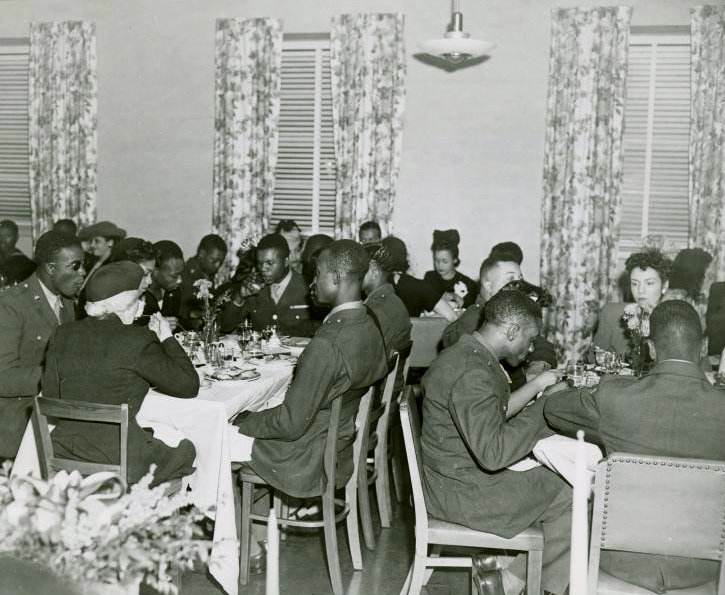
Though unseen in this image Eleanor Roosevelt and Mary McLeod Bethune were on hand to meet these wounded soldiers for Thanksgiving at Howard University’s Lucy D. Slowe Hall, 26 November 1944
It is hard to believe that today is the 70th anniversary of the D-Day invasion. When I was young this was closer to current events than history, even if I did not understand that at the time. I remember meeting so many Normandy veterans in 1994 who were going to France for the 50th. Now twenty years later so many of them are gone. Here is a reprise of something I wrote to mark the occasion in 2011.
I could not let the 67th anniversary of D-Day go unnoticed. When I was younger this was a much bigger deal than it is today. It is only a bit of a stretch to say that I have measured the events of my life according to the anniversaries of the Normandy invasion. In June 1984 I was still in high school, getting ready to start my senior year at the end of the summer. Ten years later I had graduated from college, but was unsettled and still trying to figure out what I wanted to do with my life. By 2004 I had gone to graduate school and moved to New York City. Now I am married and in full middle age.
The arc of D-Day presidential ceremonies, or lack thereof, paints a fascinating portrait of the postwar decades. In 1954 President Eisenhower, the Supreme Allied Commander of the invasion a decade earlier, skipped France altogether and instead vacationed at Camp David. His only public comment was a small proclamation about the Grand Alliance. For the 20th anniversary Ike did record a television special with Walter Cronkite entitled D-Day Plus Twenty Years: Eisenhower Returns to Normandy. The footage of the journalist and the retired president was filmed in August 1963 and is quite moving. On June 6, 1964 Johnson, who had taken office only seven months earlier after the Kennedy assassination, was in New York City speaking to the Ladies Garment Workers Union. In the waning days of Vietnam and the Nixon Administration in 1974 Americans were too tired and cynical to care about World War 2.
Reagan’s address in 1984 remains the most memorable of the anniversaries. At Pointe du Hoc he addressed a sizable audience of veterans still young enough to travel but old enough to appreciate their own mortality. President Clinton’s address on the beaches of Normandy during the 50th anniversary symbolized the passing of the baton from the Greatest Generation to the Baby Boomers. In 2004 current events overshadowed the 60th anniversary and the ceremony painfully underscored tensions in the trans-Atlantic alliance.
Today only one person mentioned it to me. Alas we have reached the tipping point where most of the veterans have either passed on or are too aged and infirm to participate in the observance. In other words it has become part of history. Makes me feel old and a little sad.
≈ Comments Off on The origins of the monuments men
I was at the Metropolitan Museum of Art’s Watson Library doing some research today when I passed this display case.
I did a double-take when I noticed this image of none other than Dwight Eisenhower himself. This is he and Mamie walking down the Met Museum steps familiar to New Yorkers for generations.
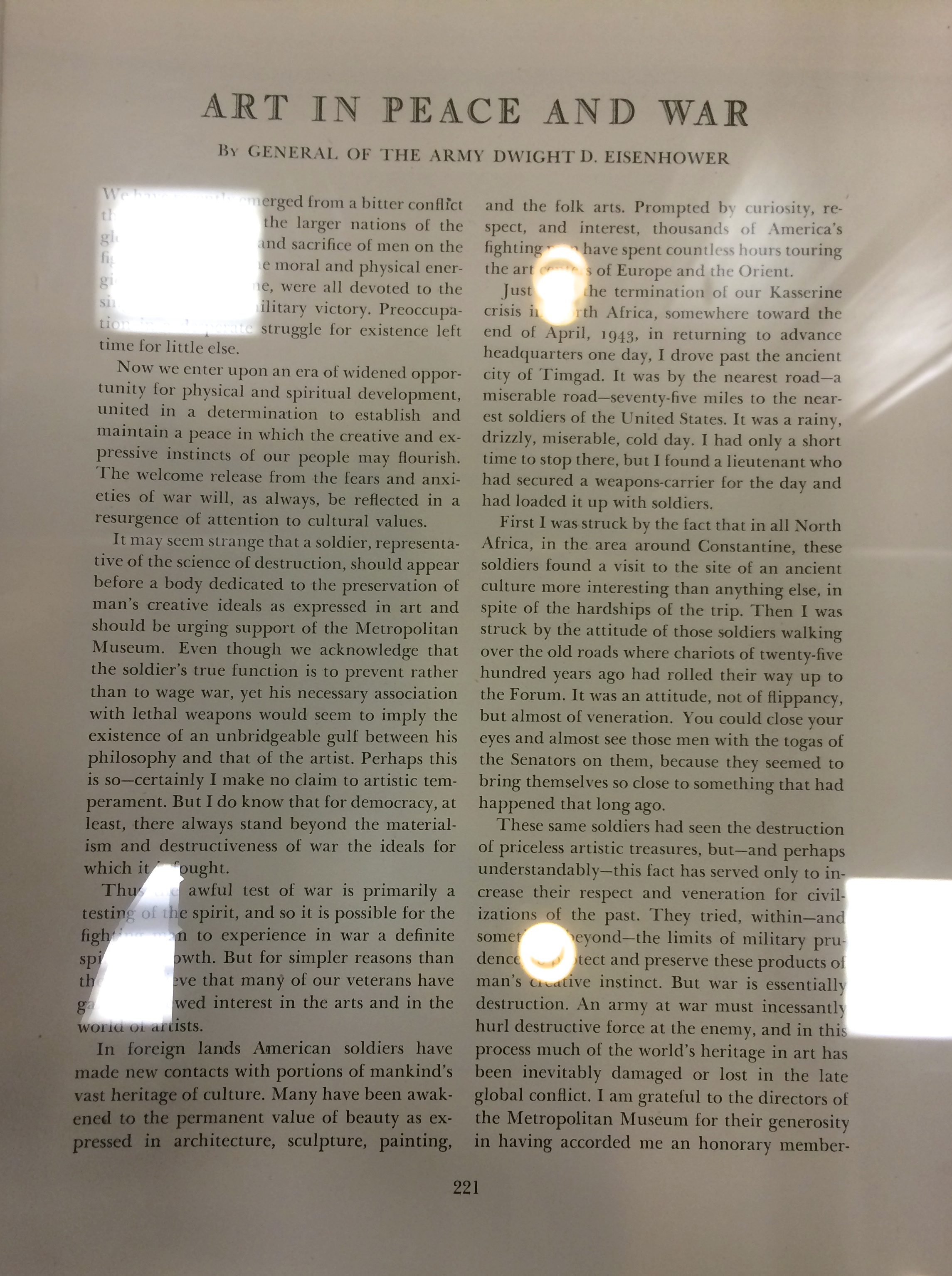
The date was 2 April 1946. That day the Met made Eisenhower an Honorary Fellow for Life for his role in saving European artworks during the Second World War. This is the first page of the address he gave that April day:
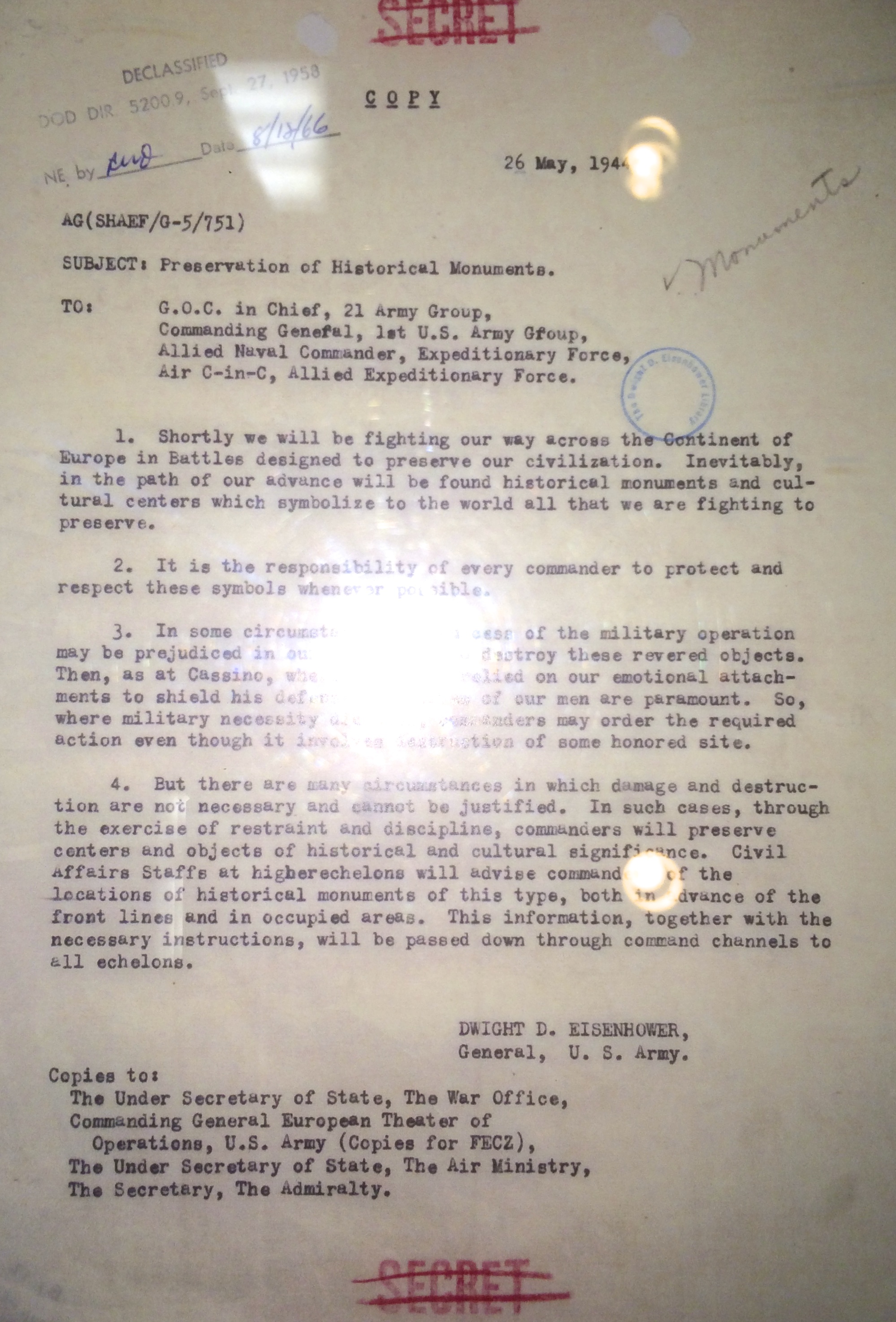
Here is the order he gave in May 1944, just a few weeks before D-Day. It is revealing that he would issue such an order even before the Normandy Invasion. He always said there was no contingency for failure. Thus, there were preparations for saving artworks even before a beachhead had been secured. Think about it.
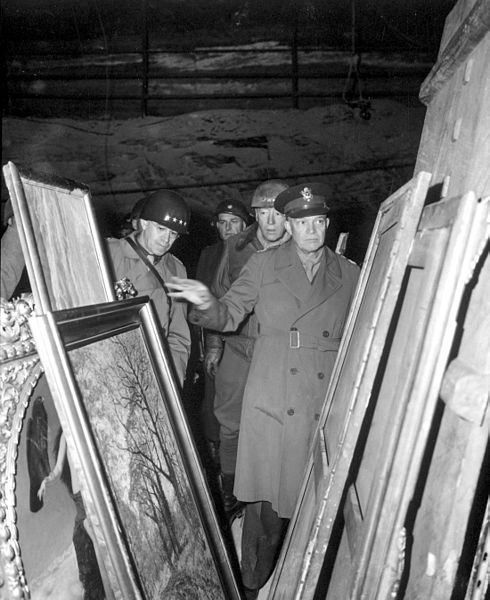
Here are Eisenhower, Patton, and Bradley. The photo was taken by a U.S. Army lieutenant in a German salt mine on 12 April 1945, a month before the war ended and a year before Ike spoke at the Met.
In a nice touch, the museum has a gallery itinerary in which one cane find artworks now in the Met that were saved by the Monuments Men. I had seen a few of these a number of times over the years without knowing their provenance.
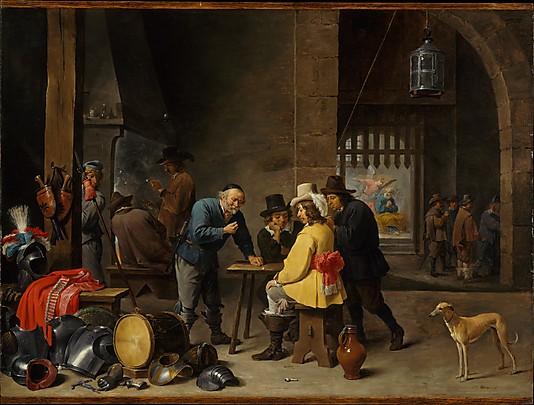
Here is one of those works.
Guardroom with the Deliverance of Saint Peter David Teniers the Younger, ca. 1645–47
The painting was donated to the Met in 1964, half a century ago and only nineteen years after the war’s end.
(images/Ike et al, National Archives; Guardroom, Metropolitan Museum of Art)
I had a productive week on my Hawley biography at the Library of Congress. I wrote some “Roosevelt’s Washington” posts for the Theodore Roosevelt Birthplace Facebook page as well. Now we are relaxing and taking it easy with coffee. It is one of those cold and bright mornings. Later while I am listening to the football games I am going to sort out everything photocopied at the LOC and make some notes and outlines.
A friend sent me a link the other day about the death of Hiroo Onoda. I have written several times about the passing of the WW2 generation. The 70th anniversary of Pearl Harbor marked the end of something for me personally. It seems that the commemorations went from “distant current events” to “history” with that 2011 ceremony.
Hiroo Onoda (standing) and his younger brother Shigeo during the war
For those who may not know, Hiroo Onoda was Second Lieutenant Onoda in the Imperial Japanese Army. He and a handful of others lived for decades in the Philippine jungles refusing to believe that the war had ended. He finally surrendered when in 1974 the authorities flew in his commanding officer to convince him to do so.
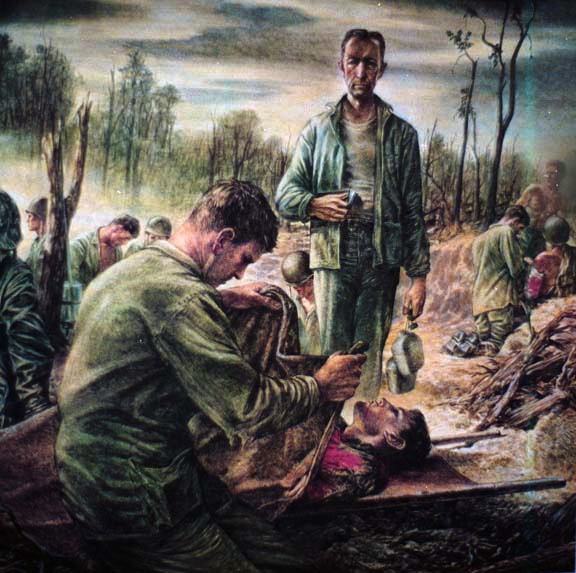
An Army chaplain performs the last rites, Bliliou (Peleliu) Island, 1944
Last summer in a post I mentioned a film called They Drew Fire. That PBS documentary was about the artists who painted and sketched the Second World War as they witnessed it in both Europe and the Pacific. When we think “art” and “war” we think of Winslow Homer, Conrad Wise Chapman, and various others who sketched for Harper’s, Leslie’s Illustrated, or what have you. I suppose that the newsreels and photojournalism one saw in Life magazine, not the paintings and sketches that came from an artist’s hand, are the dominant iconography of the WW2. That the branches of the American Armed Services commissioned dozens of individuals to go forth and record what they saw is a story that has yet to be told fully. What is most incredible is the free rein they had.
Many of the thousands of works these artists produced from 1941-1945 are sitting in a modern storage facility in Fort Belvoir, Virginia, just outside Washington. The photos remind me of the Luce Center storage one sees at the Met Museum, New-York Historical Society, the Brooklyn Museum of Art among other places. The goal is to move them into the National Museum of the United States Army that is currently being built within four years. I am interested to see how this project plays out.








 The Strawfoot