One of the most powerful war documentaries I have seen is the 2000 PBS film They Drew Fire. Good luck trying to watch it. Inexplicably the film is unavailable on Netflix, via streaming Amazon, or in such databases as American History in Video. It seems to have gone out of print, though I do see that there are some dvd copies available via Amazon from second sellers. The film is about the artists commissioned by the U.S. Army to follow the fighting in both Europe and the Pacific. The War Department, and the Roosevelt White House, encouraged these artists to depict war as it really is, naked brutality and all. And that is what they did, drawing, painting, and photographing what they saw from an artist’s perspective. That the images were so horrific is probably why the artworks sat unwanted and unviewed in government warehouses before being found again during the years of the WW2 fiftieth anniversary commemorations in the 90s.
Victor Nels Solander was not one of these artists. He toiled in the 123rd U.S. Naval Construction Battalion on Midway Island through 1944-45. Still, he left us his own testimonials of the war. When off-duty he found the time to paint several large scale murals of what he saw around him. Until earlier this month these murals were still on Midway Atoll, seventy years after the fighting ended, displayed in the movie theater. Now, more people will have the opportunity to see them after they were moved to Honolulu. The U.S. Fish and Wildlife Service oversees the care of the murals and is loaning them longterm to the Pacific Aviation Museum at Pearl Harbor.
WW2 ration book found on commuter train, July 1943
I know I have been at this blogging this awhile now because I am again re-posting this piece about the Normandy landings I wrote in 2011. The passing of the WW2 cohort is a common theme of mine, in part because I am old enough to remember veterans not as infirm geriatrics but as robust, neighbors, teachers, and just general folks you saw everyday without thinking much about. The death earlier this week of Senator Frank Lautenberg only made their passing that much more real. He was the last sitting senator who also served in the war, following the death of Daniel Inouye late last year. (Bob Dole was a WW2 veteran as well, having served in Italy, though he of course left the Senate to run for the White House in 1996. He is still practicing law in DC a month away from his 90th birthday.) I believe we are diminished with no more of these individuals serving in the U.S. Senate. Part of our institutional memory is gone with them.
I was in Grand Central Station earlier today and in their small museum space they had an exhibit of items lost-and-found by a family whose members have served as conductors for four generations over the past century, since Grand Central’s founding in 1913. I could not resist taking the above photo of this ration card that some unfortunate commuter left behind on a train in July 1943.
And, again, from 2011:
I could not let the 67th anniversary of D-Day go unnoticed. When I was younger this was a much bigger deal than it is today. It is only a bit of a stretch to say that I have measured the events of my life according to the anniversaries of the Normandy invasion. In June 1984 I was still in high school, getting ready to start my senior year at the end of the summer. Ten years later I had graduated from college, but was unsettled and still trying to figure out what I wanted to do with my life. By 2004 I had gone to graduate school and moved to New York City. Now I am married and in full middle age.
The arc of D-Day presidential ceremonies, or lack thereof, paints a fascinating portrait of the postwar decades. In 1954 President Eisenhower, the Supreme Allied Commander of the invasion a decade earlier, skipped France altogether and instead vacationed at Camp David. His only public comment was a small proclamation about the Grand Alliance. For the 20th anniversary Ike did record a television special with Walter Cronkite entitled D-Day Plus Twenty Years: Eisenhower Returns to Normandy. The footage of the journalist and the retired president was filmed in August 1963 and is quite moving. On June 6, 1964 Johnson, who had taken office only seven months earlier after the Kennedy assassination, was in New York City speaking to the Ladies Garment Workers Union. In the waning days of Vietnam and the Nixon Administration in 1974 Americans were too tired and cynical to care about World War 2. Reagan’s address in 1984 remains the most memorable of the anniversaries. At Pointe du Hoc he addressed a sizable audience of veterans still young enough to travel but old enough to appreciate their own mortality. President Clinton’s address on the beaches of Normandy during the 50th anniversary symbolized the passing of the baton from the Greatest Generation to the Baby Boomers. In 2004 current events overshadowed the 60th anniversary and the ceremony painfully underscored tensions in the trans-Atlantic alliance.
Today only one person mentioned it to me. Alas we have reached the tipping point where most of the veterans have either passed on or are too aged and infirm to participate in the observance. In other words it has become part of history. Makes me feel old and a little sad.
In October-November 1989 my brother and I took a month long tour of Europe. It was an organized affair with a European-based company in which there were many well-educated and well-travelled people from around the world. We were by far the youngest ones along for the ride, which gave us a sense of gravitas and cachet among the older crowd. People enjoy being around the young. Many of the people from that tour are gone now, which fills me with sadness. The trip started in London, continued by ferry to the Continent, on through Holland, into Germany, Poland, the Soviet Union, FInland, Sweden, and back to Britain. We had the good fortune of seeing the Berlin Wall the week before it came down. I remember getting the news from one of our fellow travelers (no pun intended) that they were tearing it in the lobby of our St. Petersburg hotel. Who could have known just the week before that such events were about to take place?
The most lasting impression of the trip was the ubiquity of the WW2 memorials seemingly present in every town along the way. This was nearly a quarter century ago, and for many WW2 was still as much current events as it was history; the candle laid on a Warsaw street corner to remember a loved one on All Saints Day might have been placed for a sister or father, not some distant ancestor never met. Seeing hundreds of such candles clustered together where some massacre had taken place was something I will never forget. In the Soviet Union memorials to the Great Patriotic War were equally ubiquitous. We saw them in Minsk, Smolensk, Moscow, St. Petersburg, and every other stop along the way. So much has happened in the world between 1989 and today. The Berlin Wall. The end of the Soviet Union in 1991. The 50th anniversary of the Second Word War. The rise of the internet and digital technology. These moments from the late fall of 1989 are embedded in my memory not just because they were turning points in 20th century history–which of course they were–but because they coincided with my own rise to adulthood. It is very much a before and after. We remember most what happens when we were young.
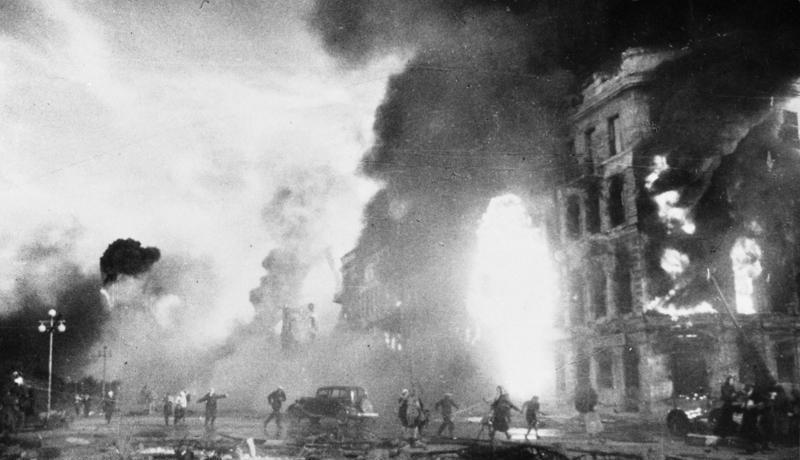
I have mentioned many times that I no longer recognize the anniversaries of Second World War the way I once did because the WW2 generation has all but stepped off the stage. Today the WW2 anniversaries commemorate historical, not current, events, which is not to say there are not many in the world for whom the events of 1939-1945 are not still deeply personal and individual tragedies. That’s something to think about when we throw around phrases like “fifty million people were killed in the war.” February 2 is on of the most meaningful dates of the conflict. Seventy years ago today the Battle of Stalingrad ended after 200 bloody days and two million individuals perished.
I remember having coffee with a friend from work in 2002 just a few days after the death of Stephen Ambrose. Specifically I was defending Ambrose against the plagiarism charges that had been leveled against him in the later years of his life. Like many I was using the Fame Defense, the notion that when Ambrose evolved from an academic to a popular historian he became careless. The plagiarism, in this argument, was a product of this carelessness. I had taken his post-1994 output (the year his D-Day oral history was released) with a grain of salt anyway. I never thought much of the Greatest Generation tribute books and films; Flags of Our Fathers, Saving Private Ryan, etc. were and are roughly akin to the regimental monuments Civil War veterans built in their own later years: celebrations and tributes to a cohort rapidly moving on. I never thought there was anything wrong with such tributes; it is just that one must see them for what they are. And Ambrose for good and ill was the dean of the genre.
Well, the Fame Defense just became considerably more difficult to mount after reading David Frum’s indictment of Ambrose and his scholarship, including his work prior to the fame and fortune he later acquired. Rule # 1: Don’t fabricate interactions with a sitting or retired President of the United States. People are keeping track–and record–of where they are every day. Ambrose is ultimately hoisted on his own petard. Not a happy story, but one that cannot be ignored.
(image by Jim Wallace for the Smithsonian Institution)
Seventy-one Decembers ago, during the German occupation of the British isle of Jersey, soldiers sent Christmas greetings home to their loved ones. This week the cards are being delivered.
Pearl Harbor 2011, the final gathering of the Pearl Harbor Survivors Association
I wrote the piece below for the 70th anniversary of the Pearl Harbor attack and am posting it again. As I said last year, I will always remember anniversaries such as December 7, June 6, and May 8 though they no longer resonate in the way they once did. I have been watching Eric Sevareid’s magnificent Between the Wars over the past several days.The sixteen part documentary, produced in 1978, provides a remarkable overview of the 1918-1941 period. What I find most striking is how recent the war, even the lead-up to the war, was as late as the 1970s. (One gets the same impression watching Lawrence Olivier narrate A World at Arms as well.) The Second World War was almost still current events in a way it obviously is not today. The highest leadership had died off by this time, but the majority of the people who fought in the war were now in full blown middle age and in the prime of their careers. Now those people have pretty much died off, or have aged considerably. I couldn’t help but think about this when I learned about the death of Congressman Jack Brooks earlier in the week. Maybe it is my own sense of aging, but I am not sure how I feel about this. Anyways, from Pearl Harbor Day 2011 . . .
A few years ago the father of a good friend of mine happened to be in the food court of a shopping mall on Memorial Day. This is a man, now in his eighties, who served in the Air Force and later played semi-professional football. He still has his leather cleats. Lou is the essence of Old School. Like shopping mall food courts throughout the country, this one was full of teenagers. Striking up a conversation with the 4-5 at the neighboring table he asked them if they knew what Memorial Day was. After the blank stares, one offered that it was a day off from school. My friend’s dad was not impressed.
When I was in school in the seventies and eighties a visit from a World War 2 vet was a HUGE deal, even in the most cynical of times just after Vietnam. (I graduated high school just a decade after the Fall of Saigon.) One vet recounted today that during a recent school visit a girl asked who Pearl Harbor was and why he was there to talk about her.
I offer these stories not to blame our country’s historical amnesia on young people, but to emphasize the educational crisis we face.
I have written about the significance to me of D-Day and aging veterans before. Personally, Pearl Harbor Day 2011 is the end of something tangible, akin to the 75th anniversary of Gettysburg in July 1938 when aged veterans turned out for one final gathering. President Roosevelt was in attendance; three years after dedicating the Eternal Peace Light Memorial in front of the 1,800 veterans and 150,000 citizens that summer day he would tell the country that December 7 would forever live in infamy. Today in Hawaii the Pearl Harbor Survivors Association held its final gathering. There are just too few Pearl Harbor survivors left seventy years later to justify a seventy-first. There will be more World War 2 anniversaries between today and the commemoration of V-J Day in 2015, but for me they will no longer seem the same. By 2015 there will be fewer WW2 veterans, and those remaining will likely be too infirm to participate in any meaningful fashion. Time moves on. It was ever thus.
Today is the 68th anniversary of the Normandy Invasion. To mark the occasion I am re-posting this piece from last year:
I could not let the 67th anniversary of D-Day go unnoticed. When I was younger this was a much bigger deal than it is today. It is only a bit of a stretch to say that I have measured the events of my life according to the anniversaries of the Normandy invasion. In June 1984 I was still in high school, getting ready to start my senior year at the end of the summer. Ten years later I had graduated from college, but was unsettled and still trying to figure out what I wanted to do with my life. By 2004 I had gone to graduate school and moved to New York City. Now I am married and in full middle age.
The arc of D-Day presidential ceremonies, or lack thereof, paints a fascinating portrait of the postwar decades. In 1954 President Eisenhower, the Supreme Allied Commander of the invasion a decade earlier, skipped France altogether and instead vacationed at Camp David. His only public comment was a small proclamation about the Grand Alliance. For the 20th anniversary Ike did record a television special with Walter Cronkite entitled D-Day Plus Twenty Years: Eisenhower Returns to Normandy. The footage of the journalist and the retired president was filmed in August 1963 and is quite moving. On June 6, 1964 Johnson, who had taken office only seven months earlier after the Kennedy assassination, was in New York City speaking to the Ladies Garment Workers Union. In the waning days of Vietnam and the Nixon Administration in 1974 Americans were too tired and cynical to care about World War 2. Reagan’s address in 1984 remains the most memorable of the anniversaries. At Pointe du Hoc he addressed a sizable audience of veterans still young enough to travel but old enough to appreciate their own mortality. President Clinton’s address on the beaches of Normandy during the 50th anniversary symbolized the passing of the baton from the Greatest Generation to the Baby Boomers. In 2004 current events overshadowed the 60th anniversary and the ceremony painfully underscored tensions in the trans-Atlantic alliance.
Today only one person mentioned it to me. Alas we have reached the tipping point where most of the veterans have either passed on or are too aged and infirm to participate in the observance. In other words it has become part of history. Makes me feel old and a little sad.
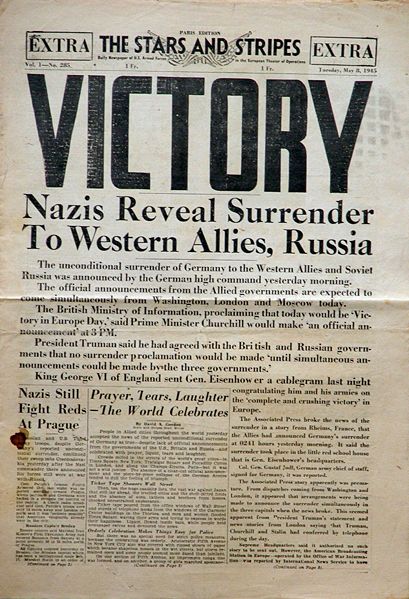
Tomorrow, May 8, is V-E Day. Or today is, depending on how you choose to do the math. I am old enough to remember when V-E Day was still a fairly big deal. Even in the early 1990s, long after I had reached full adulthood, the anniversary of the German surrender was duly noted. No one mentioned it to me today, and I am not betting on it for tomorrow either. What can you say? The world moves on. I mentioned last year on December 7th that Pearl Harbor Day 2011 was the last WW2 anniversary I would mark the way I once did.
The reason for confusion over the official ending of the war in Europe has its roots in the earliest stages of the Cold War. The Germans surrendered to the Americans on May 7th, but Stalin wanted to wait another day to make it official with his own ceremony. American and British reporters were sworn to silence, and so everyone waited. The plan was foiled when the Germans announced over the radio that they had indeed capitulated. After they did so, Ed Kennedy of the Associated Press realized the hoodwink for what it was and told the world what leaders in Washington, London, Berlin, and Moscow already knew. For his troubles he was unceremoniously fired.
I was having a conversation about this affair with someone the other day, trying to figure out why the Allies, especially the U.S., felt so beholden to Stalin. My theory is that Roosevelt never fully understood who and what Stalin was, and believed he could use his considerable personal skills to “handle” the Russian leader. Roosevelt was dead by May, however, and that does not explain all the kowtowing coming from his replacement. My speculation here is that the Truman Administration felt they owed the Soviets for their considerable contribution to victory, not to mention that they easily could have gotten back in their T-34s and rolled all the way through Western Europe if they had chosen. It all may or may not have been necessary but it was certainly a tragedy.
Kennedy’s posthumous memoir has just been released. It includes an introduction and apology from the current AP president and CEO.
A few years ago the father of a good friend of mine happened to be in the food court of a shopping mall on Memorial Day. This is a man, now in his eighties, who served in the Air Force and later played semi-professional football. He still has his leather cleats. Lou is the essence of Old School. Like shopping mall food courts throughout the country, this one was full of teenagers. Striking up a conversation with the 4-5 at the neighboring table he asked them if they knew what Memorial Day was. After the blank stares, one offered that it was a day off from school. My friend’s dad was not impressed.
When I was in school in the seventies and eighties a visit from a World War 2 vet was a HUGE deal, even in the most cynical of times just after Vietnam. (I graduated high school just a decade after the Fall of Saigon.) One vet recounted today that during a recent school visit a girl asked who Pearl Harbor was and why he was there to talk about her.
I offer these stories not to blame our country’s historical amnesia on young people, but to emphasize the educational crisis we face.
I have written about the significance to me of D-Day and aging veterans before. Personally, Pearl Harbor Day 2011 is the end of something tangible, akin to the 75th anniversary of Gettysburg in July 1938 when aged veterans turned out for one final gathering. President Roosevelt was in attendance; three years after dedicating the Eternal Peace Light Memorial in front of the 1,800 veterans and 150,000 citizens that summer day he would tell the country that December 7 would forever live in infamy. Today in Hawaii the Pearl Harbor Survivors Association held its final gathering. There are just too few Pearl Harbor survivors left seventy years later to justify a seventy-first. There will be more World War 2 anniversaries between today and the commemoration of V-J Day in 2015, but for me they will no longer seem the same. By 2015 there will be fewer WW2 veterans, and those remaining will likely be too infirm to participate in any meaningful fashion. Time moves on. It was ever thus.
I could not let the 67th anniversary of D-Day go unnoticed. When I was younger this was a much bigger deal than it is today. It is only a bit of a stretch to say that I have measured the events of my life according to the anniversaries of the Normandy invasion. In June 1984 I was still in high school, getting ready to start my senior year at the end of the summer. Ten years later I had graduated from college, but was unsettled and still trying to figure out what I wanted to do with my life. By 2004 I had gone to graduate school and moved to New York City. Now I am married and in full middle age.
The arc of D-Day presidential ceremonies, or lack thereof, paints a fascinating portrait of the postwar decades. In 1954 President Eisenhower, the Supreme Allied Commander of the invasion a decade earlier, skipped France altogether and instead vacationed at Camp David. His only public comment was a small proclamation about the Grand Alliance. For the 20th anniversary Ike did record a television special with Walter Cronkite entitled D-Day Plus Twenty Years: Eisenhower Returns to Normandy. The footage of the journalist and the retired president was filmed in August 1963 and is quite moving. On June 6, 1964 Johnson, who had taken office only seven months earlier after the Kennedy assassination, was in New York City speaking to the Ladies Garment Workers Union. In the waning days of Vietnam and the Nixon Administration in 1974 Americans were too tired and cynical to care about World War 2. Reagan’s address in 1984 remains the most memorable of the anniversaries. At Pointe du Hoc he addressed a sizable audience of veterans still young enough to travel but old enough to appreciate their own mortality. President Clinton’s address on the beaches of Normandy during the 50th anniversary symbolized the passing of the baton from the Greatest Generation to the Baby Boomers. In 2004 current events overshadowed the 60th anniversary and the ceremony painfully underscored tensions in the trans-Atlantic alliance.
Today only one person mentioned it to me. Alas we have reached the tipping point where most of the veterans have either passed on or are too aged and infirm to participate in the observance. In other words it has become part of history. Makes me feel old and a little sad.




 The Strawfoot