The Women’s Central turns 160

The founding of the Women’s Central Association of Relief, Cooper Institute, April 29, 1861

Some may or may not know that I am working on a book manuscript about Civil War Era New York City in which Theodore Roosevelt Sr., Frederick Law Olmsted, Louisa Lee Schuyler and a few others are the leading figures. Today is the 160th anniversary of one of the monumental moments in the American Civil War: it was on April 29, 1861 that approximately 3000 people turned out at the Cooper Institute to found the Women’s Central Association of Relief. Louisa Lee Schuyler was selected to run the day-to-day operations of the Women’s Central and did so with great efficiency during her tenure during the war.

Changing the subject a bit: I have noted over the past several weeks the anniversary dates of many Civil War moments, not least Sumter, Appomattox, and the Lincoln assassination. It’s difficult to imagine that the sesquicentennial began ten years ago this month. So much has happened over the past decade in terms of scholarship and current events that have changed our perceptions and memory of the war. It seems the war’s consequences and legacy are the main issues in the current narrative. This will continue as we recognize the anniversaries of events related to Reconstruction in the coming years, not to mention that 2022 will be the 200th anniversary of Ulysses S. Grant’s birth.

(image/Library of Congress)
Sunday morning coffee

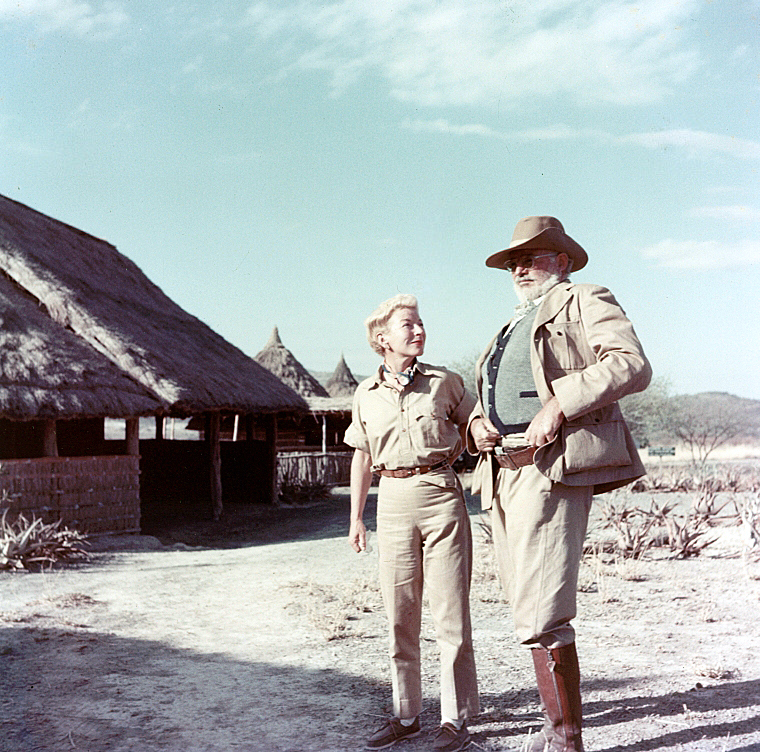
Ernest and Mary Hemingway on safari in Africa, 1953-1954

This past week I twice watched the full six hours of the new Lynn Novick / Ken Burns documentary about Ernest Hemingway. Several years ago an English instructor at my college explained to me and a class how the criticism and historiography about Hemingway has evolved in the twenty-first century. Out are the paeans to Hemingway the hyper masculine hunter, fisherman, boxer, and adventurer; in are explorations of the great writer’s alcoholism, PTSD, concussion-induced mental health issues, and other vulnerabilities. “Hemingway” fits neatly into these academic trends. Watching the story unfold over the course of several evenings was unsettling and emotionally exhausting. There were a few people with whom I was texting and emailing after having watched each installment. One friend was so distraught as to question the necessity of the entire project. I must say I really had no good answer or reply. Part of the reason for my unsatisfactory responses was that I too was trying to process the life and disintegration of Ernest Hemingway myself.

In addition to the documentary, I have been listening to serval podcasts and virtual events with Novick and Burns over these past several days. Burns in particular has turned several times to the evolving nature of celebrity itself in the now six decades since Hemingway’s suicide. We know more about public figures today than was possible decades ago in the time before the internet and other communication advancements. It was easier then for a figure like Hemingway to craft a persona. I would argue that personas are not lies and that public figures have a right to create a public-facing identity. How could they not do so? That the myth and reality inevitably fail to align neatly and perfectly is not something to unduly concern us. There is room for both. Ultimately it is the work that matters.

Of course none of that makes it any easier to watch the physical and mental breakdown of a man, let alone a great artist like Hemingway, so unblinkingly. I totally understood what my friend was getting at. The truth though has a value all its own. One thing I noticed in the interviews with Novick and Burns is that they repeatedly mentioned the importance of self-care and told listeners that if they felt they too might be suffering from chemical dependency or mental health issues to seek help.

(image/Ernest Hemingway Photograph Collection, John F. Kennedy Presidential Library and Museum)

Sally Grossman, 1939-2021

I learned today with great sadness of the passing of Sally Grossman. The name may be unfamiliar but she stares out, cigarette held aloft, on the cover of one of best albums of Bob Dylan’s career, Bringing It All Back Home. I’m listening to it right now as I type these words. More than just a beautiful woman who could strike a mesmerizing pose, Ms. Grossman was instrumental in helping her husband Albert Grossman manage many of the most important individuals and groups of the folk/blues revival. In his memoir This Wheel’s on Fire Levon Helm of The Band talks about how Sally Grossman championed what was then still Dylan’s backup musicians. She carried on with the work after her husband’s untimely passing in 1986. Here is a brief video of the creation of the album cover. I have always loved that the room still exists today preserved in the condition it was in 1965. Click here for some lovely outtakes and more. Even better, do so while listening to the record.

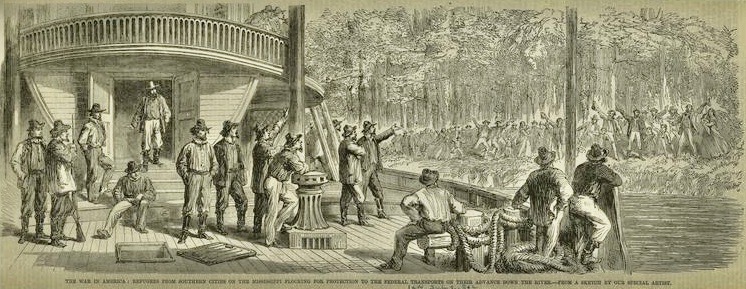
Southern refugees on the Mississippi, 1862

I spent much of last night and now this morning searching for potential images that I might use in “Incorporating New York,” my manuscript about Civil War Era New York City. The other day prepping for this I drafted a list of persons, events, and institutions that I would most like to see in the book should it get published, which I’m working hard to make happen. I am trying to find things that are a little different and less familiar to readers. So often we see that same images over and over, which is unfortunate given the rich visual history of the American Civil War. Here is an image that I will not use in my book because it’s a little beyond the scope of my narrative, but that I thought I would share here because it is so powerful. It is a woodcut drawn by Frank Vizetelly. I was having a conversation several years ago now with one of the rangers at the Theodore Roosevelt Birthplace in which we got onto the topic of refugeeism during the War of the Rebellion. I made the point that many Americans don’t or can’t comprehend that during our own civil war we had displaced persons just like any country experiencing internal strife. This image is from July 1862, which means the people we see here are fleeing the fighting out west under the direction of Ulysses S. Grant and others.

(image/NYPL)

The Sinews of Peace

Today is the 75th anniversary of Winston Churchill’s “Sinews of Peace” speech. It was on March 5, 1946 at Fulton, Missouri’s Westminster College that the former prime minister gave what is more commonly know as his “Iron Curtain” address. Yes, former prime minister. It is important to remember that Churchill left Downing Street after being defeated by Labour’s Clement Attlee in 1945. Standing there with Truman seated beside him, Churchill was speaking in his capacity as Leader of the Opposition. Whatever his other failings Churchill always saw the dangers posed by Stalin and the Soviet Union, despite the alliance during the war. The Iron Curtain speech met with mixed reviews, some regarding Churchill’s remarks about a threat from Eastern Europe as prescient and others casting his words as those of a warmonger. I can’t say I know that much about Churchill but I would wager that it was this address that led him to return to working on his eventual four-volume “A History of the English-Speaking Peoples,” which he had begun in the 1930s between the World Wars and put down for obvious reason some time around the Blitz. Again though, that’s just a hunch.

That time immediately after the Second World War is fascinating because it is seemingly so close and yet far removed all at once. It is still living memory for some, fewer and fewer every year however. Here is a five-minute excerpt for a late winter’s day of that event from 75 years ago today.

Foot tracks in the snow

I worked much of the morning and early afternoon on the draft of a project that hopefully will get published sometime in late spring. I intend to submit said draft, about 2,200 words, tomorrow after one final edit and fact check. I took a break around 1:30 for a walk and some fresh air in Green-Wood Cemetery, whose fields are still covered with snow. I saw these tracks and stopped to take a picture. I texted a friend to ask what he thought they might be, and he guessed wild turkeys.

Sunday morning coffee

Mahalia Jackson, April 1962

Last night I finished watching the new PBS documentary “The Black Church.” Over these past several evenings I watched each of the four one-hour installments over four nights. I got into something of a routine where when each episode concluded I would email a friend who was also watching and we would compare notes, if you will, with our impressions. I can’t recommend the film highly enough. One of the things I like the most about Henry Louis Gates as a documentarian is the way he listens without judgment and lets the interviewee tell their story. One need not agree with everyone all of the time, or even any of the time, to respectfully let them have their say. The Black Church, like all human institutions, is a flawed—one might say fallen—institution whose stirring triumphs exist within the complexities and ambiguities inherent in human existence. Gates and his team capture that. It is hard to image an America without the Black Church and everything it has given over the centuries not just to its followers but to the country as a whole.

Last night the same friend sent me this article asking if I had heard of the recent opening in Nashville of the National Museum of African American Music. Almost twenty-five years ago now this same friend and I took in a great exhibit about jazz at the African American Museum of Dallas. I had not seen the opening of this new museum, or even heard of its creation. With the pandemic still very much on this is a tough time for a museum to open. Hopefully it can weather these crazy times until the world opens up again. I would love to visit this place some day.

(image/photographers Carl Van Vechten via Library of Congress)

President’s Day 2021

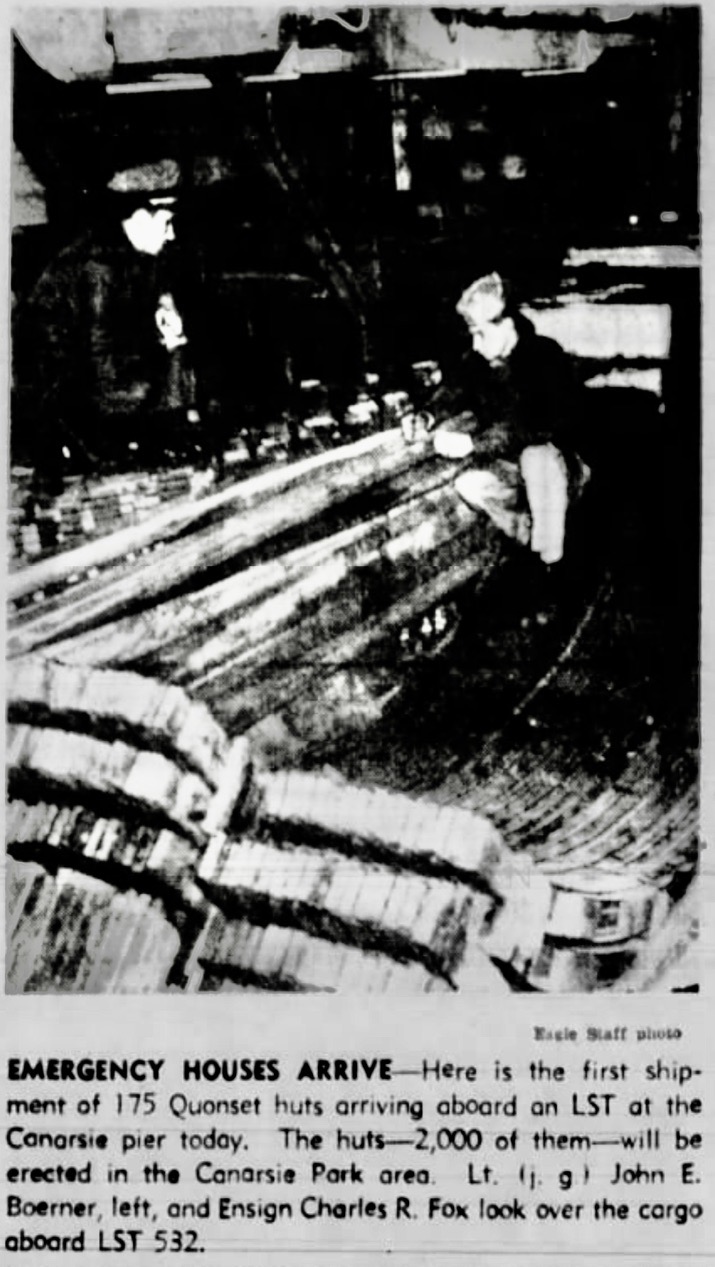
Brooklyn Daily Eagle, 15 February 1946

I did a Trader Joe’s run this morning, which meant a rare pandemic subway ride with full shower and scrubbing when I arrived home. Now I’m settling in to work on a small project that hopefully will find a home this spring or summer. I know the image quality is not that great but I wanted to share the above scene that took place in Brooklyn seventy-five years ago today. My colleague and I spend a lot of time in our class about the history and evolution of New York City discussing the housing shortage in the five boroughs in the immediate aftermath of the Second World War. As the caption notes the retrofitted quonset huts were converted into temporary housing as millions of GIs came home from Europe and the Pacific. In other civilian uses Quonset huts were used for schools as well, including Queens College. The corrugated aluminum structures were a newish invention in the early 1940s and massed produced for military use, especially in the Pacific. I would go more into the history of how they came to be used for housing but because others already have will not here today. In the image below we see the earliest period of the Baby Boom. A few years after this families would begin moving into new housing subdivisions such as Levittown. It is easy–in some circles seemingly obligatory–to ridicule the rise of postwar suburbia, but one cannot blame young families for wanting their little patch of space after having gone through the Depression and depravities of World War II.

American ex-serviceman Leonard Levinsohn and his wife Shirley, strolling with their baby through the settlement of prefabricated Quonset huts where they live, Jamaica Bay, New York City, USA, circa 1946. (Photo by Archive Photos/Getty Images)