Thanking the troops

Few Americans have understood more clearly the seductions and inadequacies of professing gratitude than Abraham Lincoln. Offering to a mother who had lost two sons in the Civil War “the consolation that may be found in the thanks of the Republic,” Lincoln nevertheless acknowledged “how weak and fruitless must be any words … which should attempt to beguile” her from her grief. Expressions of thanks constitute the beginning, not the end, of obligation.

Shooting Soldiers

This past spring I mentioned our visit to the Merchant’s House Museum on the Lower East Side to see the Dr. R.B. Bonetcou photographs of Civil War wounded.  I mentioned in that post that a book was in the works.  The exhibit ended yesterday but as writer and blogger Jim Schmidt explains at Civil War Medicine (and Writing), the book has been released.

Update: The exhibit has been extended through August 29, 2011.  If you have not yet seen the collection I suggest you do so by the end of the month.

Lee’s papers

The other day I linked to an article about the evolving legacy of Robert E. Lee.  In this week’s Salon Glenn LaFantasie has a piece on the Lee family’s attempts to control his personal papers.  Preventing researchers from learning the general’s true feelings about various public figures of the day is one reason for the hesitation; another is to keep letters of a more personal nature away from the public eye, especially letters Lee wrote when he was courting the woman who became his wife.  Personally I think Lee’s descendants are making a mistake.  The Marble Man myth has already been chipped away significantly and will never return anyway.  Ironically the best thing the Lees could do is take all of the the general’s papers and make them available to the public.  No individual is well-served by the type of adulation Lee has been subjected to for the past century and a half.  It unfair to them and us to do so.  Making him more human, including divulging details of his personal life and showing where he stood on the issues of the day and why he made the decisions he did, would be the best service Lee’s descendants could do for him.

On the lighter side

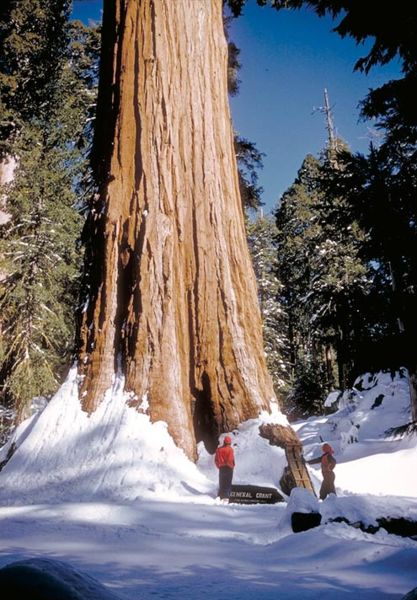
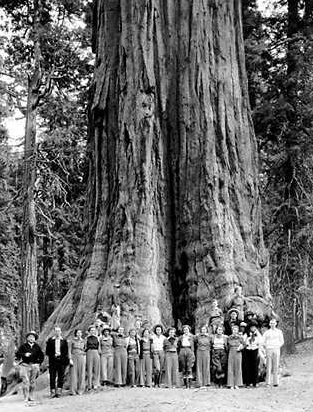
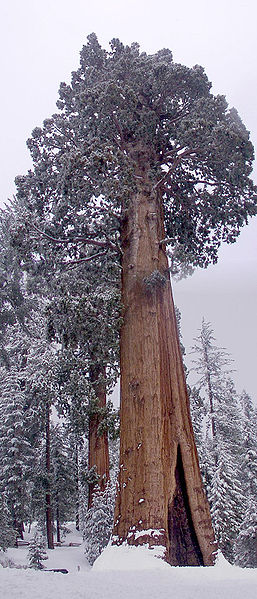
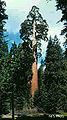
Hey everybody, you may or not know that President Ulysses S. Grant created the first national park when designated Yellowstone as such in 1872.  Who was aware, however, that at least some of the great sequoias were named after our Civil War generals?

General Grant tree (photo by Tsui)

General Grant tree, 1910

General Grant tree, 1936 (photo by George A. Grant)

Grant in winter (photo by Christoph Rückert)

The Sherman tree is taller (photo by Robert J. Boser)

(photo by Daniel Mayer)

(photo by Chris M)

Enjoy your weekend.


The return of the 69th

One hundred and fifty years ago today the 69th New York returned to New York City after the disaster at Bull Run.  On November 11th of this year the regiment returns to New York again in the form of the Louis Lang painting Return of the 69th (Irish) Regiment, N.Y.S.M. from the Seat of War.  The painting was lost just after the Second World War and had deteriorated significantly before being rediscovered in a New Jersey warehouse a few years ago.  The artist had given the painting to the New-York Historical Society in 1886 and the institution recently commissioned the Williamstown Art Conservation Center to restore the work to its proper condition.  Art Conservator, the center’s periodical, has more on the restoration.  The New-York Historical Society is one of the hidden gems of New York City cultural life.  I am so looking forward to seeing it re-open later this year and to see, also, the return of this long lost art treasure.