Leaving Ellis

Hey everybody, it is with some sadness that I report that my time at Ellis Island has come to an end.  After fifteen months of volunteering in the Interpretation Division the time has come to move on.  I will always be thankful to the rangers, especially to volunteer coordinators April Antonellis and Anthony Chu, who taught me so much and gave me the opportunity to work in the museum and with the public.  I had always known what a special place Ellis Island is, but as the weeks and then months went by I was increasingly humbled as I learned more and more about the immigration station and the 12 million people who passed through it.  It is hallowed ground.  Leaving Ellis does not mean I will stop volunteering with the NPS, however.  This summer I will begin volunteering with National Park Service across the water at Governors Island, where I can pursue my passion not only for American history in general but the Civil War in particular.  I think it is going to be a rewarding and enjoyable summer.

Be well.

Ellis Island Registry Room, May 2011

The blues and the Civil War

Hey everybody,

As I have mentioned before here at the Strawfoot I often wonder if the people of the eighteenth and nineteenth centuries could have imagined the world they bequeathed to us.  Sarah Brown is a case in point:

You’ve seen Sarah Brown on-stage if you ever went to Antone’s in the ’80s or early ’90s. She was the house bass player when Antone’s was a blues club, period, and so she backed everyone from Big Joe Turner and Sunnyland Slim to Buddy Guy and Albert Collins and Otis Rush. For almost 30 years, Brown has been one of Austin’s most valuable and visible side musicians.

But something only her closest friends knew until recently is that Brown, 59, is a descendant of John Augustine Washington, the youngest brother of George Washington. Although Brown is a blood relative of our first president, George Washington, she’s not a direct descendant, as George and Martha Washington had no children. Nor did John Augustine’s son Bushrod Washington, who inherited Mount Vernon and became a Supreme Court justice.

“Being a blues musician, it just wasn’t relevant to me to be a Washington,” said Brown, a Michigan native who has lived in Austin since 1982. The Washingtons she was committed to follow in the tradition of were Dinah and Walter “Wolfman” Washington, not America’s first family. “Our grandmother told us that we must amount to something in our own right because whatever blue blood we had was thin,” Brown said. George Washington is her great-great-great-great-great-great-uncle.

Alas I never visited Antone’s during my years in Texas, but I fondly remember R.L.’s Blues Palace in Dallas.

Harmon Killebrew, 1936-2011

(Source: Baseball Digest, April 1962; Courtesy: Wikimedia Commons)

Baseball great Harmon Killebrew has died.  The slugger led the Minnesota Twins to the American League pennant in 1965.  The team lost to the Dodgers in seven games.  Killebrew hit 573 career home runs and is eleventh on the all-time list in that category.   His home run total is even more impressive because so many of them came in the dead-ball era of the mid-to-late 1960s.  Killebrew was the power hitter of the 1960s, hitting more home runs than anyone in that decade.  He also had tremendous patience at the plate and led the major leagues in walks during those years as well.  He was inducted into the Baseball Hall of Fame in 1984.  The burly Killebrew was a gentle giant known for his politeness and quiet demeanor off the field.  Unfortunately, he never received the recognition he deserved because he spent his entire twenty-two year career playing for small market teams.

Richmond’s African burial ground

A case involving an African burial ground in Richmond, Virginia is set to go to trial next week.  The disputed site is currently a car park.  According to the Examiner:

The parking lot has been a subject of contention for at least 20 years. In 1992, a local historian, did research indicating that the parking lot, then owned by VCU, was part of a larger site known historically as the Burial Ground for Negroes.  Research indicates that African Americans, free and slave, had been buried in the area since the late 1700s…

…To many Richmonders, particularly African Americans, it is a battle for historical parity. Monument Ave has huge memorials to fallen Confederate heroes showcasing Richmond’s past as the Confederate capitol. Hollywood Cemetery has huge well kept graves of Confederate soldiers. Hollywood Cemetery also houses the grave of Confederate President Jefferson Davis and his family.

Stay tuned.


Merchant’s House Museum

Having been a volunteer in museums in New York City and elsewhere I can testify that many of the most compelling exhibitions are on display in smaller, less obvious institutions.  Right now such an exhibit is taking place at the Merchant’s House Museum on the Lower East Side.  Over the years I had walked past the museum on my way to the subway after visiting the record stores on St. Marks Place.  (That should give you an idea of how old I am.)  Until last Saturday, however, I had never been inside.  The museum is sponsoring New York’s Civil War Soldiers – Photographs of Dr. R. B. Bontecou, Words of Walt Whitman through August 1, 2011.  Unfortunately photography was not permitted in the museum, or I would have some pictures to share.  The Burns Archive, owner of the images, does have its own blog.  A book is in the works.  It is one thing to read that there were 10,000 casualties in this or that battle; it is another to see many of these “statistics” in flesh and blood.

Merchant’s House Museum garden, May 2011

This small museum is an ideal excursion when coupled with another endeavor.  In our case that was the Union Square Green Market, where we got bread, cheese, and cider for lunch afterward.  Visit if you can.

Jukebox jury

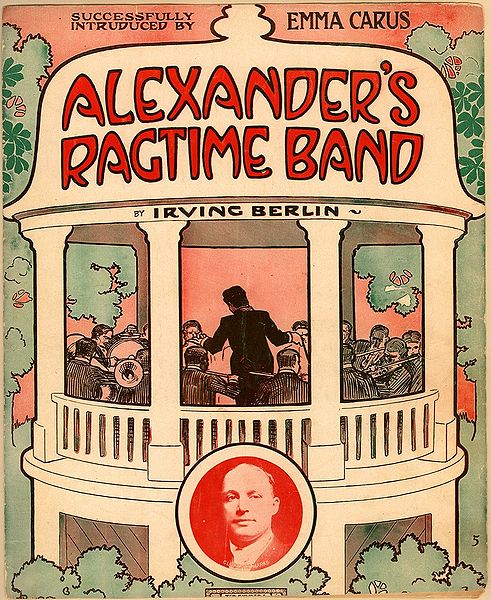
Alexander’s Ragtime Band, Irving Berlin
(Source: Duke University; Courtesy: Wikimedia Commons)

Earlier this week the Library of Congress announced the release of what it is calling the National JukeboxAccording to the LOC :

Works by Fletcher Henderson, Al Jolson, George M. Cohan, Eddie Cantor, Will Rogers, Alberta Hunter, Sergei Rachmaninoff, Leopold Stokowski, Arturo Toscanini, and opera stars Enrico Caruso, Nellie Melba and Geraldine Farrar are all covered, as are such original recordings as the Paul Whiteman Concert Orchestra’s “Rhapsody in Blue” with George Gershwin on piano, and Nora Bayes’ “Over There.”

Visitors to the National Jukebox will be able to listen to available recordings on a streaming-only basis, as well as view thousands of label images, record-catalog illustrations, and artist and performer bios. In addition, users can further explore the catalog by accessing special interactive features, listening to playlists curated by Library staff, and creating and sharing their own playlists.


Ellis Island, a national monument

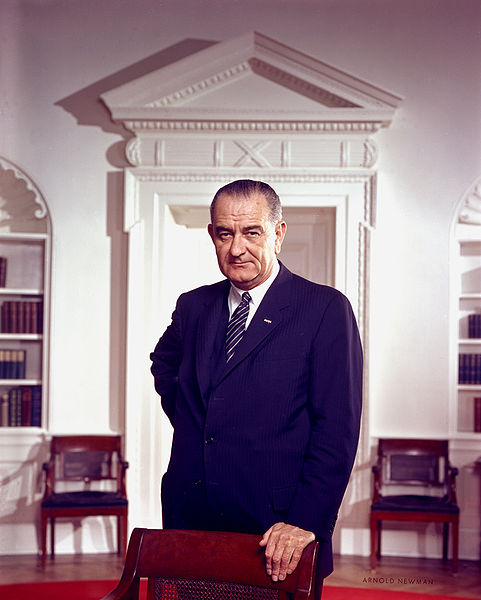
(Photo: Arnold Newman, White House Press Office; Source: Wikimedia Commons)

It was on this date in 1965 that President Lyndon Johnson signed the proclamation designating Ellis Island a national monument and placing it in the protection of the National Park Service.  The ceremony took place in the White House Rose Garden.  Here are President Johnson’s remarks:

Members of Congress, ladies and gentlemen:

For nearly three decades Ellis Island was a beacon of opportunity, a symbol of freedom for millions.

Between 1892 and 1930, 16 million immigrants entered America through the open doors of Ellis Island. These men, women, and children from many lands enriched the American melting pot. They brought to these shores a rich variety of individual gifts, a heritage derived from the total experience of all of their many nations. They made us not merely a nation, but nation of nations.

These steerage immigrants entered into the very fiber of American life. Each made contributions to the American cause. Others achieved greatness or rose to positions of national leadership. Among those who passed through Ellis Island were such eminent Americans as Irving Berlin, David Dubinsky, Father Flanagan, Justice Felix Frankfurter, Charles A. Lindbergh, Sr., Philip Murray, Jacob Potofsky, Adm. Hyman Rickover, Knute Rockne, David Sarnoff, Spyros Skouras, Igor Sikorsky. Vice President Humphrey’s mother entered the United States through Ellis Island. Fiorello LaGuardia once worked as an interpreter there.

So we profit from the legacy of Ellis Island today in all parts of this great land of ours. Its meaning is symbolized here this morning by the presence of so many of our finest Members of Congress, nineteen of whose parents or grandparents entered the American gate at Ellis Island. Their names are Bayh, Hruska, Javits, Mansfield, Muskie, Pastore, Ribicoff, Cederberg, Daniels, Dent, Farbstein, Helstoski, Joelson, Mackay, Minish, Multer, Rodino, Pucinski, and Vanik. They all belong on a roster of honor that will someday surely be commemorated in this great national shrine.

So I am signing today a proclamation making Ellis Island a part of Liberty Island National Monument. In addition, I am asking Congress to enact legislation authorizing appropriations to. make Ellis Island a handsome shrine in the broad harbor of the great port of New York.

It is also my pleasure to announce approval of a Job Corps Conservation Center on the New Jersey shore adjacent to Ellis Island. Once this center is established, Job Corps. men will transform and restore Ellis Island and help the State of New Jersey create a new Liberty State Park in a blighted section of the Jersey City waterfront.

This exciting Federal-State project will preserve a bright chapter in American history. It will bring beauty where there is now blight. It will demonstrate at the very doorstep of our largest metropolis the opportunity that is offered us if we are wise enough to cherish our authentic historic places and accept the challenge of the new conservation.

I also hope that this Congress will draw on the lessons of Ellis Island and enact legislation to provide America with a wise immigration policy adapted to the needs of the 1960’s.

Earlier this year I sent to the Congress a proposal to replace the outdated national origins quota system. I asked the Congress to replace this worn out system with a new one, a schedule of immigration priorities based on the skills of applicants, skills that this Nation now needs, and on the existence of close family relationships between applicants and United States citizens.

This long overdue change, rooted as it is in national interests and in humanitarianism, should be enacted without further delay.

I know in my heart that the people of this Nation truly believe that every individual ought to be judged on his worth as a human being and by the contribution that he makes to his country. He ought not be judged on the church he attends, or how he spells his name, or the color of his skin. We are committed in this land to that belief and our efforts will never cease until it has really, in actuality, become a permanent fact as well as a guiding principle.

Thank you very much.

Grant’s Tomb, the movie

In the early decades of the twentieth century Grant’s Tomb was a rendezvous point for the young and amorous.  (Really)  I came across a wonderful silent film from 1904 that I thought I would share.  I find it interesting not so much for the film, which is enjoyable in and of itself, but for its stunning images of the mausoleum as it was less than a decade after its dedication.

Quote of the day

It was a thing to brood over, this war with its terrible cost and its veiled meanings, and the wisest man could perhaps do little more than ask searching questions about it.

Bruce Catton, The American Heritage New History of the Civil War