Elvis Presley, 1935-1977

People have been texting throughout the day with their thoughts on the life and death of Elvis Presley. I’ve attended Elvis Week a few times over the years, which conveniently fell during a time each year when I visited relatives who lived within driving distance but who have since passed away. August 16th has always been poignant to me, and always will be for interrelated reasons. Someone I knew from my high school years was in Memphis this past week and shared pictures with my family, including one of the resting place of Lisa Marie. Here is something from Elvis’s final album, Moody Blue, released in June 1977 just two before he died. Contrary to popular belief, Elvis was still very much bringing it in his final years. Contemplative songs like this and “Good Time Charlie’s Got the Blues” comprised much of his later catalog, which tells you something.

The Day after Trinity

J. Robert Oppenheimer (light colored fedora) and General Leslie Groves (middle) at Trinity test site, 9 September 1945 two months after the text / image, United States Army Signal Corps

A friend and I saw Oppenheimer this past Wednesday at the IMAX across the street from Lincoln Center. We were in the fifth row from the front, in a theater whose capacity is 487 persons. It was incredible to sit in a sold out theater and turn around to see rows and rows of people stretching back to the highest row. I can’t recommend the film highly enough. Through the end of July—this coming Monday—the Criterion Channel is providing free access to the 1981 documentary The Day after Trinity. I myself am going to watch it over the weekend. Here is more on the documentary from the New York Times. Again, it goes back behind its paywall on August 1st. So if you want to see it, do so now.

Dateline: July 19, 1821

King George IV was coronated on this date in 1821. It’s funny how we think of his father, King George II, as having been the ruler during the Seven Years War and Revolution and his story just stopping there. Peace however came in 1783 and he lived under thirty-seven. Granted, much of his rule during that time was interrupted by his bouts of mental illness and his family’s assuming control. Still, George III was on the throne throughout the French Revolution, War of 1812, and Napoleonic Wars. Think about it.

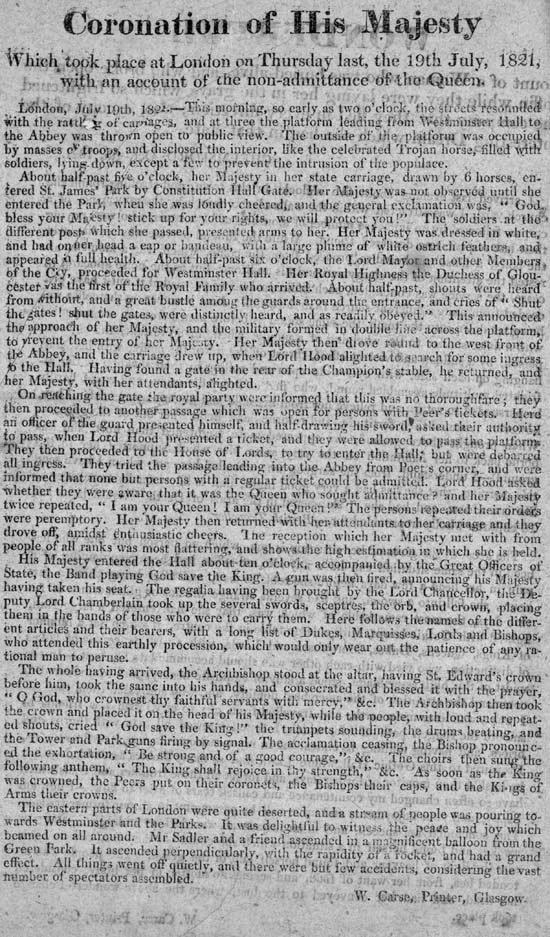
His son and successor George IV by all accounts a dreadful ruler and human. His reign lasted throughout the 1820s. It wasn’t until pivoting to this era 5-6 years ago that I grasped the extent of material culture remaining from the period. Coins, books, ceremonial tokens and other ephemera fill in the blanks more than I realized. We don’t give the people of the past as much credit as they deserve. The image we see immediately below was printed on July 19, 1823, two hundred years ago today on the second anniversary of the coronation. And below that is an edict barring the new king’s estranged wife from the ceremony.

Drawn & etched by W. Heath and published July 19, 1823, by R.H. Laurie, London / National Air and Space Museum, Gift of the Norfolk Charitable Trust
Broadside regarding the coronation of King George IV / National Library of Scotland

Subway art

I was on the subway this morning on my way to the Whitney Museum. As I stood up to get off at my stop a young girl of about five walked up to me and handed me the drawing you see above. She explained that she had drawn me during the ride and wanted me to have it. The object in my hand is a book. Being the good New Yorker that I am, I always make sure to have reading material handy when on the subway. The drawing is hanging now on the refrigerator. Re the Whitney, I had not been to the museum since it moved from the Upper East Side to the Meatpacking District several years ago. I was glad when I heard several years ago that they were moving. The Whitney always had something of an identity crisis when it was on East 75th Street, what with the Met ten blocks to the north and MOMA 20 blocks to the south. Now, on Gansevoort Street, not only does it stand alone, but closer to its roots in the Village where Gertrude Vanderbilt Whitney founded the institution in the early 1930s.

Colonel John Nixon

John Nixon reading the Declaration of Independence, July 8, 1776 / NYPL

Graveyards and cemeteries mean as much to me as historic sites themselves. When you see someone’s resting place they become more than just a figure in a book. Plus, they’re a good reminder of one’s own mortality. Hodie Mihi, Cras Tibi.

I took the image below of John Nixon’s resting place in Philadelphia’s Saint Peter’s Church cemetery in Society Hill last Saturday and knew immediately that I would post it today. His name may not be familiar, but it was he who read the Declaration of Independence for the first time. Colonel Nixon read the text from the State House steps on July 8, 1776 while couriers were racing to the other colonies to spread the word. The famous reading in New York City’s Bowling Green with its tearing down of the statue of George III was the following day. His table-design headstone was damaged by a fallen tree sometime in the past, as this unfortunately undated post on the St. Peter’s Church website explains. Diarist Christopher Marshall described the scene at the State House 247 years ago today as a “Warm sunshine morning. At eleven, went and met [the] Committee of Inspection at [the] Philosophical Hall; went from there in a body to the lodge; joined the Committee of Safety (as called); went in a body to [the] State House Yard, where, in the presence of a great concourse of people, the Declaration of Independence was read by John Nixon.” If one is Philadelphia today, the NPS is having its annual re-enactment at 11:45 this morning there at Independence Hall.

St. Peter’s Church cemetery, Philadelphia

Carpenters’ Hall reopens

It was so great to be in Philadelphia for Fourth of July weekend. The crowds were big and wherever I went the tours given by NPS rangers and museum officials were uniformly excellent. I got a lot to go on for some projects in the works. This was the scene earlier today at the reopening ceremony for Carpenters’ Hall. I’m glad they managed to get the site open by the Fourth of July after an extensive renovation complicated by an arson fire this past December that destroyed some of the mechanical infrastructure in the basement. As time passes I increasingly internalize history’s Rule #1: Go there. There is no substitute.

Independence NHP turns 75

President Truman (right) and Philadelphia Mayor Bernard Samuel, October 1948

Morristown was the first national historical park in the NPS system, created via a bill signed by Herbert Hoover on March 2, 1933. Fifteen years later President Harry S. Truman created Independence National Historical Park in Philadelphia when on June 28, 1948 he signed Public Law 795, seventy-five (75) years ago today. The development of Independence Hall and associated structures as a tourist site just after the Second World War was greatly influenced by the work of John D. Rockefeller Jr. and others at Colonial Williamsburg around the time of the Revolutionary War sesquicentennial in the 1920s and 1930s. One really cannot understand historic sites as historic sites without understanding the provenance behind how they got that way. The photograph we see here was taken in early October 1948, just over three months after Truman signed the Independence NHP enabling legislation. He is of course the one on the right and standing with Philadelphia Mayor Bernard Samuel. This visit was a campaign stop in the middle of his re-election bid that one month later would produce the famous “Dewey Defeats Truman” headline in the Chicago Daily Tribune. When this photo was taken that autumn day in 1948 he signed the visitor log: “Harry S. Truman, Independence, Mo.: temporary address: 1600 Pennsylvania Avenue, Washington, D.C.”

(image/Harry S. Truman Library & Museum)

First day of summer

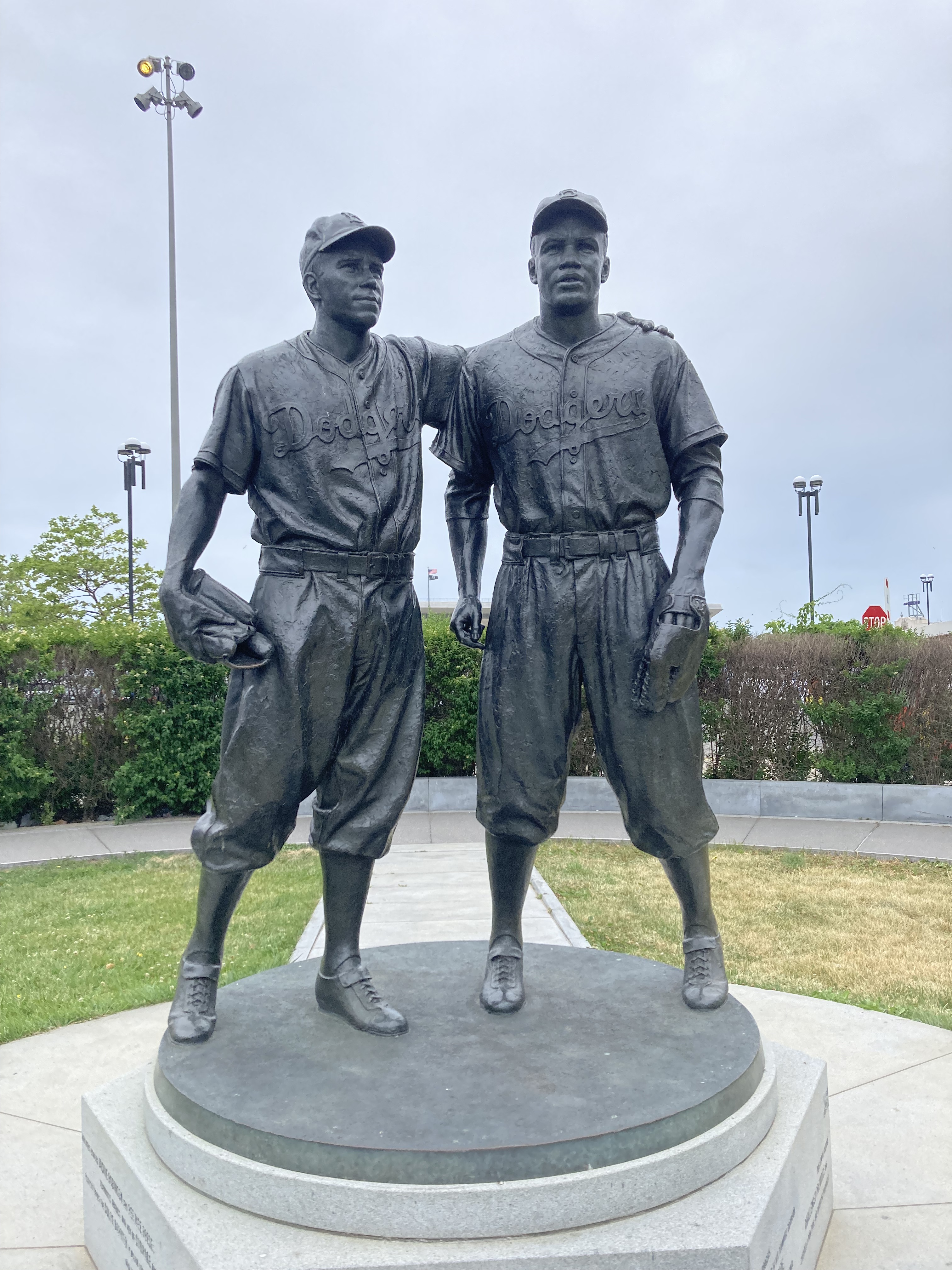
Pee Wee Reese and Jackie Robinson statue, Brooklyn Cyclones ballpark

It was an unseasonably chilly but otherwise perfect night to go to the Brooklyn Cyclones game tonight. I’ve lived in Brooklyn long enough now to remember when this team began in 2001. I like the way the team observes the Brooklyn baseball connection with its references to the Dodgers. We couldn’t help but note the new construction taking place in the neighborhood. Coney Island will always be Coney Island but neighborhoods, especially New York neighborhoods, do evolve. It was so good to be back at this little gem of a minor league ballpark after being away for several years. Here’s to a good summer.