International Holocaust Remembrance Day 2020

Auschwitz concentration and extermination camp railroad entrance

I would be remiss if I did not at least briefly mention that today is International Holocaust Remembrance Day. Today is also the 75th anniversary of the liberation of Auschwitz. Earlier today I had a brief email back-and-forth with a friend who is a Holocaust survivor. He has been speaking out on the road a lot this winter and I believe gets back to the city later in the week. After I got home I checked out some of the news coverage and social media online from around the world. It sounds ridiculous to say but it is often lost on us how global was the Second World War, the extent to which it reached into virtually every house and hamlet across the globe regardless of how large or small. The Second World War seems ironically so long ago and yet as close and relevant as it was in 1945. As the late military historian John Keegan often said, the history of war has not truly been written yet. The consequences and aftereffects are still playing themselves out, and probably willful many decades. In our current moment it is more important than ever to study history across all regions and eras, which is why there are people out there who would take it away from us.

A book they gave us at the training I attended at the U.S. Holocaust Memorial Museum two weeks ago was Michael Dobbs’s “The Unwanted: America, Auschwitz, and a Village Caught in Between,” which I intend to read this coming weekend.

(image/Bundesarchiv)

Sunday morning coffee

Herbert Hoover and Franklin D. Roosevelt ride to the inaugural, March 4, 1933

It’s a glorious morning. I am listening to Bill Evans with my coffee.

I took advantage of yesterday’s rain and sleet to move some computer files around and do my first bit of actual writing of the new year. During the holidays I outlined some projects that I intend to work on in 2020 which I think are realistic. Then it was off to Florida for some R&R followed by the training sessions at the U.S. Holocaust Memorial Museum I mentioned in a post last week. Now it’s about getting down into the weeds and doing what I can. I don’t mind admitting that I’m a tad apprehensive because my projects cross various time periods and subjects. Still I have what I feel are some good ideas on some under-explored topics that I can bring to fruition. It will be a productive winter of work.

The spring term begins tomorrow and today I’ll stay close to the house, do the laundry, buy some groceries, write a bit in the afternoon, and prepare for the excitement and grind that accompany a new semester.

Enjoy your Sunday.

(image/National Archives and Records Administration)


Asking questions

United States Holocaust Memorial Museum

Yesterday I got back from Washington, D.C., where in addition to a little rest and relaxation I attended a two-day training seminar at the United States Holocaust Memorial Museum on the Mall. There were fifty trainees from across the country all told, and the sessions were led by an extraordinary group of historians, archivists, educators, librarians, and museum professionals. I cannot express what a privilege it was to attend. I won’t go into too much detail as of yet because many details have yet to be worked out, but if all goes as planned this project will lead to several thought-provoking historiographical and interpretive programs. In these challenging, often despairing, times it is more important than ever to understand history properly. The United States’s responses to the rise of fascism, the war, and the Holocaust itself were complicated to say the least. As is the case with all historical events, one must embrace the contradictions and complexity to understand fully. As the sign in the photograph I took at the museum implies, it is up to us not just to provide answers but to ask the right questions.

Going in to the sessions I already had a number programming ideas. In the breakout sessions and group discussions the event organizers and attendees gave me a number of further options and possibilities to explore. Hopefully I gave them some ideas as well. This will be an ongoing endeavor and those conversations will continue. I intend to share more on this in the coming weeks and months as things further develop.

Dateline January 11, 1785: Congress moves to New York City

New York City Hall was home to the Confederation Congress from January 1785 until October 1788.

On Christmas Eve a few weeks back I noted that on that date in 1784 the Congress of the Confederation was packing up its temporary home in Trenton, New Jersey and moving to more permanent, or at least semi-permanent, digs in Manhattan. Specifically Congress was moving into New York City Hall on Wall Street, which it did on January 11, 1785. The image above, as the caption notes, is from prior to the Revolution. The image is more representative of the structure as it would have been in 1785, a few years before Pierre L’Enfant renovated the building in preparation for its transformation into Federal Hall.

There is a tendency to think that not much happened at City/Federal Hall during the Confederation Period, presumably due to the weakness of the Articles of Confederation themselves. It was during this time, two years later in 1787, that the Constitutional Convention convened in Philadelphia. Still, many significant things happened during the Confederation Congress’s years in the building we see here. Among other things, congressmen passed the Land Ordinance of 1785, put down Shays’s Rebellion, and passed the consequential Northwest Ordinance of 1787 that made possible the eventual ratification into statehood of numerous territories. After New York became the eleventh state to ratify the Constitution in late July 1788 Congress soon thereafter moved into the Walter Livingston House in order for L’Enfant to begin his work converting the building in time for the Federal Congress to convene on the site in March 1789 and for George Washington’s inaugural that April.

(image/NYPL)

Robert Caro’s Al Smith

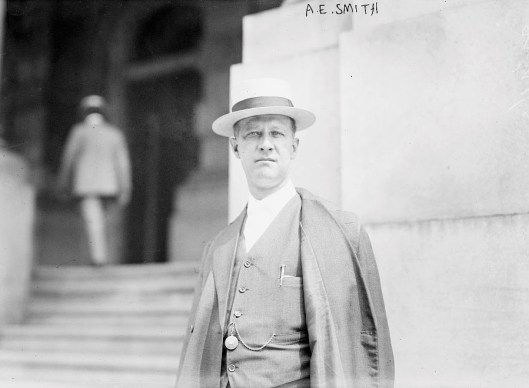
Alfred Emanuel Smith in May 1920 during his first term as governor of New York

I was on vacation last week when I received a text message from someone who was himself away, sitting on a beach in Mexico no less, telling me that the New-York Historical Society had just acquired the extensive—200 linear feet—papers of Robert Caro. I told my friend that I remembered seeing Caro interviewed on C-SPAN 12-15 years ago and Brian Lamb asking the biographer where his papers might eventually go. Caro said at the time that he was not sure, but that he would not be giving them to the Lyndon Baines Johnson Presidential Library in Austin. He had had several problems with officials there over the years, especially in the early years of his multi-volume LBJ project when at least some officials then at the archive had been personal associates of Johnson himself and thus less than forthcoming. As it happened I was reading Terry Golway’s Frank and Al: FDR, Al Smith, and the Unlikely Alliance that Created the Modern Democratic Party when my friend texted.

Caro’s papers include a great deal on Al Smith himself, one of the great and sadly forgotten figures in American history. Smith happened to enter the New York State Assembly 116 years ago this week in January 1904. Tammany boss Tom Foley, the man responsible for giving Smith his start in politics, gave Smith one piece of advice before his protégé headed to Albany that January nearly a century ago: “Don’t speak until you have something to say.” And so for that first term Smith sat as a back-bencher high above the legislative floor, taking in the proceedings and figuring out who was who and what was what. Roosevelt entered Albany politics seven years later. The word “alliance” in Golway’s title is fitting, for while Smith and FDR’s relationship was more than transactional the two very different men and never shared a friendship in any true sense. For reasons too complicated to go in to here and now, I would aver that it is not a stretch to say that without Al Smith there would be no FDR, at least no FDR as we know the man and his legacy.

I have some projects I’m hoping to accomplish involving Al Smith over the next few years and am hoping Caro’s research on the four-term New York governor and 1928 Democratic Party nominee will be available fairly soon.

(image/Library of Congress)


Christmas Eve 1784

French Arms Tavern in Trenton, New Jersey served as a temporary site of the federal government for nearly two months the year after the Revolution ended. The Confederation Congress’s final day in the tavern was Christmas Eve 1784.

Two hundred and thirty five Christmas Eves ago the Congress of the Confederation concluded its affairs in Trenton after its brief–less than two-month–stay in that southern New Jersey town. The Confederation Congress’s time in New Jersey was short but not without its highlights; it was there that the Marquis de Lafayette gave his goodbye oration to the United States legislature on December 11, 1784. Forty years later in 1824 Lafayette would return to the United States for a grand tour in which he was received with great interest and turnout everywhere he went.

The image we see above is the French Arms Tavern, where Congress met from November 1 to December 24, 1784. I had a conversation not long ago with someone in which we discussed how official and semi-official business in the Colonial, Revolutionary, and Early American periods often took place in such venues as coffeehouses and taverns. I suppose the reason is that infrastructure was just not so prevalent in those times. The men of the Confederation Congress had voted the previous day to move the nascent nation’s capital to New York City. Congress would move in to New York’s City Hall, today’s Federal Hall, on January 11, 1785. One can imagine the men wrapping up their affairs on that long ago Christmas Eve and enjoying a holiday meal before preparing in the coming days for the move to New York.

(image/Architect of the U.S. Capitol)

The American dope party

“The American Dope Party: A Lesson in Practical Patriotism Taught by the Boston Tea Party.”

Earlier today I noted that today is the 246th anniversary of the Boston Tea Party. Here we see an extraordinary allusion to that 1773 event: a 1906 Puck magazine centerfold depicting “The American dope party.” Puck began publication in 1877 and ended its run four decades later in 1918. Those who live in New York City may know the Puck Building on Houston Street just east of Broadway. That ornate structure is testimony to the magazine’s financial as well as cultural success. Puck was hugely influential and never afraid to take on all-comers, including the likes of Tammany Hall, industrial titans, robber barons, monopolists, grifters, and just plain cronies of whatever stripe. The magazine neatly coincided with the rise of Theodore Roosevelt, who appeared for good and ill on the cover more than eighty times over the decades.

For most of its long run Puck included a political cartoon centerfold. The one we see here does not depict Roosevelt himself, but does capture an issue close to his heart: his attempts to strengthen the nation’s food and drug laws. Many reformers were active in the cause of ending food and medicine adulteration. A government scientist named Dr. Harvey Washington Wiley created a Poison Squad in 1902 to eliminate Borax, formaldehyde, and other “preservatives” from the food supply. Though removed from the formula for Coca-Cola in 1903, cocaine itself remained legal in the United States until 1914; many Americans used that drug for medical purposes, but many others abused it as well. Upton Sinclair published The Jungle, his expose of the meat industry, in February 1906. Puck printed this centerfield on June 27, 1906 of “Indians” dumping unhealthy food, medicine, clothing, and “dope” into the harbor. The subtitle in small print at the bottom reads: “A Lesson in Practical Patriotism Taught by the Boston Tea Party.” It was into this milieu that President Theodore Roosevelt stepped to reform the food and drug industries during his administration.

The political and social pressure worked. That summer of 1906 Congress passed the The Pure Food and Drug Act creating the Food and Drug Administration. President Roosevelt signed both that and the Federal Meat Inspection Act on June 30, the same week this cartoon appeared.

(image/Library of Congress)


Boston Tea Party: December 16, 1773

Today is the 246th anniversary of the Boston Tea Party. As I understand it the name of this pivotal event that helped lead to the American Revolution is a construction of nineteenth century historiography; Americans began using the expression “Boston Tea Party” in the 1820s, shortly after the War of 1812. This Nathaniel Currier lithograph from 1846 does not use the term “Boston Tea Party” at all, but the still common “destruction of tea at Boston harbor.” In the lead-up to the Civil War Americans both North and South used and misused the memory of the Revolution for their own purposes. Those purposes could with be either nefarious or to appeal to people’s better angels. Lincoln in his First Inaugural hoped that “The mystic chords of memory, stretching from every battle-field, and patriot grave” might forestall civil war, which of course is not what happened in 1861. A century and a half later in our own time it remans the same, with people using and misusing the iconography of the Revolution for purposes good and ill.

We are now just two weeks away from the 2020s. As early as next March will come the first big 250th anniversary of the events leading to the American Revolution: the Boston Massacre of March 1770. I know that some communities are in the nascent stages of preparing for various anniversaries. Major League Baseball has already set the 2026 All-Star Game for Philadelphia, just as they did fifty years previously in 1976 during the Bicentennial. It is my understanding that other professional leagues intend to follow suit, but I guess time will tell.

(image/Owensboro Community & Technical College)