Rereading “Johnny Tremain”

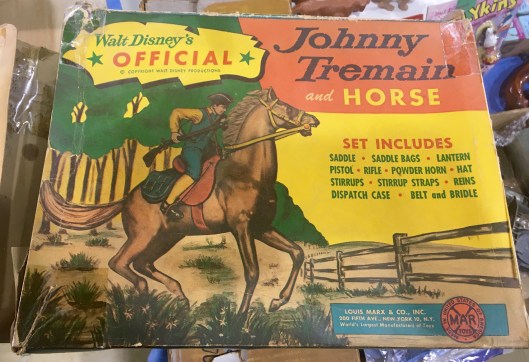
Louis Marx and Company released the Johnny Tremain playset shortly after the release of the Walt Disney movie in the late 1950s.

I hope everyone’s weekend is going well. Early last month at the East Coast Toy Soldier Show in Hackensack I took the photo one sees here. It is an original Johnny Tremain playset manufactured by Louis Marx and Company in the late 1950s just after the movie’s release in 1957. That Disney production of course was based on the 1943 Esther Forbes young adult novel of the same name. Calling Johnny Tremain a young adult novel however does not do the book full justice; Forbes fully intended the monograph to be read by adults as well as kids, which is how the best children/young adult literature is supposed to be read. Indeed Johnny Tremain’s actual subtitle is: A Story for Old and Young. Forbes was awarded the John Newberry Medal in 1944 for Johnny Tremain. I’m sure it went well with the Pulitzer Prize for History she had won the previous year for her biography of Paul Revere.

My father, who as a very young man just out of high school worked for a brief time as a longshoreman on the Boston wharves around which the book is set, gave me a copy of Johnny Tremain when I was about ten. Recently, inspired by seeing the playset above, I ordered a new copy to replace my long-lost edition. Thankfully it also contains the poignant sketchings drawn by graphic artist Lynd Ward. I am about halfway through it right now. The book stands up remarkably well. The trick to reading historical fiction is to understand the context in which the particular title was written. One must never read historical fiction with the idea one is actually studying history. Historical fiction is less “history” than “memory,” not so much a study of the past but a take on how we remember and use that past. Michael Shaara’s The Killer Angels for instance was released in 1974, toward the end of the Vietnam War. Esther Forbes began Johnny Tremain on December 8, 1941, the day after the bombing of Pearl Harbor. Prior to that she had toiled on the draft of a different novel about the Revolutionary War Era, one with a more neutral, even pacifist theme that rang hollow to Forbes after the surprise Japanese attack. Again, context is everything when it comes to historical fiction.

If one is looking for a good book to give the young (or old) reader in one’s life this holiday season, I have the perfect idea.

‘‘Frank Sinatra bought that one.’’

Fox and Sutherland 1970s ad

I came across this article from The Atlantic and thought I would pass along. I googled the author and, based on his saying that he was twenty-three when he took the job, this story would have taken place around 1981 or ’82 depending on when Sinatra actually came in. I cannot say I am surprised he would buy $800 in books, as he did in this reminiscence told from the perspective of the sales clerk several decades later; largely self-taught, Sinatra was a more erudite and intellectually voracious guy than people might realize. Charlie Parker was the same way. And like Parker, Sinatra was a man of incredible flaws but who at his best could grasp the essence of a person or situation with just a quick glance. It is part of what made them the artists that they were. Anyways, in the lead-up to the anniversary of Sinatra’s birthday this coming week here is a little something to read for those so inclined.


December 6, 1790

I was in the city at 8:00 this morning when across the street from Baruch College on 24th Street I saw this news flash on one of those kiosks one sees around the city. Thankfully I got my camera out in time to take a quick snap before the message flipped over. December 6, 1790 was the moment when the nation’s capital moved from New York City and Federal Hall to Philadelphia.

Enjoy the weekend.

“The Crown”

I hope everyone had an enjoyable and restful Thanksgiving. We have spent much of the past few days binge-watching The Crown, which I had never seen before. Apparently the story will follow Queen Elizabeth II from her 1947 marriage through the Thatcher era. The 7-8 episodes we have watched so far have been set in the 1950s. Watching them drives home, among other things, just how much England lost in the Second World War. The two decades after the war’s end were the years of Austerity Britain, with its food rationing, coal gray skies, and declining empire. When the Beatles woodshedded in Hamburg in the early 1960s one of the things that struck them the most was how much farther along was that German port city’s recovery than their native Liverpool’s. While Germany was rebuilding, Liverpool–and even London–were still scarred with roped off bomb craters a full decade and a half after the war.

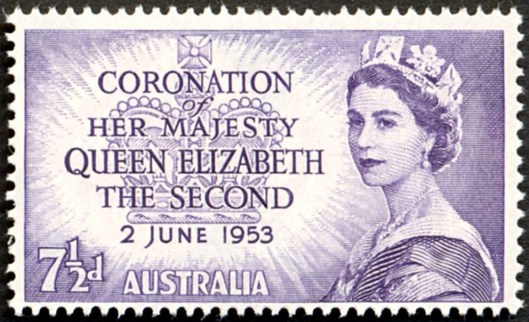
I suppose the queen’s 1953 coronation was an important reminder to the British people of their heritage, which is why they were so enamored with the twenty-six year old monarch. The nascent media of television helped too, humanizing the young queen and bringing her and her family into people’s homes in a way literally never seen before. The royals are all too human and it is wise not to idealize them too much, or even at all. At its best however the Crown as head of state represents continuity even in the most challenging times. One of the reasons I became interested in philately as a teenager was the manner that French and British stamps evolved in the 1950s & 60s during the transition of their colonies to Independence. Sometimes the nearness and immediacy of these events get driven home even in the course of daily life. Just this past week I had a conversation with someone born in the early 1970s in an island Commonwealth country in a hospital dedicated by the current Prince of Wales earlier that very year. Charles’s mother–Elizabeth II–had herself very publicly visited this same small country herself around this same time. Two decades into the twenty-first century Elizabeth II is still serving.

Enjoy your Thanksgiving weekend.

(image/Australia Post)

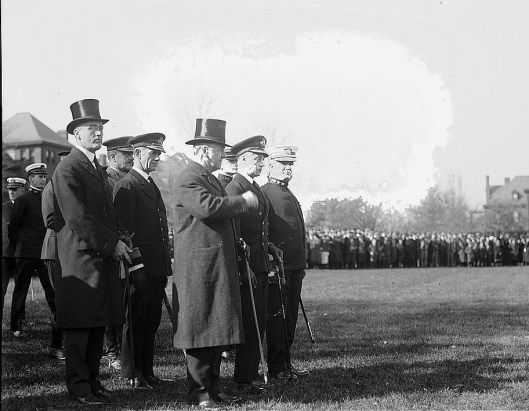
Assistant Secretary Franklin Roosevelt and Prince Edward Albert

Franklin Roosevelt had a soft spot for European royals and did not miss the opportunity to escort Edward Albert, Prince of Wales, to the U.S. Naval Academy with other dignitaries on November 14, 1919.

President and First Lady Franklin & Eleanor Roosevelt famously hosted King George VI and Queen Elizabeth at the Roosevelt estate in Hyde Park in June 1939. Twenty years previously in November 1919 Assistant Naval Secretary Roosevelt and others hosted George’s brother, Edward Albert, on the Prince of Wales’s visit to Washington D.C. This was the same trip I mentioned a few days ago in which the heir apparent to the British Crown had come to North America in that year just after the Great War’s end for an extended period. The future King Edward VIII spent most of that period, almost four months starting in early August, in British Canada, entering the United States via train on November 10 in the border town of Rouses Point, NY on Lake Champlain to a warm welcome on a cold autumn evening from U.S. Secretary of State Robert Lansing, various British & American military brass, and most of the Rouses Point population of around 2000. The following day he arrived in Washington’s Union Station while Armistice Day ceremonies were going on nearby. He spent some moments that afternoon with the incapacitated President Wilson at the White House.

The image we see above was taken at the Naval Academy of November 14. Here we see Roosevelt on the far left. It is always striking to see how strong and virile he was before contracting polio, less than two years after this photograph was taken. The Prince of Wales is second from the right, wearing the uniform of Captain of the Royal Navy. The announcement stating that Edward Albert would visit Annapolis had gone out ten days prior; in that announcement the Prince of Wales made clear he was representing not just England and Britain, but Canada and the Empire itself during his American tour. Still, his time in the American capital was brief. After the visit to the Naval Academy he took a three-day respite in White Sulphur Springs, West Virginia before coming to New York for five days. While here, among many other things, he visited West Point two hours up the Hudson to visit the cadets at the Military Academy. He was in the United States for a mere two weeks, but had done and seen much in that brief span.

(image/Library of Congress)

The Prince of Wales’s arrival

The Prince of Wales, later the Duke of Windsor after his abdication of the British Crown in the late 1930s, arrives in New York City on November 18, 1919.

This was the scene one hundred years ago today when the Prince of Wales, Edward Albert, stopped of a U.S. destroyer at Pier A on the Battery in Lower Manhattan to begin a five day goodwill tour of the city. The Prince of Wales by this times had been in North America for many months, crisscrossing British Canada before going to Washington D.C. for an audience with numerous political dignitaries in the U.S. capital. I mentioned in yesterday’s post about Alan Flusser’s new book about Ralph Lauren how Edward Albert, the future king who would quickly abdicate and become the Duke of Windsor, was one of the most photographed men of the twentieth century. This tour, coming as it did that first year after the Great War’s end, was very much a start of that process. The twenty-five year old prince was being groomed for the throne. The dapper, smiling young prince already represented the British Crown in a way his stiff, dour father, King George V, never could.

Developments in later decades showed aspects of Edward VIII’s judgment that were at best problematic, most obviously his sympathies for Nazi Germany. Those ties have never been fully explained nor likely ever will be by this point. Right now, twenty years prior to the outbreak of the Second World War in Europe, all of that was ahead. For five days in November 1919, just after the world had marked the first anniversary of the Armistice, the Prince of Wales came to New York City for five whirlwind days. About an hour after this photograph was taken he laid a wreath at Grant’s Tomb in Upper Manhattan.

(image/Library of Congress)

Alan Flusser’s Ralph Lauren

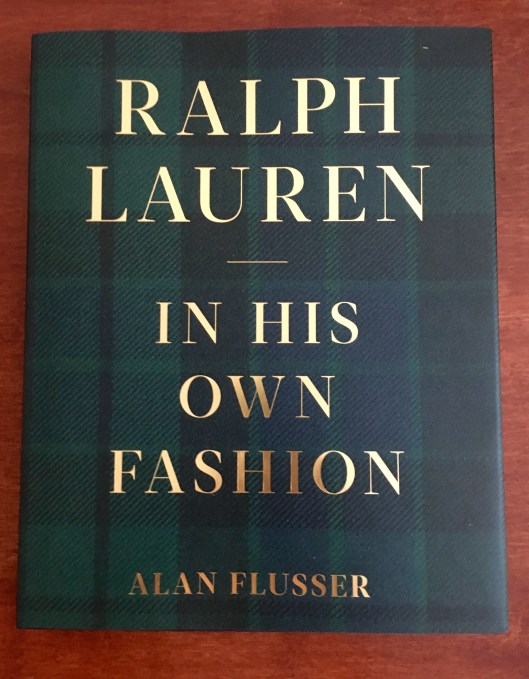
I arrived home the other day and there waiting in the vestibule was the copy you see here of Alan Flusser’s new biography of Ralph Lauren. I was surprised earlier this past week to see that the book was being released right now because I had believed it was coming out in spring 2020. There were reminders over the past twelve years that Flusser was working on a Lauren biography, little hints in interviews and whatnot that the thing was indeed coming along. Alan Flusser is where I went this summer to have my first ever made-to-measure suit made. He and the team he has gathered around him are extraordinary. Having now gone through the experience of having a custom suit made, I understand more than ever what we have lost in the over-casualization of our society. It is sobering to sit at a table and explain to other men how you want to be perceived by the world and then explore how the group of you might achieve that.

I understand that we have gained a great deal over the past half century with the cultural changes of the 1960s, and that jeans and casualwear were part of that movement. There are many things I would not want to return to, but I would submit that a return to greater public formality is something from which would all profit. This was driven home to me a few years ago when, one July, I had jury duty and in the waiting pool area of the courthouse were at least a few people–grown men in their 20s and even 30s–wearing shorts.

What makes both Flusser and Lauren unique is their understanding of tradition. The title of the book, as I take it, is a knowing play on words; the two men have never been about fashion, but style and respect for provenance. There is a huge difference. So far I have read the introduction and perused some of the sumptuous photographs of men like Fred Astaire and Duke of Windsor, two of the most photographed men of the twentieth century. This however is no mere coffee table book. In an interview I watched the other day Flusser notes that the text itself comes to 175,000 words. The text is indeed voluminous and I’m looking forward to digging in.

Veterans Day 2019

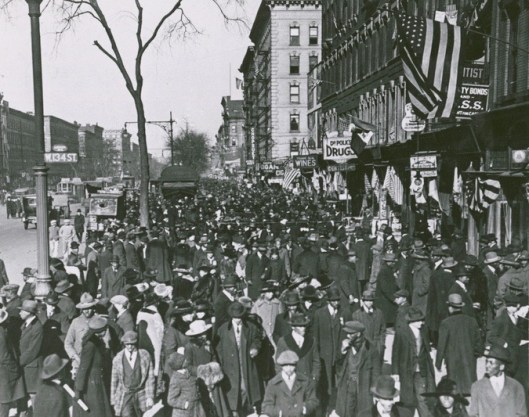
Armistice Day, Harlem 1919

I wanted to take a moment this morning to observe Veterans Day and recognize uniformed service persons past and present.

This was the scene in Harlem at 134th Street and Lenox Avenue 100 years ago today on the first anniversary of Armistice. The headlines from the newspaper of November 1919 indicate the difficulty of the peace. One newspaper headline described New Yorkers’ mood as “sober” as people gathered in churches and elsewhere to remember the living and the dead of 1914-18. All posts of the nascent American Legion in New York held events that November 11th. The mood was similar in Europe, where the French were reflecting on the negotiations at Versailles while Ferdinand Foch and others observed a mass at the Invalides. The British throughout the Empire observed two minutes of silence.

(image/NYPL)

Sunday morning coffee

Here is something one does not see every day. It is a circa 1790s medal of The Society of the Cincinnati. The Cincinnati was an organization founded by American officers of the Revolutionary War in the 1780s just as the conflict was winding down. The first owner of this would thus himself have fought in the war. The “original” Cincinnati, Lucius Quinctius Cincinnatus, was a Roman statesman and military leader who gave up power so as not to become a martial dictator. It was in this same spirit that George Washington resigned his own commission in December 1783.

I took this image yesterday at the Yale Art Gallery. Francis Patrick Garvan and his wife Mabel gave the medal and 10,000 other objects from the Colonial and Early American periods to Yale in 1930 in celebration of their twentieth wedding anniversary. It was the Garvan’s hope that these items be seen by as many people as possible, both via display in the Yale University Art Gallery itself and through loan to such institutions as Mount Vernon and elsewhere so that the items might, in the Garvan’s own words according to a 1938 Yale arts bulletin I discovered in JSTOR, “become a moving part in a great panorama of American Arts and Crafts.”