The life and times of Edward M. Riley

I was up and out of the house early this past Sunday to attend the Hackensack Toy Soldier show in New Jersey. One of the things that came home with me, purchased for a mere $1, is this 1956 National Park Service handbook about Independence National Historical Park. I have a number of modern NPS handbooks that I have purchased over the past several years for the Civil War sesquicentennial and War of 1812 bicentennial. Last year when a friend and I visited Philadelphia I bought The American Revolution handbook as well. The one we see here was written by Park Service historian Edward M. Riley, who authored a number of similar booklets on other sites in this period when the Eisenhower Administration was starting the Mission 66 initiative. One can actually read his tome on Independence National Historical Park online here. Yes, the scholarship moves on–we’re talking two decades prior even to the Bicentennial here–but in addition to keeping up with current progress in my fields of interest I am always intrigued by how historians in the past, in this case the 1950s, handled the topic at hand.
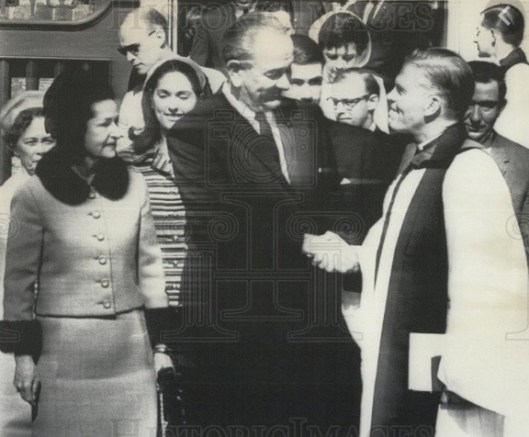
Ladybird and President Johnson with the Reverend Cotesworth Pinckney Lewis, November 1967. Days after this photograph was taken Riley telegrammed Johnson an apology for Lewis’s statements concerning the Vietnam War.

A Proquest search pulls up a small but interesting series of takes on Edward M. Riley’s life and career. In 1955 he had just left his position as historian at Independence Hall and was now at Colonial Williamsburg about to take part in a five-year, $500,000 project to study life in Colonial America. Clearly his mission was to do at Williamsburg what he had done in Philadelphia. In 1959 he is found still at Colonial Williamsburg, serving as director of research, and giving the government of Bermuda a trove of 650 letters related to that nation on the 350th anniversary of the founding of the Colony of Bermuda. In October 1963 Riley comes to Oyster Bay, Long Island to give a talk to raise funds for the renovation of Raynham Hall, a Revolutionary War site. That event was held at Christ Protestant Episcopal Church.

The reason I mention the location is because of the final piece that mentions Riley. In November 1967, Edward M. Riley, a senior warden in the Bruton Parish Episcopal Church of Williamsburg, telegramms President Lyndon B. Johnson an apology after the Rev. Cotesworth Pinckney Lewis challenged the president, who had been at the Virginia church’s service the week previously, from the pulpit on his Vietnam War policies. Riley’s role in the apology is unclear; the article seems to imply that the Bruton Parish leadership were sending the missive on orders from the Episcopal Church’s more senior leadership. Public pressure was certainly intense, with over 10,000 calls and letters coming in from around the world. Johnson was furious. It’s an extraordinary story and part of the life of an extraordinary historian and figure.

(bottom image/Historic Images Outlet)
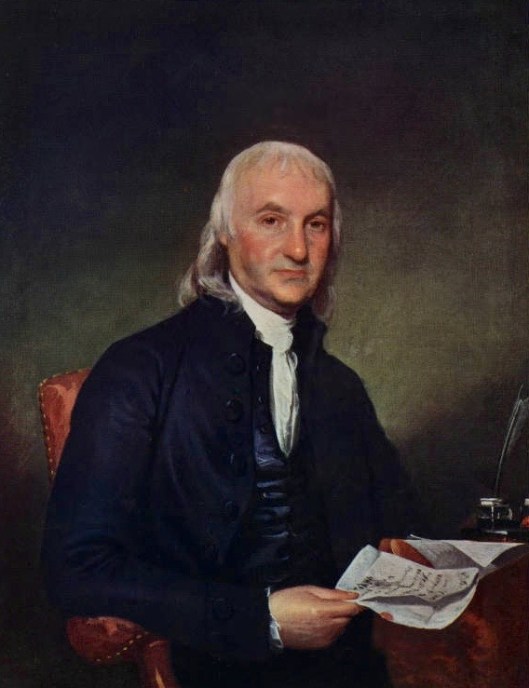
Isaac Roosevelt, colonial New Yorker

Isaac Roosevelt, 1726-1794

The Journal of the American Revolution has uploaded my article about Isaac Roosevelt. I spent much of late summer and early fall working on this project and am happy with how it came out. It had been my loss goal for several years to write about Isaac and the specific “ah ha” moment came one August Saturday at Federal Hall when I was talking to one of rangers about prominent New Yorkers of the colonial, Revolutionary, and Early American periods. When we think of these eras we tend not to think of the Roosevelts, though they were very much prominent in local, national, and international affairs in these decades. That is what I tried to convey in this piece. Isaac Roosevelt was Franklin D. Roosevelt’s great, great grandfather.

I don’t want to give away too many details at the moment but I am preparing a submission to speak at a conference next year about interlocking familial aspects of the Early American and Civil War generations, focusing on one father, son, and grandson, the last of whom features prominently in my book manuscript Incorporating New York. If it comes to pass the Roosevelts, though not front and center, will feature as well. So often we hear that both sides in the Civil War, Union and Confederate, saw themselves as the inheritors of the Founders’ legacy. That is certainly true, but how and why is something we do not always hear about. We’ll see how the pitch to conference selectors goes. In the meantime, here is my biographical narrative of the life and times of Isaac Roosevelt, a founder of the State of New York, ratifier of the U.S. Constitution, and good friend of Hamilton, Jay, and others.

(image/FDR Presidential Library and Museum)

2019, put it in the books

Nationals Ballpark, June 2019

This was the view from our seats at Nationals Ballpark this past June when we saw the Nats take on the Braves in a game that ended on a sliding catch by the Nats center fielder in the ninth that saved the game. Last night the Nationals defeated the Astros in seven to give a Washington D.C. team its first World Series since the 1924 Senators. Of course the Senators were not the only game in town back in the day; the Homestead Grays played there as well–and would have given the Senators a run for their money.

I have always been entranced by baseball in the nation’s capital, an interest fueled by the fact that my mother was born there. I reached out to numerous family members these past few weeks to ask if anyone knew if our grandparents (or parents, depending on the generation) attended Senators games while living in the District during the Depression and Second World War. No one knew for sure, but alas the consensus seemed to be no. In the 1980s my grandfather also had a Redskins Starter jacket. I never knew if his interest in the Redskins came from his time in D.C., or grew from the fact that that football team played in Boston for a time in the 1930s. He and his growing family would have been living in Anacostia when the team moved from New England to Washington in 1937. My grandparents moved back to Boston in 1945 when the war ended, with three daughters all under the age of ten in tow. The family turned, or returned, its rooting interests to the Red Sox, which is as it remains today.

It was a great season and post-season and it is so good to see championship baseball return to Washington.

Rainy Sunday winding down

I hope everyone’s weekend was good. Here was the scene yesterday at Federal Hall when Charles Starks spoke about the life and legacy of George F. McAneny. Few today know who McAneny was, but the public official and urban planner was one of the most influential figures New York City in the first half of the twentieth century. Among other things he helped turn Federal Hall into a national memorial. Starks did a good job capturing McAneny’s significance. Here we see the speaker showing an image of Robert Moses and his never-built Brooklyn-Battery Bridge. The reason that project never came to fruition was in part due to McAneny, Eleanor Roosevelt, and others.

It was so good to be in front of the public again. There is nothing like that interaction with a live audience, especially a curious audience. There was a big turnout for Open House New York, with some coming from Westchester for the day to take in Federal Hall and other venues sponsoring Open House NY events in the downtown area. There were many good questions, many of which I was able to answer and some that I was not. That is always humbling. At the same time it is also unavoidable. When it comes down to it, we know very little.

Open House New York 2019

If you are looking for something to do this weekend and live in the Greater New York area note that it is Open House New York weekend. The weather will be nice and there will be a lot going on around town. I know someone whose mother is coming in from Rhode Island so the two of them can hit some art galleries that are opening their doors just for the special, annual event that is OHNY. Federal Hall itself will be open tomorrow. Yours truly will be there for at least part of the day. It will be good to be back. In what certainly will be an informative presentation Charles Starks will be speaking about George F. McAneny, one of the most important and sadly forgotten New Yorkers of the twentieth century.

Whatever you do on your Saturday and Sunday, go out and get some.

The photographers’ Great Depression

Okies in Farm Security Administration (FSA) emergency migratory labor camp, Calipatria, Imperial Valley, February 1939. This image was taken by Dorothea Lange, a colleague of Arthur Rothstein whose images are included in the current exhibit at Roosevelt House.

I’m sorry about the lack of posts recently. I have spent much of the past several weeks finishing the draft of a project that proved more difficult and time-involved that I had imagined. I submitted the draft the other day. We’ll see if comes to pass toward the end of the year. People were asking me at work yesterday what I intended to do over the three-day weekend; when they did I answered with a negative: “not writing and editing.”

Last night I went to Roosevelt House on East 65th Street for the opening of the exhibit “A Lens on FDR’s New Deal: Photographs by Arthur Rothstein, 1935-1945.” Rothstein was one of the great visual chroniclers of Depression Era America. It is not going too far to say that he, his friend and colleague Dorothea Lange, and others shaped our awareness and memory and of what the country was enduring in the 1930s and early 1940s. Part of the reason the Roosevelt Administration created the initiative to photograph the severity of the economic crisis to begin with was to press the need for its New Deal programs.

Rothstein was the son of refugees from Eastern Europe. Like so many immigrants and first-generation Americans, he was eager to make his contribution. Born in 1915, Rothstein attended Columbia University at fifteen and in the mid-1930s, just a young man in his early 20s, found himself driving across the country on dirt roads, sleeping in his car, eating off a hot plate, and shooting 80,000 images in migrant camps, farming communities, and elsewhere.

Rothstein’s daughter, Dr. Annie Segan, put the exhibition together in with her husband and the Roosevelt House historian. With over 125 photographs it is the biggest exhibit of Rothstein images to go on display in more than a quarter century. Other photographers are included as well. Many of the images were taken from tiny negatives. Rothstein’s daughter in her talk called them “picture stories.” Incredibly the trove of 175,000 images taken by Rothstein and the nearly twenty other photographers working for the Resettlement Administration (RA) and Farm Security Administration (FSA) were nearly discarded by indifferent bureaucrats in the years after the Second World War. Thankfully they were saved and are available to the public at the Library of Congress and online.

The exhibit runs into January 2020.

(image/Library of Congress)


Sunday morning coffee

Senator Hiram W. Johnson was a founder of the Progressive Party. In 1912 he ran with Theodore Roosevelt on the Bull Moose ticket against Wilson, Taft, and Debs. After the Great War Johnson helped killed U.S. entry into the League of Nations.

I’m gearing up here in my home office to get some writing done on an article. The project is taking a little longer than I wanted but it will get down in due time. The laundry will get thrown in somewhere along the way as well.

I received an email yesterday from Mike Hanlon at Roads to the Great War, who let me know that they published my piece about Henry A. Wise Wood and the League for the Preservation of American Independence. I’ll let one read the entire thing if inclined, but in a nutshell Wood and like-minded individuals such as Senator Hiram Johnson did everything in their power to kill Woodrow Wilson’s Covenant for the League of Nations.

I don’t want to go into any details here, but some colleagues and I at work received some exciting new this past Friday about a public history project for which we submitted a proposal. We heard that ours was one of the winners. Now comes the task of ironing out some logistics and putting the thing together. When the time comes, I will share more.

Enjoy your Sunday.

(image/Library of Congress)

Talking Hart Island podcast

I received an email recently from author and podcaster Michael T. Keene, who introduced himself and told me of his exciting new project: the Talking Hart Island podcast. For those who may not know, Hart Island is located in Long Island Sound near the Bronx and since 1869 has served as New York City’s potters field. It is the largest public burial ground in the United States. Approximately one million souls rest there today. Hart Island is still very much a working cemetery; officials estimate it has about another decade to go before reaching full capacity. One hundred and fifty years of burials dating back the days of Tammany offer many exciting interpretive possibilities for a podcast.

Today is an exciting time in the long history of Hart Island. Currently run by the NYC Department of Correction and tended by inmates from Rikers, Hart Island may soon open as a public park if the city council votes to change the island’s jurisdiction to the Parks Department. DNA is now making it possible to identify some of the unknown. These are the stories Mike Keene and his team are telling. Today I listened to the segment one featuring Russell Shorto, To start at the very beginning was a great move. Too often when the public thinks of the history of New York they think it begins with the British. In reality it was the Dutch who set the tone and character of what they called New Netherland. Much of that Dutch ethos remains with us today.

There are already three episodes of Talking Hart Island available for listening, with a new episode coming weekly. Give it a listen by clicking on the image above.

Constitution Day

Audience at FDR’s Constitution Day speech, September 17, 1937

Today, September 17, is Constitution Day. It was on this date in 1787 that the Framers met for the final time to sign the document they had written over that contentious summer. It was never a sure thing and was still not a done deal; after that the Constitution went to the states for ratification, a process that took several years as state delegates argued for and against. It was in this period that Hamilton, Jay, and Madison authored The Federalist.

Constitution Day is one of those holidays, like Flag Day and Evacuation Day, that used to be a significant part of American culture but that are hardly remembered today. We would do wise to keep in mind what we stand to lose; if we have learned anything over the past few years it is that our world is more fragile than we would like to think. Many thousands used to turn out in places like Brooklyn’s Prospect Park and Borough Hall for speeches and parades. There is still some of that. The Rufus King Manor in Queens, for instance, is having its annual observation and fundraiser today. King himself was one of the drafters of the Constitution and was there in Philadelphia for most of the convention. Other events are undoubtedly taking place elsewhere.

President Roosevelt gave his 1937 Constitution Day speech during his Supreme Court packing initiative, largely seen today as one of the major blunders of his administration.

Here are two images from the 1937 Constitution.Day. President Roosevelt spoke that evening at the base of the Washington Monument. One can see the seriousness on his face. That is because this event came during his notorious Courting Packing controversy and he was trying to rally support. The thing never went his way and it is justifiably seen as a low mark in his twelve year presidency.

(images/Library of Congress)


The summer of 1919’s terrible climax

Boston’s Faneuil Hall. Headquarters of the National Guard during the September 1919 police strike. Governor Calvin Coolidge called out the guard in response to lotting and violence.

Summer technically has another week and a half to go, and these waning days mark the anniversary of one of the worst events of that terrible Red Summer of 1919: the Boston Police Strike raged for nearly a week that September. It was anarchy when more than 1000 police officers walked off the job. Hobbes was right. The same thing happened in Montreal half a century later in 1969. The Boston strike was just one of the many violent outbreaks that year, many of which were essentially pogroms against African-Americans. In a broader context in can also be seen as another in one of the thousands of strikes that had taken place across the country dating back decades to the Gilded Age.

Guardsmen rounding up gamblers in Boston Common during the municipal police strike of 1919

The big winner in the 1919 Boston Police Strike was Governor Calvin Coolidge, whose calling out of the National Guard helped staunch the violence and looting. The following year Coolidge was on the national ticket when he and Warren G. Harding defeated Franklin D. Roosevelt and James M. Cox in the 1920 presidential election. I wish my grandparents on both sides were still alive for me to ask if they remembered the incident; all four grew up in Boston and would have been between 5-10 at the time, old enough perhaps to remember something or to have heard older relatives discussing it in later years. Alas I will ever know because the opportunity is just no longer there.

(images/Boston Public Library)