Unscaffolding the Trylon and Perisphere

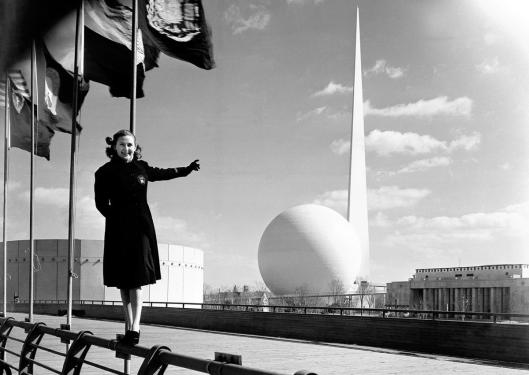
A 1939 World’s Fair guide shows off the Trylon and Perisphere after the scaffolding came down, February 22, 1939

I don’t have much to add but wanted to share this photograph I discovered this morning while preparing for next week’s classes. Here we see a young woman standing before the Trylon and Perisphere after the remainder of their scaffolding was taken off on 22 February 1939. The World’s Fair coincided with the sesquicentennial of George Washington’s First Inaugural; President Roosevelt opened the Fair on 30 April, 150 years to the day after Washington took the oath of office in Lower Manhattan at Federal Hall. In winter 1939 Robert Moses’s crews were working long shifts to prepare the fair grounds in Queens in time to ensure the event opened on time come spring. Presumably they took the scaffolding off on Washington’s Birthday intentionally to promote the upcoming fair and emphasize the tie-in to the first president.

(image/Associated Press)

Madame Chiang-Kai-shek’s 1943 charm offensive

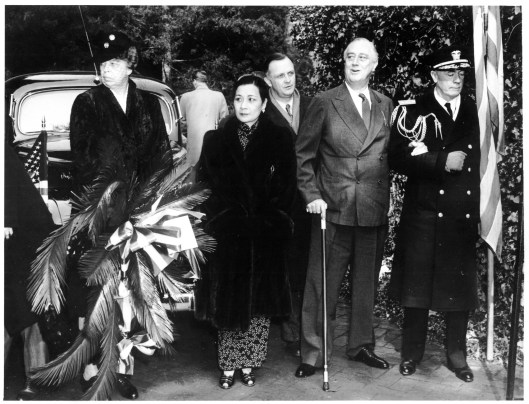
Franklin and Eleanor Roosevelt host Madame Chiang-Kai-shek at Mount Vernon on George Washington’s birthday, February 22, 1943. The worldly, charming, and politically shrewd wife of the leader of the Chinese Nationalists was on a good will tour of the United States, officially to gain support for the war effort against the Japanese but also, more surreptitiously, for the Nationalist struggle against Mao’s Communists.

Here is an extraordinary moment in twentieth century.  The image depicts Eleanor and Franklin Roosevelt with Madame Chiang Kai-shek at George Washington’s tomb at Mount Vernon on February 22, 1943, seventy-six years ago today. As early as 1943–more than fifteen months before the invasion of Normandy, five months before the Allied offensive on Sicily, with North Africa hanging in the balance and the Japanese still largely in control of the Pacific–President Roosevelt was already thinking of what a post-Second World War world might look like. Roosevelt believed that China would become one of the world’s Great Powers in the years immediately after the war. This was not an unreasonably assumption; then and now China was the world’s most populous nation. That alone made that nation a potent force. Roosevelt had nonetheless convinced himself that he was something of a China expert, basing his belief on the Delano family’s ties to the country dating back nearly a century. His grandfather had been active in what was euphemistically called the China Trade, which in addition to legitimate business activity essentially meant the sale of opium.

Roosevelt’s naïveté led to some unfortunate policy choices but one might forgive the president for his views on China, whose internal and external politics were exceedingly complicated. For one thing the Japanese had committed human rights violations there on an unprecedented scale. The Rape of Nanking, human experiments, and the imposition of slave labor were just some of their depredations. It is no wonder that President Roosevelt extended Lend-Lease aid to China to the extent that he did. Complicating it all however was the internal struggle between Chiang Kai-shek’s Nationalists and Mao Zedong’s Communists. That was the real struggle playing out there. And that is the reason Madame Chiang Kai-shek visited the United States in early 1943. On February 18 she addressed a joint session of Congress, becoming the first Chinese person and first-ever woman ever to do so. Four days later this photo was taken on George Washington’s birthday at his Mount Vernon tomb, where she placed a wreath at Washington’s tomb.

Six years after this photo was taken Mao’s forces won the Civil War against Generalissimo Chiang Kai-shek’s Nationalists. Roosevelt by that time had been gone for almost five years. Chiang Kai-shek lived until 1975 and his widow lived to be 106. She died in New York City in 2003.

(image/Mount Vernon)

Remembering John Patrick Diggins

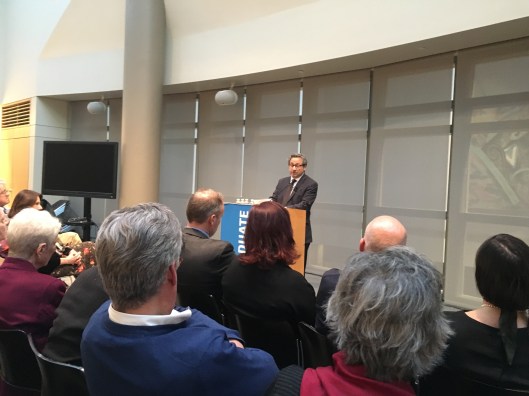
Andrew Delbanco, president of the Teagle Foundation and Alexander Hamilton Professor of American Studies at Columbia University, giving the 10th annual John Patrick Diggins Memorial lecture, CUNY Graduate Center, February 19, 2019

I can hear the snow melting as I type these words. I am leading a tour of Brooklyn’s Grand Army Plaza for a colleague’s class later this morning. It should be warm enough but hopefully not too squishy out there. This past Tuesday I went to the CUNY Graduate Center to hear Andrew Delbanco, president of the Teagle Foundation and Alexander Hamilton Professor of American Studies at Columbia University, give the 10th annual John Patrick Diggins Memorial lecture. I took a class on the Cold War with Jack Diggins in Fall 2004, fifteen years ago. He died in 2009, the same year my own father died. That these things were now so long ago is extraordinary to contemplate.

Professor Delbanco spoke movingly about fugitive slaves prior to the American Civil War, basing his lecture on his new book The War Before the War: Fugitive Slaves and the Struggle for America’s Soul from the Revolution to the Civil War. Delbanco is not a historian per se but an English and American Studies professor. He brought a strong narrative drive to the topic, touching on the writing of Melville, Emerson, and Frederick Douglass to name just three. One thing that made the talk so affecting was the human detail. It is one thing to say that 750,000 or more people died in the Civil War; it is another to give a sense of the human drama of individual lives a voice. As the cynical but accurate saying goes: one death is a tragedy, but one million deaths is a statistic. Delbanco also infused a sense of humility into his talk, something that is too often lacking in the writing and presentation of history. Who among us can say what we would have done had we lived in another time and place? What will our own disenchants say about us and the decisions we made, individually and as a society? One must embrace complexity. I could not think of a more fitting talk in the memory of John P. Diggins.

Presidents Day 2019

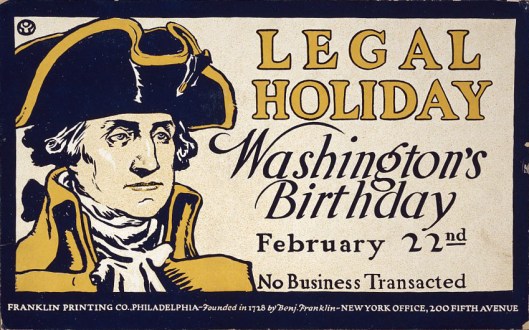
I would love to have been able to visit Mount Vernon today but alas that was not feasible. I imagine they are having events today, and again this coming Friday on President Washington’s actual birthday. Inspired by yesterday’s post about Al Smith and his annual viewing of the retired firemen of Brooklyn, I’m leaving in a bit to visit the New York City Fire Museum in SOHO. Fire houses played a role in Washington and 4th of July observances from the time of the Early Republic until just a few recent decades ago. I’m up and out early because when I return I have to prepare for the week ahead, not least the laundry.

Enjoy your Presidents Day, everyone.

(image/Early twentieth century Edward Penfield poster via Library of Congress)

Washington’s Birthday 1928

New York governor Al Smith reviewed the Kings County Volunteer Firemen’s Association on Washington’s Birthday in 1928 in the leadup to the presidential race.

I was reading a good-natured online debate the other between a couple of people arguing the merits and demerits of American holidays. One of the running threads–indeed, the instigation of the discussion–was the idea of President’s Day itself. Some were averring that the holiday we are observing this weekend is now a second-tier observance, which is tough to argue against. It was not always the case however. President’s Day began as George Washington’s Birthday, and is still legally considered as such in many of the fifty states. Up until around the Second World War however Washington’s Birthday was still considered one of our most prestigious holidays, ranking below Christmas and Easter and on par with the 4th of July. It makes sense that Americans would have two secular holidays–one in winter and the other in summer–of such consequence. From the early days of the Republic through the mass immigration of the early twentieth century these holidays gave Americans a shared narrative. The 4th of July is still part of that narrative, but Washington’s Birthday–or even the more general “President’s Day–not so much.

Some of the men assembled to speak at Brooklyn Borough Hall were in their 90s. Later that day Governor Smith and Congressman Fiorello La Guardia spoke at the Brace Memorial Newsboys’ Lodging House in Manhattan.

Here above we see a moment during which Washington’s Birthday was still very much part of our cultural fabric. In 1928 Governor Alfred E. Smith visited Brooklyn to review the organization of retired Kings County firemen. From the steps of Borough Hall he watched the procession of men, some in their 90s, as they hailed the man everyone knew would run for the presidency that coming November. The Eagle, whose offices were adjacent to Borough Hall, noted that “Only the Roman candles and fireworks of the old political campaigning [were] missing.” It was not just Brooklynites; firemen had come from throughout Long Island, Manhattan, and as far away as Philadelphia and Delaware to see and hear Smith.

The governor had been coming to this event throughout the 1920s. He had come down from Albany for a few days to appear at several events; after speaking to and lunching with the retired firemen in Brooklyn, Smith returned to Manhattan and dined at the Brace Memorial Newsboys’ House on William Street. Lodging houses like the one Smith spoke at on Washington’s Birthday 1928 dated back to the days when Charles Loring Brace and Theodore Roosevelt Sr. created them prior to the Civil War. There with Smith at the lodging house was U.S. Congressman Fiorello La Guardia. Smith’s message to the 1,200 assembled hardscrabble lads was to accept that life is difficult even under the best of circumstances. The governor and presidential aspirant understood difficulty, having been born a slum kid on the Lower East Side and toiling in the Fulton Fish Market before becoming a Tammany man and starting his rise.

(images/Brooklyn Daily Eagle)

Sunday morning coffee

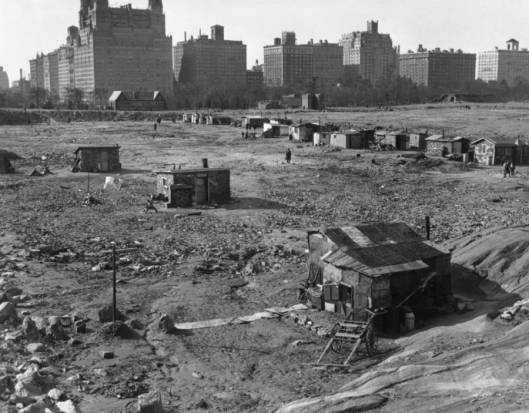
Depression Era Hooverville in New York’s Central Park, circa early 1930s

Good morning, all. I have spent a good portion of the morning putting together this week’s presentations for our class on the life, times, and legacy of Robert Moses. I have learned a tremendous amount already this year. I thought I would share this incredible image I intend to show tomorrow in class. This is a so-called Hooverville in Central Park during the Great Depression. These squatter camps were ubiquitous across the United States and were so named in derisive “tribute” to President Herbert Hoover, who Americans unfairly blamed for the onset of the financial crisis.

I am often taken aback looking at old photographs of such cities as New York, London and Paris and seeing how dirty and chaotic they were not so very long ago. Yes, this was the era of the Great Depression and a Hooverville to boot; still, the early twentieth century cities were not the gleaming metroplises we know today. When I moved to New York City twenty-two years ago in 1997 the Bowery still had the last of its flop houses. Today those are gone and in their place are boutiques selling expensive retail goods.

(image/skyscrapercity.com)

Living with Moses

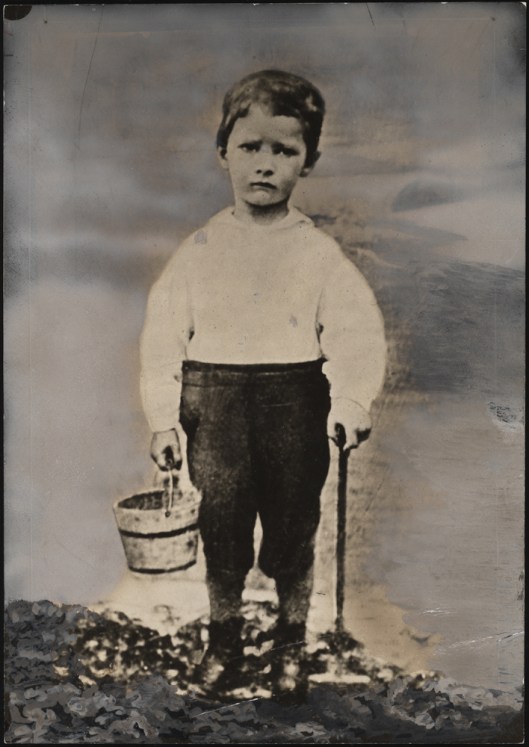
Alfred E. Smith, seen here at age four in 1877 at Coney Island, became governor of New York State in November 1918 five days before the Armistice. He was a good friend and mentor to master builder Robert Moses.

I hope everyone is enjoying their Sunday. Looking out the window right now I see it is clear and bright blue. How cold it might be is another story. I’ll find out when I run some errands in a bit. I spent a good portion of the morning preparing lesson plans for the week, which includes a sizable number of images to accompany the talks. My colleague and I decided to focus our course this semester on Robert Moses, who for good and ill gave New Yorkers most of the city we live in today. What we most want students to get from the class is an understanding of the complexity of Moses’s legacy, that Moses was less a psychotic power broker and more a flawed and complicated public servant who did the best he could within his circumstances to build New York City and State as he believed proper within the historical moment.

In a sense the course picks up where my book manuscript, Incorporating New York, ends. I finish my manuscript about Theodore Roosevelt Sr., Louisa Lee Schuyler, and their cohorts in 1923 with the opening of the Theodore Roosevelt Birthplace. Moses gets his first position of genuine authority in 1924, when his friend and mentor Governor Alfred E. Smith appoints him leader of the Long Island State Park Commission. By this time the balance has shifted in New York City from the old Dutch and British families to the Italians, Jews and others who had arrived from the Old World over the previous several decades. The major exceptions to that of course are Eleanor and Franklin Roosevelt, whose stars are rising in this period and would carry on until Eleanor’s death in 1962. Moses himself holds on until six years after that, when Governor Nelson Rockefeller relieves him of the remainder of his duties in 1968. Over the years the Roosevelts would be friends, allies, and sometimes adversaries of Smith and Moses. I have been rolling up my sleeves and digging in since the start of the year and will proceed thusly until Memorial Day Weekend. It has been a great deal of work but a blast at the same time.

(image/Museum of the City of New York)

The presidents of Charles Addams

The first 37 presidents as drawn by New Yorker cartoonist Charles Addams in 1972

This past August, almost six months ago now, a friend and I visited the Morris-Jumel Mansion in Upper Manhattan. Among other things, on display at the time was an exhibit of the works of cartoonist Charles Addams. The artist was the originator of The Addams Family, which he based on his real life family much in the way Matt Groening later based The Simpsons on his own family. I have no doubt that Groening knew the history of Addams’s work when starting out in the late 1980s, around the time Charles Addams died of a heart attack in 1988. Addams had begun working for the New Yorker in 1935 during what we know see was a golden age of magazine writing and drawing. His contemporaries include such figures as Rea Irvin, Norman Rockwell, and J. C. Leyendecker. The item that struck me the most that day at the Morris-Jamel house was this image we see here of the presidents, which Addams created for the June 3, 1972 New Yorker cover. This would have been the summer of the McGovern vs Nixon presidential race.

The photo is not the best because the drawing was behind a pane of glass. I told my friend on that hot August day that I would post this come late January on what would have been Franklin Delano Roosevelt’s birthday. FDR was born on this day in 1882. We see him here in the top row, fourth from the left, standing tall with his characteristic big grin.

Alexander Hamilton, 1816-1889

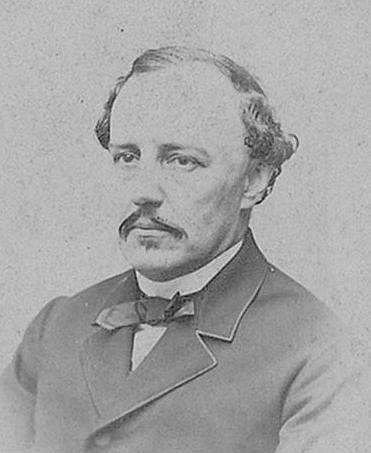
Alexander Hamilton, a grandson of the Founding Father, served in the American Civil War and was prominent in the social fabric of New York City and Hudson River Valley cultural life before and after the war.

Alexander Hamilton, grandson and namesake of the first Treasury Secretary, was born on this date in New York City in 1816. Hamilton was the younger brother of Eliza Hamilton Schuyler, which thus makes him the uncle of Louisa Lee Schuyler. Hamilton served in Spain as a diplomat on the staff of his friend Washington Irving in the late 1840s and early 1850s. When the American Civil War broke out a decade later he and his brother-in-law George Lee Schuyler served on the staff of General John E. Wool in Virginia and elsewhere. It is lost on us sometimes how close to the Revolutionary War was the Civil War; many of the figures on both sides of the Rebellion were the grandchildren of the first generation of Americans and were convinced that they were fulfilling the wishes of the Founders. It is a theme I expand upon in Incorporating New York, my book manuscript about the Civil War Era generation that came of age in the mid-1850s and lived on through the late nineteenth and early twentieth centuries.

Alexander Hamilton (1816-1889) headstone, Sleepy Hollow Cemetery

Alexander Hamilton was a Civil War officer, prominent lawyer, and founding member & eventual president of the Knickerbocker Club. He died 130 years ago this year and is buried in the Hamilton-Schuyler plot in Sleepy Hollow Cemetery north of New York City, up the hill from the final resting place of his friend Washington Irving. I took the photo above when a friend and I visited early this past December.

(top image/D. Appleton & Co.: A.A. Turner, photographer)


President Buchanan and the future King Edward VII visit Mount Vernon

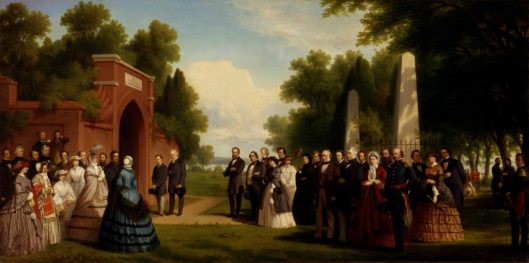
This painting of President Buchanan, the Prince of Wales, and several dozen dignitaries at George Washington’s tomb in October 1860 captures a dramatic moment in diplomatic history just prior to the outbreak of the American Civil War.

Two inspirations for visiting Mount Vernon last week was a trip to the Philadelphia Museum of the American Revolution last June and a chance viewing of the above painting at the National Portrait Gallery in August. Here we see President James Buchanan and the Prince of Wales, who forty-one years after the events depicted here would become King Edward VII, visiting Washington’s tomb at Mount Vernon in October 1860. Buchanan knew the royals well, having served as Ambassador of the United States to the Court of St. James’s from 1849-53 when the prince was a very young lad. The events depicted in the painting took place in early October 1860, one month before the presidential election won by Abraham Lincoln.

The Prince of Wales was in the United States on a goodwill tour. Everyone put of a brave face but relations between the countries were strained. This all took place within living memory of the War of 1812 and even, for some very aged persons, the Revolutionary War itself, and tension in the Anglo-American relationship were evident. This was the tour during which Michael Corcoran of New York’s 69th Infantry Regiment refused to march his men before the Prince of Wales in review. The controversy in New York took place a week after this trip to Washington. The British entourage was unimpressed with the still-young nation’s capital. The unfinished crown atop the Capitol Building, stump of the unfinished Washington Monument, and shabby condition of even Mount Vernon itself–onetime home and final resting place of the colonial general and father of the country–reflected poorly on American ingenuity and even the viability of republican government itself. Given the hysteria and fever pitch surrounding the four-man presidential race then underway, once cannot really blame them for thinking such things.

(image/Visit of the Prince of Wales, President Buchanan, and Dignitaries to the Tomb of Washington at Mount Vernon, October 1860, painter Thomas P. Rossiter; Smithsonian National Portrait Gallery)