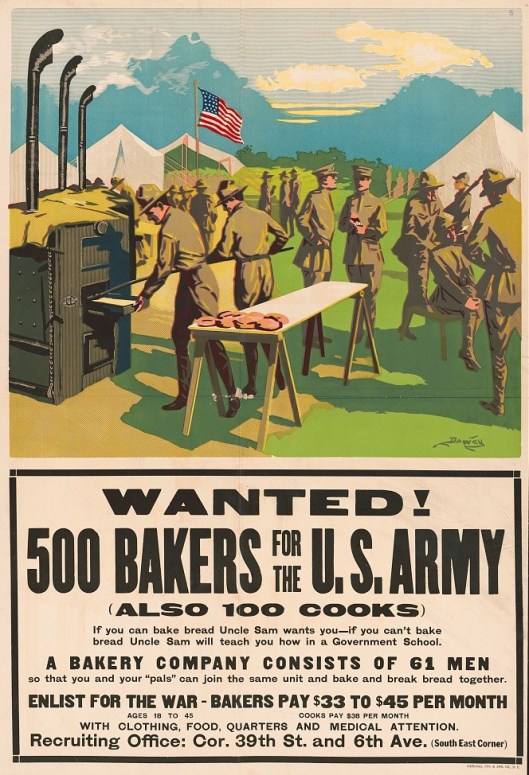
One of the many advertisements soliciting bakers and cooks in the early months of America’s entry in the war.
One does not find it in the drill-book that the way to keep coffee and slum hot after it left the rolling kitchens is to take out the boilers with the food in them, wrap these boilers in old blankets, put them on the two-wheeled machine-gun carts, which can go nearly anywhere, and work forward to the troops in this way. This is just one instance, one trick of the trade. It is something that only training and experience can supply, and yet it is of most vital importance. I have known divisions to help feed the more recently arrived divisions on their right and left, when all have the same facilities to start with. I have known new troops, fighting by an older division, to be forty hours without food when men of the older division had been eating every day.
–Lieutenant Colonel Theodore (Ted) Roosevelt, Jr. Average Americans, 1919
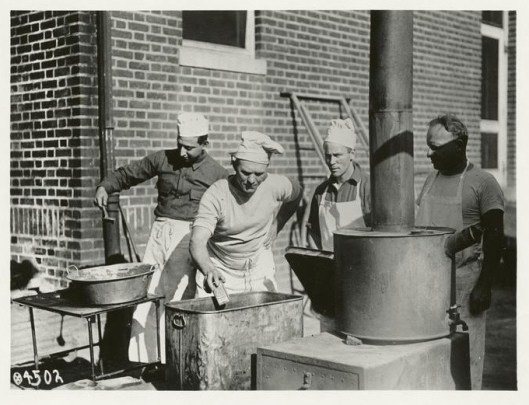
Four men learn the basics in a Great War era Cooks’ and Bakers’ School, circa 1917
They say an army moves on its stomach and no one understood this more than the U.S. War Department in May 1917. One hundred years ago today the Quartermaster Corps on Governors Island issued a joint statement along with the Navy asking trained cooks to join the ranks. Pay for a trained military cook could come to as much as $45 a month, or just over $1,100 in today’s dollars. It was not just cooks that were in short supply. Equally scarce were butchers and bakers. Recruiting qualified candidates was no small task. One general estimated in 1918 that a single regiment of a thousand or so men required as many as forty-five trained cooks to keep the unit properly nourished. The general continued that more than 11,000 cooks would be necessary to feed what was becoming the American Expeditionary Forces. It was an immediate problem; people must eat every day and hundred of thousands of men were enlisting across the country.
The Army could train men in the culinary arts as well. Cooks’ and Bakers’ Schools had been a common feature of military barracks in the Regular Army for some time. With the United States now in the war the Army, Navy and Marine Corps were expanding their culinary schools, which were usually a four month program covering the basics of food preparedness. Recruiting food preparers proved slow going and further pleas went out over much of the summer of 1917, usually to little avail. Apparently the men were not interested because they preferred the glory of shouldering a rifle and fighting the Hun than they did the alleged ignominy of ladling soup and potatoes to hungry doughboys.
It was a gorgeous day today and I took advantage of the spring weather to visit Green-Wood Cemetery. While there I came across this headstone for one Mary M. Aitkin. When I got home I checked Ancestry and the Brooklyn Daily Eagle but found nothing on this veteran of the First World War. Aitkin’s headstone seems to be part of the plot for the Donnelly’s. Here below is a wider view. I searched for a Mary M. Donnelly as well but found nothing. I was struck by the sandy ground, which seems to have been recently tilled. This is not uncommon in Green-Wood which is still very much a working cemetery. Still, the bronze plaque protruding from the ground seemed striking.
if one looks closely at the Donnelly headstone one notes that there are names engraved for individuals who have not yet passed on. That leads one to believe this is very much a living cemetery plot, no pun intended. Coincidentally or not there is also a Mary on the larger headstone, for an individual born in 1956. Part of the power of visiting cemeteries is wondering about the lives of those one comes across. I would love to know the story here. It is interesting to note that Ms. Aitken died forty-six years ago this week. Also, she was older than most uniformed service persons who served in the Great War. Born on 8 November 1888, she turned thirty three days prior to the Armistice.
Hanoi, North Vietnam: American servicemen, former prisoners of war, are cheering as their aircraft takes off from an airfield near Hanoi as part of Operation Homecoming, February 1973
Last night I finished Through the Valley: My Captivity in Vietnam, former POW William Reeder Jr.’s unflinching but in the end hopeful memoir of his experiences. I hope more first-person accounts of the Vietnam War are released in the coming years; veterans of this era are now in the late stages of middle age and if they don’t tell their stories now the accounts may be lost forever. Each narrative is another tile in the mosaic. Now is actually an opportune time because each year through 2025 marks the 50th anniversary of the events. The New York Times is running a yearlong account of the events of 1967 which one can read here if so inclined. It will be interesting to see if they do the same for 1968, which was the year the war turned after the Tet Offensive, Walter Cronkite’s visit, and the growing intensity of the protests leading up to the presidential election that November.
Reeder’s account is a harrowing one but ends with his hard-earned lesson that whatever situation one may in there can always be reason for hope if one chooses. Daily or the now almost half century since his return he reminds his children, now grown and some with kids of their own, that every day offers an opportunity and something to treasure. Remember during this Great War centennial that other events worthy of recognition are taking place as well.
(image/National Archives and Records Administration)
≈ Comments Off on Augustus Peabody Gardner, part one
Congressman Alexander Peabody Gardner (D-MA) was on the golf course in 1916 but back in a military uniform one year later. In May 1917 he was appointed a colonel in the Army.
In Sunday’s post I mentioned Theodore Roosevelt’s efforts to raise four divisions to fight the Germans in the Great War. Two of the major players in that episode were Senator Henry Cabot Lodge and his son-in-law Augustus Peabody Gardner. Lodge and Peabody were Boston Brahmins, part of a world that Roosevelt came to know in the late 1870s while attending Harvard. The names say it all: Lodge, Peabody, Gardner. I am not sure how Augustus is related to Isabella Stewart Gardner, the founder of the museum that bears her name, but the connection is there somewhere. I intend to do a deeper dive on A.P. Gardner later in the centennial, but today I wanted to pause and note something I found to be of great interest: it was one hundred years ago today that he left the United States House of Representative to return to military service.
Augustus Gardner had been a congressman for fifteen years. Before that he had served in the Spanish-American War. Gardner resigned on May 16 and returned immediately to the Officers’ Reserve Corps. Apparently the original plan was to join Major General Leonard Wood’s command in Charleston, South Carolina before going on to France. He was wasting no time. Less than ten days after stepping down, Gardner was stationed for the time being not in the Palmetto State but in New York Harbor at Governors Island. He wrote his wife on May 25 from the Department of the East explaining that he had a small billet in the officers club. He seemed eager to back in uniform but complained that the Army Band was having a soirée just outside. The noise chased him out of his quarters and back to the desk in the Adjutant’s office. Gardner was one of the earliest proponents of Preparedness and knew most of the major players in the movement, including obviously Wood and Roosevelt. With the United States officially in the war and the American military apparatus now gearing up, he was again in an officer’s uniform. He seemed eager to get down to it. In the letter to his better half he explained that he probably would not be leaving the island much because he wanted to focus on the tasks at hand.
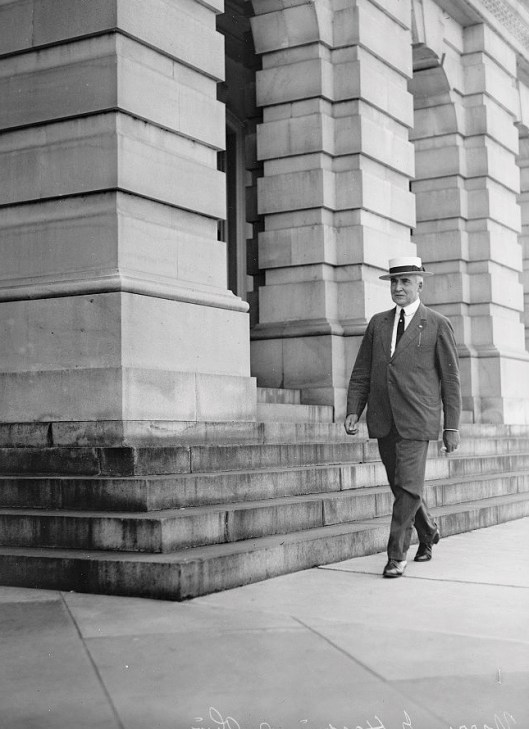
Senator Warren G. Harding (R-OH) was an advocate for Colonel Roosevelt during the Army Bill debates in April-May 1917.
By the second week of May 1917 Woodrow Wilson and both houses of Congress were furiously negotiating and ironing out the details on an Army Selective Service Bill that would institute a draft. It may surprise some to realize that almost a month and a half after the U.S. declaration of war Theodore Roosevelt’s plans for creating his own force were part of that process. In early May the Senate approved a Draft Bill, with an amendment that would have allowed the Rough Rider to create a volunteer force of up to four divisions. Roosevelt had powerful champions and detractors. Old friend and mentor Senator Henry Cabot Lodge was a reliable ally. Senator Warren G. Harding of Ohio also backed Roosevelt’s wish to fight overseas. Lodge’s son-in-law, Congressman Augustus Peabody Gardner of Massachusetts, too was on board. Field Marshal Joseph Joffre, who was in the United States on a diplomatic and goodwill tour, also supported Roosevelt and his plan. Back in France, Clemenceau too wanted Roosevelt to join the fight. This is not surprising; the French were desperate and wanted as many boots on the ground as America could provide.
The situation reached a new phase when the House scheduled for May 12 a vote on the Army Bill. Roosevelt telegraphed Harding and Gardner on the 10th that he had not intended his division plan to impede the greater need for conscription. He could not help adding a dig, however, that had his wishes been granted a month ago things would not have come down to this. The situation was so tense because sentiment was so divided. Opponents of Roosevelt’s plan were equally powerful and included Secretary of War Newton D. Baker, most of the senior military leadership, and President Wilson himself. On May 12 the House of Representatives voted 215-178 to approve Roosevelt’s four division plan, sending the Army Bill back to conference where the House and Senate would further debate Roosevelt and the other complicated issues involved in raising the American forces needed to fight in the Great War.
≈ Comments Off on No Pullmans this time for troops on the move
New York National Guardsmen traveled in luxury on their way to the Mexican Border in June 1916 during the Punitive Expedition (above). Accommodations would be more spartan eleven months later in the leadup to the larger campaign to come against the Kaiser.
I have not been there yet but the Governors Island season began last weekend. Normally things get underway Memorial Day Weekend but they are starting earlier this year. Things were moving at Governors Island one hundred years ago as well. Leonard Wood was gone by now, banished by Newton Baker and Woodrow Wilson to the Department of the Southeast in South Carolina. The new commander in New York Harbor was J. Franklin Bell. He got off to a running start; the Plattsburg training camp was scheduled to open in mid-May, within two weeks of his arrival at Governors Island to command the Department of the East. Thankfully General Bell had men like Major Halstead Dorey continuing with the work they had begun over the previous few summers preparing the nascent American forces. Officers at the Preparedness camps were also working diligently.
Now there was an increased sense of urgency. With war having been declared over a month ago men were moving not just to Plattsburg but to camps across the forty-eght states. This created an extraordinary logistical problem for the War Department. The act of moving men, let alone training and supplying them, was a task unto itself. On 8 May 1917 officers at the Plattsburg training camp announced the train schedule for the troops slated to start arriving later in the week. Here and elsewhere the railroad system was the primary means of travel and the system was severely tested and strained as spring went on. This was not lost on Secretary of War Newton Baker. On 21 April Secretary Baker had issued an order prohibiting the use of luxurious Pullman sleeper cars for the movement of American troops. It was to be day cars only for the doughboys. The measure allowed for a few exceptions–with prior approval–under extenuating circumstances but Baker was adamant that the order be carried out So many men had to be moved to so many different locales on so few rails that there was no other option.
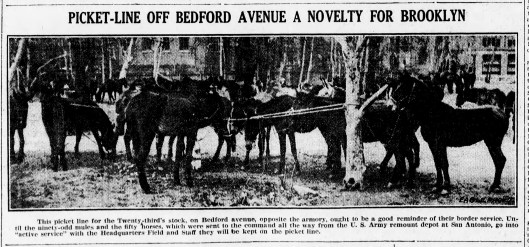
The 23rd New York had recently returned from its service on the Texas-Mexico border when this image was taken in April 1917. The 23rd was part of the New York Division, known officially as the 6th Division when it served duty patrolling the Rio Grande during the second half of 1916. New York State’s allotment for the Mexican Border campaign was a full division, almost 20,000 men. When the unit left for Texas in July 1916 they took almost 4,000 horses and mules with them, which in turn were just a portion of the 70,000 animals the Americans took with them in support of Pershing’s Punitive Expedition. Beasts of burden were a prized commodity; American suppliers had been selling them by the thousands to European nations since the outbreak of the Great War, shipping them overseas for duty in the trenches pulling field artillery and whatnot. To say the animals were expendable would be an understatement.
The 23rd did not see combat in Texas. That was left to Pershing Regulars. The New York militia, with all the other National Guard units, patrolled the Rio Grande under the command of Major General Frederick Funston. In a sense it was the dog that did not bark; their presence kept the border calm. The regiment did participate in a 110-mile hike and undergo a division-wide inspection by Governor Charles S. Whitman. Most of the New York Division was home–“bronzed and fit” as one headline captured it—by late winter 1917. The 23rd saw duty until the end and was one of the final units to return. By the time this photo was taken the United States had declared war on Germany. Through early spring the 23rd’s battalions were dispatched piecemeal across the state to guard infrastructure from sabotage. Everyone knew however that it was a matter of time before the men went overseas. As mentioned the regiment saw no combat during the Mexican campaign, but its experiences on the border served the men well when it was time to go to Europe.
In January 2016 I wrote a piece for Mike Hanlon’s Roads to the Great War about how the Great War’s grain crisis was one of the immediate causes of Prohibition. Advocates for Temperance had been active for decades dating back to the mid-nineteenth century, but their moment arrived with the coming of the war in Europe. Herbert Hoover had bee active in feeding the starving masses Over There for years before America joined the Allied cause. When war finally came for the Americans in April 1917, the call for conserving American grain became only louder. One man leading that charge was Colonel Theodore Roosevelt.
At a gathering of the Long Island Farmers’ Club on April 21 Roosevelt stressed the importance of prohibiting the use of grains in distilled sprits for the duration of the war. Roosevelt had powerful like-minded allies. Senator Albert B. Cummins, a Republican from the breadbasket of Iowa no less, initiated a measure in Congress that same day that would have done that very thing. For the time being however, things remained as they were.
Europeans had been working on the problem on their own for some time. One day prior to all this, authorities in London announced that 850,000 acres of land had been repurposed over the past year across Great Britain for the planting of grains. Everyone knew the consequences. Just weeks earlier German mines and torpedoes had sunk the Belgian Relief Commission vessels the Anna Fosteness and Trevier, sending thousands of tons of grain and other foodstuffs to the ocean floor just off the coast of the Netherlands. These were only two of the most recent German attacks, which were coming almost weekly by now.
One hundred years ago today, 28 April 1917, Theodore Roosevelt was speaking to an audience of thousands at the Chicago Stock Yards. His message was much the same as it had been in Mineola when speaking to the Long Island farmers the previous week. He could not have spoken more clearly, imploring his audience to “Farm and Arm” for the fight against the Kaiser. It was not a coincidence that the Colonel had ventured to Chicago. The West had been much more apathetic to Preparedness in the leadup to America’s entry into the war. Most internationalists resided in the Northeast, where of course Roosevelt himself lived.
(image/U.S. National Archives and Records Administration)
Levon Helm died five years ago today. Here is the post I wrote that day.
The other night I was sitting on the sofa when the voice of Levon Helm wafted from the other room. The Hayfoot was watching a video clip of “The Night They Drove Old Dixie Down.” Instinctively I got up and went into the bedroom, where we watched it lying down. Like so many other songs sung by Helm–“Up on Cripple Weight,” “Don’t Do It,” The Weight”–it never fails to move. Sadly, the voice has been silenced; Helm died of throat cancer in New York City on Thursday. The drummer was born in the Mississippi Delta town of Elaine, Arkansas and grew up in nearby Helena. When he was a teenager Helm became the percussionist for Ronnie Hawkins. The two Arkansans eventually ended up north of the border and playing in a unit known as Ronnie Hawkins and the Hawks. After breaking off from Hawkins, the unit morphed into Levon Helm and the Hawks. Soon they were backing Bob Dylan just as the Hawks. Eventually the five members of the group–Helm, Robbie Robertson, Rick Danko, Richard Manuel, Garth Hudson–went out on their own as simply…The Band.
The group released its first album, Music From Big Pink, in July 1968. Big Pink was the group’s rented communal house in upstate New York. The album is notable for many reasons. First, it was a fully realized piece of work, created by musicians who had already woodshedded for a number of years. Released during the worst excesses of the Age of Aquarius, Big Pink manages to avoid the indulgences of the era. The reason for this, I believe, is because Helm especially was so grounded the American Songbook. You can’t have been a musician growing up in the Mississippi Delta in the 1940s and 1950s and not absorb its traditions. The first music group Helm saw in person was Bill Monroe and the Blue Grass Boys in 1946, the incarnation of that band that included Lester Flatt and Earl Scruggs. He was six years old. Helm later saw Elvis play in person several times–Memphis being less than an hour’s drive from Helena–before the man who would be King was a cultural phenomenon.
Tradition meant a great deal to Helm and to everyone in The Band. 1968 was a year of turmoil throughout the world. A short list of incidents include: the Tet Offensive, the assassination of Martin Luther King Junior and subsequent rioting in hundreds of American cities, the Events of May in Paris that almost overthrew the French government, and the assassination of Bobby Kennedy in June. And that is just the first six months of the year. At a time when the battle cry for many baby boomers was “Don’t trust anyone over 30,” the group members pointedly posed with their extended family wearing their finest for what would be a widely disseminated group photo. Roots.
The Band’s original incarnation dissolved in 1976 after the famous Winterland concert filmed by Martin Scorsese and released as The Last Waltz in 1978. The breakup was probably inevitable given the tension, creative and otherwise, between Mr. Helm and Mr. Robertson. Helm later went on the road with other iterations of the lineup but to less effect. He was first diagnosed with cancer in the late 1990s and fought the disease, with periods of remission, up until the end. Helm was always an active musician, but in part to pay his medical expenses he was especially productive over the last several years of his life. Two of his finest efforts came during this period: Dirt Farmer (2007) and Electric Dirt (2009). He was proof positive that a rock star can age gracefully if he acts his age and stays himself.
With some artists it is just a lifelong thing. Thankfully for us.






 The Strawfoot