The American Machiavelli

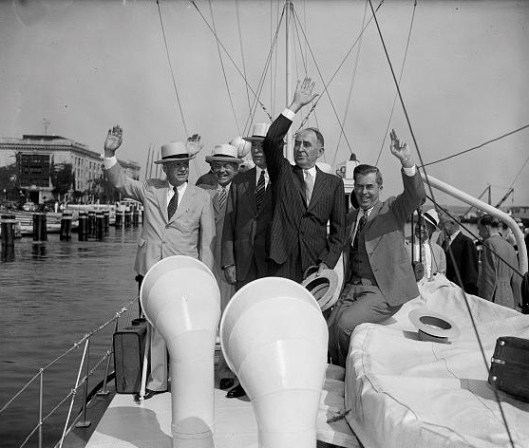
Annapolis, Maryland, 25 June 1937: Congressional and Cabinet leadership boards to meet FDR at the Jefferson Island Democratic Club, left to right: House Majority Leader Sam Rayburn, Secretary of War Harry H. Woodring; Secretary of State Cordell Hull; Speaker of the House William B. Bankhead; and Secretary of Agriculture Henry A. Wallace

Annapolis, Maryland, 25 June 1937: Congressional and Cabinet leadership boards to meet FDR at the Jefferson Island Democratic Club; left to right: House Majority Leader Sam Rayburn, Secretary of War Harry H. Woodring, Secretary of State Cordell Hull, House Speaker William B. Bankhead, and Secretary of Agriculture Henry A. Wallace

Roosevelt knew how to use these men for his own purposes; he resembled Hawthorne’s picture of Andrew Jackson as one who who compelled every man who came within his reach to be his tool, and the more cunning the man, the sharper the tool.

–James McGregor Burns, Roosevelt: The Lion and the Fox: Vol. 1, 1882-1940

(image/Library of Congress)


Behind Bayonets and Barbed Wire

POW burial detail at Camp O¹Donnell just after the Bataan Death March

POW burial detail at Camp O¹Donnell just after the Bataan Death March

I had a meeting in the city today, after which I went to a small movie theater in Greenwich Village to see the film Behind Bayonets and Barbed Wire. It is a documentary about the Bataan Death March. What made it more immediate was that we interviewed one of the subjects this past summer at Governors Island. The film is a joint U.S./Chinese production and so focused in part on the often overlooked Sino experience during the Second World War. One can imagine that with China playing an ever larger role on the economic and political stage that this will be a more common thing. The interviews with the survivors are always riveting without lapsing into bathos, and the documentary even ends on something of an uplifting note.

The film’s major drawback was the unfortunate decision to re-enact scene from the Bataan march and the later POW experiences at the Mukden Prison Camp. I cannot express how distracting the re-creations are, or the extent to which they cheapen the film. The re-enctments may lessen the movie but they can’t take away from the events themselves; the Bataan/Mukden story is too powerful for that. With all that said, the filmmakers did the historical record a great service by interviewing these people before it was too late. If you have a chance, try to  see the film if you can. I’m sure it will be available via streaming in the near future.

(image/Associated Press via National Archives)


Assemblyman Ted Roosevelt

troosevelt-letterI know someone who is researching their local library out on Long Island who in the process came across this interesting Roosevelt document. It is a $20 pledge from Ted Roosevelt toward the creation of the Freeport Long Island Memorial Library. The library opened in 1924 and is one of the few libraries that served–and serves–as a Great War memorial. Note that the letterhead is addressed Albany, where Roosevelt was serving in the New York State Assembly when he signed this in August 1920. His signature is quite similar to his father’s. One can only speculate to what extend that might have been intentional.

It was a busy time for the thirty-three year old Great War veteran. Ted had returned from France in March 1919 and immediately helped get the nascent American Legion off the ground. That year he also began his political career, winning the assembly chair from Nassau County that fall. In 1920 he was running for re-election and spent much of the summer criss-crossing the county. Ted and wife Eleanor were not just thinking of his re-election. The Brooklyn Daily Eagle notes in its October 2, 1920 edition that Eleanor Butler Alexander-Roosevelt turned out in Freeport for the Nassau launch of the Warren G. Harding-Calvin Coolidge presidential campaign.

(image/Freeport Memorial Public Library)

A year in the hands of Chuck Braverman

One day when I was attending graduate school I mentioned in class that the authors of both the books we had read that week had both emphasized that they had been college students in 1968, that year in our nation’s history when the world seemed to be falling apart. To my astonishment the professor asked “What happened in 1968?”

That little vignette came back to me earlier today when I came across the documentary short that Chuck Braverman produced for the The Smothers Brothers Comedy Hour in early 1969. I had not seen this in many years. One can draw many lessons from Braverman’s minor classic. The one I will draw on here, after our divisive election season, is that the world has always been troubled but that, whatever one believes or wherever one falls on the spectrum, the world is not grinding to a halt. From Harding in 1920 calling for a return to normalcy after the Great War, the influenza epidemic and the riots of 1919; to FDR’s first inaugural in 1933; to JFK’s January 1961 message about being disciplined by a hard and bitter peace, our nation has gone through anxieties of many varieties before today’s times. Breath deep and take in Chuck Braverman’s brief history lesson.

The Unknown Soldier

Here is a little something to get your week off to a good start, especially with it now getting dark so early. The other day I received a group email from the folks at the World War One Centennial Commission with a brief preview of a film coming out this Friday, Veterans Day. The film was produced by the WW!CC in cooperation with C-SPAN 3. The film premiers at 10:00 am and airs again at 10:00 pm Eastern Time that night before showing a few times over the weekend.


Sunday morning coffee

I’m sorry about the lack of posts in recent weeks but with the semester in full swing it has been a grinding period at work. I’ll have more posts in the coming days and weeks. Last Saturday I was in Oyster Bay for the Theodore Roosevelt Association conference. It was great seeing some folks again and meeting new people as well. The talks were great. After lunch I took a cab to Sagamore Hill with a couple from Texas who I had met that very morning. The three of us had split an earlier cab getting from the Glen Cove train station to the conference hall. I had never been to Sagamore before. It was rewarding to share the experience with others who have a strong knowledge of the topic. Because there is so much to see–I am fully aware that I missed a great deal in just our 2-3 hour jaunt–I’ll probably go back during a warmer weekend this winter.

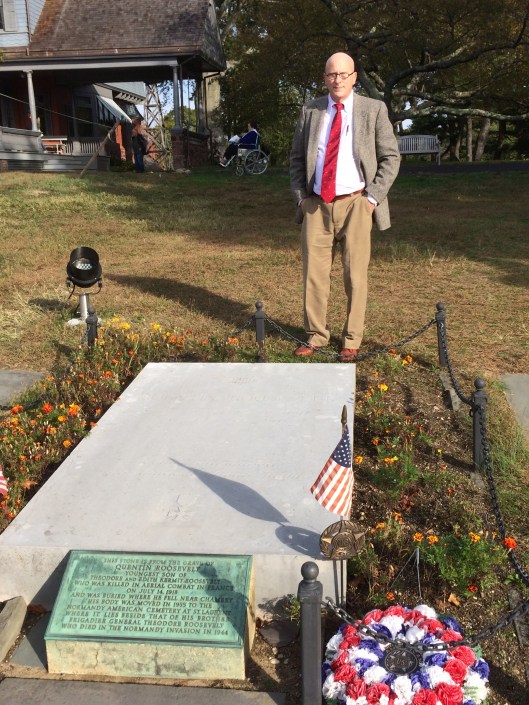
Quentin Roosevelt memorial, Sagamore Hill: 29 October 2016

Quentin Roosevelt memorial, Sagamore Hill: 29 October 2016

Yesterday I finished Hissing Cousins: The Lifelong Rivalry of Eleanor Roosevelt and Alice Roosevelt Longworth. I don’t know untold the story was, but the authors did a fine job of conveying the complicated relationship between the two women who between them lived in the White House for twenty years. I saw the co-authors (and married couple) speak at the Roosevelt House on East 65th Street a few years ago and spoke briefly to one of them. One thing the Ken Burns’s Roosevelt documentary did well was show how the two sides of the family interconnect in all its human complexity. The authors of this dual Alice and Eleanor biography have done the same.

This weekend I began James MacGregor Burns’s  Roosevelt: The Lion and the Fox. The book came out a full sixty years ago, in 1956,and straddles a line between history and current events. It is volume one of an eventual two volume work and ends in 1940 on the cusp of the Second World War. Volume two came out out in 1970. I’m reading it with the awareness and caveat that James Burns was an open admirer of FDR. As a cog in the political/academic nexus of the 1940s-60s though, I suppose this was inevitable. My impression however is that Burns did not lapse into the role of court historian the way Arthur Schlesinger Jr. did. The Lion and the Fox is a political biography and I am looking forward to hearing what Burns has to say about young Roosevelt as assistant navy secretary during WW1.

Vandalism at the Philly ULC

Stereograph showing the vandalized stairs

Stereograph showing the vandalized stairs

Monuments and memorials are a big part of what we talk about in our Learning Places class. Unfortunately one component of that discussion is how statuary and historic structures are often vandalized. This vandalism can be political in nature, such as when people write graffiti on monuments they disapprove of. Other times people destroy them for financial gain, breaking the memorial and selling its materials for scrap. It’s unfortunate but that’s the way it goes. Alas I could not embed it directly into this post, but here is a news clip we showed to the students yesterday in class. It shows some vandals tearing down a stone wall at the Philadelphia Union League Club and tearing out its brass banister. The news article has been updated since yesterday and apparently they have a strong idea, even the name, of who it might be. It’s an extraordinary clip.

(image/NYPL)

Building the national WW1 memorial

world_war_i_photographs_-_nara_-_285372This article from the Wall Street Journal came through my in-box earlier today and I thought I would pass along. Remember that one of the primary missions of the World War One Centennial Commission is to build a memorial in Washington D.C. I did not know until reading this earlier today that the studio work is being done here in New York City, in the Bronx no less. From the looks of it things are proceeding well. In an era when luxury condos are going up seemingly on every corner here in Gotham, even in the out boroughs, it is warming to see work like this being carried out here the way it once was. Check out the piece.

(image/American Engineers returning from the St. Mihiel front, National Archives)

Phil Chess, 1921-2016

I noted with interest the passing of Phil Chess earlier this week. Though I would not put too much into it, it was fitting that Chess, a fixture in the Chicago music scene for well over half a century, died the week the Cubs made it to the World Series for the first time since 1945. Phil and his older brother Leonard were the founders of Chess Records, one of the independent labels that sprung up after the Second World War to record the urban blues. The brothers started in what we’ll euphemistically call the entertainment industry when in 1938 they began operating juke joints catering to the South Side’s growing African-American community. I’m simplifying here but when their Macomba Lounge burned down in 1950 they used the insurance to fund what would become Chess. The brothers would spend the next decades recording Muddy Waters, Howlin’ Wolf, Chuck Berry, Sonny Boy Williamson, Little Walter, Etta James and scores of others.

Chess Records Studios as seen in 2012

Chess Records Studios as seen in 2012

The story truly began during World War One. In The Warmth of Other Sons Isabel Wilkerson notes that the Chicago Defender mentioned in passing in its February 5, 1916 edition that northern railroads were facilitating the movement of African-American laborers from the South to the North to work in the munitions plants. After the war the Chess brothers were part of that other Great Migration; their father, Yasef Czyz, came to the United States from Motal, Poland (today part of Belarus) just after the Great War. He soon sent for his wife and children. By the time Leonard and Philip reached their mid-twenties the blues too had come age. Leonard in particular spent much of the early 1950s traveling not only the South but through Northern industrial hubs such as Detroit, St. Louis and Gary, Indiana–essentially anywhere within driving distance from Chicago where Africans-Americans lived, worked, and socialized–to plug the Chess catalog and scout for new talent. Phil was the quieter, younger brother who kept things running.

I have always been conflicted about the Chess Brothers and their cohorts. On the one hand there is no question that they recorded, disseminated, and thus saved an essential component of American–and today, world–culture. On the other hand their enterprise was built on a foundation of exploitation of that talent. That exploitation became only more apparent when the Rolling Stones, Eric Clapton and others came along and began making real money; in the 1960s those once-pesky things like contracts, copyrights and royalties went from ancillary issues to matters of serious economic consequence. One can’t argue that it is not part of the story.

The Chess family has maintained–not without merit–that while their business practices were sometimes unorthodox, they looked after their artists in their own ways. This meant things like paying for funerals and medical expenses, occasionally bailing someone out of jail, and dirty work like paying for abortions in those years prior to Roe v Wade. Let’s not kid ourselves; we’re talking about bluesmen here. It is a messy and human story from a time when America was a harder place and people did what they had to do to get along. Today the blues is securely canonized, but such was not always the case. The life and times of Phil Chess were–and still are–part of why it is so mythologized.

(image/Steve Browne & John Verkleir via Wikimedia Commons)