How We Used to Live

I took the afternoon off yesterday to have lunch and hang out with an old friend, an architect who moved away from the city several years ago. Though born here in New York City, his mother is French and he brings a strong strong European perspective to his worldview. We got to talking about The Beatles and how through some force–coincidence?, luck?, divine intervention?–their rise coincided with the transition from Austerity Britain to Swinging London. In the grander scheme of things Britain’s transformation was a process that began in 1914 in the chaos and destruction of the Great War and ended with Britain bankrupt and stripped of its empire in the wake of the Second World War. I often tell my students that history is all around them if they care to look. This morning, relaxing with my coffee, and came across this trailer for a 2013 British film called How We Used to Live, which I had never heard of before.

Enjoy.

America’s Last Autumn

American headlines were full of leisure and optimism on Labor Day 1916. The United States entered the Great War the following spring.

American headlines were full of leisure and optimism on Labor Day 1916. The United States entered the Great War the following spring.

I’m having my morning coffee this Labor Day Monday. It appears that the tropical storm that had been heading our way has veered off and left us with a nice day. I’m staying close to the house today, preparing for the semester ahead and attending to a few other tasks. There is so much to get done in the coming weeks; it’s nice to have a day to regroup a bit.

I came across and thought I’d share this Brooklyn Daily Eagle page from Labor Day Weekend 1916. Like now the United States was then in the middle of a presidential election, with the incumbent Wilson running against Charles Evans Hughes on the motto that he had kept us out of war. What struck me about the newspaper one sees here is that Fall 2016 was very much America’s Last Autumn, much in the way that 1914 was Europe’s Last Summer. A difference would be that for Europeans the guns of August came entirely out of the blue, whereas American two years later were cognizant of the stakes and potentiality of their involvement in the war. That’s what makes the newspaper here so striking. I won’t run down the headlines because one can read them readily enough, but it is fascinating to see what Americans, or at least New Yorkers, were thinking about during their Labor Day holiday one hundred years ago.

(image/Brooklyn Daily Eagle)

William Patton Griffith, Patriotic Instructor

Griffith_William_Patton_1_FrontAfter class today I was following up on some leads that will hopefully carry over into the next few class meetings. I was searching the Brooklyn Daily Eagle database when I came across an article about one William Patton Griffith. This led me to a search engine to find out more about the man. And that is where, among other things, I came across the photo you see here. It is the front and back of the same image. Griffith fought in the Civil War and was in his 90s when he finally died in the 1930s. Like many veterans he was actively engaged in veteran and civic affairs throughout his adult life; in his final years he was brought out for public engagements, one of those aged Civil War veteran whose symbolic power at Decoration Days and Fourths of July rested in that he survived anachronistically into the mid twentieth century. How in the 1920s or 1930s, in the wake of the Great War, the Roaring Twenties and Great Depression, could one not have been moved to meet a survivor of Gettysburg, Pea Ridge, or the Peninsula Campaign?

Patriot instructorIt is a striking images. He exudes the appearance of a man nearing the end of his life seemingly content that he has accomplished what had set out to achieve. What struck me too was his job title: patriotic instructor. Some very rudimentary digging indicated that this was a formal position within the Grand Army of the Republic, of which Griffith was a long and active member. It is tempting to scoff at such a thing, but as the saying goes the past is a foreign country and they do things differently there. I intend to talk more about Griffith in class next Tuesday.

(images/New York State Archives, Grand Army of the Republic records)

The passing of the armies

Veterans_of_World_War_I_MemorialI had the opportunity this past weekend to spend some time with the official historian of a particular American military unit. This is an outfit that stretches back to the mid-nineteenth century and has fought in most of America’s engagements since that time. No longer active duty, this individual traces his time with the outfit back to the early 1970s. During our conversation he mentioned the unit’s annual dinners, which he has attended going back to his days as a young, active duty officer. I asked him if at these annual gatherings he ever had the opportunity to meet and talk with any of the Great War veterans who had worn the regiment’s insignia in 1917-18. He lit up when I asked and said that indeed he had. These WW1 veterans would have been in their mid 70s at the time.

The historian filled in a few anecdotes before noting ruefully that while he had indeed made these men’s acquaintance, he did not engage with them as extensively as would have liked today. Now those doughboys are all gone. Of course he was not the unit historian at that time, but a young, Vietnam-era officer with much on his mind. Today as the unit historian he has made certain to record and preserve all he can about the rapidly fading WW2 veterans. In just a few years they too will be all gone.

(image/Visitor7 via Wikimedia Commons)

The Battle of Brooklyn at 240 years

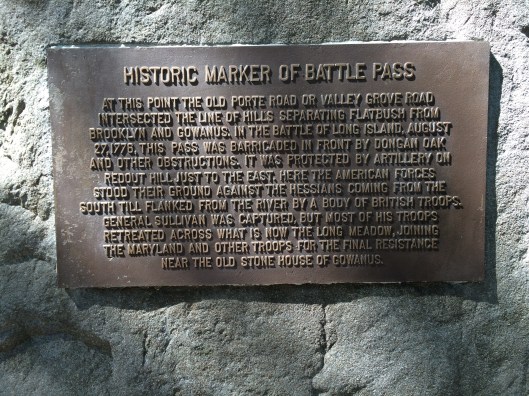
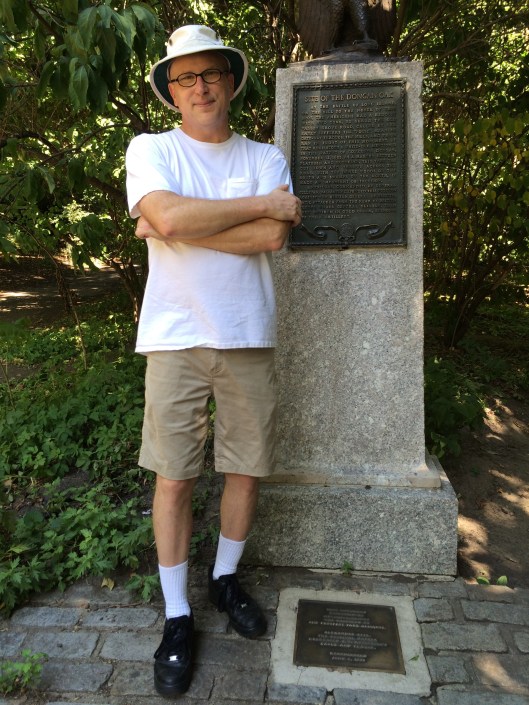
The fall semester, indeed the entire 2016-17 academic year, started this past Thursday. This term our students are studying Brooklyn’s Grand Army Plaza, with the first few weeks dedicated to the Battle of Brooklyn in order to give students a sense of place. Today my colleague and I were in Prospect Park following the route of George Washington men on this date 240 Augusts ago. I believe there were a few events scheduled for later in the day but I was surprised that no one else was looking at these markers. Here with little comment are a few snapshots from the day.

IMG_3449

IMG_3455

IMG_3452

IMG_3462

IMG_3467

IMG_3470

A man in the arena

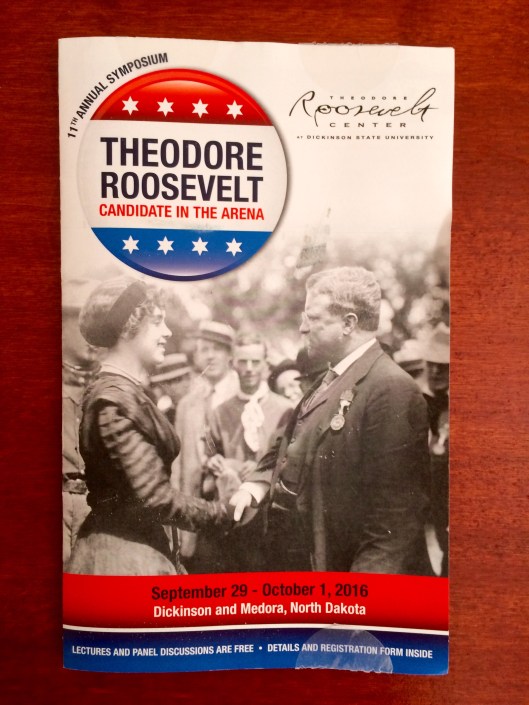
IMG_3408The other day I received the brochure you see here in the mail. It is for the 11th annual Roosevelt symposium at Dickinson State University in North Dakota. When one thinks of Roosevelt’s legacy the Birthplace in Manhattan and the house in Oyster Bay, Long Island immediately come to mind, along with the Theodore Roosevelt Association too of course. The staff at Dickinson State’s Theodore Roosevelt Center however have been doing an incredible job preserving TR’s legacy. I noted with interest that this year’s focus is Theodore Roosevelt as elective candidate. It is lost on some today how many constituencies to whom Roosevelt had to appeal to in his decades of public service. He entered the arena for the first time in 1884 and remained so more or less continuously until 1912. Like a good politician he could many things to many people: an old Knickerbocker to his Silk Stocking Manhattan neighbors, a Southerner below the Mason-Dixon line through his mother’s side of the family, and a cow poke out West.

In a presidential election year it is easy to see why organizers are focusing on Roosevelt as candidate. Of course his hat was not in the ring 100 years ago; after the fracture of the Republican Party in 1912 he sat out the campaign four years later. He was a perennial thorn in Woodrow Wilson’s backside in the lead-up to the 1916 election. Running on the mantra that he had kept America out of the European war, Wilson defeated Charles Evans Hughes fairly handily. Alas I will not be able to attend the symposium but I do intend to keep an eye on if the TRC will be live streaming the conference, which runs from September 29-October 1.

“We’re in the forever business.”

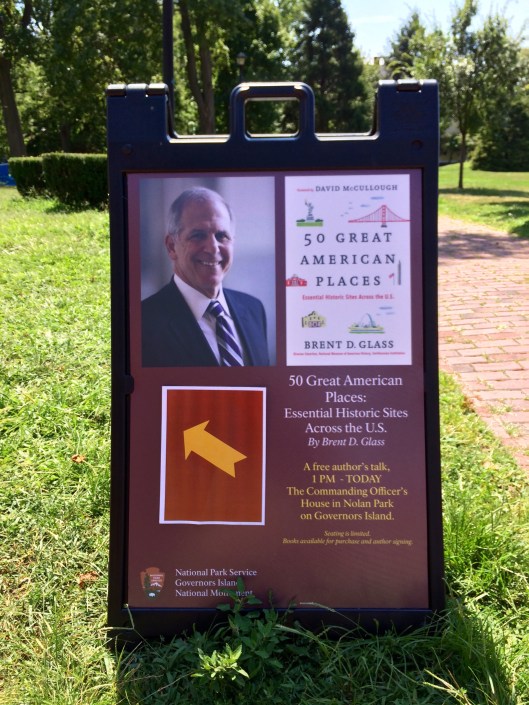
IMG_3441Author Brent D. Glass spoke about his new book 50 Great American Places this afternoon in the Commanding Officers Quarters at Governors Island. Author talks are not unusual at Governors Island but there was a particular reason Mr. Glass showed up when he did: this August marks the 100th anniversary of the founding of the National Park Service. President Woodrow Wilson signed the enabling legislation on August 25, 1916. That signing came in the midst of the presidential election and less than a year before American entered the Great War. Not all of the places about which Mr. Glass writes in his tome are under the auspices of the Park Service; some are state or local concerns, or even in the hands of privately-controlled institutions.

IMG_3445Glass is Director Emeritus of the National Museum of American History, Smithsonian Institution and categorized the selections into five themes, which included Democracy, Cultural Diversity, and Military. Among the sites included are the Seneca Falls (NY) Convention, the Statue of Liberty, Mesa Verde, Little Rock Central High School, and Gettysburg. That last one had special resonance for Glass; his father had trained under Eisenhower at Gettysburg’s Camp Colt during Word War I. Glass added that though Eisenhower’s job was to train doughboys in tank warfare, so unequipped was the Army that his father did not see an actual tank until he reached France. I’d read this from others’s accounts of those training exercises.

Summer is winding down but there is never a bad time to explore America’s cultural heritage. There is no substitute for going where history was made, and Brent D. Glass provides a valuable guide for doing just that.

Governors Island’s 52nd Street

Swing Street was the scene for New York's jazz clubs and a hangout for GIs.

Swing Street was the scene for New York’s jazz clubs and a hangout for GIs.

I am sorry about the lack of posts recently. This is the time of year when I slow down a bit, relax, and prepare for the coming academic year. I’ve spent much of the past week and a half listening to the Mets lose night after night. Queens’ Major League Baseball Club has not won two game in a row since July 6.

I had an interesting experience at Governors Island last week. I was there this past Thursday to conduct two oral histories with another volunteer. The first one was with a gentleman who worked in the Military Police in the 1950s. I took the opportunity to ask him a question that had long bothered me. Some readers may know that Castle Williams served as an Army disciplinary barracks for many decades. In my reading of many jazz histories and biographies over the years a recurring theme that Miles Davis, Dizzy Gillespie and others repeatedly came back to was the considerable Military Police presence on 52nd Street. “The Street” as it was known–no number was required if you mentioned jazz–was notorious for men in uniform drinking, fighting and causing mayhem. (It is a story for another time, but in retrospect it seems obvious that many of these GIs were suffering from ptsd.)

It was always my speculation that when these servicemen got into trouble the place to which they were usually taken was Governors Island. The Army would have handled such matters, not the civilian NYPD. Still, this was all conjecture on my part; in all my reading on both jazz and Governors Island, I never saw anything in writing that backed up my educated guess. That is, I had no corroboration of this until last week, when during the oral history I asked the interviewee if such was indeed the case. To my great satisfaction he confirmed what I had long suspected: that the uniformed servicemen picked up for making trouble on 52nd Street back in the days of the great nightclubs were indeed brought to Castle Williams on Governors Island. It fits into the narrative of Castle Williams as a minimum security facility. These troublemakers would be brought to be processed, sleep it off, and wait for the next step in the process. I cannot tell you how pleased I was to hear this firsthand from the former MP himself.

(image/William P. Gottlieb Collection, Library of Congress)

One man’s Governors Island

Today's interviewee lived in Fort Jay's south barracks during his tenure on Governors Island in the early 1960s. He was stationed here until the Army left and made way for the Coast Guard.

Today’s interviewee lived in Fort Jay’s south barracks during his tenure on Governors Island in the early 1960s. He was stationed here until the Army left and made way for the Coast Guard.

I was at Governors Island this morning, where another volunteer and I interviewed a First Army veteran via telephone. The man was 97 and quite sharp; he remembered his years of service with great eloquence and clarity. It really is a privilege speaking to individuals such as this. I mean, it is unforgettable. This former lieutenant colonel graduated from Gettysburg College in 1941 and served in Europe during the Second World War. He grew up in Gettysburg and told us that when he was sixteen years old Franklin Delano Roosevelt’s motorcade passed his house en route to the ceremony for the lighting of the Eternal Light Peace Memorial at the Gettysburg 75th anniversary in 1938. He even had a job making 50 cents and hour putting up the tents for the aged Civil War veterans in attendance.

One thing that made today’s interview that much more poignant is that we had a young man with us for the first part of the session who himself will be heading off to Gettysburg College in two weeks to begin his freshman studies. That is, this morning we had an 18-year-old young man speaking with a 97-year-old WW2 veteran who once aided Civil War veterans in attendance to see FDR mark the 75th anniversary of the Battle of Gettysburg in the presence of living Civil War veterans. That’s some crazy stuff. Our subject also recalled seeing General Eisenhower around town in Gettysburg, the president and his wife of course residing there for many years in the only house they ever owned. All in all it was an amazing morning.

Watching movies at Camp Travis

Men of the 165th Depot Brigade on movie night, which may also have included live entrainment performed by the troops themslves

Men of the 165th Depot Brigade on movie night, which may also have included live entertainment performed by the troops themslves

I have spent part of the week researching a project we are hoping will come to fruition this coming Sunday at Governors Island. In my digging I came across this semi-related image of African-American troops taking in a movie at Camp Travis in 1917. It is fascinating on several levels but one thing I find interesting is how aware the entire room is that they are being photographed for posterity. One sees the same phenomenon in pictures of Civil War troops, though in that era photography was still in its infancy. I am guessing that as late as 1917 photography seemed novel to these men. I cannot help but wonder what movies–certainly silent pictures–they would have watched. The original caption hints that in addition to any films being screened there was probably a variety-night aspect to these types of affairs. As a depot brigade these men likely did not see combat in France, but performed the crucial–and back-breaking–function of logistics and supply.

(image/Schomburg Center for Research in Black Culture, Photographs and Prints Division, The New York Public Library. “Movies!’ Building No.1, Army Y.M.C.A., Camp Travis, Texas.” The New York Public Library Digital Collections. 1917. http://digitalcollections.nypl.org/items/510d47e2-08cb-a3d9-e040-e00a18064a99)