• About

The Strawfoot

~ a New Yorker's American History blog

The Strawfoot

Category Archives: Baseball

Opening Day 2019

28 Thursday Mar 2019

Posted by Keith Muchowski in Baseball, Robert Moses, Style

≈ 2 Comments

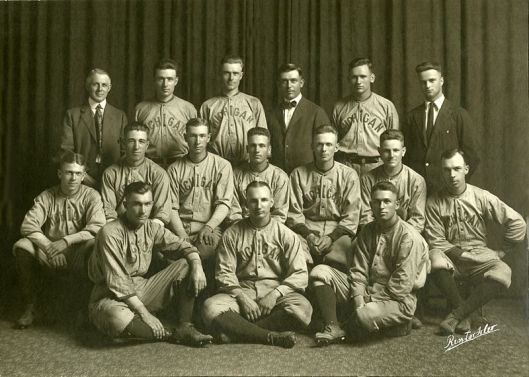
Professional and college baseball players such as the 1919 University of Michigan baseball team were returning to the field in that first spring after the Great War’s end.

The days have been busy and full this week, which is a good thing. We took our students to the Brooklyn Heights Promenade yesterday afternoon to view and discuss the construction of Robert Moses’s Brooklyn-Queens Expressway. I concluded the presentation with a brief reading, just two paragraphs, from Truman Capote’s 1959 Holiday magazine article “A House in the Heights.” Capote lived in at least two rented homes in Brooklyn Heights during his time in New York City. I pointed out to students the one at 16 Pineapple.

I would be remiss if I were not to note that today is Opening Day of the Major League Baseball season. Today is the earliest Opening Day ever. It makes sense to push up the start of the season to accommodate the longer post-season; they just don’t want it falling into November. I came across this photograph of the 1919 University of Michigan baseball team and find it extraordinary on a number of level. First of all is the stunning clarity of this image, taken not on the field but within the control of a photographer’s studio. The menswear of both the players and coaches/managers is intriguing as well. One of baseball’s most special features is that you get dressed up to play it. Baseball uniforms are not so much gym clothes but style wear. There is a reason the Yankees wear pinstripes.

When this photo was taken ball players were returning from Europe and rejoining their college and pro teams. I’ll probably come back to it in October, but as it would turn out the 1919 Black Sox scandal, and subsequent trial, would add to the bitterness and cynicism of the post-Great War milieu in the early 1920s.

Enjoy the season.

(image/Rentschler’s Studio, Ann Arbor, Michigan; Bentley Historical Library)
Sunday morning coffee

02 Sunday Sep 2018

Posted by Keith Muchowski in Baseball, Franklin Delano Roosevelt, Great War centennial

≈ Comments Off on Sunday morning coffee

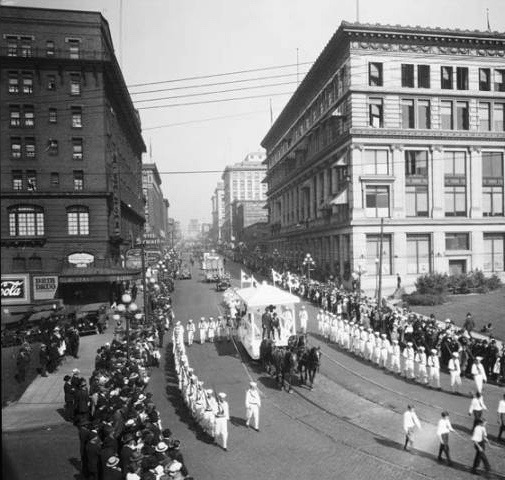
I hope everyone’s Labor Day Weekend is going well. It has been good to have a three day weekend after the long, hard push of the first week of the academic year. I am off to Grant’s Tomb in a little bit and am running a tad late, but wanted to quickly share this photograph. This was Labor Day 1918 in Seattle. Here we see sailors marching around and behind a Red Cross float. The War Industries Board and other governmental and quasi-governmental organizations did much to quell civil unrest during the Great War but there were still a surprising number of strikes. Here is a list I found in a very cursory search, which I am sure it is hardly a complete tally. Franklin D. Roosevelt was Assistant Secretary of the Navy in the Wilson Administration and would consciously do all he could as president during World War 2 to ensure labor peace. Still, strikes did occur during the Second World War as well.

Labor Day 1918 fell on Monday September 2. It also marked the end of the Major League Baseball regular season. Teams did not play a regular 154-game schedule but were limited to about 130 games, depending on how many they had gotten in by Labor Day. There were a large number of double-headers that day to squeeze in as much as they could.

Enjoy your weekend, all.

(image/Museum of History & Industry, Seattle)


Grover Cleveland Alexander changes uniforms

16 Monday Apr 2018

Posted by Keith Muchowski in Baseball

≈ Comments Off on Grover Cleveland Alexander changes uniforms

Grover Cleveland Alexander’s World War One draft registration card

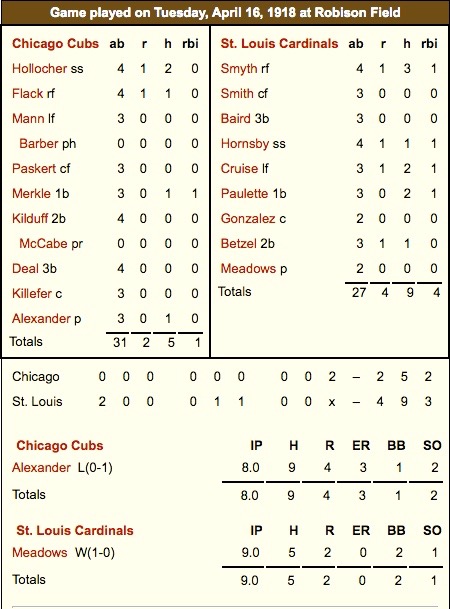
A few weeks back on Opening Day I mentioned that baseball once began much later than it does today. The Cubs and Cardinals began their 1918 seasons playing each other on April 16. Those on the field in St.Louis that day included Grover Cleveland Alexander, starting for the Cubs, and Rogers Hornsby, playing shortstop for the Cardinals. Alexander was an established star by this point and was slated to earn $8000 for the season; Hornsby, an up-and-comer in his third season with the Cardinals, would earn precisely half that after losing a bitter contract dispute to the Cardinals’ Branch Rickey. Throughout late 1917 and early 1918 baseball players were getting their draft notices from their local boards. In January 1918 Hornsby had appealed for a deferment to board officials back home in Fort Worth, Texas. Hornsby argued that his baseball salary was his family’s sole source of income. He received a Class 3 deferment and was thus free to play ball.

Owners understood that there was a manpower shortage and agreed to a 21 (not 25) player roster for the 1918 season. They also held an abbreviated spring training. Though Grover Cleveland Alexander turned thirty-one in February 1918 he was still eligible for the draft. In December 1917 the Philadelphia Phillies traded Alexander and batterymate Bill Killefer to the Cubs. The trade was partly about money but another, more cynical, reason may have been because Phillies management realized that both players were likely to be drafted into the A.E.F. sometime in 1918. The trade was a huge deal and made headlines across the country.

Alexander held out for a signing bonus but finally reported to the Cubs in mid-March. Meanwhile his draft board went about its work. The head clerk in Howard Country, Nebraska announced on April 12 that as of yet Alexander had not been called. There was great confusion, with some newspapers saying Alexander had been drafted and others saying he had not. Less than forty-eight hours later things had become clearer. Grover Cleveland Alexander had indeed been drafted into the Army and was to report to Camp Funston by the end of the month. Alexander asked to be allowed to join the Navy but his draft board would not have it.

Cubs and Cardinals 1918 Opening Day box score, via Baseball Almanac. Grover Cleveland Alexander had been drafted just days before the game and would join the Army by the end of April.

The pitcher’s call-up finally came just as the Cubs were breaking training in mid-April. On April 16 Alexander and the Cubs were in St. Louis to begin their season against the Cardinals. That very day Killefer received notice from his own draft board in Michigan that he had been declared 1A: eligible for draft and service. The board had originally designated Killefer 4A but the government appealed that status and won. So there they were facing the Rogers Hornsby and the Cardinals at Robison Field. Alexander pitched well but not effectively enough to win. The Cardinals took the contest 4-2. He went 1-for 3 at the plate. Hornsby went 1-for-4 with a run scored and an RBI. Sure enough, Alexander would soon leave the Cubs to train at Camp Funston. He pitched two more games, winning both and ending his season, before it truly began, with three complete games and a 1.73 ERA.

Opening Day

29 Thursday Mar 2018

Posted by Keith Muchowski in Baseball, Woodrow Wilson, WW1

≈ Comments Off on Opening Day

Today is Opening Day of the baseball season. I think it might be an intriguing summer here in New York. The Mets and Yanks are looking pretty good. Time will tell.

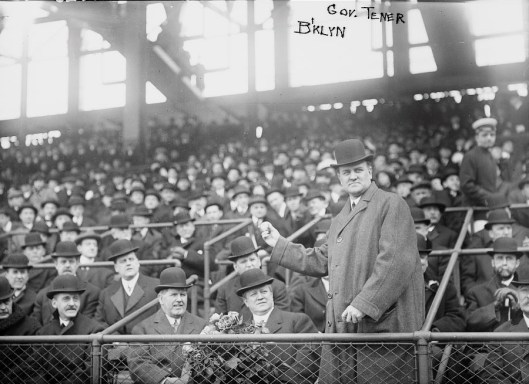
John Kinley Tener, governor of Pennsylvania and president-elect of the National League, throws out the first pitch in Brooklyn, April 1914. Four years later he would discourage NL owners from starting afternoon games an hour later during the newly-inaugurated Daylight Savings Time.

Opening Day 1918 came of April 15, which was about normal for the era; in the years of the 154-game season and no divisional playoffs, baseball started much later than today. In the weeks leading up to that season’s first pitch, baseball had an interesting issue to think through: what to do about Daylight Savings Time. Congress passed and President Wilson signed the bill creating DST in mid-March 1918. Perhaps not surprisingly the innovative Germans were the first country to try Daylight Savings during the Great War, starting the practice in 1916. The Brits, French, Dutch, Italians, Scandinavians and others quickly followed suit. It was thus inevitable the Americans would institute it as well. Daylight Saving Time here in the United States began at 2:00 am Sunday March 31, 1918. It also happened to be Easter.

Baseball teams, especially in the National League, began discussing the merits of moving weekday games from 3:30 to 4:30 pm at the time of the passing of the legislation in mid-March. Executives believed that moving games back an hour would boost revenue at the turnstiles because it would be easier for people to come to the game from work. It was the extra hour of sunlight made the potential time shift possible. Remember, night games did not begin until the mid-1930s. Much of official Washington vehemently opposed the idea, noting that the Daylight Savings measure was intended not for entertainment purposes but to save resources such as gas and coal, and to boost productivity in the munitions factories.

For several weeks after the legislative passing of Daylight Saving Time, Charles Ebbets and other owners contemplated moving games back an hour to boost attendance. The Brooklyn Daily Eagle captured Ebbets’s decision a few weeks prior to Opening Day.

One man in agreement with this was National League president John Kinley Tener. The Irish-born Tener grew up in Pittsburgh and took to baseball as a young immigrant. He participated in Albert G. Spalding’s world baseball tour in the late 1880s. Tener played for Cap Anson’s Chicago Nationals (today’s Cubs) in 1888 and 1889 and then did a brief stint in the Players League in 1890. A Republican, Tener served in the U.S. Congress from 1909-11 and then became governor of Pennsylvania. It was while serving in Harrisburg that the National League owners voted him president in December 1913.  He took the job with the condition that he finish out his gubernatorial term. Tener took the National League reins in 1915.

As early as March 19, 1918, when Daylight Savings Time became law, some baseball executives began advocating for the 4:30 start. Officially the National League Office had no position and left the matter up to individual clubs. The New York Giants wanted to move to 4:30 to better accommodate subway commuters. Charlie Ebbets, owner of the Brooklyn Robins (later the Dodgers), too was keen on the shift. Ban Johnson, president of the American League, split the difference and advocated for a 4:00 start time for his clubs. Johnson’s National League counterpart, Tener, made clear his preference that teams stay with the 3:30 start time. Ebbets eventually bowed to the pressure and kept his team’s schedule as it was in past seasons.

Enjoy the season, everyone.

(top image/Library of Congress)

Bart says . . .

30 Monday Oct 2017

Posted by Keith Muchowski in Baseball, The lighter side

≈ Comments Off on Bart says . . .

What a great game last night. I told the Hayfoot a long time ago that what makes baseball so great is that on any given day you may see something you never forget. Multiply that by ten in October.

Sunday morning coffee

23 Sunday Jul 2017

Posted by Keith Muchowski in Base Hospital No. 9, Baseball, Governors Island, Memory

≈ Comments Off on Sunday morning coffee

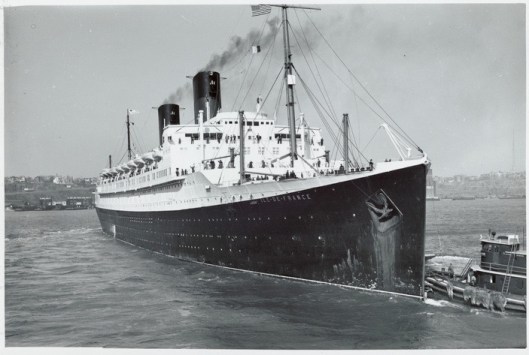
Dr. Schrock went back to France in 1928 and returned to the United States aboard the Ile de France.

I listened to the Mets come-from-behind, walk-off-with-a-homer win last night. They were down 4-0 in the first inning and won 6-5. Baseball is so conducive to listening on the radio. The Mets’ announcers got into a long discussion about the 1973 Mets-Athletics World Series, in which the As defeated the Mets in seven games. They had a good talk about Ray Fosse, the As All-Star catcher from the 1970s who currently does As radio broadcasts. Among other points, they noted that Fosse, Johnny Bench, Bob Boone, Carlton Fisk, and Thurman Munson were all born within nine months of each other in 1947.

Robert D Schrock as a young undergrad at Wabash College, circa 1905. He won an award for oratory at Wabash and later graduated with honors from Cornell Medical School before working as a doctor in the A.E.F.

While listening I was also doing a bit more digging on Dr. Robert D, Schrock and his World War I experience. He did his basic training at Governors Island in the middle of a heat wave in July-August 1917. Dr. Schrock was one of more than two dozen physicians at New York Hospital who in 1916 volunteered to go to Europe. By this time they fully understood what they would be getting into; it was the year of Verdun and the Somme. And it was not just the doctors; a full contingent of nurses, administrators, and orderlies all agreed to put on a uniform and go. It would have been more, but someone had to stay back and run New York Hospital itself. That is why the board of directors devised a plan deciding who would stay and who would go. Remember, the United States was not in the war yet. Nor was it a given that America would join the fight at all. Had they gone right away it would have been all about saving and repairing the lives of the various nations in the war at the time. Dr. Schrock and the rest of Base Hospital No. 9 arrived in St. Nazaire in late August 1917 and after a bit more training went to various facilities to attended the maimed. Schrock himself spent nearly three weeks in the front lines at the Battle of Passchendaele (Third Ypres), which was already in full swing when the New York Hospital Contingent arrived in France and lasted in November. He and two other doctors were thrown into saving the British, Indians, Canadians, and ANZACS.

Schrock arrived in France as a first lieutenant and returned to the United States as a major aboard the Wilhelmina in April 1919. One gets the impression that his Great War experience was a big influence in his life. An Ancestry search reveals that he traveled at least twice to Europe in the ensuing decades. At least twice. I found conclusively that he returned to France in 1928, presumably for the tenth anniversary of the Great War. He came home from that trip aboard the Ile de France, one of the great and less heralded luxury liners. In summer 1937 he and wife Elizabeth traveled to Germany, returning on the New York in early August. One can imagine the sobering realization that a second world war was imminent hanging over that trip. It’s an incredible story. I know a few people who have been preserving and organizing their relatives’ Great War letters. If someone in your family fought in the war and you have their photographs and letters, I encourage you to document it in some way. The Great War centennial is an opportune time to do it. Each story is another tile in the mosaic.

(image/top, New York Public Library; bottom, The Wabash)

Decoration Day 1917

29 Monday May 2017

Posted by Keith Muchowski in Baseball, Charles S. Whitman (Governor), Governors Island, J. Franklin Bell (General), Leonard Wood (General), Memory, Monuments and Statuary, New York City

≈ 3 Comments

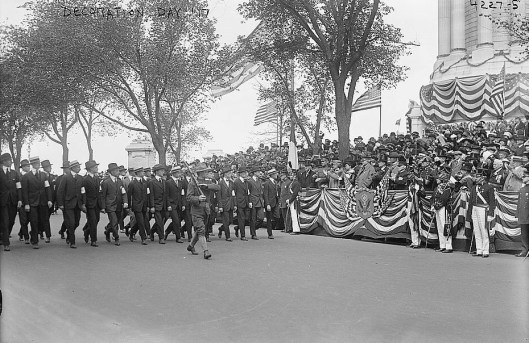
I wanted to share a few images from Decoration Day 1917. These photographs were taken near the Soldiers’ and Sailors’ Memorial Monument in Manhattan’s Riverside Park. Turn out was higher than for Decoration Day parades in recent years, which is not surprising given that this was the first Memorial Day since the call for war. The parade route was actually cut shorter in 1917 to accommodate the increasingly infirm veterans of the Grand Army of the Republic. About four hundred GAR veterans marched in New York City’s 1917 Decoration Day parade, one hundred and thirty fewer than just a year earlier. Veterans of the Spanish-American War and New York Guardsmen recently returned from Texas fell in behind. All told, 18,000 men and women marched in the parade through the Upper West Side. For the first time ever there was a regiment of Negro troops included in New York City’s Decoration Day parade. Though many would not have grasped it at the moment, the perceptive understood that this was an early sign of the coming of what became the New Negro Movement.

That is Major General J. Franklin Bell, commander of the Department of the East on Governors Island, and Governor Charles S. Whitman on the review stand. In the two middle image, they are there on the right in the box. Conspicuously absent is Leonard Wood, though his spirit in a sense was present. Before leaving New York City several weeks earlier he had given his blessing for a parade of the Public School Athletic League. While the veterans’s event was going on, a separate parade comprised of 40,000 schoolchildren was taking place south of here.

Memorial Day also means baseball. Just north of the Soldiers’ and Sailors’ Memorial Monument in the Polo Grounds Grover Cleveland Alexander of the Philadelphia Phillies lost 5-1 to the New York Giants. He went on to win thirty games that season. The following year Alexander was in France fighting the Germans. The Yankees were in Philadelphia playing the other team from the City of Brotherly Love, the Athletics. The Yankees won a double header and held the A’s scoreless over twenty-four innings. The Dodgers, then still the Brooklyn Robins, lost 2-0 to the Braves in Boston. It’s worth noting that the American League was less than twenty years old at this time and very much a competing association with the National. American League owners consciously put teams in cities were the Senior Circuit already had a presence. It says something about the size and influence of Gotham that unlike Boston, Philadelphia, and other cities New York ended up with not just two but three teams.

Enjoy your Memorial Day, everyone.

(images/Library of Congress)

The Yankees support General Wood

10 Monday Apr 2017

Posted by Keith Muchowski in Baseball, Governors Island, Leonard Wood (General), Preparedness (WW1), Woodrow Wilson

≈ 2 Comments

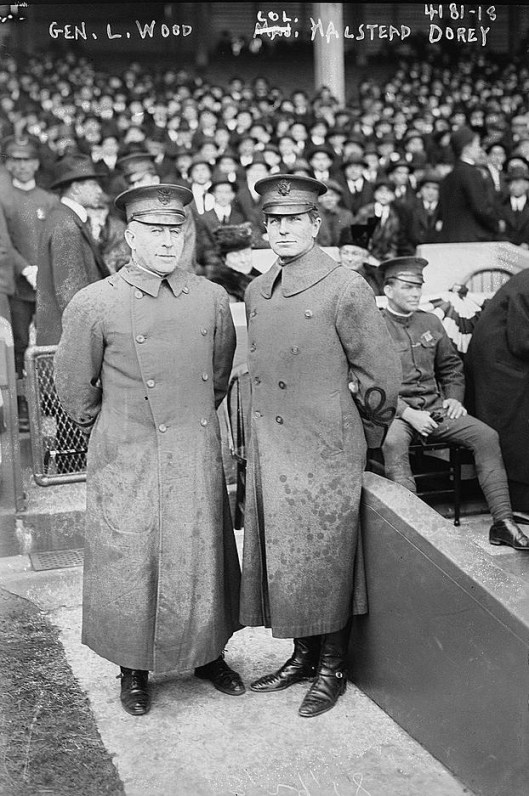
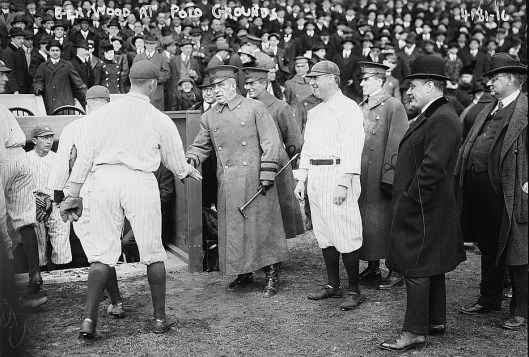
The New York Yankees play their home opener this afternoon against the Tampa Bay Rays. In 1917 the Yankees opened their season at the Polo Grounds versus Babe Ruth and the Boston Red Sox. Leonard Wood threw out the first pitch. I wrote about that two years ago on Opening Day. Here today are two more images of that event. This was 11 April 1917, in between Wood’s lateral demotion from the Department of the East and his move to South Carolina. Dorey had worked for Wood from their time together in the Philippines through the Preparedness movement on Governors Island. President Wilson had relieved Wood of command there a few weeks before this photo was taken. Wood however was still in New York wrapping up in preparation for his transfer to the Department of the Southeast.

Even more intriguing is the photograph below.The men to the extreme right are Yankee owners Colonel Jacob Ruppert and Tillinghast L’Hommedieu Huston. Ruppert is the better known today and was the George Steinbrenner of his era: a German-American who bought the Yankees at a low point and turned them into a juggernaut. On April 13, two days after this photo was taken, Ruppert and other German-Americans met with New York City mayor John Purroy Mitchel at City Hall to announce their formation of a Committee of Men of Teuton Blood in support of the American war effort.

All but forgotten today is his co-owner, with whom he bought the sputtering Yankees in 1915. Tillinghast L’Hommedieu Huston had served in the Spanish-American War nearly two decades earlier. In February 1917 when things were heating up with Germany he proposed a Sportsmen’s Battalion of athletes to fight should war indeed come. When it finally did, Huston returned to military service and served in France as part of the 16th (Engineers) Regiment. He eventually became the colonel of that unit.

Yankee owners Jacob Ruppert and Tillinghast L’Hommedieu Huston (in suits, far right) went out of their way on Opening Day 1917 to publicly express their support for Major General Leonard Wood. One month later Huston himself would join what became the A.E.F.

(images/Library of Congress)

Private Herman Ruth

03 Monday Oct 2016

Posted by Keith Muchowski in Baseball, Governors Island, Washington, D.C.

≈ 4 Comments

General Pershing and Private Ruth exchange salutes, 28 May 1924

General Pershing and Private Ruth exchange salutes, 28 May 1924

The above photo came through my in-box today and I thought that with the baseball post-season beginning this week it would be apropos to share. This is Babe Ruth saluting General John Pershing outside the State, War and Navy Building in Washington D.C. Ruth had recently joined 104th Field Artillery of the New York National Guard at Pershing’s request as a way to generate interest in the Citizens’ Military Training Camps. The Army needed all the help it could get half a decade after the Treaty of Versailles; the military drawback of the early 1920s meant that the United States again had a small fighting force.

A little digging shows that Ruth had sought a khaki uniform in New York but could not find one for his large frame. It is interesting to note that by today’s he is not that large. This is 1924 and he actually looks relatively slim, certainly slimmer than we came to know him as he grew older and stouter due to his excesses. It says something that a man of this physical stature would be considered stout for his time, and that a uniform could not be found in his size in all of New York. Ruth reported to the Quartermaster General’s office in Washington to be fitted early on May 28 and reported to Pershing for this photo op after that. Photo op is the right phrase: a basic search reveals several outtakes of the two men saluting, smiling, and/or shaking hands.

The Yankees were in Washington to play the Senators in on odd two-game road trip that lasted all one day. The Yankees and Senators split a double-header at Griffith Stadium. The Bambino went 3 for 8 in the two games. Ruth visited numerous Citizens’ Military Training Camps in the years after this photo was taken. By the endow the decade Ruth had apparently had enough; in April 1930 he informed Major General Hanson E. Ely, commander of the Second Corps Area at Fort Jay on Governors Island, that he was stepping down. Though again a “civilian” Ruth continued making a contribution, signing bats and balls to be given as trophies at CMTC athletic events until at least the mid-1930s.

Baseball’s brief European moment

12 Tuesday Jul 2016

Posted by Keith Muchowski in Baseball

≈ Comments Off on Baseball’s brief European moment

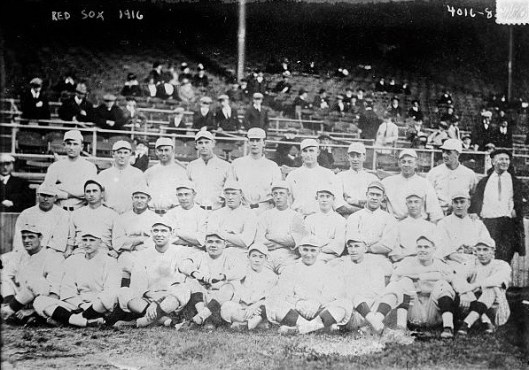
The United States was not yet involved in the Great War when the Boston Red Sox won the World Series in 1916. Still, Canadians were playing the game overseas in military leagues. Note Babe Ruth sitting fourth from the left.

The United States was not yet involved in the Great War when the Boston Red Sox won the World Series in 1916. Still, by this time Canadian and other colonial troops were already playing the game overseas in their own military leagues. Note Babe Ruth sitting fourth from the left.

They are playing the All Star game tonight in San Diego. During the Great War the best individual players of the American League did not yet play their counterparts from the Senior Circuit in the game that traditionally marks the half way point of a season. That is probably because the World Series itself had begun only in 1903 and the game was still institutionalizing itself. Still, even though the United States had not entered the war by 1916, baseball was catching on overseas; it was the war’s second summer and Canadians had brought the game with them when they packed their old kit bags and headed off to fight the Hun. There were even military leagues comprised of Canadians and other men from the colonies playing one another.

Wounded Canadians pose in Mrs. Astor's hospital, circa 1915

Wounded Canadians pose in Mrs. Astor’s hospital, c. 1915

Men in uniform brought baseball to many corners of the globe over the course the twentieth century. The U.S. occupations of Latin and South America are what led to the rise of the Dominican, Puerto Rican and other Hispanic stars we see today. Baseball’s popularity expanded in Japan after 1945, though I hasten to add that the baseball was already going strong with the Japanese even in the 1920s and 1930s. William Howard Taft noted in the 1910s, after his presidency, that Filipinos were picking up the game during his years as Governor-General of the Philippines. Americans entered the Great War in 1917 and when they did of course brought their bats, balls, and gloves with them. Even stars like Ty Cobb ended up in uniform.

It is curious why the game did not stick permanently with Europeans after the war. Perhaps it was because the countries were too devastated and the populations of young men too damaged to take up the pastime. Or maybe cricket, soccer, cycling and the like were just too entrenched. Or maybe it was a combination of all these things. Again, I don’t know. We can only wonder might have happened to international baseball had the game not had more a fleeting moment in the sun during the First World War.

(images/Library of Congress)

← Older posts
Newer posts →

Enter your email address to subscribe to this blog and receive notifications of new posts by email.

Join 258 other subscribers

Categories

Archives

  • November 2023 (1)
  • October 2023 (3)
  • September 2023 (3)
  • August 2023 (4)
  • July 2023 (7)
  • June 2023 (10)
  • May 2023 (8)
  • April 2023 (6)
  • March 2023 (5)
  • February 2023 (4)
  • January 2023 (4)
  • December 2022 (4)
  • November 2022 (8)
  • October 2022 (2)
  • September 2022 (4)
  • June 2022 (1)
  • May 2022 (1)
  • April 2022 (13)
  • January 2022 (1)
  • December 2021 (2)
  • November 2021 (1)
  • October 2021 (3)
  • September 2021 (3)
  • August 2021 (5)
  • July 2021 (1)
  • June 2021 (1)
  • May 2021 (4)
  • April 2021 (3)
  • March 2021 (4)
  • February 2021 (7)
  • January 2021 (4)
  • December 2020 (4)
  • November 2020 (3)
  • October 2020 (4)
  • September 2020 (7)
  • August 2020 (5)
  • July 2020 (7)
  • June 2020 (11)
  • May 2020 (7)
  • April 2020 (9)
  • March 2020 (9)
  • February 2020 (7)
  • January 2020 (6)
  • December 2019 (7)
  • November 2019 (9)
  • October 2019 (4)
  • September 2019 (6)
  • August 2019 (10)
  • July 2019 (8)
  • June 2019 (6)
  • May 2019 (9)
  • April 2019 (8)
  • March 2019 (6)
  • February 2019 (8)
  • January 2019 (5)
  • December 2018 (10)
  • November 2018 (6)
  • October 2018 (9)
  • September 2018 (11)
  • August 2018 (11)
  • July 2018 (17)
  • June 2018 (10)
  • May 2018 (8)
  • April 2018 (9)
  • March 2018 (8)
  • February 2018 (5)
  • January 2018 (7)
  • December 2017 (11)
  • November 2017 (8)
  • October 2017 (9)
  • September 2017 (11)
  • August 2017 (12)
  • July 2017 (14)
  • June 2017 (18)
  • May 2017 (11)
  • April 2017 (10)
  • March 2017 (9)
  • February 2017 (11)
  • January 2017 (14)
  • December 2016 (7)
  • November 2016 (8)
  • October 2016 (8)
  • September 2016 (9)
  • August 2016 (6)
  • July 2016 (12)
  • June 2016 (8)
  • May 2016 (9)
  • April 2016 (6)
  • March 2016 (12)
  • February 2016 (10)
  • January 2016 (9)
  • December 2015 (9)
  • November 2015 (11)
  • October 2015 (8)
  • September 2015 (9)
  • August 2015 (13)
  • July 2015 (14)
  • June 2015 (11)
  • May 2015 (11)
  • April 2015 (18)
  • March 2015 (10)
  • February 2015 (8)
  • January 2015 (8)
  • December 2014 (12)
  • November 2014 (13)
  • October 2014 (16)
  • September 2014 (11)
  • August 2014 (16)
  • July 2014 (12)
  • June 2014 (13)
  • May 2014 (10)
  • April 2014 (10)
  • March 2014 (11)
  • February 2014 (12)
  • January 2014 (10)
  • December 2013 (11)
  • November 2013 (14)
  • October 2013 (14)
  • September 2013 (14)
  • August 2013 (13)
  • July 2013 (17)
  • June 2013 (9)
  • May 2013 (13)
  • April 2013 (13)
  • March 2013 (16)
  • February 2013 (15)
  • January 2013 (15)
  • December 2012 (18)
  • November 2012 (18)
  • October 2012 (21)
  • September 2012 (14)
  • August 2012 (16)
  • July 2012 (21)
  • June 2012 (22)
  • May 2012 (24)
  • April 2012 (20)
  • March 2012 (23)
  • February 2012 (22)
  • January 2012 (15)
  • December 2011 (23)
  • November 2011 (22)
  • October 2011 (23)
  • September 2011 (18)
  • August 2011 (19)
  • July 2011 (20)
  • June 2011 (29)
  • May 2011 (25)
  • April 2011 (18)
  • March 2011 (21)
  • February 2011 (11)

Meta

  • Create account
  • Log in
  • Entries feed
  • Comments feed
  • WordPress.com
Creative Commons License
This work is licensed under a Creative Commons Attribution-NonCommercial-ShareAlike 4.0 International License.

Enter your email address to subscribe to this blog and receive notifications of new posts by email.

Join 258 other subscribers

Categories

Archives

  • November 2023 (1)
  • October 2023 (3)
  • September 2023 (3)
  • August 2023 (4)
  • July 2023 (7)
  • June 2023 (10)
  • May 2023 (8)
  • April 2023 (6)
  • March 2023 (5)
  • February 2023 (4)
  • January 2023 (4)
  • December 2022 (4)
  • November 2022 (8)
  • October 2022 (2)
  • September 2022 (4)
  • June 2022 (1)
  • May 2022 (1)
  • April 2022 (13)
  • January 2022 (1)
  • December 2021 (2)
  • November 2021 (1)
  • October 2021 (3)
  • September 2021 (3)
  • August 2021 (5)
  • July 2021 (1)
  • June 2021 (1)
  • May 2021 (4)
  • April 2021 (3)
  • March 2021 (4)
  • February 2021 (7)
  • January 2021 (4)
  • December 2020 (4)
  • November 2020 (3)
  • October 2020 (4)
  • September 2020 (7)
  • August 2020 (5)
  • July 2020 (7)
  • June 2020 (11)
  • May 2020 (7)
  • April 2020 (9)
  • March 2020 (9)
  • February 2020 (7)
  • January 2020 (6)
  • December 2019 (7)
  • November 2019 (9)
  • October 2019 (4)
  • September 2019 (6)
  • August 2019 (10)
  • July 2019 (8)
  • June 2019 (6)
  • May 2019 (9)
  • April 2019 (8)
  • March 2019 (6)
  • February 2019 (8)
  • January 2019 (5)
  • December 2018 (10)
  • November 2018 (6)
  • October 2018 (9)
  • September 2018 (11)
  • August 2018 (11)
  • July 2018 (17)
  • June 2018 (10)
  • May 2018 (8)
  • April 2018 (9)
  • March 2018 (8)
  • February 2018 (5)
  • January 2018 (7)
  • December 2017 (11)
  • November 2017 (8)
  • October 2017 (9)
  • September 2017 (11)
  • August 2017 (12)
  • July 2017 (14)
  • June 2017 (18)
  • May 2017 (11)
  • April 2017 (10)
  • March 2017 (9)
  • February 2017 (11)
  • January 2017 (14)
  • December 2016 (7)
  • November 2016 (8)
  • October 2016 (8)
  • September 2016 (9)
  • August 2016 (6)
  • July 2016 (12)
  • June 2016 (8)
  • May 2016 (9)
  • April 2016 (6)
  • March 2016 (12)
  • February 2016 (10)
  • January 2016 (9)
  • December 2015 (9)
  • November 2015 (11)
  • October 2015 (8)
  • September 2015 (9)
  • August 2015 (13)
  • July 2015 (14)
  • June 2015 (11)
  • May 2015 (11)
  • April 2015 (18)
  • March 2015 (10)
  • February 2015 (8)
  • January 2015 (8)
  • December 2014 (12)
  • November 2014 (13)
  • October 2014 (16)
  • September 2014 (11)
  • August 2014 (16)
  • July 2014 (12)
  • June 2014 (13)
  • May 2014 (10)
  • April 2014 (10)
  • March 2014 (11)
  • February 2014 (12)
  • January 2014 (10)
  • December 2013 (11)
  • November 2013 (14)
  • October 2013 (14)
  • September 2013 (14)
  • August 2013 (13)
  • July 2013 (17)
  • June 2013 (9)
  • May 2013 (13)
  • April 2013 (13)
  • March 2013 (16)
  • February 2013 (15)
  • January 2013 (15)
  • December 2012 (18)
  • November 2012 (18)
  • October 2012 (21)
  • September 2012 (14)
  • August 2012 (16)
  • July 2012 (21)
  • June 2012 (22)
  • May 2012 (24)
  • April 2012 (20)
  • March 2012 (23)
  • February 2012 (22)
  • January 2012 (15)
  • December 2011 (23)
  • November 2011 (22)
  • October 2011 (23)
  • September 2011 (18)
  • August 2011 (19)
  • July 2011 (20)
  • June 2011 (29)
  • May 2011 (25)
  • April 2011 (18)
  • March 2011 (21)
  • February 2011 (11)

Meta

  • Create account
  • Log in
  • Entries feed
  • Comments feed
  • WordPress.com
Creative Commons License
This work is licensed under a Creative Commons Attribution-NonCommercial-ShareAlike 4.0 International License.

Enter your email address to subscribe to this blog and receive notifications of new posts by email.

Join 258 other subscribers

Categories

Archives

  • November 2023 (1)
  • October 2023 (3)
  • September 2023 (3)
  • August 2023 (4)
  • July 2023 (7)
  • June 2023 (10)
  • May 2023 (8)
  • April 2023 (6)
  • March 2023 (5)
  • February 2023 (4)
  • January 2023 (4)
  • December 2022 (4)
  • November 2022 (8)
  • October 2022 (2)
  • September 2022 (4)
  • June 2022 (1)
  • May 2022 (1)
  • April 2022 (13)
  • January 2022 (1)
  • December 2021 (2)
  • November 2021 (1)
  • October 2021 (3)
  • September 2021 (3)
  • August 2021 (5)
  • July 2021 (1)
  • June 2021 (1)
  • May 2021 (4)
  • April 2021 (3)
  • March 2021 (4)
  • February 2021 (7)
  • January 2021 (4)
  • December 2020 (4)
  • November 2020 (3)
  • October 2020 (4)
  • September 2020 (7)
  • August 2020 (5)
  • July 2020 (7)
  • June 2020 (11)
  • May 2020 (7)
  • April 2020 (9)
  • March 2020 (9)
  • February 2020 (7)
  • January 2020 (6)
  • December 2019 (7)
  • November 2019 (9)
  • October 2019 (4)
  • September 2019 (6)
  • August 2019 (10)
  • July 2019 (8)
  • June 2019 (6)
  • May 2019 (9)
  • April 2019 (8)
  • March 2019 (6)
  • February 2019 (8)
  • January 2019 (5)
  • December 2018 (10)
  • November 2018 (6)
  • October 2018 (9)
  • September 2018 (11)
  • August 2018 (11)
  • July 2018 (17)
  • June 2018 (10)
  • May 2018 (8)
  • April 2018 (9)
  • March 2018 (8)
  • February 2018 (5)
  • January 2018 (7)
  • December 2017 (11)
  • November 2017 (8)
  • October 2017 (9)
  • September 2017 (11)
  • August 2017 (12)
  • July 2017 (14)
  • June 2017 (18)
  • May 2017 (11)
  • April 2017 (10)
  • March 2017 (9)
  • February 2017 (11)
  • January 2017 (14)
  • December 2016 (7)
  • November 2016 (8)
  • October 2016 (8)
  • September 2016 (9)
  • August 2016 (6)
  • July 2016 (12)
  • June 2016 (8)
  • May 2016 (9)
  • April 2016 (6)
  • March 2016 (12)
  • February 2016 (10)
  • January 2016 (9)
  • December 2015 (9)
  • November 2015 (11)
  • October 2015 (8)
  • September 2015 (9)
  • August 2015 (13)
  • July 2015 (14)
  • June 2015 (11)
  • May 2015 (11)
  • April 2015 (18)
  • March 2015 (10)
  • February 2015 (8)
  • January 2015 (8)
  • December 2014 (12)
  • November 2014 (13)
  • October 2014 (16)
  • September 2014 (11)
  • August 2014 (16)
  • July 2014 (12)
  • June 2014 (13)
  • May 2014 (10)
  • April 2014 (10)
  • March 2014 (11)
  • February 2014 (12)
  • January 2014 (10)
  • December 2013 (11)
  • November 2013 (14)
  • October 2013 (14)
  • September 2013 (14)
  • August 2013 (13)
  • July 2013 (17)
  • June 2013 (9)
  • May 2013 (13)
  • April 2013 (13)
  • March 2013 (16)
  • February 2013 (15)
  • January 2013 (15)
  • December 2012 (18)
  • November 2012 (18)
  • October 2012 (21)
  • September 2012 (14)
  • August 2012 (16)
  • July 2012 (21)
  • June 2012 (22)
  • May 2012 (24)
  • April 2012 (20)
  • March 2012 (23)
  • February 2012 (22)
  • January 2012 (15)
  • December 2011 (23)
  • November 2011 (22)
  • October 2011 (23)
  • September 2011 (18)
  • August 2011 (19)
  • July 2011 (20)
  • June 2011 (29)
  • May 2011 (25)
  • April 2011 (18)
  • March 2011 (21)
  • February 2011 (11)

Meta

  • Create account
  • Log in
  • Entries feed
  • Comments feed
  • WordPress.com
Creative Commons License
This work is licensed under a Creative Commons Attribution-NonCommercial-ShareAlike 4.0 International License.

Blog at WordPress.com.

  • Subscribe Subscribed
    • The Strawfoot
    • Join 229 other subscribers
    • Already have a WordPress.com account? Log in now.
    • The Strawfoot
    • Subscribe Subscribed
    • Sign up
    • Log in
    • Report this content
    • View site in Reader
    • Manage subscriptions
    • Collapse this bar
 

Loading Comments...