• About

The Strawfoot

~ a New Yorker's American History blog

The Strawfoot

Category Archives: Franklin Delano Roosevelt

Thinking of the Emergency Relief Appropriation Act while isolating in place

08 Wednesday Apr 2020

Posted by Keith Muchowski in Franklin Delano Roosevelt, Harold Ickes, Harry Hopkins, New Deal

≈ Comments Off on Thinking of the Emergency Relief Appropriation Act while isolating in place

left to right: Henry Morgenthau, Joseph Kennedy, Harry Hopkins, and Harold Ickes at the White House, 1935

Today marks the 85th anniversary of the passage of one of the most significant acts of legislation to come during the Roosevelt Administration, which is saying a lot: it was on April 8, 1935 that the Emergency Relief Appropriation Act became law. The act gave Franklin Roosevelt even wider latitude to distribute Depression emergency funds as he saw fit. Surprisingly there does not seem to be an image of the signing, which took place after Roosevelt returned from a spring fishing trip. FDR being the master politician he was that probably was not accidental, though I don’t know why. Perhaps he was trying to paper over the failures and miscues of some of the alphabet soup agencies that had come into being in the two years since his presidency began. Two central ideas of the bill were 1) that the money would be more decentralized, giving state and local leaders more input into how to spend New Deal funds, and 2) that the emphasis would shift from relief itself to public works. The biggest change that came out of the bill was the creation of the Works Progress Administration.

The WPA’s influence surrounds most Americans every day, even if they are unaware. A good many of our bridges, post offices, roads, and so much more came out of it over the next several years. Culturally it did a lot too. As I type these words I can see the WPA American Guides for New York and Washington D.C. on my bookshelf. In addition to writers they put painters such as the young Jacob Lawrence to work via the Federal Art Project. Politically the Emergency Relief Appropriation Act led to a power struggle between Harold Ickes and Harry Hopkins over who would become the czar distributing these billions of dollars. Hopkins, who hardly anyone knows anymore despite all he did during the Depression and Second World War, won the struggles. The New Deal was not perfect and had all sorts of unintended consequences but I do not have the confidence in anyone within a leadership position in the current federal administration that I would have had in Hopkins, or Harold Ickes for that matter. So much of that story began eighty-five years ago today.

(image/Library of Congress)

Searching for an Historian: Researching the Poughkeepsie Post Office Mural of the NY State Ratification of the U.S. Constitution (July 1788) painted by Gerald Foster

15 Sunday Mar 2020

Posted by Keith Muchowski in American Revolutionary War, Federal Hall National Memorial, Founding Fathers, Franklin Delano Roosevelt, Guest Posts, Isaac Roosevelt

≈ Comments Off on Searching for an Historian: Researching the Poughkeepsie Post Office Mural of the NY State Ratification of the U.S. Constitution (July 1788) painted by Gerald Foster

This past November I received an email from Bob Crothers, an independent scholar who had my article in the Journal of the American Revolution about Isaac Roosevelt and was reaching out to tell me of his research relating to New York State before, during, and immediately after the Revolution. Bob received his B.A. in Economics from Brown and M.B.A. from Harvard Business School before a long career on Wall Street and Madison Avenue. Now retired, he is pursuing his interest in History full-time researching and presenting on various subjects. Among other topics, Bob has an interest in the New Deal Era mural in the Poughkeepsie post office depicting the 1788 New York State Ratification Convention that took place in that city. Bob and I finally met in person last month when he came to Federal Hall on Presidents Day. Last week he traveled to Washington D.C. to conduct research on the post office mural. Here is his guest article on the experience.

By Bob Crothers
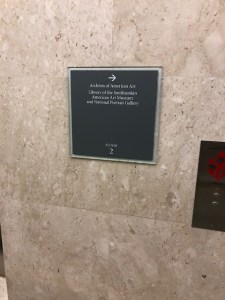
I’m preparing a talk to be given in the fall of this year on the debate and compromise of the New York State Ratification Convention. This Convention took place June 17-July 26 1788 in the then-third Court House of Poughkeepsie, which burned down in 1804. In November 2019, the day after Thanksgiving, I visited the only memorial to this long-forgotten event. That memorial is a late 1930s mural located on the second floor of a Depression Era-built Post office painted by a New Jersey artist named Gerald Foster.

The mural shows 23 of the 67 delegates to this convention and focuses on a handshake between Alexander Hamilton, the most well known Federalist, both state and nation-wide, and Governor George Clinton, probably the most dedicated Anti-Federalist in the nation at this time. Clinton was the first non-royal New York governor; he would go on to serve twenty-two years in the post; he also served as Vice-President in Thomas Jefferson’s second term. Clinton subsequently died in office as James Madison’s first term Vice-President in 1812.

Two more dedicated political enemies than Hamilton and Clinton (perhaps excluding Hamilton and Burr) would be hard to find. Governor Clinton, first elected in June 1777, had done a remarkably effective job of protecting the state’s interests and keeping taxes low, taking full advantage of the great harbor growing in NYC.

The mural memorializes the July 26, 1788 breakthrough in the Federalist/Anti-Federalist debate and stalemate threatening to keep New York State from ratifying the U.S. Constitution. The stalemate was finally broken when the prominent Anti-Federalist Melancton Smith, a one-time sheriff of Poughkeepsie but at the time a NYC resident, brought his mentor, Governor Clinton, to an agreement with Federalist Alexander Hamilton, to ratify the Constitution. The key to this was the pledge that the first American Congress, set to meet in NYC would pass, in its first assembly, both 1) a Bill of Rights and 2) the promise of another Constitutional Convention within two years. This handshake ended by far the most difficult negotiation between these first two identifiable political parties in US constitutional history. Under those terms, New York became the eleventh state to ratify the US Constitution.

Foster’s mural as depicted on a 1987 United States Postal Service special cancellation commemorative card

As I studied the mural, it seemed to me unlikely that the painter would have known of this history and thus been able to choose the participants depicted in this painting, But who could have advised and directed him? I had a candidate in mind, Franklin Delano Roosevelt, but needed to find a way of gaining more information.

I knew FDR to be a serious historian, particularly of his own Dutch Colonial family and of Dutchess County, where his branch of the family had resettled in the early 19th Century, following the arrival and settlement of his family in New York City in the 1600s.

I enlisted two potential resources: 1) the FDR Presidential Library in Hyde Park NY to trace FDR’s involvement and 2) the Smithsonian Institution’s Archive of American Art in Washington, DC, which holds the papers of the artist, Gerald Foster.

The FDR Presidential Library suggested I send them an email outlining my interest, which would be assigned to one of their several archivists, who would respond to me within two weeks. Precisely two weeks later, to the day, I received a healthy packet of materials from Mr. F., my archivist, which contained two particularly interesting items, The first was a copy of a manuscript letter dated May 28, 1939 from Foster to the head of the U.S. Department of the Treasury’s Section of Fine Arts (“the Section”), the funder of the mural, pertaining to ”the subject matter and the characters portrayed” in his Ratification Mural. One sentence reads: The idea for this group was suggested by Pres. Franklin D, Roosevelt. Another reads: Authentic old portraits were found for eighteen (out of 21) of the figures shown.

The second item was a copy of a typewritten letter from the chief of the Section of Fine Arts to the President of the United States, dated April 29, 1939, dealing with a jury of local Poughkeepsie arts experts, including a “Miss Reynolds” concerning the approval of designs for several Poughkeepsie post office murals. A sentence reads: “Since Miss Reynolds is not in agreement with the jury, and as there are four or five designs which appear to us to be of merit, I would appreciate very much your reviewing the designs.”

So FDR was clearly involved in this mural development and there was a Cherchez La Femme individual named Reynolds making trouble. Shades of Alexander Hamilton’s affair many years earlier! (Further research turns up many references to Miss Reynolds as FDR’s great friend and fellow historian at the Dutchess County Historical Society, Helen Reynolds. Mystery solved!)
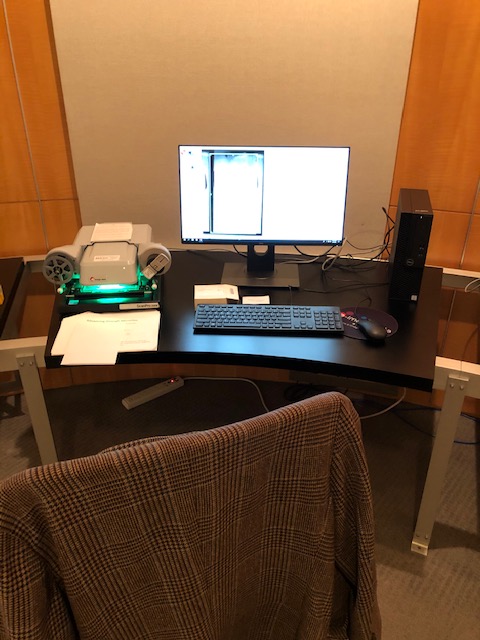
Bob Crothers’s work station at the Archives of American Art as he went through microfilm researching Foster’s mural, March 2020

This past week, I explored the painter’s side of the occasion and found several interesting references in the microfilm of Gerald Foster’s papers at the Archives of American Art in Washington D.C. The first was a typed memo describing Foster’s recollections and personal details of his meeting(s) with FDR on this and two other, less significant, murals done by the painter. Another was a handwritten note on the verso of an unidentified sketch noting FDR’s involvement in the details of its preparation. And lastly there is the local Poughkeepsie newspaper’s page one announcement on May 18, 1938 of the Ratification mural’s dedication.

QED, the Ratification mural in the Poughkeepsie Post Office was conceived and directed by our then-president, Franklin Delano Roosevelt, aided by his fellow Dutchess County Historical Society correspondent Helen Reynolds, and executed by muralist Gerald Foster in 1937/38.

a “New Valley Forge”

23 Sunday Feb 2020

Posted by Keith Muchowski in Federal Hall National Memorial, Franklin Delano Roosevelt, George Washington, Memory

≈ Comments Off on a “New Valley Forge”

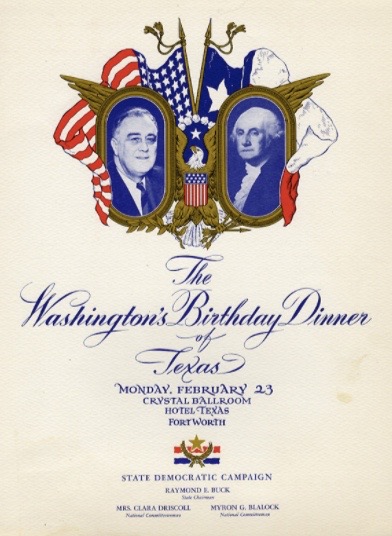
Here are a few more images from my presentation this past Monday at Federal Hall on Presidents Day. Here we see an announcement for a Washington Birthday Democratic fundraiser held in Fort Worth, Texas on February 23, 1942. This was less than two months after Pearl Harbor in those tense days when the United States was getting up to speed in its war effort. The U.S. had been the “arsenal of democracy,” manufacturing tanks, bullets, jeeps, and whatnot for the Allies long prior to Pearl Harbor. Now American fighting men themselves would join the fray. As we see from the announcement the dinner was held on February 23, not Washington’s actually birthday, because the 22nd fell on a Sunday.

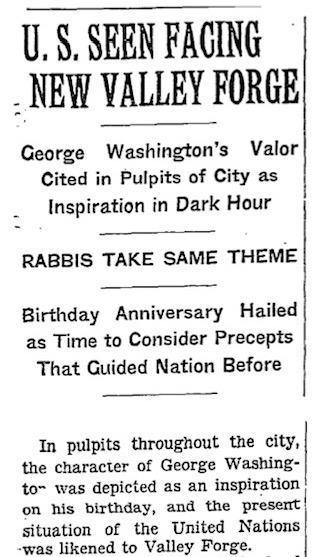
New York Times, February 23, 1942

Roosevelt himself did not attend the dinner, though as we see the Texas Democratic leadership was not hesitant to use his likeness, and on equal footing with President Washington no less. One must remember that Texas in this era was part of the Solid South, comprised, like the rest of the region, of Dixiecrats who since the Civil War eighty years previously had stood against the Party of Lincoln. In the 1930s these leaders, and those who voted for them, were part of the fragile New Deal coalition supporting FDR in cooperation with the Democratic machines of the northern cities. That coalition would hold another three decades until fracturing in the chaos of the Vietnam War and bitterness of the Civil Rights Movement. Roosevelt’s vice-president in his first two terms had been John Nance Garner, a Texan and former Speaker of the U.S. House of Representatives. The tension and unease in their relationship were representative of the strains within the New Deal coalition itself.

Garner was gone by 1942 and now Roosevelt was facing the war in his unprecedented third term. What we see here is the snippet of an article from the February 23, 1942 New York Times describing the mood on Washington’s birthday in those weeks just after Pearl Harbor. The first public observation of George Washington’s birthday had been at Valley Forge in the winter of 1778. Now America was facing a “new Valley Forge.” Attendees at the Fort Worth soiree did not meet Franklin Roosevelt, but they did hear him. That night he gave one of his fireside chats over the radio outlining the progress and stakes of the war, and the lessons to be learned from the experience and difficulties of Washington and the men of his Continental Army all those years earlier.


Robert Caro’s Al Smith

10 Friday Jan 2020

Posted by Keith Muchowski in Alfred E. Smith, Franklin Delano Roosevelt, Historiography, Libraries, Robert Moses

≈ Comments Off on Robert Caro’s Al Smith

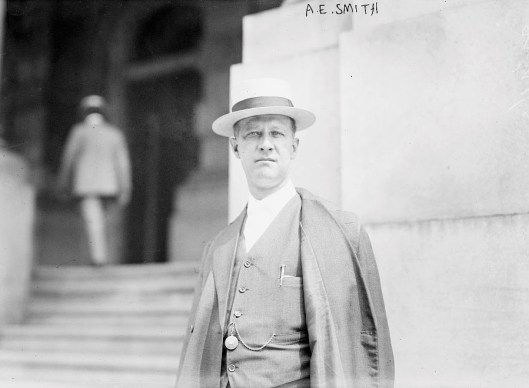
Alfred Emanuel Smith in May 1920 during his first term as governor of New York

I was on vacation last week when I received a text message from someone who was himself away, sitting on a beach in Mexico no less, telling me that the New-York Historical Society had just acquired the extensive—200 linear feet—papers of Robert Caro. I told my friend that I remembered seeing Caro interviewed on C-SPAN 12-15 years ago and Brian Lamb asking the biographer where his papers might eventually go. Caro said at the time that he was not sure, but that he would not be giving them to the Lyndon Baines Johnson Presidential Library in Austin. He had had several problems with officials there over the years, especially in the early years of his multi-volume LBJ project when at least some officials then at the archive had been personal associates of Johnson himself and thus less than forthcoming. As it happened I was reading Terry Golway’s Frank and Al: FDR, Al Smith, and the Unlikely Alliance that Created the Modern Democratic Party when my friend texted.

Caro’s papers include a great deal on Al Smith himself, one of the great and sadly forgotten figures in American history. Smith happened to enter the New York State Assembly 116 years ago this week in January 1904. Tammany boss Tom Foley, the man responsible for giving Smith his start in politics, gave Smith one piece of advice before his protégé headed to Albany that January nearly a century ago: “Don’t speak until you have something to say.” And so for that first term Smith sat as a back-bencher high above the legislative floor, taking in the proceedings and figuring out who was who and what was what. Roosevelt entered Albany politics seven years later. The word “alliance” in Golway’s title is fitting, for while Smith and FDR’s relationship was more than transactional the two very different men and never shared a friendship in any true sense. For reasons too complicated to go in to here and now, I would aver that it is not a stretch to say that without Al Smith there would be no FDR, at least no FDR as we know the man and his legacy.

I have some projects I’m hoping to accomplish involving Al Smith over the next few years and am hoping Caro’s research on the four-term New York governor and 1928 Democratic Party nominee will be available fairly soon.

(image/Library of Congress)


Assistant Secretary Franklin Roosevelt and Prince Edward Albert

24 Sunday Nov 2019

Posted by Keith Muchowski in Franklin Delano Roosevelt, Washington, D.C.

≈ Comments Off on Assistant Secretary Franklin Roosevelt and Prince Edward Albert

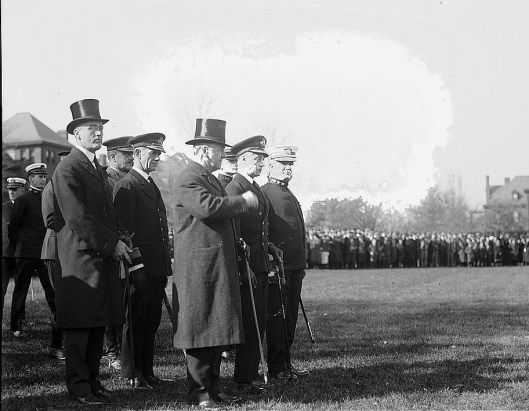
Franklin Roosevelt had a soft spot for European royals and did not miss the opportunity to escort Edward Albert, Prince of Wales, to the U.S. Naval Academy with other dignitaries on November 14, 1919.

President and First Lady Franklin & Eleanor Roosevelt famously hosted King George VI and Queen Elizabeth at the Roosevelt estate in Hyde Park in June 1939. Twenty years previously in November 1919 Assistant Naval Secretary Roosevelt and others hosted George’s brother, Edward Albert, on the Prince of Wales’s visit to Washington D.C. This was the same trip I mentioned a few days ago in which the heir apparent to the British Crown had come to North America in that year just after the Great War’s end for an extended period. The future King Edward VIII spent most of that period, almost four months starting in early August, in British Canada, entering the United States via train on November 10 in the border town of Rouses Point, NY on Lake Champlain to a warm welcome on a cold autumn evening from U.S. Secretary of State Robert Lansing, various British & American military brass, and most of the Rouses Point population of around 2000. The following day he arrived in Washington’s Union Station while Armistice Day ceremonies were going on nearby. He spent some moments that afternoon with the incapacitated President Wilson at the White House.

The image we see above was taken at the Naval Academy of November 14. Here we see Roosevelt on the far left. It is always striking to see how strong and virile he was before contracting polio, less than two years after this photograph was taken. The Prince of Wales is second from the right, wearing the uniform of Captain of the Royal Navy. The announcement stating that Edward Albert would visit Annapolis had gone out ten days prior; in that announcement the Prince of Wales made clear he was representing not just England and Britain, but Canada and the Empire itself during his American tour. Still, his time in the American capital was brief. After the visit to the Naval Academy he took a three-day respite in White Sulphur Springs, West Virginia before coming to New York for five days. While here, among many other things, he visited West Point two hours up the Hudson to visit the cadets at the Military Academy. He was in the United States for a mere two weeks, but had done and seen much in that brief span.

(image/Library of Congress)

Isaac Roosevelt, colonial New Yorker

02 Saturday Nov 2019

Posted by Keith Muchowski in Federal Hall National Memorial, Founding Fathers, Franklin Delano Roosevelt, Incorporating New York (book manuscript project), Isaac Roosevelt

≈ Comments Off on Isaac Roosevelt, colonial New Yorker

Isaac Roosevelt, 1726-1794

The Journal of the American Revolution has uploaded my article about Isaac Roosevelt. I spent much of late summer and early fall working on this project and am happy with how it came out. It had been my loss goal for several years to write about Isaac and the specific “ah ha” moment came one August Saturday at Federal Hall when I was talking to one of rangers about prominent New Yorkers of the colonial, Revolutionary, and Early American periods. When we think of these eras we tend not to think of the Roosevelts, though they were very much prominent in local, national, and international affairs in these decades. That is what I tried to convey in this piece. Isaac Roosevelt was Franklin D. Roosevelt’s great, great grandfather.

I don’t want to give away too many details at the moment but I am preparing a submission to speak at a conference next year about interlocking familial aspects of the Early American and Civil War generations, focusing on one father, son, and grandson, the last of whom features prominently in my book manuscript Incorporating New York. If it comes to pass the Roosevelts, though not front and center, will feature as well. So often we hear that both sides in the Civil War, Union and Confederate, saw themselves as the inheritors of the Founders’ legacy. That is certainly true, but how and why is something we do not always hear about. We’ll see how the pitch to conference selectors goes. In the meantime, here is my biographical narrative of the life and times of Isaac Roosevelt, a founder of the State of New York, ratifier of the U.S. Constitution, and good friend of Hamilton, Jay, and others.

(image/FDR Presidential Library and Museum)

The photographers’ Great Depression

12 Saturday Oct 2019

Posted by Keith Muchowski in Film, Sound, & Photography, Franklin Delano Roosevelt, Memory, New Deal

≈ Comments Off on The photographers’ Great Depression

Okies in Farm Security Administration (FSA) emergency migratory labor camp, Calipatria, Imperial Valley, February 1939. This image was taken by Dorothea Lange, a colleague of Arthur Rothstein whose images are included in the current exhibit at Roosevelt House.

I’m sorry about the lack of posts recently. I have spent much of the past several weeks finishing the draft of a project that proved more difficult and time-involved that I had imagined. I submitted the draft the other day. We’ll see if comes to pass toward the end of the year. People were asking me at work yesterday what I intended to do over the three-day weekend; when they did I answered with a negative: “not writing and editing.”

Last night I went to Roosevelt House on East 65th Street for the opening of the exhibit “A Lens on FDR’s New Deal: Photographs by Arthur Rothstein, 1935-1945.” Rothstein was one of the great visual chroniclers of Depression Era America. It is not going too far to say that he, his friend and colleague Dorothea Lange, and others shaped our awareness and memory and of what the country was enduring in the 1930s and early 1940s. Part of the reason the Roosevelt Administration created the initiative to photograph the severity of the economic crisis to begin with was to press the need for its New Deal programs.

Rothstein was the son of refugees from Eastern Europe. Like so many immigrants and first-generation Americans, he was eager to make his contribution. Born in 1915, Rothstein attended Columbia University at fifteen and in the mid-1930s, just a young man in his early 20s, found himself driving across the country on dirt roads, sleeping in his car, eating off a hot plate, and shooting 80,000 images in migrant camps, farming communities, and elsewhere.

Rothstein’s daughter, Dr. Annie Segan, put the exhibition together in with her husband and the Roosevelt House historian. With over 125 photographs it is the biggest exhibit of Rothstein images to go on display in more than a quarter century. Other photographers are included as well. Many of the images were taken from tiny negatives. Rothstein’s daughter in her talk called them “picture stories.” Incredibly the trove of 175,000 images taken by Rothstein and the nearly twenty other photographers working for the Resettlement Administration (RA) and Farm Security Administration (FSA) were nearly discarded by indifferent bureaucrats in the years after the Second World War. Thankfully they were saved and are available to the public at the Library of Congress and online.

The exhibit runs into January 2020.

(image/Library of Congress)


Constitution Day

17 Tuesday Sep 2019

Posted by Keith Muchowski in Alexander Hamilton, Franklin Delano Roosevelt, James Madison, Rufus King

≈ Comments Off on Constitution Day

Audience at FDR’s Constitution Day speech, September 17, 1937

Today, September 17, is Constitution Day. It was on this date in 1787 that the Framers met for the final time to sign the document they had written over that contentious summer. It was never a sure thing and was still not a done deal; after that the Constitution went to the states for ratification, a process that took several years as state delegates argued for and against. It was in this period that Hamilton, Jay, and Madison authored The Federalist.

Constitution Day is one of those holidays, like Flag Day and Evacuation Day, that used to be a significant part of American culture but that are hardly remembered today. We would do wise to keep in mind what we stand to lose; if we have learned anything over the past few years it is that our world is more fragile than we would like to think. Many thousands used to turn out in places like Brooklyn’s Prospect Park and Borough Hall for speeches and parades. There is still some of that. The Rufus King Manor in Queens, for instance, is having its annual observation and fundraiser today. King himself was one of the drafters of the Constitution and was there in Philadelphia for most of the convention. Other events are undoubtedly taking place elsewhere.

President Roosevelt gave his 1937 Constitution Day speech during his Supreme Court packing initiative, largely seen today as one of the major blunders of his administration.

Here are two images from the 1937 Constitution.Day. President Roosevelt spoke that evening at the base of the Washington Monument. One can see the seriousness on his face. That is because this event came during his notorious Courting Packing controversy and he was trying to rally support. The thing never went his way and it is justifiably seen as a low mark in his twelve year presidency.

(images/Library of Congress)


The summer of 1919’s terrible climax

10 Tuesday Sep 2019

Posted by Keith Muchowski in Franklin Delano Roosevelt

≈ Comments Off on The summer of 1919’s terrible climax

Boston’s Faneuil Hall. Headquarters of the National Guard during the September 1919 police strike. Governor Calvin Coolidge called out the guard in response to lotting and violence.

Summer technically has another week and a half to go, and these waning days mark the anniversary of one of the worst events of that terrible Red Summer of 1919: the Boston Police Strike raged for nearly a week that September. It was anarchy when more than 1000 police officers walked off the job. Hobbes was right. The same thing happened in Montreal half a century later in 1969. The Boston strike was just one of the many violent outbreaks that year, many of which were essentially pogroms against African-Americans. In a broader context in can also be seen as another in one of the thousands of strikes that had taken place across the country dating back decades to the Gilded Age.

Guardsmen rounding up gamblers in Boston Common during the municipal police strike of 1919

The big winner in the 1919 Boston Police Strike was Governor Calvin Coolidge, whose calling out of the National Guard helped staunch the violence and looting. The following year Coolidge was on the national ticket when he and Warren G. Harding defeated Franklin D. Roosevelt and James M. Cox in the 1920 presidential election. I wish my grandparents on both sides were still alive for me to ask if they remembered the incident; all four grew up in Boston and would have been between 5-10 at the time, old enough perhaps to remember something or to have heard older relatives discussing it in later years. Alas I will ever know because the opportunity is just no longer there.

(images/Boston Public Library)

Marguerite Alice LeHand, 1896-1944

31 Wednesday Jul 2019

Posted by Keith Muchowski in Eleanor Roosevelt, Federal Hall National Memorial, Franklin Delano Roosevelt, Marguerite "Missy" LeHand, Those we remember

≈ Comments Off on Marguerite Alice LeHand, 1896-1944

I hope everyone’s summer is going well. I know I have gotten away from the blog a bit but I have been doing some summer things. I have also been trying to finish a book chapter about Eleanor Roosevelt. It is almost done and I’ll turn it in to the editor sometime later in the week. It proved a little difficult to manage because when I stated at Federal Hall n early June I pivoted heavily to the Early American Period. I have no regrets and have learned a great deal. It has given me a more holistic understanding of American History, especially as I try to make sense of our own historical moment. Still, it has been a bit difficult moving from one era back to the other.

Missy LeHand holds up a dime given in the fight to find a cure for infantile paralysis, January 28, 1938

I did want to make certain to pause and remember one of the most important figures of the Roosevelt Era: Marguerite Alice “Missy” LeHand, who died on this day seventy-five years ago in 1944. Ms. LeHand was born in Potsdam, New York and grew up in the working-class Boston suburb of Somerville. She entered the Roosevelts’ world in her mid-20s around the time Franklin ran unsuccessfully for the Vice Presidency in 1920. Marguerite stayed on and proved invaluable after Franklin contracted polio in August 1921; while Roosevelt was seeking in vain for a cure that would never come, Ms. LeHand worked on his behalf. She was part of the inner circle, hanging out on the houseboat in Florida and settling in to her own room at Warm Springs. Ms. LeHand was a charter member of Roosevelt’s Cuff Links Gang, the small circle of early advisors during that Vice Presidential run to whom he each gave a set of gold cufflinks with his initials engraved on one and the recipient’s engraved on the other. Technically she was his secretary but she was so much more than that; when Roosevelt assumed the presidency she was for all intents and purposes the White House chief-of-staff. Had she been a man more people would have appreciated the role she played in his administration.Throughout the long administration others came and went; Marguerite LeHand stayed.

She suffered a debilitatingly stroke in 1941 just as the United States was on the verge of entering the war. FDR had little time to attend to Ms. LeHand as much as he would have liked, but he and Eleanor did make sure her needs were taken care of. She convalesced n the White House but after starting a fire with a cigarette and burning herself significantly she was sent back to Massachusetts. Eleanor Roosevelt, Felix Frankfurter, James A. Farley, and Joe Kennedy were just a few who attended her funeral.

(photograph by Harris & Ewing via Library of Congress)

← Older posts
Newer posts →

Enter your email address to subscribe to this blog and receive notifications of new posts by email.

Join 258 other subscribers

Categories

Archives

  • November 2023 (1)
  • October 2023 (3)
  • September 2023 (3)
  • August 2023 (4)
  • July 2023 (7)
  • June 2023 (10)
  • May 2023 (8)
  • April 2023 (6)
  • March 2023 (5)
  • February 2023 (4)
  • January 2023 (4)
  • December 2022 (4)
  • November 2022 (8)
  • October 2022 (2)
  • September 2022 (4)
  • June 2022 (1)
  • May 2022 (1)
  • April 2022 (13)
  • January 2022 (1)
  • December 2021 (2)
  • November 2021 (1)
  • October 2021 (3)
  • September 2021 (3)
  • August 2021 (5)
  • July 2021 (1)
  • June 2021 (1)
  • May 2021 (4)
  • April 2021 (3)
  • March 2021 (4)
  • February 2021 (7)
  • January 2021 (4)
  • December 2020 (4)
  • November 2020 (3)
  • October 2020 (4)
  • September 2020 (7)
  • August 2020 (5)
  • July 2020 (7)
  • June 2020 (11)
  • May 2020 (7)
  • April 2020 (9)
  • March 2020 (9)
  • February 2020 (7)
  • January 2020 (6)
  • December 2019 (7)
  • November 2019 (9)
  • October 2019 (4)
  • September 2019 (6)
  • August 2019 (10)
  • July 2019 (8)
  • June 2019 (6)
  • May 2019 (9)
  • April 2019 (8)
  • March 2019 (6)
  • February 2019 (8)
  • January 2019 (5)
  • December 2018 (10)
  • November 2018 (6)
  • October 2018 (9)
  • September 2018 (11)
  • August 2018 (11)
  • July 2018 (17)
  • June 2018 (10)
  • May 2018 (8)
  • April 2018 (9)
  • March 2018 (8)
  • February 2018 (5)
  • January 2018 (7)
  • December 2017 (11)
  • November 2017 (8)
  • October 2017 (9)
  • September 2017 (11)
  • August 2017 (12)
  • July 2017 (14)
  • June 2017 (18)
  • May 2017 (11)
  • April 2017 (10)
  • March 2017 (9)
  • February 2017 (11)
  • January 2017 (14)
  • December 2016 (7)
  • November 2016 (8)
  • October 2016 (8)
  • September 2016 (9)
  • August 2016 (6)
  • July 2016 (12)
  • June 2016 (8)
  • May 2016 (9)
  • April 2016 (6)
  • March 2016 (12)
  • February 2016 (10)
  • January 2016 (9)
  • December 2015 (9)
  • November 2015 (11)
  • October 2015 (8)
  • September 2015 (9)
  • August 2015 (13)
  • July 2015 (14)
  • June 2015 (11)
  • May 2015 (11)
  • April 2015 (18)
  • March 2015 (10)
  • February 2015 (8)
  • January 2015 (8)
  • December 2014 (12)
  • November 2014 (13)
  • October 2014 (16)
  • September 2014 (11)
  • August 2014 (16)
  • July 2014 (12)
  • June 2014 (13)
  • May 2014 (10)
  • April 2014 (10)
  • March 2014 (11)
  • February 2014 (12)
  • January 2014 (10)
  • December 2013 (11)
  • November 2013 (14)
  • October 2013 (14)
  • September 2013 (14)
  • August 2013 (13)
  • July 2013 (17)
  • June 2013 (9)
  • May 2013 (13)
  • April 2013 (13)
  • March 2013 (16)
  • February 2013 (15)
  • January 2013 (15)
  • December 2012 (18)
  • November 2012 (18)
  • October 2012 (21)
  • September 2012 (14)
  • August 2012 (16)
  • July 2012 (21)
  • June 2012 (22)
  • May 2012 (24)
  • April 2012 (20)
  • March 2012 (23)
  • February 2012 (22)
  • January 2012 (15)
  • December 2011 (23)
  • November 2011 (22)
  • October 2011 (23)
  • September 2011 (18)
  • August 2011 (19)
  • July 2011 (20)
  • June 2011 (29)
  • May 2011 (25)
  • April 2011 (18)
  • March 2011 (21)
  • February 2011 (11)

Meta

  • Create account
  • Log in
  • Entries feed
  • Comments feed
  • WordPress.com
Creative Commons License
This work is licensed under a Creative Commons Attribution-NonCommercial-ShareAlike 4.0 International License.

Enter your email address to subscribe to this blog and receive notifications of new posts by email.

Join 258 other subscribers

Categories

Archives

  • November 2023 (1)
  • October 2023 (3)
  • September 2023 (3)
  • August 2023 (4)
  • July 2023 (7)
  • June 2023 (10)
  • May 2023 (8)
  • April 2023 (6)
  • March 2023 (5)
  • February 2023 (4)
  • January 2023 (4)
  • December 2022 (4)
  • November 2022 (8)
  • October 2022 (2)
  • September 2022 (4)
  • June 2022 (1)
  • May 2022 (1)
  • April 2022 (13)
  • January 2022 (1)
  • December 2021 (2)
  • November 2021 (1)
  • October 2021 (3)
  • September 2021 (3)
  • August 2021 (5)
  • July 2021 (1)
  • June 2021 (1)
  • May 2021 (4)
  • April 2021 (3)
  • March 2021 (4)
  • February 2021 (7)
  • January 2021 (4)
  • December 2020 (4)
  • November 2020 (3)
  • October 2020 (4)
  • September 2020 (7)
  • August 2020 (5)
  • July 2020 (7)
  • June 2020 (11)
  • May 2020 (7)
  • April 2020 (9)
  • March 2020 (9)
  • February 2020 (7)
  • January 2020 (6)
  • December 2019 (7)
  • November 2019 (9)
  • October 2019 (4)
  • September 2019 (6)
  • August 2019 (10)
  • July 2019 (8)
  • June 2019 (6)
  • May 2019 (9)
  • April 2019 (8)
  • March 2019 (6)
  • February 2019 (8)
  • January 2019 (5)
  • December 2018 (10)
  • November 2018 (6)
  • October 2018 (9)
  • September 2018 (11)
  • August 2018 (11)
  • July 2018 (17)
  • June 2018 (10)
  • May 2018 (8)
  • April 2018 (9)
  • March 2018 (8)
  • February 2018 (5)
  • January 2018 (7)
  • December 2017 (11)
  • November 2017 (8)
  • October 2017 (9)
  • September 2017 (11)
  • August 2017 (12)
  • July 2017 (14)
  • June 2017 (18)
  • May 2017 (11)
  • April 2017 (10)
  • March 2017 (9)
  • February 2017 (11)
  • January 2017 (14)
  • December 2016 (7)
  • November 2016 (8)
  • October 2016 (8)
  • September 2016 (9)
  • August 2016 (6)
  • July 2016 (12)
  • June 2016 (8)
  • May 2016 (9)
  • April 2016 (6)
  • March 2016 (12)
  • February 2016 (10)
  • January 2016 (9)
  • December 2015 (9)
  • November 2015 (11)
  • October 2015 (8)
  • September 2015 (9)
  • August 2015 (13)
  • July 2015 (14)
  • June 2015 (11)
  • May 2015 (11)
  • April 2015 (18)
  • March 2015 (10)
  • February 2015 (8)
  • January 2015 (8)
  • December 2014 (12)
  • November 2014 (13)
  • October 2014 (16)
  • September 2014 (11)
  • August 2014 (16)
  • July 2014 (12)
  • June 2014 (13)
  • May 2014 (10)
  • April 2014 (10)
  • March 2014 (11)
  • February 2014 (12)
  • January 2014 (10)
  • December 2013 (11)
  • November 2013 (14)
  • October 2013 (14)
  • September 2013 (14)
  • August 2013 (13)
  • July 2013 (17)
  • June 2013 (9)
  • May 2013 (13)
  • April 2013 (13)
  • March 2013 (16)
  • February 2013 (15)
  • January 2013 (15)
  • December 2012 (18)
  • November 2012 (18)
  • October 2012 (21)
  • September 2012 (14)
  • August 2012 (16)
  • July 2012 (21)
  • June 2012 (22)
  • May 2012 (24)
  • April 2012 (20)
  • March 2012 (23)
  • February 2012 (22)
  • January 2012 (15)
  • December 2011 (23)
  • November 2011 (22)
  • October 2011 (23)
  • September 2011 (18)
  • August 2011 (19)
  • July 2011 (20)
  • June 2011 (29)
  • May 2011 (25)
  • April 2011 (18)
  • March 2011 (21)
  • February 2011 (11)

Meta

  • Create account
  • Log in
  • Entries feed
  • Comments feed
  • WordPress.com
Creative Commons License
This work is licensed under a Creative Commons Attribution-NonCommercial-ShareAlike 4.0 International License.

Enter your email address to subscribe to this blog and receive notifications of new posts by email.

Join 258 other subscribers

Categories

Archives

  • November 2023 (1)
  • October 2023 (3)
  • September 2023 (3)
  • August 2023 (4)
  • July 2023 (7)
  • June 2023 (10)
  • May 2023 (8)
  • April 2023 (6)
  • March 2023 (5)
  • February 2023 (4)
  • January 2023 (4)
  • December 2022 (4)
  • November 2022 (8)
  • October 2022 (2)
  • September 2022 (4)
  • June 2022 (1)
  • May 2022 (1)
  • April 2022 (13)
  • January 2022 (1)
  • December 2021 (2)
  • November 2021 (1)
  • October 2021 (3)
  • September 2021 (3)
  • August 2021 (5)
  • July 2021 (1)
  • June 2021 (1)
  • May 2021 (4)
  • April 2021 (3)
  • March 2021 (4)
  • February 2021 (7)
  • January 2021 (4)
  • December 2020 (4)
  • November 2020 (3)
  • October 2020 (4)
  • September 2020 (7)
  • August 2020 (5)
  • July 2020 (7)
  • June 2020 (11)
  • May 2020 (7)
  • April 2020 (9)
  • March 2020 (9)
  • February 2020 (7)
  • January 2020 (6)
  • December 2019 (7)
  • November 2019 (9)
  • October 2019 (4)
  • September 2019 (6)
  • August 2019 (10)
  • July 2019 (8)
  • June 2019 (6)
  • May 2019 (9)
  • April 2019 (8)
  • March 2019 (6)
  • February 2019 (8)
  • January 2019 (5)
  • December 2018 (10)
  • November 2018 (6)
  • October 2018 (9)
  • September 2018 (11)
  • August 2018 (11)
  • July 2018 (17)
  • June 2018 (10)
  • May 2018 (8)
  • April 2018 (9)
  • March 2018 (8)
  • February 2018 (5)
  • January 2018 (7)
  • December 2017 (11)
  • November 2017 (8)
  • October 2017 (9)
  • September 2017 (11)
  • August 2017 (12)
  • July 2017 (14)
  • June 2017 (18)
  • May 2017 (11)
  • April 2017 (10)
  • March 2017 (9)
  • February 2017 (11)
  • January 2017 (14)
  • December 2016 (7)
  • November 2016 (8)
  • October 2016 (8)
  • September 2016 (9)
  • August 2016 (6)
  • July 2016 (12)
  • June 2016 (8)
  • May 2016 (9)
  • April 2016 (6)
  • March 2016 (12)
  • February 2016 (10)
  • January 2016 (9)
  • December 2015 (9)
  • November 2015 (11)
  • October 2015 (8)
  • September 2015 (9)
  • August 2015 (13)
  • July 2015 (14)
  • June 2015 (11)
  • May 2015 (11)
  • April 2015 (18)
  • March 2015 (10)
  • February 2015 (8)
  • January 2015 (8)
  • December 2014 (12)
  • November 2014 (13)
  • October 2014 (16)
  • September 2014 (11)
  • August 2014 (16)
  • July 2014 (12)
  • June 2014 (13)
  • May 2014 (10)
  • April 2014 (10)
  • March 2014 (11)
  • February 2014 (12)
  • January 2014 (10)
  • December 2013 (11)
  • November 2013 (14)
  • October 2013 (14)
  • September 2013 (14)
  • August 2013 (13)
  • July 2013 (17)
  • June 2013 (9)
  • May 2013 (13)
  • April 2013 (13)
  • March 2013 (16)
  • February 2013 (15)
  • January 2013 (15)
  • December 2012 (18)
  • November 2012 (18)
  • October 2012 (21)
  • September 2012 (14)
  • August 2012 (16)
  • July 2012 (21)
  • June 2012 (22)
  • May 2012 (24)
  • April 2012 (20)
  • March 2012 (23)
  • February 2012 (22)
  • January 2012 (15)
  • December 2011 (23)
  • November 2011 (22)
  • October 2011 (23)
  • September 2011 (18)
  • August 2011 (19)
  • July 2011 (20)
  • June 2011 (29)
  • May 2011 (25)
  • April 2011 (18)
  • March 2011 (21)
  • February 2011 (11)

Meta

  • Create account
  • Log in
  • Entries feed
  • Comments feed
  • WordPress.com
Creative Commons License
This work is licensed under a Creative Commons Attribution-NonCommercial-ShareAlike 4.0 International License.

Blog at WordPress.com.

  • Subscribe Subscribed
    • The Strawfoot
    • Join 229 other subscribers
    • Already have a WordPress.com account? Log in now.
    • The Strawfoot
    • Subscribe Subscribed
    • Sign up
    • Log in
    • Report this content
    • View site in Reader
    • Manage subscriptions
    • Collapse this bar
 

Loading Comments...