
1918 U.S. Department of Labor poster (image/Library of Congress)

03 Monday Sep 2018
Posted in Great War centennial
≈ Comments Off on Happy Labor Day
1918 U.S. Department of Labor poster (image/Library of Congress)
02 Sunday Sep 2018
Posted in Baseball, Franklin Delano Roosevelt, Great War centennial
≈ Comments Off on Sunday morning coffee
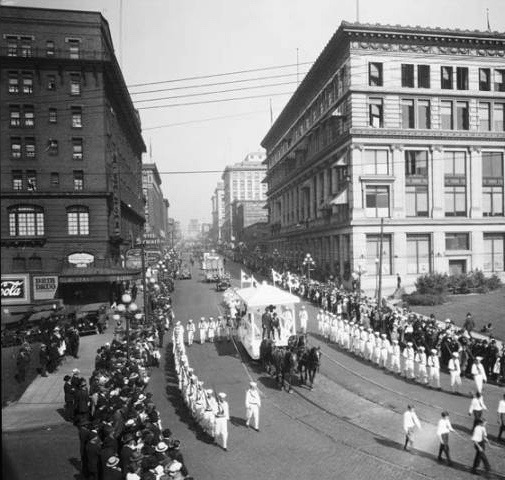 I hope everyone’s Labor Day Weekend is going well. It has been good to have a three day weekend after the long, hard push of the first week of the academic year. I am off to Grant’s Tomb in a little bit and am running a tad late, but wanted to quickly share this photograph. This was Labor Day 1918 in Seattle. Here we see sailors marching around and behind a Red Cross float. The War Industries Board and other governmental and quasi-governmental organizations did much to quell civil unrest during the Great War but there were still a surprising number of strikes. Here is a list I found in a very cursory search, which I am sure it is hardly a complete tally. Franklin D. Roosevelt was Assistant Secretary of the Navy in the Wilson Administration and would consciously do all he could as president during World War 2 to ensure labor peace. Still, strikes did occur during the Second World War as well.
Labor Day 1918 fell on Monday September 2. It also marked the end of the Major League Baseball regular season. Teams did not play a regular 154-game schedule but were limited to about 130 games, depending on how many they had gotten in by Labor Day. There were a large number of double-headers that day to squeeze in as much as they could.
Enjoy your weekend, all.
(image/Museum of History & Industry, Seattle)
04 Wednesday Jul 2018
Posted in Great War centennial
≈ Comments Off on Happy 4th
 (image/Library of Congress)
14 Thursday Jun 2018
Posted in Great War centennial, Memory, New York City
≈ Comments Off on Flag Day
Flag Day 1918 was a fairly big endeavor here in New York City. For one thing, the United States was now fully engaged in the war in Europe. The Battle of Cantigny for instance had taken place just weeks earlier, with significant casualties and American deaths. Labor, management, public school children and other constituencies turned out that June 14 to show their colors. Overall Flag Day 1918 seems to have been a positive thing. However it commenced what to some may have appeared a more worrying event: June 14, 1918 was the kickoff to what national organizers were calling Loyalty Week, in which the foreign-born, especially Germans, were being asked to demonstrate their adherence and show their support for the war effort. Here we see a whiff of the nativism that had been escalating for some time. Anti-German episodes had occurred in the United States since the start of the war and had increased after the Ludendorff Offensive had begun in March 1918.
Still, tens of thousands of New Yorkers from across the five boroughs, including Russians and Slovaks from Brooklyn, Jews and Italians in the Lower East Side, German-Americans from Yorkville, and those whose roots dated the Revolutionary War Era turned out in a celebratory mood. Here are a few photos, just three of many, from that day.

The Sons of the Revolution in the State of New York held this gathering at the Sub-Treasury building near Wall Street. The sign reads: Eat less. Feel better. Look better. Help win the war.

Central Park
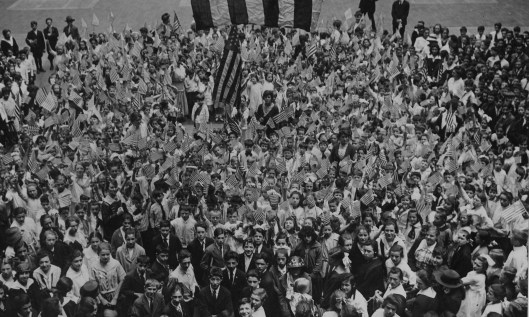
New York City schoolchildren
(images/National Archives)
05 Saturday May 2018

Lewis Hine image of Cantigny battlefield, April 1919
I’m wrapping up my coffee before heading to work to teach my last bibliographic instruction class of the semester. A friend and I were looking at these Lewis Hine images that The Atlantic posted this week and I thought I would share on this weekend morning. Apparently the American Red Cross commissioned Hine to take these images as a means of drumming up support back home for the Red Cross’s important work attending the sick, the wounded, and the hungry. We actually used the one above in the film we made last fall. It is hard to believe that we are now almost four years into the Great War centennial. I suppose it is difficult to comprehend from an American perspective because we did not join the war until April 1917 and really did not become fully involved until Spring 1918. The Battle of Cantigny, where the First Infantry Division fought so tenaciously, was in May 1918. Hine took the photo above almost a full year later.
Franklin and Eleanor Roosevelt sailed for Europe on January 1, 1919, around the time Hine was taking the images that The Atlantic published this week as part of a series over the course of the centennial. It was not the first time Eleanor or Franklin had been on the Continent. Now in their 30s, the Assistant Secretary of the Navy and his wife were already well-traveled and had seen much of the world. Still, they were shocked at what they saw in those months after the Armistice. Eleanor wrote at the time that “I never saw anything like Paris. The scandals going on would make many a woman at home unhappy. It is not place for the boys [the impressionable doughboys], especially the younger ones . . . All the women in the restaurant look to me exaggerated, some pretty, all chic, but you wonder if any are ladies.”
Though given the subject matter I don’t know if one can “enjoy” the photographs, they are indeed poignant and striking. Here they are one more time.
(Image/Lewis Wickes Hine, Library of Congress)
29 Sunday Apr 2018
Posted in Film, Sound, & Photography, Great War centennial, New Yorkers in Uniform: From World War One to Today (film)
≈ Comments Off on Sunday morning coffee
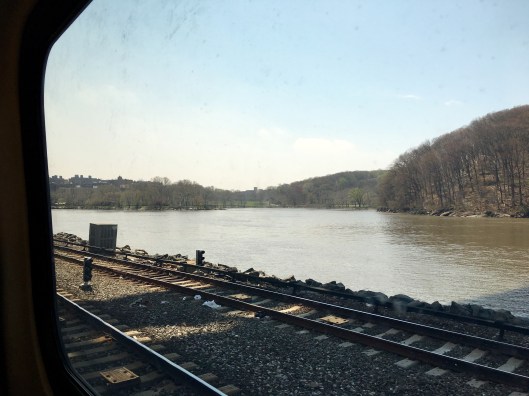
Hudson River from Metro North train, 28 April 2018
We had a great time in Yonkers yesterday for the film showing and discussion about our documentary New Yorkers in Uniform: From World War One to Today. I do not have any pictures of the event itself right now, but I believe a few of the others took some still photographs and possibly even some film footage. If so, I will share when I have. The subject of our film, Thomas Michael Tobin, was born in Yonkers in 1886 and died there in 1966. I have only been to Yonkers three times now: for the on location film shooting in March 2017, the showing this past December, and now again yesterday for the one at the historical society. The city has come to mean a lot to me. I took the photo you see above aboard the train on the way up yesterday morning. As you can see, even though it is late April the foliage has not yet begun here in the Greater New York area.
After the program a small group of us ended up at the Yonkers Brewing Company across the street from the train station for dinner. I don’t want to discuss the details too much right now, but we have some interesting plans that we believe will bring our film project to full fruition between now and the 100th anniversary of the Armistice in November. Ideally we will go back to Yonkers in the fall but we are not 100% certain. We’ll see how it goes.
Doing the event yesterday at the Yonkers Historical Society was a great treat. There were many interesting people involved in some fascinating projects that they told me about during the after party. The doing of local history helps keep the stories alive in immediate and direct ways. I was glad to see there were some young people in attendance as well. I will keep everyone up to date on how things develop over the spring and summer.
01 Sunday Apr 2018
01 Thursday Mar 2018
Posted in Great War centennial
≈ Comments Off on Meeting a doughboy’s son
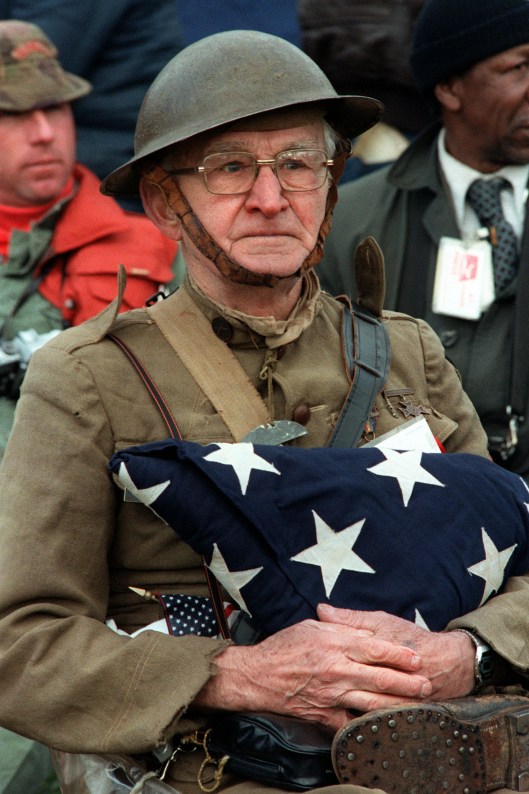
An 86-year-old World War I veteran attends the dedication day parade for the Vietnam Veterans Memorial, 13 November 1982
I had an interesting experience this past Tuesday at the final event for our Gilder Lehrman, Library of America, National Endowment for the Humanities World War One project: the son of a Great War veteran attended. As you might imagine, I was surprised–greatly and pleasantly–when he told me. I asked the gentleman if during the conversation he might be willing to share his father’s story. It turned out to be fascinating.
As it turned out the man’s father was born in Italy in the 1890s, came to the United States during the great wave of migration in the early twentieth century, and ended up back in Europe wearing an American doughboy’s uniform when the United States entered the war. It is a fascinating but actually not entirely unusual story. An interesting book came out several years ago called The Long Way Home telling the stories of twelve American soldiers who came through Ellis Island. It is one thing to say that millions of people fought in a war. Hearing individual stories makes it more relatable; each soldier’s story, from wherever he came and however he served, is another tile in the mosaic. The veteran whose son attended the function the other day was in his late 60’s when his son was born, which from doing the math as Iroughly calculated it would have been in the 1960s. So, this aspect of the story is a bit more anomalous. It is similar to the stories one hears of Civil War veterans who fathered children in the 1900s and 1910s. To hear the son tell the story was a humbling experience and a reminder that when we discuss about the Great War we are not talking about ancient history, but a historical moment within the living memory of even the children of the soldiers who served.
(image/Department of Defense. Defense Audiovisual Agency by Mickey Sanborn)
01 Monday Jan 2018
20 Wednesday Dec 2017
Posted in Film, Sound, & Photography, Great War centennial, Museums, Theodore Roosevelt Jr (President), Theodore Roosevelt Sr (Father)
≈ Comments Off on World War I and the Visual Arts
Last night was a special evening: a friend invited me to a group event at the Metropolitan Museum of Art for a private reviewing of the World War I and the Visual Arts exhibit currently on display through 7 January 2018. There were about a dozen of us on the tour, which took place after the Met Museum closed. To be in the Metropolitan Museum of Art is always special, and even more so when it is the holidays and the place is empty. We arrived a little before the tour when the museum was emptying out and got to take in the Neapolitan Christmas tree that is on display every year. Here are a few photos from the evening.

Walter Trier color lithograph, “Maps of Europe.” Look closely.

As with the lithograph above, these color postcards are that much more striking in juxtaposition to the black and white images one usually sees from the Great War.

The four helmets are prototypes designed by Met curator Dr. Bashford Dean during the war for the United States military. As you can tell from the bottom two in particular, they are influenced by medieval armor. Here is more, including a letter to Dean from Theodore Roosevelt. President Roosevelt’s father helped found the Metropolitan Museum of Art.

Our guide was the exhibition curator, seen here second from the right explaining this series.

Note the plea in the left hand portion asking the AEF to please rush. There were posters in the exhibit from all of the major nations.

It is not every day one sees the galleries empty at the Met. I snapped this one real fast as the group was heading out.
All in all this was a special night. Here is to good friends who think of you when opportunities such as this arise.


 The Strawfoot