I was passing through Union Station this morning and saw one of my favorite memorials for the first time in ages, this rendering of A. Philip Randolph that stands near the gates to the train platforms. It is strange how some figures become institutionalized in our public memory and others get forgotten. Randolph has been overlooked in our civic culture, which is a tragedy. Perhaps in Randolph’s case it is because he does not fit into any neat category, but instead exists in a grey area between union leader and civil right activist. Or perhaps it is because railroads just don’t play the role in our society that they once did, and so we fail to see his significance. Among other things Randolph founded The Brotherhood of Sleeping Car Porters in 1925, a labor union comprised almost exclusively of African-American men who worked in various capacities on the railroads that then criss-crossed the entirety of the United States. I’m far from an expert on Randolph but as I understand it he had a somewhat contentious relationship with W.E.B. DuBois. Others, like Fiorello La Guardia, offered their support over the years. In 1941 he had a tense stand-off with the Roosevelt Administration over a March on Washington that Randolph wanted to organize in protest against job discrimination in the defense industry. Randolph eventually backed down but that event took place in 1963.
We are riding the storm out here, so far fortunate that we have not lost power or anything worse. We’ll see what the next thirty-six hours brings.
Joe Galloway in San Fransisco, 2017 / photograph by Christopher Michel
Someone texted me the other day that Vietnam War correspondent Joe Galloway died earlier this week. In the texting thread that ensued I pointed out that given the events of our current moment it seemed appropriate in a bitterly ironic way that the chronicler of that conflict died when he did. Galloway’s death comes seven months after Neal Sheehan’s passing this past January. We were fortunate that Lynn Novick, Ken Burns and their team were able to get the two journalist’s on film for their 2017 documentary “The Vietnam War.” In the winter of their lives they added further nuance to our understanding of the war and the era. Galloway in particular was ubiquitous on the promotional circuit during and immediately after the film’s release, talking with Burns and others at symposia and other public events. Sheehan it seems was too infirm by that point to contribute in such a manner.
1967 Mercury Records promotional image of Tom T. Hall
Galloway was not the only figure from the era who died this week. A second was Tom T. Hall. Known as The Storyteller, Hall was born in Kentucky in 1936. Historian Bill C. Malone tells us in his important book “Country Music, U.S.A.” that one of Hall’s greatest inspirations as a songwriter was Hemingway. One can see that in the succinctness and brevity of Hall’s lyrics. The songs are short, and the language crisp and clear. Hall told you the story and then quickly wrapped it up. Just like Hemingway. That is a much more difficult thing to pull off than the reader or listener realizes. That one does not see the effort and deliberation that went into it means the creator succeeded. I must say that as much as I admire Tom T. Hall’s imagination and proficiency I never entirely warmed up to his catalogue. His songs, at least to me, never quite had the depth of expression found in the work of Kris Kristofferson, Vern Gosdin, Townes Van Zandt, and others. I don’t find myself going back to Hall’s work regularly the way I do with others. Listening to Merle Haggard or Bob Dylan at twenty-five is not the same as listening to them at forty, and again at fifty as one’s own life and circumstances evolve. Once you have heard a Tom T. Hall song, you basically know what it is. The figure he reminds me the most of is Buck Owens, another supremely talented, deeply intelligent figure whose oeuvre never quite plumbed the depths that it could have. Still it’s hard to argue with a song like “Harper Valley P.T.A.,” Hall’s 1968 classic sung by Jeannie C. Riley skewering the hypocrisy inflicted upon a single mother by her “betters” in the small town in which she lives as she’s trying to get by. We are fortunate we had Joe Galloway and Tom T. Hall while we did.
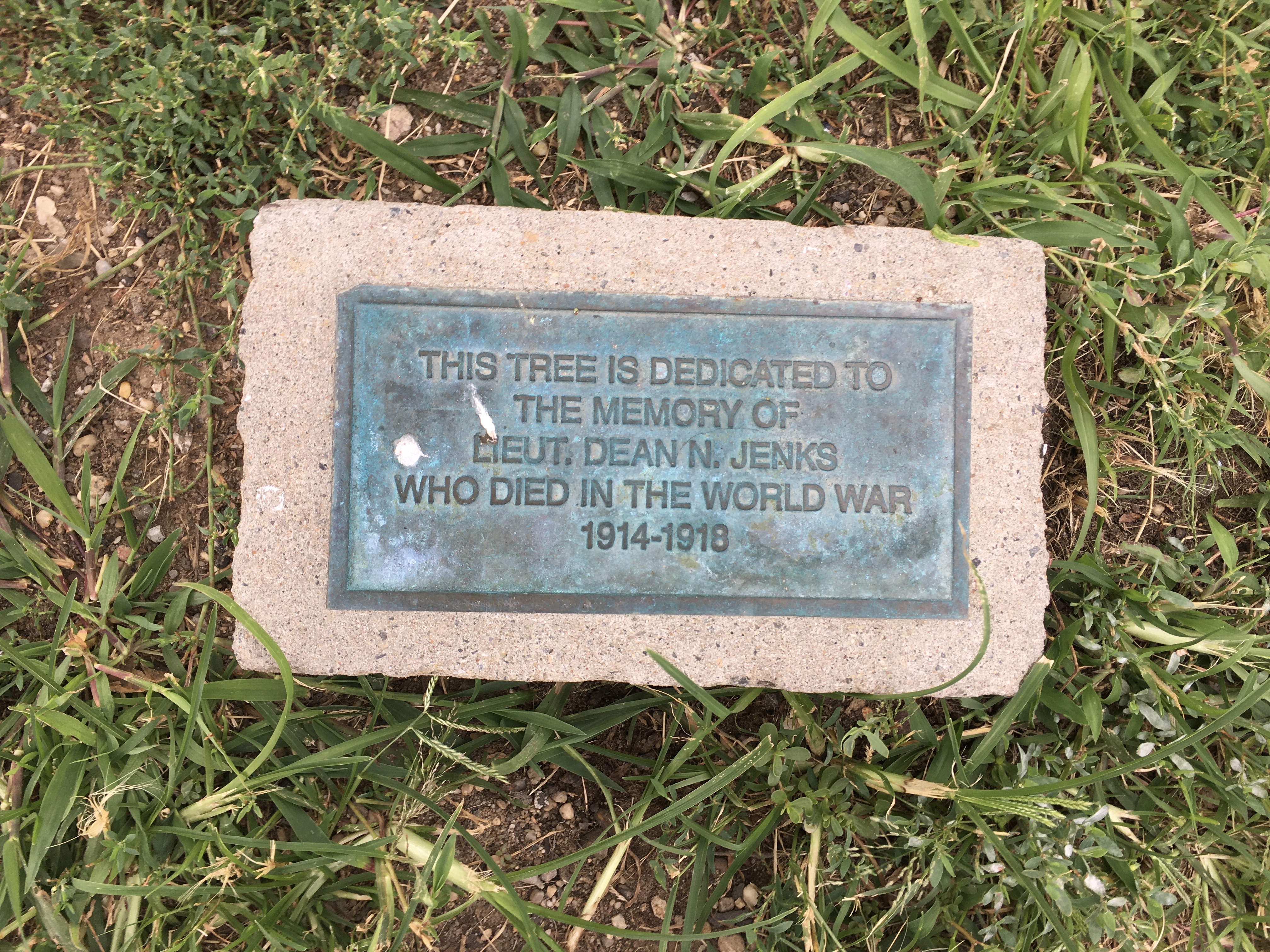
Lieutenant Dean N. Jenks tablet, Eastern Parkway, Brooklyn
This morning I met a friend in Brooklyn’s Grand Army Plaza. In theory we were there to discuss potential assignments and strategies for when we again co-teach our placed-based learning class in Spring 2022. More than that though it was a just a beautiful day to hang out, have some good conversation, and take in the day. Our meanderings included a walk down Eastern Parkway near the public library, botanic garden, and Brooklyn Museum. Among other places we were promenading on the median in between the north and south lanes of Eastern Parkway, a place I had not been in probably more than two years given the pandemic and everything else. The city has clearly done a lot of work on Eastern Parkway, planting young trees and improving the general infrastructure. It is a beautiful spot. The rehab work seemingly also included the re-setting of dozens of markers placed around Brooklyn a century ago after the Great War to commemorate men from the borough who had died in that conflict. I wrote about this twice several years back. Apparently someone in the Parks Department during the renovations had the foresight to save and then position these markers beside the newly-planted trees along the parkway. I can’t tell you how thankful I am that this is the case.
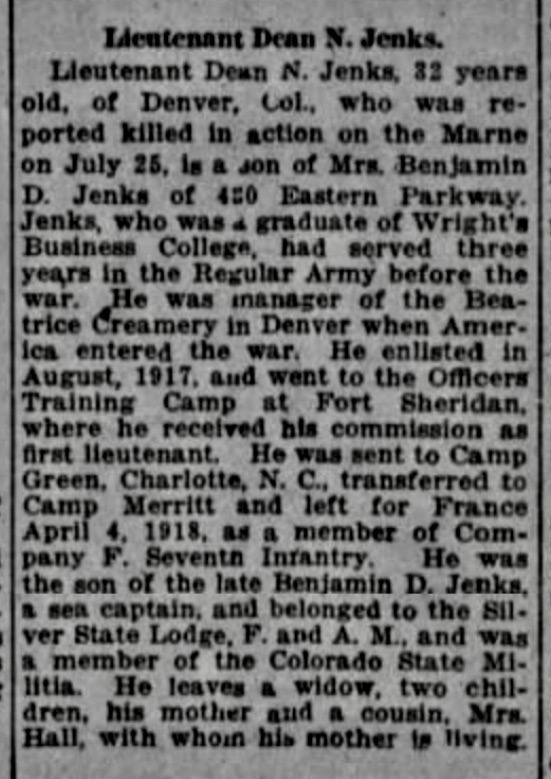
Lieutenant Jenks’s obituary, BrooklynDailyEagle, August 29, 1918
We stopped at several of them along our walk when I took the image you see above of the tablet for Lieutenant Dean N. Jenks. I told me friend I would do at least a shallow dive on Lieutenant Jenks when I got home. A BrooklynDailyEagle search pulled up this obituary. Jenks was already in his thirties when America entered the war and was living in Colorado with his wife and two children. His mother lived on Eastern Parkway. Either Jenks grew up in Brooklyn and moved out West, or vice versa. I suspect the former. It’s more likely that he as a young man made his way to the Centennial State than that his mother left there and moved to the borough of Brooklyn. Plus, Jenks’s father was a sea captain, which means the family likely lived on the East Coast near the Atlantic Ocean as opposed to land-locked Colorado.
In New York and elsewhere we walk past such things every day without giving them a second thought. That is entirely natural given the pressures of daily life and everything we have to get done in the course of a day. Pausing even for a few minutes when we can however gives us an opportunity to recognize men like Lieutenant Dean Jenks, who was killed in far-off France in July 1918 and left behind a young wife, two kids, and an already-widowed mother.
I was off today and took it as a chance to visit the Metropolitan Museum of Art. Because they are doing limited ticketing due to the pandemic, I booked my reservation ten days ago. I was the third person in line and, as you can see from this image, had the place essentially to myself for a brief period. This is the facade of the Branch Bank of the United States, later the Assay Office, that stood on Wall Street next to Federal Hall until the 1910s. When the building was torn down they boxed up this exterior, put it in storage for several years, and in the 1920s repurposed it as the entranceway to the American Wing. How one walks through the enclosed atrium with its natural sunlight into the doorway adds to that ambiance. Immediately inside are portraits of Alexander Hamilton and DeWitt Clinton, a nice touch by someone at the Met who obviously knows the facade’s provenance and connection to where it once stood in Lower Manhattan.
I was telling a friend earlier that The Met is one of those places, like Gettysburg or the old Yankee Stadium, where when you’re there time seems to have stopped. The last time I was here was Lincoln’s Birthday 2020, fifteen months ago. I had an brief talk with one of the guards who was telling me about what the shutdown was like for those who work there. Returning was a sign that in the coming weeks and months things may be returning to a semblance of normalcy.
I worked much of the morning and early afternoon on the draft of a project that hopefully will get published sometime in late spring. I intend to submit said draft, about 2,200 words, tomorrow after one final edit and fact check. I took a break around 1:30 for a walk and some fresh air in Green-Wood Cemetery, whose fields are still covered with snow. I saw these tracks and stopped to take a picture. I texted a friend to ask what he thought they might be, and he guessed wild turkeys.
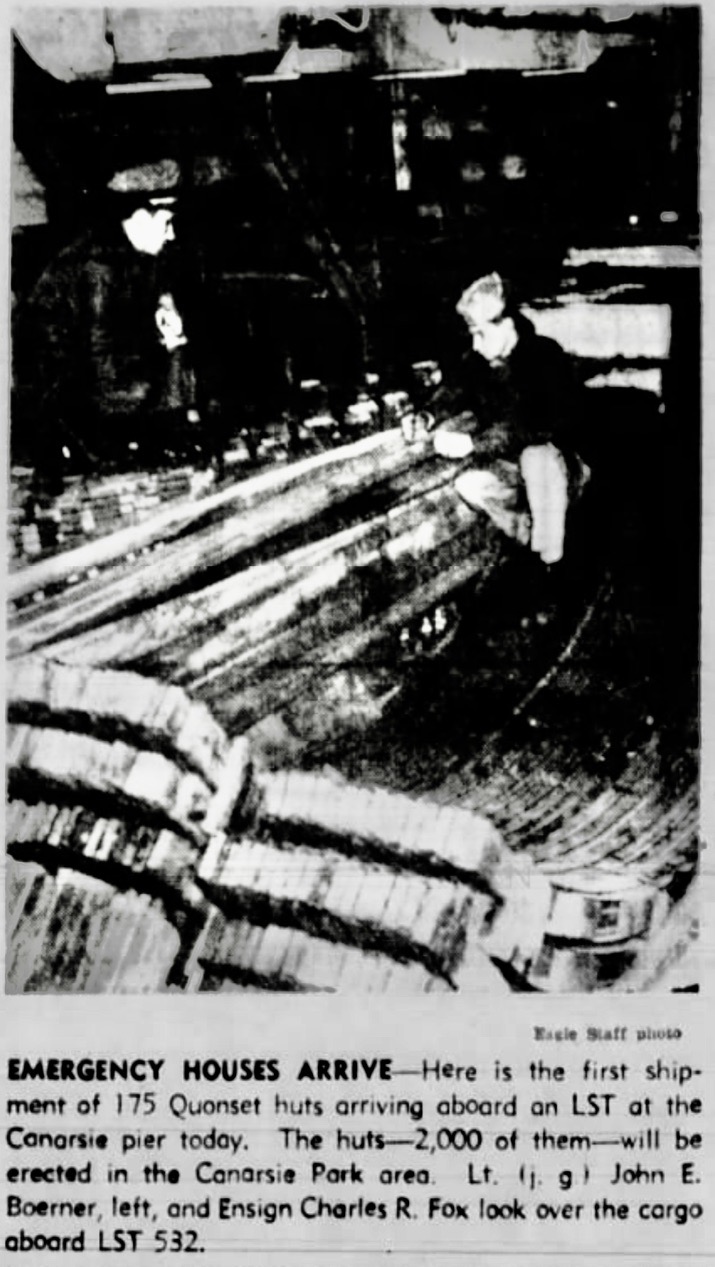
I did a Trader Joe’s run this morning, which meant a rare pandemic subway ride with full shower and scrubbing when I arrived home. Now I’m settling in to work on a small project that hopefully will find a home this spring or summer. I know the image quality is not that great but I wanted to share the above scene that took place in Brooklyn seventy-five years ago today. My colleague and I spend a lot of time in our class about the history and evolution of New York City discussing the housing shortage in the five boroughs in the immediate aftermath of the Second World War. As the caption notes the retrofitted quonset huts were converted into temporary housing as millions of GIs came home from Europe and the Pacific. In other civilian uses Quonset huts were used for schools as well, including Queens College. The corrugated aluminum structures were a newish invention in the early 1940s and massed produced for military use, especially in the Pacific. I would go more into the history of how they came to be used for housing but because others already have will not here today. In the image below we see the earliest period of the Baby Boom. A few years after this families would begin moving into new housing subdivisions such as Levittown. It is easy–in some circles seemingly obligatory–to ridicule the rise of postwar suburbia, but one cannot blame young families for wanting their little patch of space after having gone through the Depression and depravities of World War II.
American ex-serviceman Leonard Levinsohn and his wife Shirley, strolling with their baby through the settlement of prefabricated Quonset huts where they live, Jamaica Bay, New York City, USA, circa 1946. (Photo by Archive Photos/Getty Images)
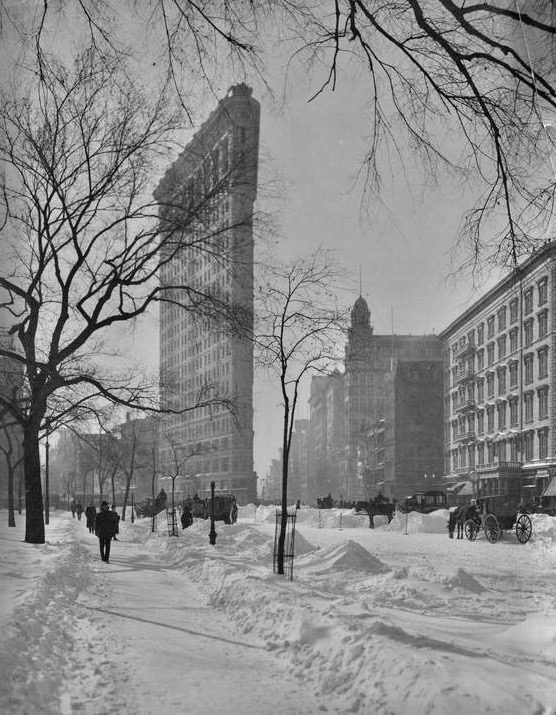
Flatiron Building, 1905 / Detroit Photographic Co. via NYPL Digital
Although we do not have a view of the Flatiron where we are here in Brooklyn, the view from our window is very much the same this February morning as it was 115+ winters ago. Wherever you are, stay safe and warm.








 The Strawfoot