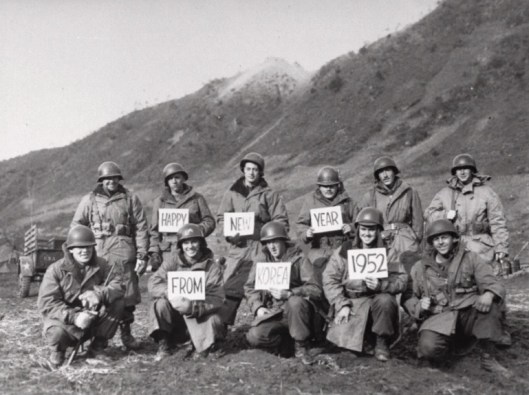
(image/Life magazine)

01 Tuesday Jan 2019
Posted in Uncategorized
≈ Comments Off on Happy New Year
(image/Life magazine)
25 Tuesday Dec 2018
Posted in Uncategorized
≈ Comments Off on Merry Christmas

(image/1918 postcard via NYPL Digital Collections)
31 Wednesday Oct 2018
Posted in Uncategorized
≈ Comments Off on Happy Halloween
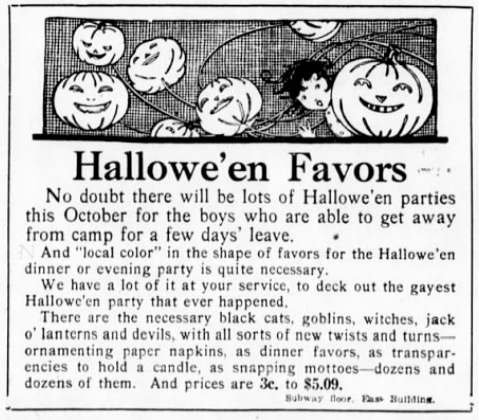 Happy Halloween, everyone. I saw this small ad from an October 1918 edition of the Brooklyn Daily Eagle and thought I would share. I found it curious that it does not give a store name or address, saying only “Subway floor, East Building.” Perhaps the Brooklyn subways were still so rare that readers would have known what that meant? I don’t know. They are plugging their wares to be used for Halloween parties in honor of soldiers on leave from their training camps. The war was grinding to its conclusion by late October 1918, and would end less than two weeks later. The ad is fascinating because it shows us in real time that many doughboys were still stateside when the war’s end came. As for Halloween itself, other editions of the Daily Eagle inform us that there was a big party at Camp Dix on Halloween night. I’m sure camps across the country had their own as well.
Enjoy the day.
16 Friday Mar 2018
Posted in Uncategorized
≈ Comments Off on Joe College and Betty Co-ed
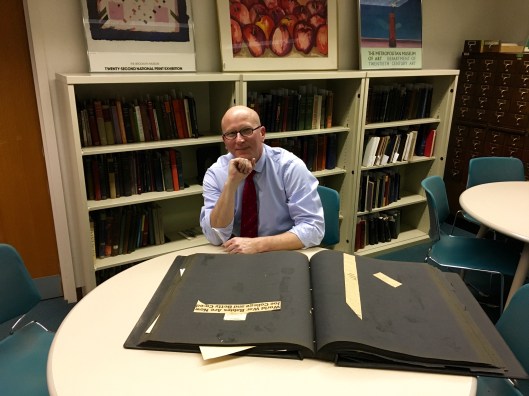
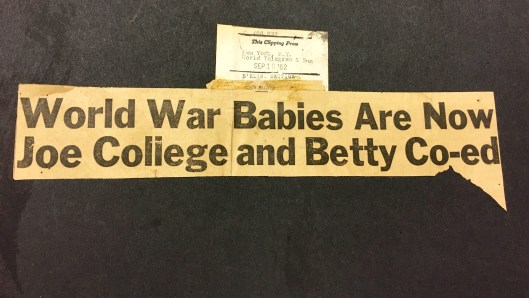 The college at which I work was founded in 1946 as a GI Bill school. Apparently in its early decades the college hired a clipping service to track the school in the press. On Wednesday a colleague and I were sorting through some of the old binders when we came across the article whose headline you see here. It’s interesting on a number of levels. First off, it’s from the New York World Telegram and Sun, a newspaper that folded in the late 1960s after the various consolidations coinciding with rising printing costs and advent of television in the decades after the Second World War. Next, the article is about Baby Boomers going off to college. This article is from September 1962. These freshmen would have been born in 1944. Demographically they would not have been Baby Boomers. As I understand it that generation technically begins with persons born starting on or after January 1, 1946. Still, it’s close enough. By the early 1960s it is not the World War II generation but their children who are the incoming student body.
 One of the great tragedies of the First World War is that there was no assistance for the retuning doughboys. When they came home they were left to fend for themselves. We will never know how the 1920s and beyond would have played out had a Servicemen’s Readjustment Act in, say, 1919 and not twenty-five years later as it did.
31 Wednesday Jan 2018
Posted in Uncategorized, WW1
≈ Comments Off on Great War inflation

Food prices jump from $.90 to $1.29, Brooklyn Daily Eagle: January 31, 1918
This striking headline appeared in the Brooklyn Daily Eagle one hundred years ago today. A jump from $.90 to $1.29 represents a 30% increase in the price of groceries. The way I have always understood it American food producers had done well the first three of the war, selling food stuffs to European governments to feed their hungry armies out in the field. This demand in turn set off inflation here in the United States, not to staggering proportions but at least enough for American consumers to feel the pinch. Rationing and price controls too contributed to inflation at the dinner table.
As of late January 1918 the United States still had few troops stationed overseas, though the number of men in uniform and in training stateside was growing exponentially. This was putting additional strain on both the food supply and the transportation systems that brought goods from here to there within the United States. One can only imagine what Americans were thinking when they saw headlines like this in the winter of 1918.
01 Monday Jan 2018
Posted in Uncategorized
≈ Comments Off on Thinking of James Reese Europe
Hello all, I wanted to again wish everyone a happy and healthy 2018. I could not let the 100th anniversary of the arrival in France of James Reese Europe and the rest of the Harlem Hellfighters go unmentioned. Alas I could not find a recording of the rendition of “La Marseillaise” that they played upon their arrival on 1 January 1918. I don’t even know if a recording was made. If not, that is unfortunate. I intend to do more on Europe and the Hellfighters over the year. Enjoy this clip.
I will be off the computer grid for the next week. I am putting both the book and blog aside for a bit. Things will pick up again next week. I am looking forward to an exciting 2018. FYI, last week I received a reply from the person at the cultural institution I mentioned. Things are still in the planning stages and so I don’t want to give too much away, but it looks like we may indeed be doing something WW1-related this spring. I’ll have more on this in March.
Here is to a good 2018.
18 Friday Aug 2017
Posted in Uncategorized
≈ Comments Off on

The Smithsonian digitized Horace Pippin’s notebook in the mid-2000s.
It’s a rainy Friday. I’m going to stay in a get some writing done. The academic year starts a week from today. Next week will be full of meetings and preparation. I had a meeting earlier this week with a faculty member in the English Department for a module we are doing this fall semester based on the World War One grant our library received from The Library of America and the Gilder Lehrman Institute. This past February The Library of America published World War I and America: Told By the Americans Who Lived It, an anthology edited by the Pulitzer Prize-winning biographer of Woodrow Wilson, A Scott Berg. We received a copy of the book as part of the grant. Over four class sessions students will first watch the film we are producing and then for homework read various passages from the LOA anthology. We are choosing a cross-section of fiction and non-fiction, as well as poetry and even some music by James Reese Europe. The lyrics to at least one song are included in the book. Students will read the lyrics and we will then listen to the song. We will then discuss how the war brought jazz to Europe and led to the Lost Generation in Paris and the Harlem Renaissance here at home.
When I was at the New-York Historical Society last week taking in the WW1 exhibit, I was touched to see that they had included a few works by Horace Pippin. The LOA anthology includes an excerpt from Pippin’s journal, which he composed immediately after the war. The students will read Pippin and learn about the Harlem Hellfighters. The LOA and Gilder Lehrman Institute provided a number of themes for exploration, to which we intend to hew closely. Why invent the wheel when someone has done it for you? At the end of the module students will write brief essays about what they learned and what they might like to know about moving forward. I think this is going to be a fun project.
(image/Smithsonian Institution)
27 Tuesday Jun 2017
Posted in Uncategorized
≈ Comments Off on George Lee Schuyler and the America’s Cup

George Lee Schulyer donated the America’s Cup to the New York Yacht Club in 1851. Ten years later he wrote this letter to President Lincoln with news about the Union Defense Committee’s efforts to provision Daniel Sickles’s brigade one month into the Civil War.
New Zealand defeated the United States in the America’s Cup off the coast of Bermuda yesterday. In a strange coincidence, for my book I am currently writing about George Lee Schuyler, father of Louisa Lee Schuyler. George Schuyler co-founded the New York Yacht Club in 1844. After his schooner America won a regatta in England in 1851, Schuyler and his mates donated the trophy to the New York Yacht Club. The club would henceforth own what was now the America’s Cup in perpetuity with the proviso that the club host competitions with “any organized yacht club of any foreign country.” Legal agreements in the late 1880s tightened the language and made the agreement more binding.
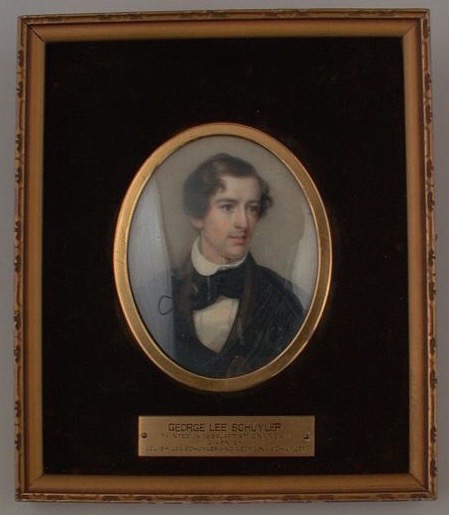
Louisa and her sister donated this portrait of their father to the N-YHS in 1925 along with about a dozen other works. The two women were descendants of both Philip Schuyler and Alexander Hamilton.
George Lee Schuyler was a member of John Dix’s Union Defense Committee and later an aide to General John E. Wool. His daughter was a good friend of Theodore Roosevelt Sr. and active in the Women’s Central Association of Relief. Louisa was going strong well into the twentieth century. During the First World War she performed some of the same relief functions she had in American Civil War over half a century earlier. She and her sister presented this portrait to the New-York Historical Society in 1925 and made the gift official in Louisa’s 1926 will.
(bottom image/New-York Historical Society)
14 Wednesday Jun 2017
Posted in Uncategorized
≈ Comments Off on Flag Day 2017

{image/Library of Congress)
27 Tuesday Dec 2016
Posted in Uncategorized
≈ Comments Off on Governor Whitman reviews the 13th
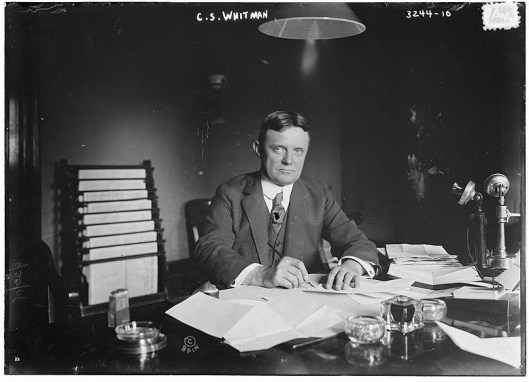
Governor Charles Seymour Whitman spoke at the 13th Armory in Brooklyn on 27 December 1918. He had just lost a narrow race to challenger Al Smith and had asked for a recount, which was ongoing at the time.
As I said yesterday I intend to do deeper dives into the various reviews that took place in late 1918/early 1919 when the time comes. In the meantime I wanted to note the 98th anniversary of Governor Charles Seymour Whitman’s 1918 visit to the Brooklyn 13th Armory. I knew that there were parades and such in the aftermath of the Armistice, but it did not occur to me until these last few days just how ubiquitous they were. I suppose that in those heady days after the Kaiser’s abdication and Germany’s surrender that people felt that war really might have been rendered obsolete. Wilson was certainly optimistic while in Paris.
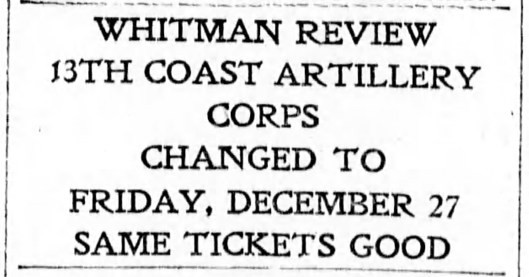
These ads ran all week in the Brooklyn Daily Eagle announcing the date change.
Governor Whitman of New York had lost to Al Smith in the November 5 gubernatorial race. Smith was the Democratic candidate and Seymour the incumbent Republican and Prohibition candidate. It’s almost a cartoon of late nineteenth and early twentieth century New York politics: Smith was a Tammany man and Whitman a Union League Clubber. The old and new were mixing in this period. On Memorial Day 1918 Whitman was in Brooklyn’s Grand Army Plaza for the GAR parade; a month after he was at the state GAR encampment in Ithaca. Still, his Prohibitionism and Smith’s Catholicism show hints of what was coming in the 1920s.
(images/Library of Congress and Brooklyn Daily Eagle)
 The Strawfoot