Good Friday

I’m sorry about the lack of posts this week. I have been concentrating on my talk for the New York History conference in Cooperstown later this spring. Next week at my college I’ll be giving something of a preliminary talk during our annual faculty research program. It is an opportunity to run through some ideas before I give the “real” talk come June. I will be talking about Theodore Roosevelt Sr., William E. Dodge Jr. and what they did for the Union war effort. The basics are pretty much in place but I have more to do before it is there. I am fascinated by New York’s role in the war, and how that role played out in the ensuing decades as well. It is something I think we don’t fully understand.

Today I was actually holed up with a minor ailment, fighting off a cold and minor fever. On the Hayfoot’s instructions I have been drinking warm milk spiked with turmeric. It is a great elixir for staving off illness and infection. I have taken the opportunity to get a quarter of the way through David Eisenhower’s Going Home to Glory: A Memoir of Life with Dwight D. Eisenhower, 1961-1969. I read memoirs with the caveat that they are–by definition–self-serving but I must say Ike’s grandson does an excellent job of recounting the president’s time after he left the Oval Office. David is a very learned and thoughtful individual who knows his history.

I have been t the Eisenhower Farm several times over the years, but the book fills in significant gaps in my knowledge. In the Eisenhower house one sees a fair amount of Civil War memorabilia, and obviously his ties to Gettysburg go back to his years as a West Point cadet, but I had never quite put two and two together that his retirement in January 1961 coincided with the Centennial. I cannot help but wonder what he thought, if anything, about the way it all unraveled. He did create the Centennial Commission in 1957 after all. The book goes well with Evan Thomas’s Ike’s Bluff, which I finished a few weeks back.

Since 2008 and my first trip to Gettysburg I have been focusing so intently on the Civil War. It has been good because I feel I know much more than I did even just half a decade ago. Still, I feel I’ve lost some edge and my well-roundedness. It is important to focus on other areas to achieve greater wisdom. I am trying to do that this spring.

Going Home is actually the second memoir I have read in the past few days. Last week I downloaded Cynthia Helms’s An Intriguing Life to my Kindle from the library. Ms. Helms was married to CIA director Richard Helms and has certainly led a, well, intriguing life. Born in England in 1923 she served in the WRENS during the war before moving to America and raising a family. In her memoir she recounts transporting Queen Elizabeth ( i.e. later the Queen Mum) in her craft out to a waiting ship for a royal inspection. She also mentions seeing the Supreme Allied Commander, one Dwight Eisenhower, in the lead-up to the D-Day invasion. She was in her late teens and early twenties, understand. Now 90, Ms. Helms lives still lives in Washington and is still going strong; she seems to have known everyone who lived and served in the capitol going back decades. It is a witty and chatty look at the nation’s recent history as s told by someone who saw it. I feel I know Washington a little better than I did before. The best thing you can say about a book is that it brings you to a different level when you are done with it.

One Saturday on the Mall

I went to DC for the weekend to see the Mrs., who began her job the Tuesday after President’s Day Weekend and moved into the apartment last week. The new job and commute has been going well, but is nevertheless difficult and challenging on many levels as you might imagine. This was my first trip to Washington since February. Saturday we took advantage of the warmish late winter weather to visit the Mall. The cherry blossoms are not yet in bloom but it was nonetheless a gorgeous day.

IMAG0005

I was glad to see that the Smithsonian National Museum of African American History and Culture is proceeding apace. The sign above is from the construction site. I couldn’t resist sticking my camera above the chain link fence and take the picture of the footprint.

IMAG0006

2015 is not far away.

We next walked down the Mall to the Martin Luther King jr. Memorial. No one deserves to be recognized on the Mall more that Dr. King, but I am afraid I must concur with the monument’s detractors. I understand what they were trying to accomplish but the Soviet Realist statue just doesn’t work. Still, it was good to see people congregating around the monument to one America’s great citizens. Maybe that’s enough.

I hope the powers-that-be think the Eisenhower Memorial through all the way before they build something that will remain on some of our nation’s most precious space for decades to come.

IMAG0009

The Hayfoot noticed that a ranger tour was in progress and so naturally we joined. The ranger really knew his stuff. We were on the tour for a good hour. Later I asked him where he began and he said the Lincoln Memorial. I was surprised because if you know the National Mall you know this is a pretty fair distance. The entire talk must have been more than two hours and he was picking up people as he went. We were in awe. I cannot overstate how much he brought to the experience.

IMAG0012

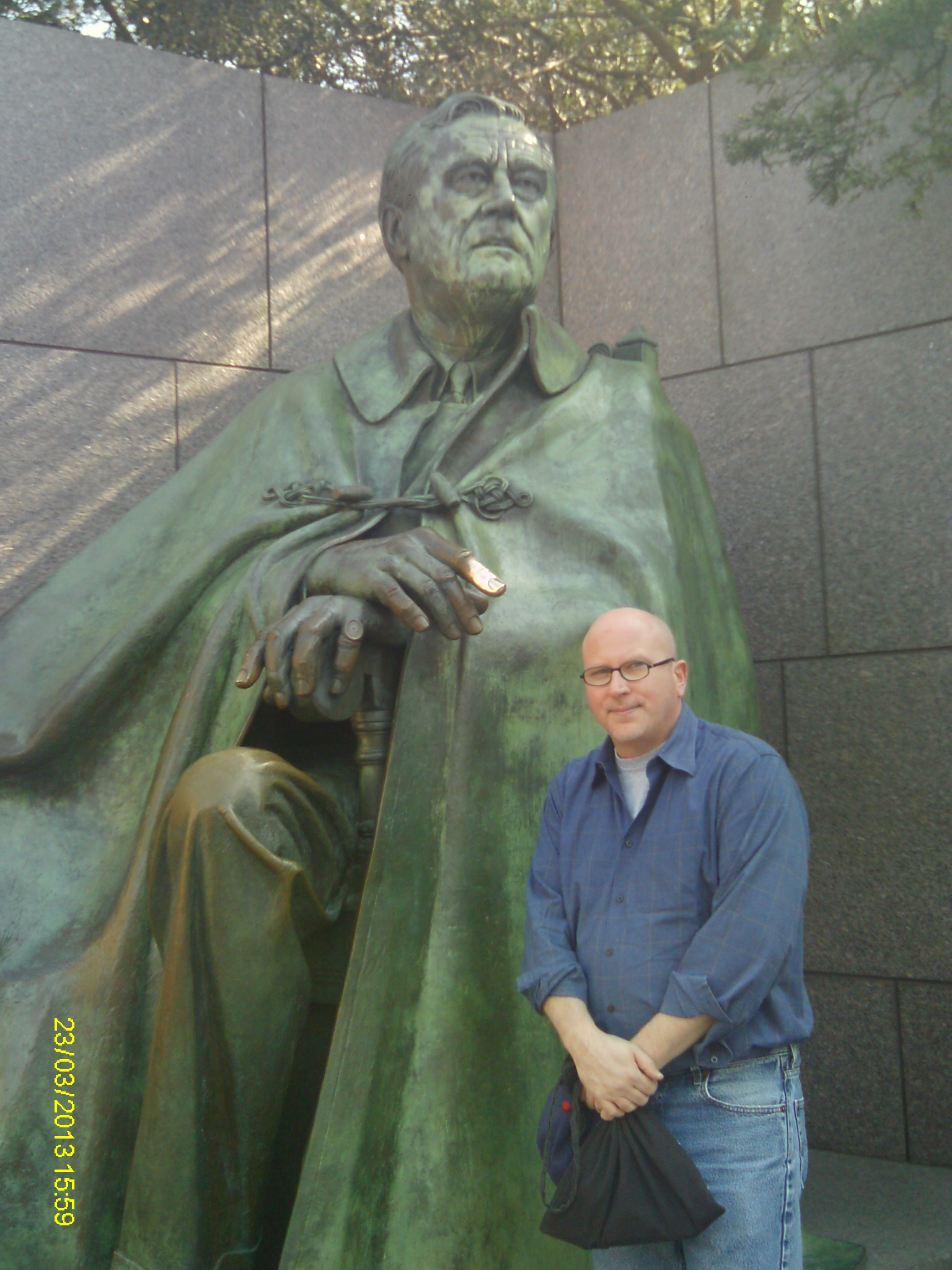
I had never seen the FDR Memorial before and did not know it was so large. The memorial is divided into different “rooms,” each covering different parts of Roosevelt’s presidency. There is a lot going on but it all ties together seamlessly and there is a nice mix of realism and avant-gardism. Above is the less controversial FDR statue; less so because his wheelchair is somewhat obscured by the cape. There is a smaller likeness of the 32nd president sitting in a chair in the memorial’s “prologue.” I thought both showed his humanity and vulnerability.

Note the right index finger. The shininess is the wear caused by people touching the statue. The damage is a reminder of why one should not do that.

IMAG0016

. . . Listening attentively to a fireside chat. The sculptor captured the earnestness of the listener.

IMAG0018

This couple serve as a reminder that in much of the country the Depression began in the early 1920s, not with the Great Crash of ’29 and Dust Bowl as we believe in our collective memory.

IMAG0010

. . . and last but not least the Jefferson Memorial. I had never realized quite how it all fits together until visit until this most recent visit. We are looking forward to more excursions when this spring and summer in one of the cities we now call home.

Quote of the day

IMAG0019

In the evenings when Washington was quiet, I would often go to the Lincoln Memorial and talk to Mr. Lincoln. In those days you could drive right up and park at the foot of the steps of the memorial . . . I loved that majestic seated figure surrounded by his eloquent words. I found him to be a wonderful listener.

–Cynthia Helms, An Intriguing Life: A Memoir of War, Washington, and Marriage to an American Spymaster

News flash: Lady Liberty reopening July 4th

It was good news today when the Park Service announced that the Statue of Liberty will be reopening on the 4th of July. It sounds far off, what with snow and slush still on the ground here in the Big Apple, but summer will be here before we know it. I had a feeling an announcement might be coming soon based on what I had been reading online the past week or so. Local, state, and federal officials were pressing harder for a re-opening date. It is understandable. The Statue is a major tourist attraction and is important to the New York and New Jersey economies. I imagine the Ellis re-opening is still a ways off, probably early 2014, though that is just my guess. I’m looking forward to seeing the crowds again when the Governors Island season in late May and people are again flocking to the Battery as the summer moves along.

Questions for Ranger Shelton Johnson

Gloryland_frontcoverShelton Johnson’s Gloryland is one of the most meaningful books I have read in recent years. The novel tells the story of Elijah Yancy, a Buffalo Soldier serving in the U.S. Army at the turn of the twentieth century. The book is many things: a meditation on the importance of family and place, a reminder of the role that nature plays, or should play, in all of our lives, a treatise on the ironies and injustices of race in America, a thoughtful work of literature. If you have not read Gloryland, I recommend adding it to your reading list. Regular readers of this site may remember Ranger Johnson from the poignant short film The Way Home. He was also prominent in Ken Burns’s The National Parks: America’s Best Idea. Ranger Johnson has had a long and successful career with the NPS and currently serves at Yosemite National Park. Recently, he took time from his busy schedule to answer some question about his debut novel, his thoughts on Interpretation, and more.

The Strawfoot: The protagonist of your novel, Gloryland, is Sergeant Elijah Yancy. Tell us something about him. Where was he born and what was his family history?

Ranger Johnson: Elijah is the son of sharecroppers.  His mother and father were enslaved before emancipation.  He was born in Spartanburg, SC and raised there until he left forever as a young man.

His grandmother was Seminole. Relations between African and Native Americans may surprise some readers. Is this something readers comment on?

The fact that he had 2 grandmothers who were Seminole and Cherokee would not surprise African American readers.  There was a census done around 1900 that determined that roughly 1 out of every 3 African Americans had an Indian branch to their family tree.  Certain Indian cultures took in runaway slaves such as the Seminole, but also the Cherokee and the Choctaw. Consequently, many African Americans are also part Indian as a result of this history.  It’s just that you never hear about it in popular culture such as novels and movies, but Black people have known about this heritage for years.  My maternal grandparents are Black Cherokees from Oklahoma.

Elijah was born on Emancipation Day, January 1, 1863, and had an older brother killed at Fort Wagner during the Civil War. What were the experiences of African American soldiers in the nineteenth and early twentieth centuries? Fighting Indians, Cubans, Filipinos, and other people of color must have have, to say the least, brought about mixed feelings in these men. Is this something they discussed privately amongst themselves, or shared in letters to friends and loved ones back home?

This fact and the soldiers feelings about this “activity” was shared in their correspondence.  There’s a book that collects some of these reminiscences entitled, “Smoked Yankees and the Struggle for Empire” by Willard Gatewood.  In these letters you can hear how the buffalo soldiers felt about their struggle with the Filipino Insurrectos, men that were fighting for their own freedom from the Spanish, and then the U.S.  They were definitely aware of the irony! Some of these soldiers just concentrated on doing their duty.  Period. But others were conflicted, most notably David Fagan who deserted from the American forces and joined with the Filipino people and their struggle for independence.  Some of the Buffalo Soldiers stayed on in the Philippines after the war, married, and became part of the culture.  There was even a call for African Americans to move to the Philippines because life there was so much better than life at the time in any part of the South…

You have spoken to many descendants of Buffalo Soldiers over the years. Yancy himself is telling his story thirty years after his military service ended. Were the stories these men had to tell passed on from one generation to the next, or is it something that has only come to light in recent decades?

I haven’t spoken to many descendants, but I have spoken to a few.  These stories/contributions were passed on from family member to family member, generation to generation.  They weren’t in the history books but they were shared in the homes of hundreds of families…

What was it like working as a Buffalo Soldier in Yosemite National Park in 1903? Why were they there and what duties did they perform?

It was hard work, but a soldier was used to hard work!  It was also a “dream” job so to speak.  One officer referred to service in Yosemite as “the Cavalryman’s Paradise!”  Their duties weren’t that different from today’s Wilderness Ranger, i.e. long patrols, enforcement of park rules and regulations, basically providing a presence of authority, that the park was being taken care of…

Shelton_JohnsonYou grew up in Detroit, but also spent time in Europe and elsewhere because your father was in the Army. What was it like living in these places?

I was very young at the time so my memories are vivid but limited!  I went to Kindergarten in Germany and first grade in England, but those memories became very important once I returned to Detroit because they provided an imaginative alternative to the inner city environment that was my home for many years.  Most of my friends in Detroit had never been overseas let alone lived overseas.  It made it easier for me to imagine life in a place that was different…

How did you eventually come to work for the National Park Service and what inspired you to do so?

I was a student in the University of Michigan’s Master of Fine Arts Program in Creative Writing.  My emphasis was poetry.  I decided to take a job as a dishwasher in Yellowstone National Park. I did this because I grew up in Detroit watching nature programs with my grandfather who used to fish on Mackinac Island.  I remember seeing many documentaries about Yellowstone and the other national parks but I had never visited a national park in this country.  I had been in the mountains before during the time my family lived in Germany.  We visited Berchtesgaden or Eagle’s Nest which was a former stronghold of Hitler during WWII.  It was also high in the Bavarian Alps and I never forgot the beauty of those snowy mountains…

Traditionally, African American attendance at National Parks, especially the nature parks, has been significantly lower than that of whites. One of your goals is to increase awareness of the National Parks within the African American community. What are some of the misconceptions Africans Americans, Latinos, and other minority groups have about Yellowstone, Yosemite, the Grand Canyon, and elsewhere?

I think it’s basically an unknown and with any unknown there’s a certain amount of fear.  Some African American are nervous about visiting ANY area where there are very few other African Americans.  You have to remember that there’s a history of violence against African Americans, and those cultural memories are alive and well.  There’s still fear of groups like the KKK and other supremacist organizations, and that results in fear and anxiety.  People don’t go on vacation to be fearful or anxious!  Consequently, some African Americans who briefly considered a trip to a national park, decide to go somewhere else because of this fear of the unknown.  But history can work in your favor too.  The knowledge that the Buffalo Soldiers once protected Yosemite and Sequoia can result in a feeling of ownership and pride rather than fear and that can lead to a trip back to the mountains.

Who, or what, would you say are your greatest intellectual influences?

Too many to list. I was a literature major!  John Keats, Langston Hughes, Shelley, Richard Wright, Shakespeare, Chaucer, St. John Perse, Cavafy, Anna Akmatova, Pablo Neruda, Gabriel Garcia Marquez, Aime Cesaire, and the list goes on!

You have a Literature background. What role, if any, has this played in your approach to Interpretation?

It has shaped everything in terms of structure and content with regard to my Interpretive programs, as well as my classical music background!

(images/top, Sierra Club; bottom, National Park Service)

Now playing: Good Ol’ Freda

Reviews are starting to come in about the documentary Good Ol’ Freda. Freda was Freda Kelly, longtime head of the Beatles Fan Club. Since first hearing about this project a few weeks back, I have been surfing the internet to learn more about this amazing woman–just a girl of seventeen when she met John, Paul, George, and Pete in Liverpool over half a century ago. She seems a woman of tremendous grace and spirit. Working for the Beatles was exceptionally difficult, the workload intense and the employers entitled and demanding. John Lennon spoke in the Playboy interview about the sarcastic put downs and verbal abuse the band members frequently unleashed on Neil Aspinall, Mal Evans, and other aides. I have no idea if they did this to their club secretary, but Lennon did fired her at one point; when he tried to recant she made him literally get on his knees and ask for forgiveness. He understood the power of a good woman. I have not seen it yet because the film has just now started the festival circuit, but I am glad she chose not to produce a tell all exposé. I have no interest in which ones, if any, she may have slept with, or what she may have seen during craziest moments of Beatlemania. And don’t kid yourself, Beatlemania had its tawdry underside. Like many in the inner circle, she seemed glad to serve and asked for little in return. There is something to be said for restraint. After the breakup Ms. Kelly had a trove of material that, instead of selling on the increasingly lucrative Beatle memorabilia market, she gave away piece by piece over the years to fans she thought worthy. Now she has given the rest of us this look inside one of the great phenomena of the 20th century. Look for it at your local art house this spring.

Reviews here, here, here.

Sunday morning coffee

I am sitting here having my morning coffee, still adjusting to the turning forward of the clocks. I have refraining from updating on the Liberty/Ellis island situations for the past few weeks because the situation appeared fluid and the news contradictory. Now, it seems that Liberty will be opening this summer and Ellis in 2014. The structural damage was especially severe in Elli’s main building, particularly to the electricity and other infrastructure. This is taking considerable time to repair. The Ellis artifacts are now safely housed in Maryland and will be held and preserved there in the meantime. If you have ever been to Ellis Island you know how special these treasures are. Here is a look at the preservation process, complete with photographs and audio. It is worth ten minutes of your Sunday.

Pic of the day

73rd and Central Park West; 3:00 pm, 9 March 2013

73rd and Central Park West; 3:00 pm, 9 March 2013

I was at the New-York Historical Society today. Afterward I took advantage of the spring-like weather to have lunch on the benches across the street from the Dakota.