The Maryland Campaign continues

Reading is not enough when it comes to understanding the military components of our civil war. One must visit to grasp things more fully. It was not until I visited Antietam for the first time in 2009 that I realized how close it was to Harper’s Ferry, South Mountain, and other places. This changed my whole concept of the fighting in these places, especially in regards to climate, time, and topography. Visiting also taught me that to understand Gettysburg, Antietam, or any other military activity from the war one must understand the campaign, not just one battle from it. However big and dramatic these events were, they are just one piece in a larger context.

So looking forward to seeing the handwritten Emancipation Proclamation the week after next.

Intelligent growth

I mentioned the other day that I have been following the anniversary of the Maryland Campaign with great interest. This coming week come the sesquicentennial events of South Mountain (the 14th) and Harper’s Ferry (the 15th). A week from tomorrow is Antietam’s 150th. Every year when we visit we are struck by the ever increasing urban sprawl in Washington County. The McMansions are now just a few miles down I-65 from the Antietam battlefield. Sprawl is a complicated issue, especially in the Greater Washington area with its expanding population. One would like to save as much land as possible; on the other hand, people have a right to live where and how they wish. What’s more, municipalities must balance the needs of the local community against the larger interest. Every acre added to the a national battlefield or historic site is one taken off the local tax rolls. Mayors and city councils are not evil or wrong for thinking about such things. The issue is further complicated by changing demographics. The Greater Washington Area has undergone a shift in recent decades with people coming from around the country–and around the world–who have no emotional attachment to the American Civil War. We ourselves are part of that trend. We take the Boltbus regularly to visit good friends of ours who moved to Maryland recently and live not an hour away from Sharpsburg. There are no easy answers.

Things would be worse across the country without groups such as the Civil War Trust, of which I am a member. At the more local level, the Save Historic Antietam Foundation has done much work in the past two decades to ensure that growth is managed sensibly. David T. Whitaker of Smart Growth Maryland has the story.

(image/John Delano)

Book now.

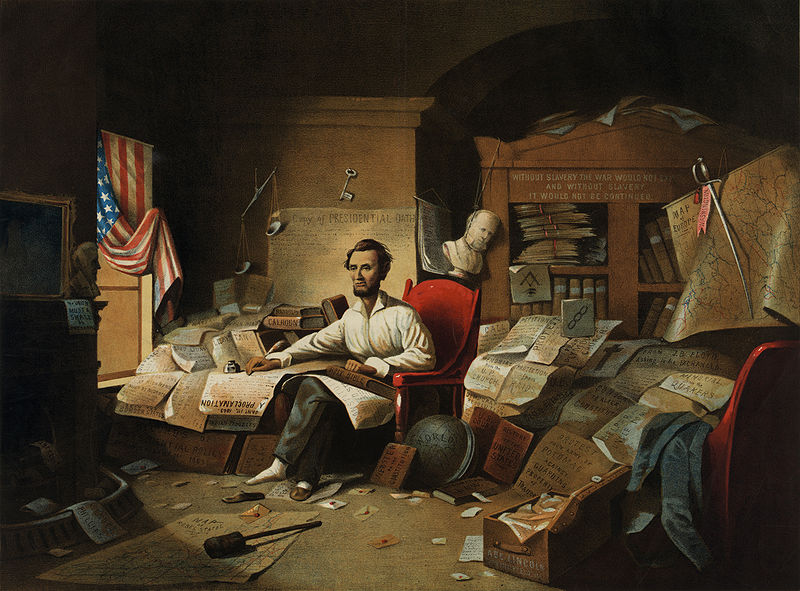
The sesquicentennial events of the Maryland Campaign are now underway. I know that the interpretive ranger staff at Antietam, among other places, has been preparing for months. I would love to be in Maryland for anniversary weekend but alas that will not be feasible. Still, the campaign had obvious consequences for the country and there are many events marking the occasion accordingly. The culmination of the military campaign was of course Lincoln’s release of the Preliminary Emancipation Proclamation on September 22, 1862. It had slipped under my radar but thankfully the Hayfoot noticed that the New York Public Library’s Schomburg Center for Research in Black Culture is having a four-day-only exhibit to mark the occasion. The First Step to Freedom will be showing in the Harlem library’s exhibit hall from September 21-24. There have been several excellent exhibition marking the proclamation over the past year but this one is special: it includes the last surviving draft of the document written in President’s Lincoln hand. The exhibition is free but tickets are required. We just booked ours a few minutes ago.

Try to make this one if you can. And Sylvia’s is just down the street. What are you doing for the sesquicentennial?

(image/President Lincoln writing the Proclamation of Freedom, David Gilmour Blythe)

A Cemetery Special

Yesterday a good friend of ours came over to spend the day and have dinner. We also took advantage of the beautiful weather to visit the garden cemetery  around the corner from where we live. It was a wonderful afternoon, one of the highlights of the summer, and topped off by the meal the Hayfoot had ready for us when we arrived home. Later in the evening she was scanning Netflix for something to watch (having finished our Ugly Betty run last week.) when she stumbled up a captivating documentary called, appropriately enough, A Cemetery Special. The PBS website has a snippet. Producer Rick Sebak travelled the country visiting cemeteries from Boston’s Mount Auburn down to Key West and up to Alaska. Cemeteries are ultimately places for the living and Sebak captures why we feel rejuvenated after visiting these resting places. Here is a 2005 interview with the filmmaker from the Washington Post. If you have a chance, check it out.

Oyster-tecture

Oyster dredging in Long Island Sound

Fifteen years ago, just a month after moving to Brooklyn, I was at a Christmas party when the subject turned to the revitalization of New York City. This was December 1997 and while The Turnaround had already been underway for some time this was the period of exuberance at its most irrational. The Dot Com boom was going full steam here in Gotham and the city was flush with young internet entrepreneurs spending money like no tomorrow before they eventually had to move back to Nebraska and live with their parents after it all went bust. This happened to someone who lived on my block. Many of the other guests were younger folks in their early 20s (I was thirty at the time.) and when I noted how clean New York City had become a few of them scoffed. One girl even challenged me, asking me if I truly believed New York City was “clean” and looking t me incredulously when I answered in the affirmative. It was then that I realized how much older I was than the others. Old enough to remember the 1970s, I considered it progress that the Hudson was no longer catching on fire. In the 1990s kayakers were again paddling the waters around Manhattan. 1997’s twenty-year-old, too young to remember the chaos that was New York in the 70s, had no concept of this. It was one of my first experiences on the other side of the generation gap. Things have improved since the 1990s as well. Just last month several hundred swimmers came to Governors Island to swim the circumference of the island. The waters are cleaner but there is still a ways to go. A major problem is the pollutants embedded in the much. Enter the humble oyster, once a staple of New York’s many island.

(image/Popular Science Monthly, 1893-94)

Hiram Cronk, cont’d

In June I wrote the post below about Hiram Cronk, the last veteran of the War of 1812. Aging veterans are fascinating for their ordinariness. As it turns out Cronk’s descendants are still living in New York State and have more information about their ancestor who voted for Andrew Jackson and shook hands with Lafayette during his famous 1824 visit.

I have been boning up on my War of 1812 for the bicentennial and my volunteer duties at Governors Island. America’s Second War of Independence is not something I know a whole lot about and I am finding myself increasingly intrigued and intellectually excited. It is going to be a great summer. Below is some wonderful film footage of the funeral of Hiram Cronk, the last known veteran of that conflict. The one-time private died in 1905 and was given a funeral with full military honors in Manhattan. Afterward, Cronk was held in state in New York’s City Hall and subsequently buried in Brooklyn’s Cypress Hills National Cemetery. There was nothing unique about the man or his military service. As I have written before, aged veterans eventually become famous by virtue of their longevity. Cronk was born in 1800, a year after George Washington died, and lived into Teddy Roosevelt’s second term. He would have been sixty-five when President Lincoln was assassinated, and he still lived another four decades after that. Pretty crazy, huh?

Labor Day Weekend

It is hard to believe the summer is winding down. I had a lot of fun and accomplished many of the things I set out to do in summer 2012. In these months I focused especially on my volunteering at Governors Island and learning more about the Reconstruction and Gilded Ages. Too often we study the Civil War without focusing on what came after. The same impulse is there in the study of the Second World War, where the interest is on say the Battle of the Bulge but not the chaos and cleanup of Europe in the late 1940s and 1950s. War is precise and offers a clear narrative; its aftermath is messy and full of shabby compromise. Who wants to study that? It is an impulse one must fight against. How much detail does one need to know about the fighting on Little Round Top or the plight of the 101st Airborne at Bastogne?

I came away with a new appreciation for the postwar presidents, especially Hayes, Garfield, and Arthur. I’ve written before about how we too often dismiss these presidents. The tendency is to skip from Lincoln to Teddy Roosevelt and his Bully Pulpit. One cannot understand the Civil War, however, without understanding how that generation lived and the decisions they made after the Appomattox. It was very complicated time and one that deserves better. I still have much to learn but I feel many of these figures are no longer the stick figures they always were to me before say Memorial Day.

Enjoy your weekend.

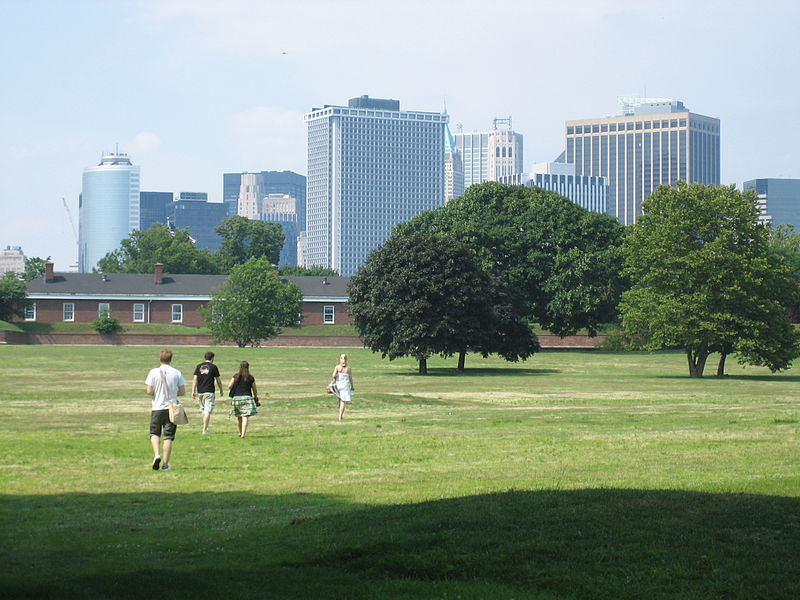
Governors Island, then and now

We headed down to the tip of Manhattan to catch the ferry at the Battery Maritime Building, slip #7 adjacent to the Staten Island ferry terminal. So far it all seemed very familiar, except for the absence of the Shore Patrol.

Jan Kelsey lived on Governors Island in the 1970s with her Coast Guard officer husband. Recently the two returned to see what had changed and what still remained. I never tire of hearing the stories of those who lived and worked on the island, just as I never tired of meeting people who had passed through Ellis during my time there. The best bits are in the details. As Hemingway said, tell them about the people and the places and how the weather was. Ms. Kelsey has certainly done that. This is the most lucid 1,500 word take on Governors Island I think I have read.

As she recommends, come check it out for yourself. There is another month to go in the season.And remember, the island is open Labor Day Monday.

(image/Chris Ruvolo)


The crossroads of the Mississippi Delta

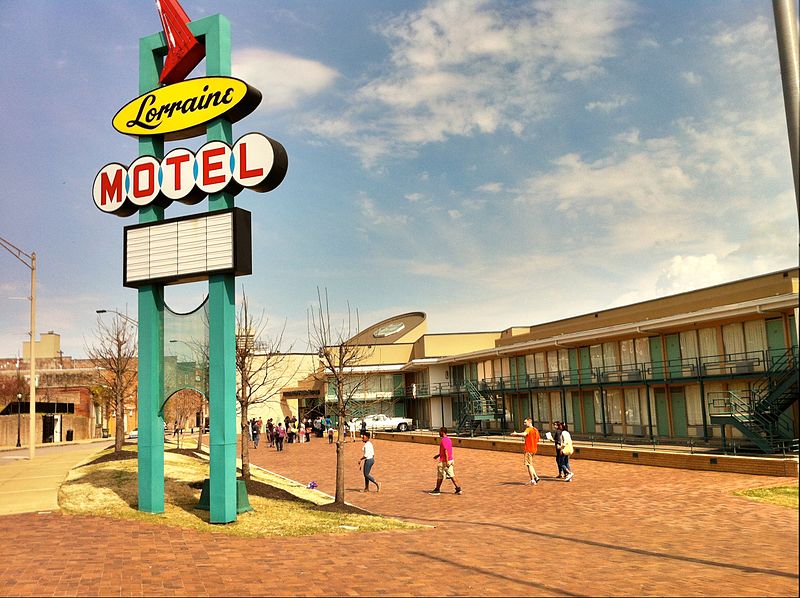
Late this past week we were doing the New Student Orientations on my campus, meeting the incoming freshmen and giving them an overview of how and what our library can do for them. It is one of the signals that a new semester is about to begin. The fall is especially busy because the incoming body is always larger in August than January. The groups came in waves over an hour long period and in the five minutes or so between incoming sections we were b.s.ing about what we had done over our summer. I mentioned how if my father were still alive the Hayfoot and I almost certainly would have gone to Memphis for a few days during our visit. The River City is special not just for its own cultural importance–which is significant–but for its proximity to so much else. The first time I ever “visited” was in 1997 when I was passing through during my drive from Texas to New York during my move to Brooklyn. Needless to say,with all of my worldly possessions crammed into one automobile, a 1,500 mile drive, and a deadline to make to start a new job there was not much time or inclination to do any sightseeing. I vowed to make it back when time and circumstances allowed. Thankfully I did.

One thing I never realized until visiting Graceland was how close it is to the Mississippi line it is. These are the things you discover when you’re out there seeing it for yourself. In a piece written in recognition of Elvis Week Patrick Teegarden explains how Memphis is “an ideal ‘base camp’ for learning the ambiguities that are America.”

Enjoy your Sunday.

(image/DavGreg)

Friday morning coffee

The sesquicentennial events of the Maryland Campaign are quickly approaching. This should be something special, especially at Antietam where the interpretive staff have been preparing for several years. I have been fortunate in that the 150th anniversary of the Civil War came at precisely the moment when I was ready for it. Intellectually, five or ten years ago would have been too soon, and a decade down the line might have been too late in some ways personally. Meeting the Hayfoot when I did was the biggest catalyst. These are the times of one’s life.