It’s President’s Day

I am typing this in a cafe in Union Station on my iPad. The Hayfoot and I are waiting for the bus back to New York. We had a good weekend seeing our new niece and also hitting the Corcoran and the National Portrait Gallery. The great thing about the Corcoran is that it is right next to the White House, and so there is much to see in the immediate area. We got a treat yesterday. Last month we had seen a documentary about St. John’s Church and vowed to visit if ever given the chance. Yesterday that chance came when we were walking through Lafayette Square and happened to see the old church across the way on H Street. We tried to open the front door only to find it locked. Thinking that was that we headed off when around  the corner we found a side entrance. As it turned out the church was closed, but a man told us we could come in for  5-10 minutes if we wished. And of course, we did! He pointed us to the pew at the rear of the church where Lincoln often entered–always alone–for a few minuted of quiet contemplation. For nearly two centuries almost very president, including the present one, has at least occasionally attended services at St. John’s. Having the place entirely to ourselves for a few minutes, on the Sunday of President’s Day weekend no less, was something special.

Enjoy your day.

Bon weekend

Hey everybody, I am off to Washington, DC tomorrow for President’s Day weekend. I love the nation’s capitol a little more with every visit. It is especially meaningful to be there for American-specific holidays. I was there last year for Memorial Day.

I am taking the Boltbus and am first going to visit the Smithsonian’s National Postal Museum, which is conveniently across the street from Union Station. The NPM has an exhibit of Lincoln certified plate proofs that I have wanted to see for awhile. Their website says its closing in “Summer 2012,” which doesn’t leave much wiggle room if one is trying to plan ahead. I have not been to the NPM in about seven years. Also on the agenda is the Corcoran Gallery of Art for the Shadows of History: Photographs of the Civil War from the Collection of Julia J. Norrell. It is not all Civil War. The real reason for the trip is to see my niece for the first time. Her three month birthday will be tomorrow.

If you live in the Big Apple, or are here for the weekend, remember that President’s Day is a Holiday Monday at the Metropolitan Museum of Art. Last month I wrote about my visit to the New American Wing on the day of its re-opening after a four year renovation. Among other treasures in the maginficent new galleries are numerous works by Augustus Saint-Gaudens. When I visited last month I saw his Standing Lincoln. As it turns out this was a recent purchase by the Met, who announced the new acquisition on Lincoln’s Birthday this past Sunday. Something tells me Harold Holzer had a hand in this. Thankfully.

If you are looking to read the book on Lincoln as depicted in bronze and stone check out James Percoco’s Summers with Lincoln: Looking for the Man in the Monuments, which I bought at the National Gallery of Art the day after I proposed to my wife in a Washington hotel room.

An added bonus of the visiting the Met would be the chance to see the Romare Bearden exhibit, which I am going to scramble to catch before it closes on March 4.

Whatever you choose to do, have a safe and enjoyable weekend.

(image/1890 plate proof, Smithsonian National Postal Museum)

A check in the mail

I opened my mailbox this evening and inside was the first check I have ever received for my writing. Let’s just say I won’t be retiring anytime soon. It was a cool $75 for a series of four articles I wrote for a forthcoming woman’s history encyclopedia. That would be $75 combined for the set, not $75 multiplied by four. I dare not compute what it comes out to by word count. In all seriousness, we don’t do these things for the money, which is a gesture more than anything else. A few weeks I turned down even the token sum offered by a different publisher because it was a state library organization that I figured could better use the funds they offered for the two articles I wrote for them. (You can read them here and here.) It is all part of my effort to establish myself in the profession. Writing these six encyclopedia articles (average length=1,000 words) has taught me a great deal about not just the subjects, but about the publishing industry and process as well. I feel I am getting there.

Also in the mail was the Summer 2011 issue of New York History, the mouthpiece of the New York State Historical Association, which I joined last month. I have always been fascinated with the history of New York City, even before moving here in 1997. Now I am finding myself increasingly interested in the state as a whole. I am trying to become more active statewide. Joining NYSHA, and the National Council on Public History, which I did at the same time, seemed like good ways to do that.

The creative economy

Clarksdale Passenger Depot, early 20th century

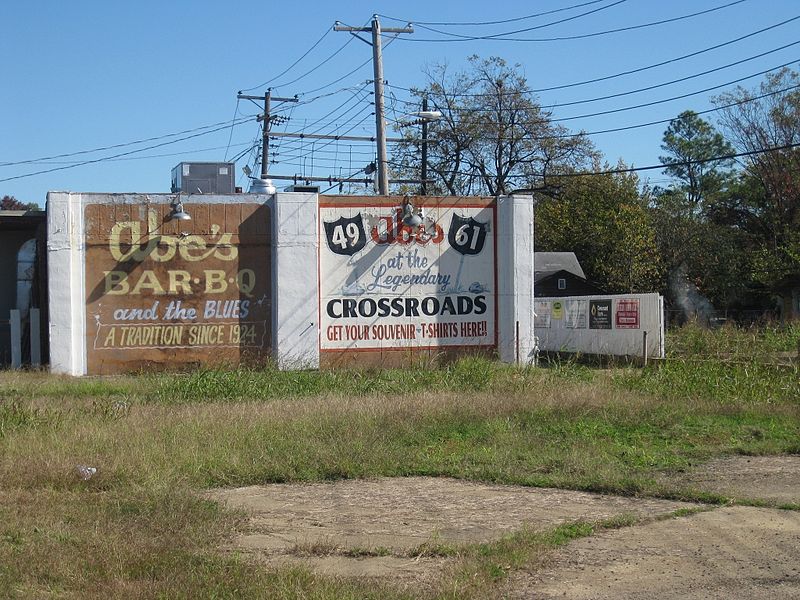
Until he died three years ago I visited my father every August in Arkansas, where he retired in the early 1990s. I always went for about 8-10 days and almost every year I borrowed his car and took a side trip to some locale. Memphis, Shiloh, Pea Ridge, and Clarksdale, Mississippi were a few of the places I visited, sometimes alone, sometimes with my father in tow. (In one of the trips where I went solo I got my dad’s Cadillac up to 95 mph on Highway 61 just outside Greenville. And yes, it felt great.) Every time I returned to New York friends would look at me incredulously when I told them where I went and what I saw and did. It would surprise many folks who live outside the Northeast how provincial this region can be, especially in Boston, where my family is originally from, and New York City, where I live today. Things to see and do west of the Hudson or Charles Rivers? Absurd. (See here and here.) People have literally told me that they could not imagine doing something in any part of what they dismiss as “the flyover.”

Many small towns I have visited were doing their best to capitalize on heritage tourism, some more successfully than others. The Civil War is just a small part of it. Music (jazz and the blues), literature (Faulkner, Tennessee Williams, Flannery O’Connor, et al), and other historical and cultural points of interest are also part of the equation. Towns such as Helena, Arkansas that boomed with Mississippi River commerce decades ago have been bypassed by changes in transportation. The city is too far off the highway to maintain its relevancy. One town that is succeeding is Clarksdale, Mississippi, home of the Delta Blues Museum. I knew the town was making it when I saw the thriving galleries in the small midtown. It’s the maxim that wherever the artists and gays go, the money follows. The rest of the state is catching on.

Clarksdale, 2009

(images/Mississippi Dept. of Archives & History; Thomas R. Machnitzki)

Updating Ellis

I am off work today and am going into the city in awhile to have lunch with one of the park rangers from Ellis Island. I have not been to Ellis since transferring to Governors Island nearly a year ago. I still haven’t seen the new exhibit, Journeys: The People of America 1550-1890, that opened later in 2011. I am hoping to see it next month when an old friend from library school visits from Texas. The exhibit is phase one in the renovation of the immigration museum. I am pleased that it is now up and running. Many believe that Ellis Island is the story of American immigration, not realizing that the depot opened in 1892 and that millions of individuals had passed through other ports in earlier times. One of the least known stories in our rich history is that of Castle Garden, the immigration station in Lower Manhattan that processed millions of Europeans, especially Germans and Irish, from 1855-1890. Many visitors mistakenly believe their ancestors came through Ellis, not realizing that it did not open until the late nineteenth century. Phase two of the renovation will tell the story of immigration after 1924, when immigration quotas were tightened, up through the present day influx that is again transforming and enriching our society.

In yesterday’s Times Liberty-Ellis Island Foundation President Stepehen A. Briganti explains that “If we didn’t tell the current story we would be obsolete in 25 years.” This to me seems correct. Ellis Island is a fascinating place that every American should visit if they have the opportunity. Still, it is one tile in the larger mosaic of America’s immigration story. The immigration museum was built in the 1980s and opened in 1990s in the years when the immigrants were in late middle age and were eager to tell their story before they were gone. They succeeded. Now, wisely, the Foundation and Park Service are putting that story into even greater perspective.

Winter is a great time to visit Ellis Island.

Finding comfort

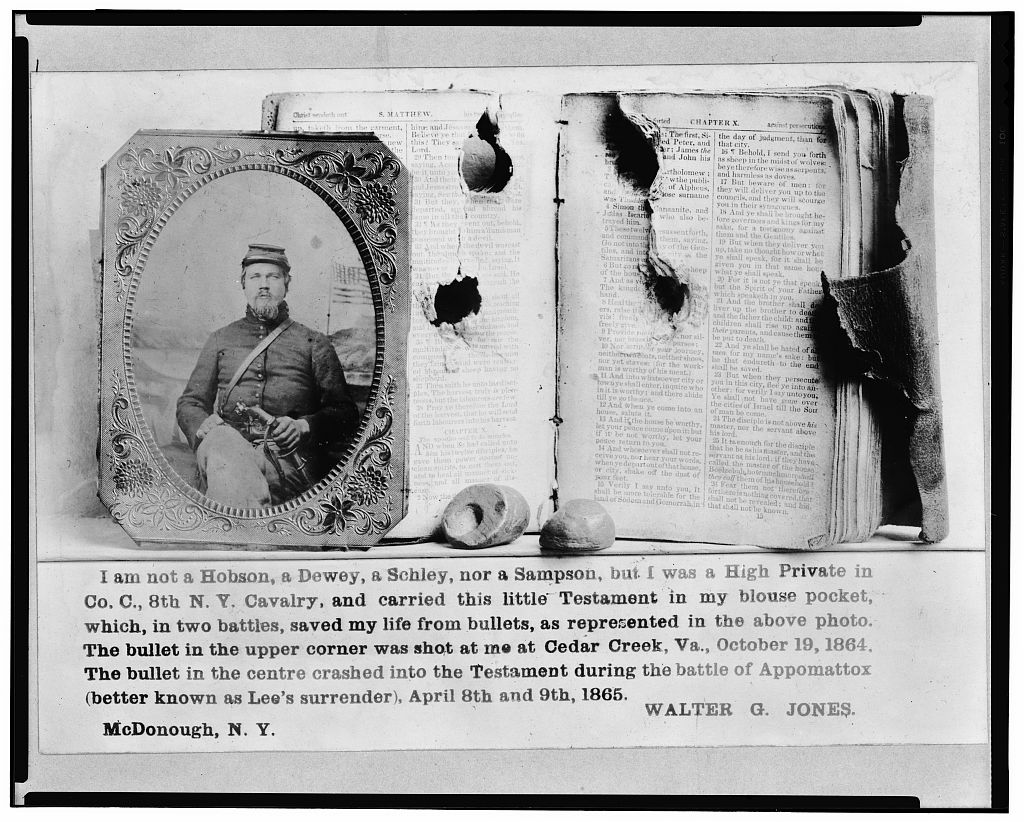
Private Walter G. Jones, 8th New York Cavalry, and his New Testament

With the Hayfoot at work and no football for the first Sunday in months your humble writer was left to his own devices to keep himself entertained today. I decided to visit the Museum of Biblical Art to see the newly opened exhibit Finding Comfort in Difficult times: A Selection of Soldiers’ Bibles. The museum is part of the American Bible Society, an institutuion founded in 1816 to promote the reading of scripture and the abolition of slavery. I have always had an interest in the Bible as a librarian and historian and had been looking forward to this exhibit since reading a recent review in the Wall Street Journal. I was not the only one. When I asked the receptionist if attendance was good she said it had picked up since the WSJ article appeared. On the questionaire I was asked to fill out before leaving there was even a box to check off labeled “Wall Street Journal” for “How did you learn of the show?”

Finding Comfort examines the history of soldiers’ Bibles from 1861 to the present day, but the bulk of the exhibit is dedicated to the Civil War. About half of the thirty six monographs on display are from that conflict. Taking a “Hate the sin; Love the sinner.” approach, the ABS distributed Bibles to both Union and Confederate troops. The logistics of transporting and distributing Bibles to rebels proved difficult however, and the vast majority of the books were given to Union men. There were similar groups in the South that tried to pick up the slack. The Bible Society of the Confederate States of America, for instance, was one such organization that did so. Still, this was not enough. My favorite in the exhibit was a Bible published in England by Oxford University Press for the British and Foreign Bible Society. Copies of these King James Versions of the New Testament were shipped in bulk to the Caribbean to be smuggled into Charleston, South Carolina aboard the blockade runner Minna. The ship, the Bibles, and all the other goods aboard intended for the Southern war effort did not make it. The Minna was overrun by a Union ship on December 6, 1863 and towed into a Federal port.

Most of the Bibles on display are small tomes designed for their lightness during the march and to fit snugly in a soldier’s pocket. Indeed, the story of a Billy Yank saved from death by the Bible carried in his breast pocket is one of the cliches of the war. Finding Comfort is an apt title for the exhibit. The years 1861-65 were indeed difficult times and the ABS provided meaning and comfort throughout the war to hundreds of thousands of men who were scared, far from home, and facing death on a daily basis. Most poignant to me were the photographs and handwritten notes in some of the items. It is always jarring to me to walk into a museum off the street, examine the personal items of individuals like these in solitude, and walk back into the cacaphony of the city. It is like being in on a secret that those around me are not aware. The exhibit is small, but worth seeing. A good way to do it is the way I did today: catching the show and then having a walk in nearby Central Park.

The Civil War is better than football. It is the real life story of people not very different from us who did extraordinary things under the most trying circumstances. Not a bad way to spend Lincoln’s Birthday.

(image/Library of Congress)

Canada remembers…

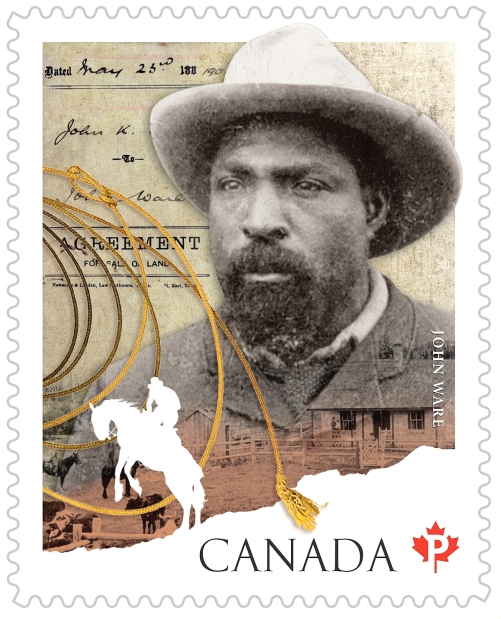
John Ware, c. 1845-1905

I confess to not knowing who John Ware was until reading this announcement from Canada Post advertising the release of the above commemorative stamp in his honor. I confess, too, that it never occurred to me that Black History Month is observed North of the Border. Ware was born into slavery in South Carolina and found his way to the Lone Star State after the Civil War. In Texas he joined the legions of black cowboys who worked the range. During a long drive Ware ended up in Calgary, settled there, and established a life for himself. I have been a philatelist almost my whole life and must say CP has done a beautiful job on the Ware stamp. There is more on the man here.

(Image courtesy/Canada Post)

The Way Home

Hey everybody, you never know what is waiting for you when you log on but today something special came through my inbox. Amy Marquis, an associate editor at National Parks Magazine, has just released a short film chronicling a visit to Yosemite by a group of late adult African Americans. For most, perhaps all, it was their visit to a national park. I’ll let the film say the rest.

The aging soldier, update

(Hat tip Gianni Rocco)

In May 2011 I noted the passing of Claude Choules, the last veteran of the Great War. In that small piece I mentioned that Florence Green was thus the last surviving uniformed service person known to have served in the war. Well, a friend has informed me that Mrs. Green died this past Saturday, two weeks before what would have been her 111th birthday. Green, born Florence Beatrice Patterson in London the same month as Queen Victoria’s funeral, joined the Women’s Royal Air Force when she was seventeen. The RAF and others will be participating in the services.

Sad to know that a generation has finally, truly come to an end.