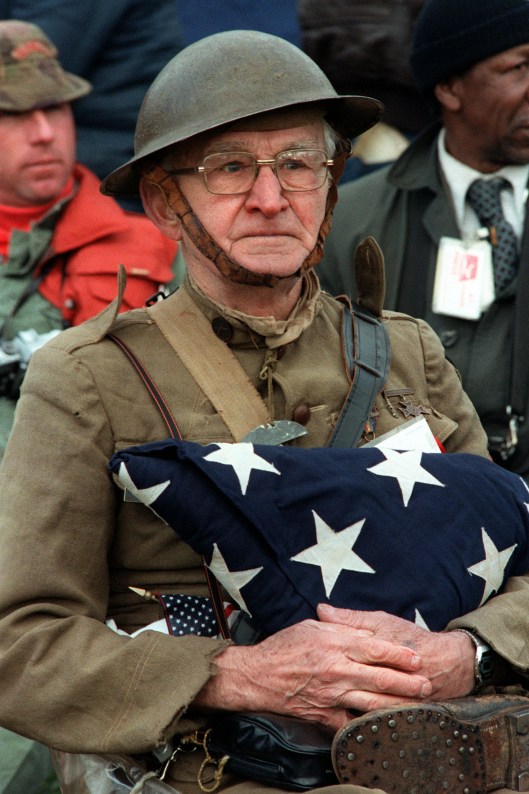
Meeting a doughboy’s son

An 86-year-old World War I veteran attends the dedication day parade for the Vietnam Veterans Memorial, 13 November 1982

I had an interesting experience this past Tuesday at the final event for our Gilder Lehrman, Library of America, National Endowment for the Humanities World War One project: the son of a Great War veteran attended. As you might imagine, I was surprised–greatly and pleasantly–when he told me. I asked the gentleman if during the conversation he might be willing to share his father’s story. It turned out to be fascinating.

As it turned out the man’s father was born in Italy in the 1890s, came to the United States during the great wave of migration in the early twentieth century, and ended up back in Europe wearing an American doughboy’s uniform when the United States entered the war. It is a fascinating but actually not entirely unusual story. An interesting book came out several years ago called The Long Way Home telling the stories of twelve American soldiers who came through Ellis Island. It is one thing to say that millions of people fought in a war. Hearing individual stories makes it more relatable; each soldier’s story, from wherever he came and however he served, is another tile in the mosaic. The veteran whose son attended the function the other day was in his late 60’s when his son was born, which from doing the math as Iroughly calculated it would have been in the 1960s. So, this aspect of the story is a bit more anomalous. It is similar to the stories one hears of Civil War veterans who fathered children in the 1900s and 1910s. To hear the son tell the story was a humbling experience and a reminder that when we discuss about the Great War we are not talking about ancient history, but a historical moment within the living memory of even the children of the soldiers who served.

(image/Department of Defense. Defense Audiovisual Agency by Mickey Sanborn)

Monday morning coffee

Editing the manuscript yesterday

It rained all day yesterday and I took advantage of the inclement weather to stay in and edit my manuscript. It is amazing how the more you revise the more you find. I sent the draft to a friend last night for him to read. I probably have another 1500 words to reach the finish line. After that, it will be mainly be the clerical work of further editing and the data entry of adding the citations into Zotero. After this week as I wrap up the draft, blogging will pick up again as well.

Enjoy your day and your week.

Presidents Day 2018

I have spent the weekend wrapping up the penultimate chapter in my Civil War book, which ends with the death of Theodore Roosevelt Sr. in February 1878. As it happened I was writing yesterday of President Rutherford B. Hayes’s May 1877 trip to New York City. Hayes, wife Lucy, and much of the cabinet came to New York for a very public series of events spread over a few days. In today’s parlance, we would say that Hayes was consolidating his base. He actually had lost Manhattan to Samuel J. Tilden quite handily in the 1876 presidential election, on his way to losing the overall popular vote. Much of Hayes’s support came from individuals like Theodore Roosevelt Sr., John Jay, Joseph H. Choate and their allies in organizations such as the Union League Club. Roosevelt was at just about every one of the public and private gatherings held in Hayes’s honor.

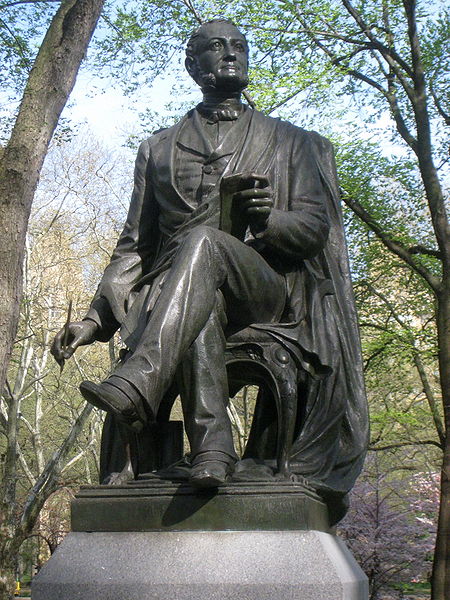
Contemporary photograph of Fitz-Greene Halleck statue in Central Park

The dedication depicted here took place on 15 May 1877. A short list of those on hand to see President Hayes dedicate the statue to poet Fitz-Greene Halleck includes William Cullen Bryant, William M. Evarts and Carl Schurz, Generals Winfield Scott Hancock and William Tecumseh Sherman, and former New York governor Edwin D. Morgan. The Seventh Regiment Band played. After this event Hayes toured the American Museum of Natural History in its temporary quarters within the Central Park Arsenal escorted by Theodore Roosevelt Sr. It is strange how in popular memory we tend to jump from Lincoln to Theodore Roosevelt, dismissing the administrations that came between. Abe and Teddy are the subjects of considerably more biographies than all the others between. I believe we serve ourselves poorly and that it is our loss for not doing so.

Enjoy your Presidents Day, everyone.

(images/top, NYPL; bottom, unknown photographer via Wikimedia Commons)

Sunday evening coffee

I hope everyone’s weekend has been good. It has been a rainy one here in Brooklyn. I seized the opportunity the inclement weather has provided to write. I crossed the 70,000 word barrier today on the draft of my book about Civil War Era New York. The word count for the draft itself will land somewhere in the 72,500 range. The editing, honing, and fact checking over the rest of the winter might add another 2000 or so after that. I am off tomorrow for Lincoln’s Birthday. I’ll also be waiting for a repairman to come and fix something in the house. I wrote 1000 words yesterday and gain today. If I can do that a third day in a row, I’ll be in great shape. I even told a friend I would send him the draft to read one week from today. They say that one should write the book one wants to read, and I have done that.

Someone asked me today if I feel myself winding down. I did not until today. For the past several weeks I was worrying as I neared the finish line. The tendency for intellectual drift and self-sabotage only became more marked as I neared the end of this stage. I’m past that now. The trick has been to force myself from becoming impatient and to let the process take care of itself. Of course the book is a long way from release, if it ever is indeed published. I don’t want to give away too much just yet, but I have been developing what I think might be some good public history opportunities related to the Incorporating New York for this spring and summer. First things first, though: finishing the draft over the next seven days.

(image/NYPL)

“Serious but not critical”

Theodore Roosevelt as he was in 1918. After years of living the strenuous life his health declined precipitously that year and led to his death in January 1919.

While of course no one could have know it at the time Theodore Roosevelt had just eleven months to live as of February 6, 1918. For those watching Roosevelt’s activities however, it was clear that his health was failing. One hundred years ago today he was at Roosevelt Hospital in New York City for surgery to remove accesses on a thigh and in his ears. He had acquired these maladies first in Cuba during the Spanish-American War and later, more seriously, in Brazil in 1913-14 during trip down the River of Doubt. This was Roosevelt’s second procedure in less than a week; surgeons had operated on him in Oyster Bay a few days previously before bringing him into the city for more extensive tests and, ultimately, the additional surgery. There to keep him company in the coming days while he recuperated were daughters Alice and Ethel, wife Ethel, and his sister Corinne. Not present were his four sons, who by now were all in uniform and on active duty. Telegrams of support poured in from Woodrow Wilson, French President Raymond Poincaré, Prime Minister Georges Clemenceau, and scores of others.

It was still an active time for Colonel Roosevelt. Remember, he was still just fifty-nine years old. In this period he was writing his columns for the Kansas City Star and speaking his mind on what he saw as the failures of the Wilson Administration in getting the United States up to speed and involved in the Great War. He had had to cancel a number of public talks that very week for the surgery itself. He was in Roosevelt Hospital for nearly a week and suffered a few set back. This is what led his physicians to inform the public that Roosevelt’s condition was “serious but not critical.” He was on the mend, at least temporarily, by mid-February. Some were still optimistic. and there was even public chatter at this time of Roosevelt running for the White House again in 1920.

(image/NYPL)

Great War inflation

Food prices jump from $.90 to $1.29, Brooklyn Daily Eagle: January 31, 1918

This striking headline appeared in the Brooklyn Daily Eagle one hundred years ago today. A jump from $.90 to $1.29 represents a 30% increase in the price of groceries. The way I have always understood it American food producers had done well the first three of the war, selling food stuffs to European governments to feed their hungry armies out in the field. This demand in turn set off inflation here in the United States, not to staggering proportions but at least enough for American consumers to feel the pinch. Rationing and price controls too contributed to inflation at the dinner table.

As of late January 1918 the United States still had few troops stationed overseas, though the number of men in uniform and in training stateside was growing exponentially. This was putting additional strain on both the food supply and the transportation systems that brought goods from here to there within the United States. One can only imagine what Americans were thinking when they saw headlines like this in the winter of 1918.

FDR, 1882-1945

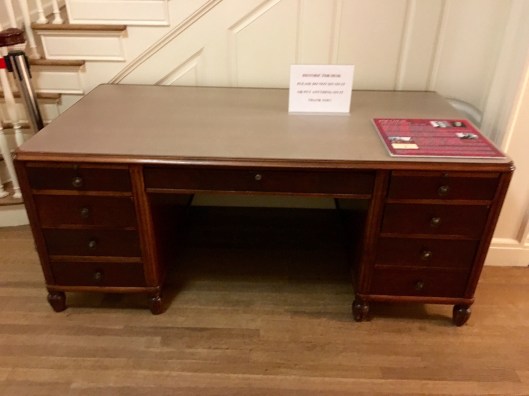
The desk Franklin Delano Roosevelt kept in the family’s East 65th Street townhouse

Franklin Delano Roosevelt was born on this date in 1882. On these winter days I sometimes think of the coming summer, when among other things I usually make a day trip to Hyde Park. When I was there last summer I asked the ranger if the site does something every January 30 to commemorate the occasion of the only four term president’s birth. She said the library & museum hold a brief ceremony every year, often with a contingent from the West Point Band just down the Hudson on hand to play. She emphasized the brevity of the ceremony. The winds blowing cold off the river in late January make a longer event untenable.

The photograph of the desk you see above was not taken in Hyde Park. I took the photo this past November at the Roosevelt House on East 65th Street. I sent the image to a friend of mine the night I took this. He was shocked at how modest and unadorned the desk was. I explained that, for all the wealth the Roosevelts had, they tended toward Dutch restraint. Roosevelt once famously said while president that he did not want a memorial in his honor after his death to be any larger than his desk. They honored that request in the mid 1960s. That it took twenty years to build even such a modest edifice is testimony to how long these things take.

When we think of the Hudson River Roosevelts we think of Hyde Park and Washington. Over course there were the twelve White House years. Thirty years before then, during the First World War when he was Assistant Secretary of the Navy, Franklin and Eleanor rented a house from her Aunt Bamie just off Dupont Circle. Still the Manhattan home, with his mother Sara living next door in a detached townhouse, was very much the family domicile for large stretches throughout their lives. I kept the image above in my photo stream for the past 2 1/2 months waiting until this winter day to mark the 136th anniversary of FDR’s brith.

More “eyes” for the Navy

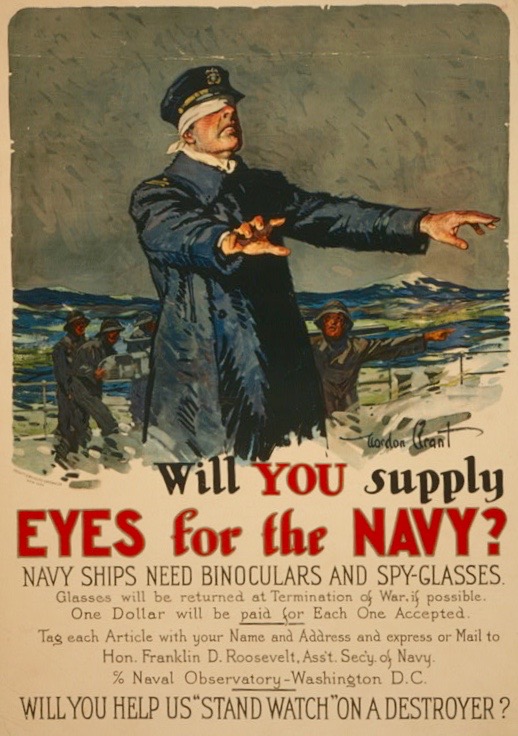
1917 poster produced by the Sackett & Wilhelms Corporation of New York for the Navy Department

In the final week of January 1918 the U.S. Navy Department sent out a request to all Americans to please send any binoculars, telescopes, spy glasses, sextants, and visual aids of similar nature to Assistant Secretary of the Navy Franklin D. Roosevelt care of the Naval Observatory on Massachusetts Avenue. This was the second such plea put out by the Navy in the past two months. Binoculars were the most desired item on the wish list. Strictly speaking any items sent were to be loans not gifts; the Navy offered $1 for the use of any item for the duration of the war. The dollar was actually a technicality; government agencies were prohibited from taking possession of any goods without payment. Thousands of packages flooded in to the Observatory over the last five weeks of 1917 and first several weeks of 1918. Still, the need was so great that the Navy issued the second plea.

Apparently word got around too that some people were holding back because they were unsure of if/how/when they would ever receive their items returned. There were enough letters to the editor of various newspapers complaining of packages sent but not acknowledged that Roosevelt felt the need to draft a communiqué explaining that the Navy was doing all it could to address the backlog. He made clear too that, while all items would be duly tagged before being sent to ships, submarines, and lookout points, the Navy could not realistically be expected to return every item to its proper owner. Equipment can be lost or destroyed in time of war.

Unpacking binoculars and other visual aids at the Naval Observatory, 1918

The return of items was no small thing. One citizen noted that his binocular set cost $50, which is more than $1000 in today’s currency. One of the reasons the visual equipment was so expensive, and for the shortage itself, was because many of the premier manufacturers of such items were Swiss, German, French, or other European concerns. These makers were either now on the other side in the Great War; or, if the country of origin were an American ally, it was just logistically impossible for companies to send such things. Also, it was not uncommon during the war for manufacturers to retrofit their factories to produce different goods for the war effort. Thus the call from Roosevelt in late 1917 and early 1918.

(images/Library of Congress)

Vonnegut in winter

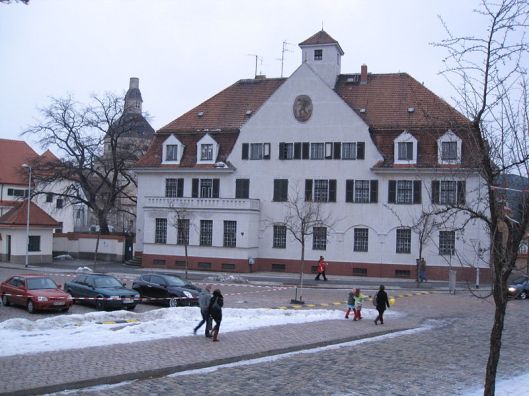
February 2010 image of the slaughterhouse where, sixty-five Februaries previously, Kurt Vonnegut survived the Dresden firebombing

One of my undertakings for this winter is to re-read the Kurt Vonnegut catalog. Like many, I read Vonnegut extensively in high school and college but got away from him over the years, though I did return to Slaughterhouse Five from time to time. Vonnegut is one of those writers one can return to at different points in one’s life, reading him with fresh eyes from the changing perspectives of one’s age. I intend to read both the fiction and non-fiction. I will have to do a literature review before diving in fully, but I am considering some type of project in which I analyze the World Wars on Vonnegut’s family. I know that a fair amount has been done on Vonnegut but I think there are some threads left to untangle. If this happens, it will not be until summer or fall.

Vonnegut in uniform during the Second World War, circa 1943-45

Again it has been a while since I have read him, but I recall him discussing the effect that the anti-German hysteria had on his family in Indiana during the First World War. Vonnegut, born in 1922, was a young enlisted man during the Second World War and famously survived the February 1945 firebombing of Dresden Germany as a prisoner of war. That experience in turn was the basis of Slaughterhouse Five, usually considered his most important work. He often downplayed the role that his Second World War experiences played on his personal life, claiming that people often go through cataclysmic events with little to no impact on their own psyches. That may or may not be true. It is without question true that the Second World War played a huge role in his writings. His mother’s 1944 suicide was also a factor in his worldview.

Right now I am focusing on the early novels. I finished God Bless You, Mr. Rosewater on Friday and started Mother Night yesterday. I am struck by how little science fiction there is in these considering that he is usually put in the Sci Fi/Fantasy genre. Some of those devices, time travel, etc., would come in later works but I would hesitate to put him in that category. A second thing that strikes me on reading these novels today is that, when Vonnegut was writing them, the Second World War was more current events than history. I never saw it that way when I was reading them in the 1970s & 80s because to my perspective the Second World War was already part of Ancient History. My sense and perspective on time has changed entirely now that I am in full blown middle age. So it goes.

If I indeed pursue some type of project on Vonnegut, perhaps a series of articles here on the Strawfoot, I may try to tie it in with Rod Serling. Perhaps it might be a compare and contrast of the two men and how they were influenced by their experiences in the Second World War. In some ways these are still current events: it is striking to see how the problems created by the events of the twentieth century are touching the world we live in today.

(images/top, Keith Gard; bottom United States Army)