Happy New Year

American newspapers captured the mood of early January 1917.

American newspapers captured the mood of early January 1917.

I have a candle going and am sitting here with my New Years Day coffee.

It was such a help when the Brooklyn Public Library digitized and published the first half of the BDE morgue’s run about 10-12 years ago. When they completed the second half of that project a few years later, things because even better. I always knew that the Eagle was Brooklyn’s paper of record from 1841-1955, but I don’t think I truly realized how authoritative the periodical was until earlier this past year when I began co-teaching my course and using it so heavily in the classroom. New York with its dozen or so dailies was always a newspaper town–the newspaper town–until the papers began consolidating in the 1950s. By the 80s and 90s only three were left. I suppose I always thought of the Eagle as separate from New York’s newspaper culture because Brooklyn until fairly recently was markedly distinct from Manhattan. The answer is probably not that difficult to earn, I don’t even know if they sold the Eagle in Manhattan.

In its 3 January 1917 edition the Eagle published a series of cartoons that other papers had printed in the days around the turn of the year. The one above in particular caught my attention. It may seem that 2016 with its crazy election season and so many other things was the worst of times, but for perspective  remember that a century earlier was the year of Verdun and Somme. When the new year came in 1917 there was still no end in sight for what this cartoon pointedly calls the European War. The Americans did not enter the conflict until April.

Happy New Year. Enjoy your day.

(image/Brooklyn Daily Eagle)


Looking forward at the end of the year

In doing the research for the posts this past week on the USS New York and the fleet review of December 1918 I came across sobering articles about a riot involving African-American troops from the Bush Terminal in late 1918. Really it was just one in a number of racial and other disturbances throughout the city, indeed throughout the country, during and immediately after the war. This one involved some men denied service at a saloon on DeKalb Avenue and quickly escalated into a scene with 2000 lookers-on and 150 military and civilian police. Shots were fired but no one was killed or injured. Incidents like these are part of why the Great War plays a smaller role in the imaginations of most Americans than other of our conflicts. Expectations so high in America and around the world in those heady days after the Armistice soon became mired in complexity and dashed hopes.

Brooklyn's Bush Army Terminal was integral to the war effort.

Brooklyn’s Bush Terminal was integral to the war effort.

Troops began coming home in that final week of 1918, a process that would continue in February and March of 1919. The end of our own year right now has me reflective on what happened in this heady months just after the Armistice. Temperance and suffragism were two goals of the Progressive Movement that came to fruition after the fighting stopped. What eventually came to be called the New Negro Movement was also coalescing. Scholars like W.E.B. DuBois believed that African-American soldiers returning from the Great War would comprise a vanguard that would end Jim Crow. That came partially true in cultural movements such as the Harlem Renaissance. In the meantime there were incidents like the bloody Red Summer of 1919. The relatively minor incident at a bar in Brooklyn was just a precursor. These are all topics to be explored as the Great War Centennial continues.

(image/Library of Congress)

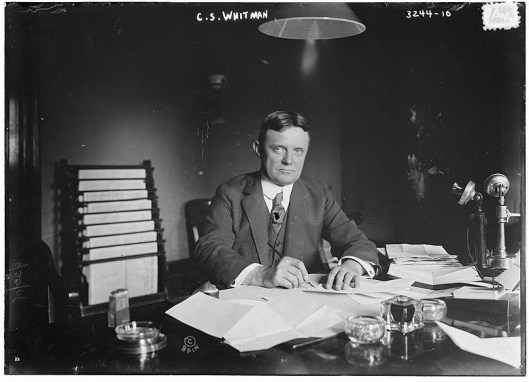
Governor Whitman reviews the 13th

Governor Charles Seymour Whitman spoke at the 13th Armory in Brooklyn on 27 December 1918

Governor Charles Seymour Whitman spoke at the 13th Armory in Brooklyn on 27 December 1918. He had just lost a narrow race to challenger Al Smith and had asked for a recount, which was ongoing at the time.

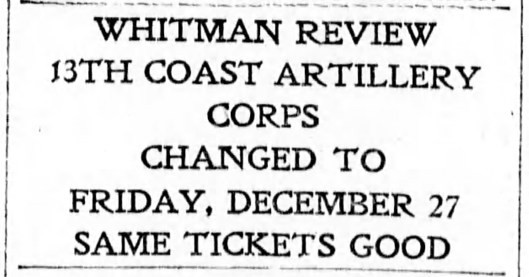
As I said yesterday I intend to do deeper dives into the various reviews that took place in late 1918/early 1919 when the time comes. In the meantime I wanted to note the 98th anniversary of Governor Charles Seymour Whitman’s 1918 visit to the Brooklyn 13th Armory. I knew that there were parades and such in the aftermath of the Armistice, but it did not occur to me until these last few days just how ubiquitous they were. I suppose that in those heady days after the Kaiser’s abdication and Germany’s surrender that people felt that war really might have been rendered obsolete. Wilson was certainly optimistic while in Paris.

These ads ran all week in the Brooklyn Daily Eagle announcing the date change.

These ads ran all week in the Brooklyn Daily Eagle announcing the date change.

Governor Whitman of New York had lost to Al Smith in the November 5 gubernatorial race. Smith was the Democratic candidate and Seymour the incumbent Republican and Prohibition candidate. It’s almost a cartoon of late nineteenth and early twentieth century New York politics: Smith was a Tammany man and Whitman a Union League Clubber. The old and new were mixing in this period. On Memorial Day 1918 Whitman was in Brooklyn’s Grand Army Plaza for the GAR parade; a month after he was at the state GAR encampment in Ithaca. Still, his Prohibitionism and Smith’s Catholicism show hints of what was coming in the 1920s.

(images/Library of Congress and Brooklyn Daily Eagle)

The 1918 fleet review: a snapshot

The USS Arizona docking at the 96th Street pier, Thursday 26 December 1918

The USS Arizona docking at the Hudson River 96th Street pier, Thursday 26 December 1918

Happy Boxing Day, all.

In doing my research for the USS New York article I came across a trove of material relating to the dreadnoughts, the Brooklyn Navy Yard, and the political/social milieu in which these ships were built and then served in the Great War. I intend to write more about all this when the 100th anniversary of the review comes around two short years from today, but in the meantime I wanted to share this stunning image of the USS Arizona taken in the Hudson River on December 26, 1918. There had been so many parades and ceremonies in the 5-6 weeks after the Armistice, but the NYC Naval Review of 1918 stood out. There were nearly a dozen dreadnoughts and scores of accompanying others ships in New York Harbor. There was a dress parade as well.

Woodrow Wilson was not in attendance because by this time he was already in Paris. These same ships of the review had escorted him there just two weeks earlier. His Secretary of the Navy Josephus Daniels watched the review from the presidential yacht, the Mayflower. Daniels’s assistant, Franklin D. Roosevelt, was there too, watching from the Aztec. With his love of the Navy there was no way FDR would have missed something like this. The above photo is so great because Assistant Naval Secretary Franklin Roosevelt had attended the laying of the Arizona’s keel just a few years earlier. Obviously no one could have known at the time, but this ship went down at Pearl Harbor on another December day decades after this photo was taken.

(image by Paul Thompson via National Archives)


The Christmas Ship

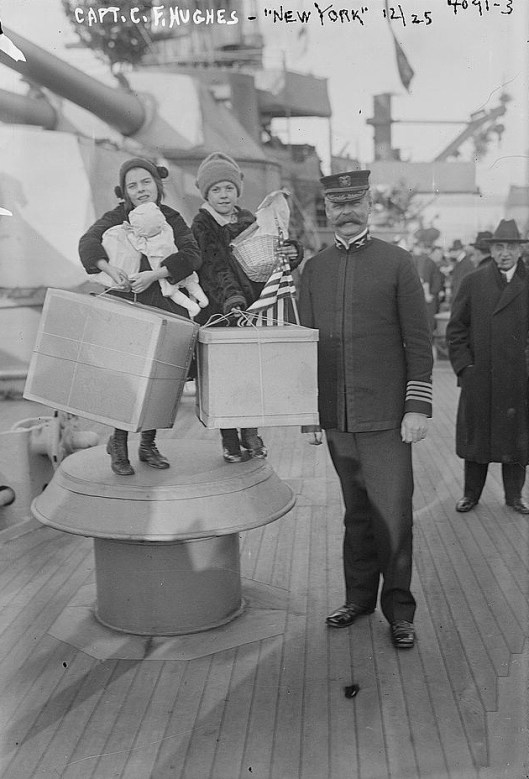
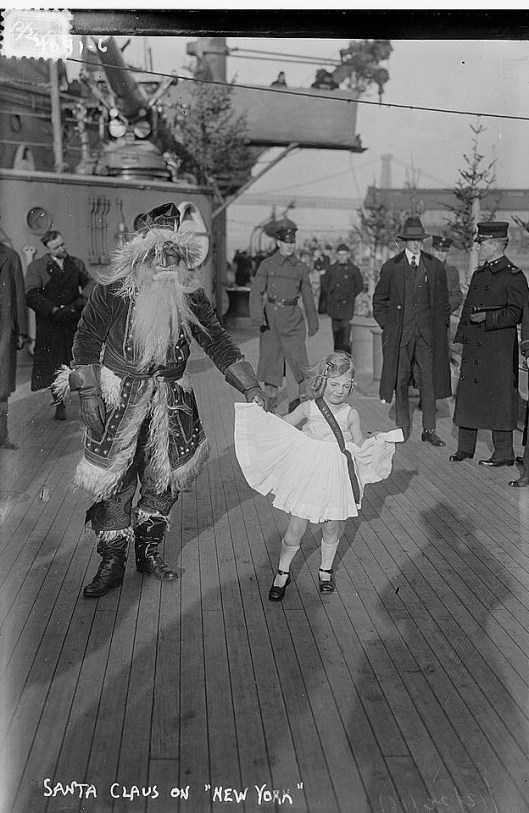
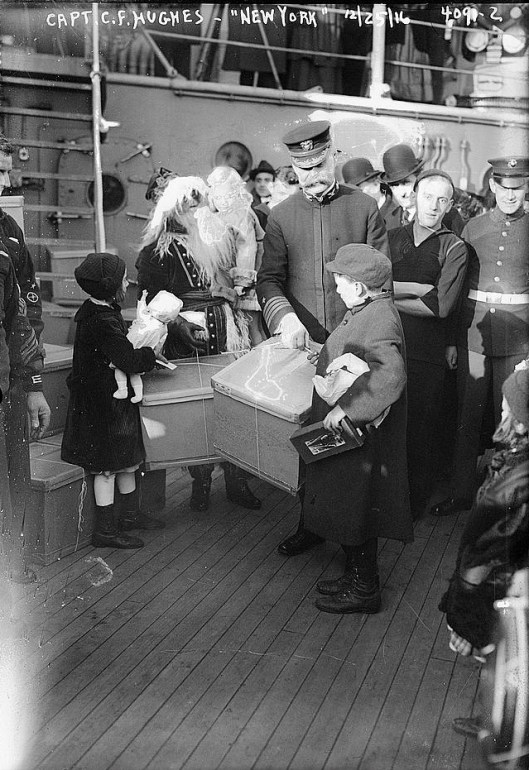
It is a rainy Christmas Eve morning here in Brooklyn. Listening to the rain is quite relaxing. I just wrapped up and emailed off a small project that hopefully will see the light of day in the next few weeks. I don’t want to give too much away for the moment but I will say here that it is about the USS New York. Yesterday I came across these incredible images at the Library of Congress Prints and Images website and thought I would share them today. They were taken aboard the New York in the Brooklyn Navy Yard one hundred years ago, on Christmas Day 1916.

I am submitting them with little comment but will note that the funds for the gifts and toys were provided by the crew. On his own dime the ship photographer printed 1917 calendars with images of Captain Hughes and others, which he then sold for 30 cents apiece. The ship tailor raffled off a custom made suit, and so forth. For its endeavor, which it had begun the year before after returning from the blockade of Veracruz, the New York became known as the Christmas Ship. For Christmas 1916 they raised $1000–over $22,000 in today’s currency–and provided toys and Christmas dinner to 500 needy New York children. One year after these images were taken the United States was in the Great War and the dreadnought was attached to Britain’s Grand Fleet, keeping the Germans in check in the North Sea.

A few things: notice the Williamsburg Bridge in the background of some of the images; also note the stamps in some of the images, which I intentionally did not crop out. I could not tell if these were revenue stamps, and if so why they would be necessary. If anyone knows, I’d be interested to learn.

Merry Christmas, everyone.

23483v

23486v

23484r

23489r

23482v

Josephus Daniels looks back on 1916

With the election over and the year winding down Naval Secretary Josephus Daniels issued his annual report in December 1916.

With the election over and the year winding down Naval Secretary Josephus Daniels issued his annual report in December 1916.

Woodrow Wilson had won re-election by the time his Secretary of the Navy, Josephus Daniels, submitted his annual report on the state of the Navy in December 1916. In his communiqué Daniels singled out the Brooklyn Navy Yard for distinction. It was a busy era at the facility on the East River across from Manhattan; everyone knew that ships would be increasingly important with the coming completion of the Panama Canal. Construction of the USS New York and Florida had begun even before the outbreak of the Great War, and the Arizona came soon after.

During the hot summer of 1916 Daniels pushed for a greater expansion of the Navy, advocating for 100+ new ships. This was good news to Daniels’s assistant, the rising politico, Preparedness advocate, and avid amateur naval historian Franklin Delano Roosevelt. FDR had personally attended the laying of the keel for the USS Arizona in March 1914, the same month Wilson entered the White House. Now, 2 1/2 years later, Secretary Daniels wrote that the Brooklyn Navy Yard had “demonstrated an increase of efficiency in new construction” and added that “the actual cost” of the Arizona in real dollars was much lower when compared with that of those even slightly older ships. The cost per ton of the Florida had been $286, of the New York $233, and of the Arizona $211.

(image/Library of Congress)

75 years ago today: Pearl Harbor

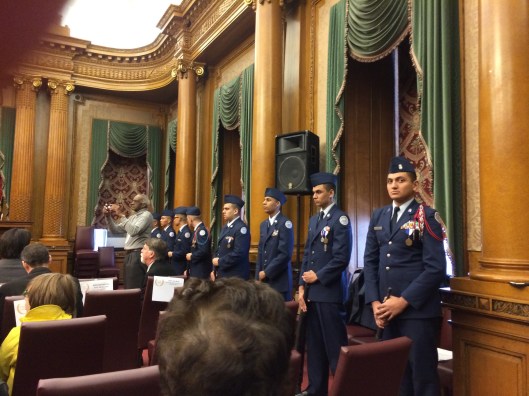
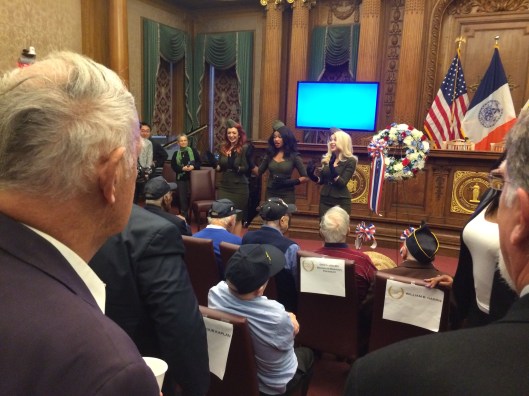
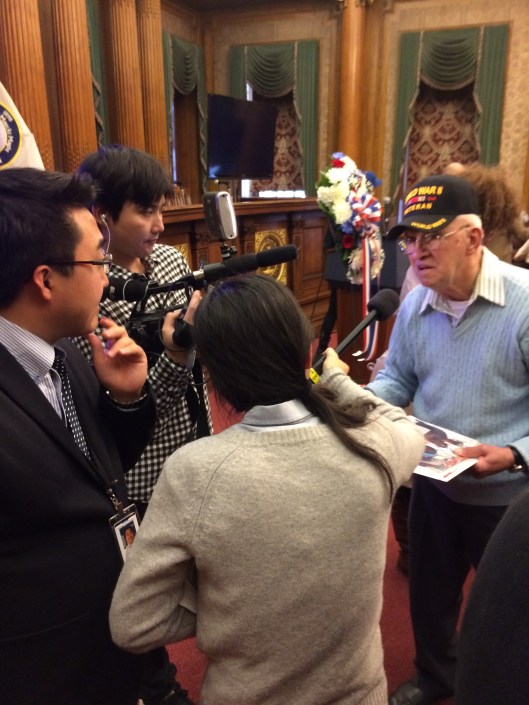
I attended a Pearl Harbor 75th anniversary event on Monday. The Cadman Park Conservancy organized the event, which was held at Brooklyn Borough Hall. There were eighteen WW2 veterans in attendance, one of whom was a Pearl Harbor survivor. Having the event in Brooklyn was poignant, being that ships such as the Arizona were built just a few miles away at the Navy Yard. I wrote five years ago about the Pearl Harbor anniversary and so won’t do so again here. I do want to share a few images from the day. There is only one 75th anniversary of the attack on Pearl Harbor.

Camera crews were gathered.

Camera crews gathered.

ROTC teams from two high schools provided color guards.

ROTC teams from two high schools provided color guards.

An a cappella trio doing period songs also performed.

An a cappella trio doing period songs also performed.

Brooklyn Borough Historian Ron Schweiger spoke about life in the borough as it was in 1941.

Brooklyn Borough Historian Ron Schweiger spoke about life in the borough as it was in 1941.

The commemoration had several fine speakers besides Ron. Understandably the veterans themselves were the focus.

The commemoration had several fine speakers besides Ron. Appropriately, the veterans themselves were always the focus.

After the speeches, wreath laying, songs, and color presentations, film crews moved in to interview the men.

After the speeches, wreath laying, songs, and color presentations, film crews moved in to interview the men.

1939: another generation for the American Field Service

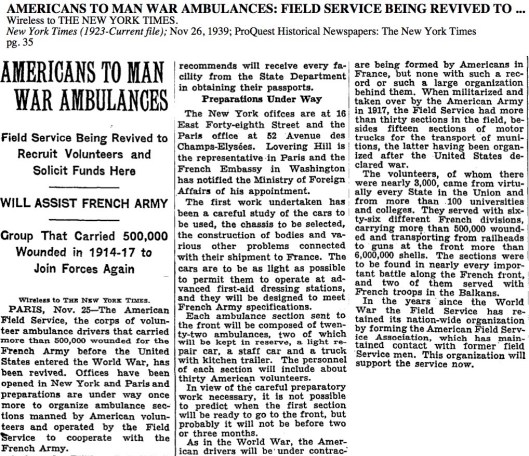
an excerpt from the New York Times article about American drivers leaving for Europe in 1939

an excerpt from the New York Times article about American drivers leaving for Europe in November 1939

Yesterday I was working on a small project that hopefully will come to pass in 2017. I don’t want to go too much into the details just yet; we’ll see how things go. I did come across something I thought worth sharing: this 26 November 1939 New York Times article about the next generation of American Field Service ambulance drivers heading off for Europe. This is the cohort that would serve in the Second World War. Oddly enough, their departure fell between Franksgiving on the 23rd and Thanksgiving on the 30th. The AFS story began in 1914 when idealistic young men, usually from America’s finest universities, left their campuses for the field hospitals of Flanders, Italy and elsewhere. We had a reconstructed WW1 AFS ambulance at Governors Island on Doughboy Day this past September which drew large crowds.

When war came to Europe again in September 1939, the AFS picked up where it left off after the Armistice and Treaty of Versailles twenty years earlier. It’s interesting to note the initial centers were Paris and New York City, as they were during the First World War. November 1939 was of course six months prior to the German occupation of Paris. I imagine that by summer 1940 the Parisian offices had relocated either to Vichy France or to another European city.

Franksgiving

Because Franksgiving itself lasted three years I figure I get today and 2018 to share this post I wrote last year on Black Friday. Enjoy your weekend, everyone.

I hope everyone got enough to eat yesterday and refrained from waking up at 4:00 this morning for Black Friday. In a sense we have Franklin Roosevelt to thank/blame for turning the day after Thanksgiving into the retail orgy it has become. Since 1863, when Lincoln asked Americans to pause and give thanks for what they had during the difficult days of the Civil War, the country always marked Thanksgiving on the last Thursday in November. Decades later, in the waning days of the Depression, leaders of the Retail Dry Goods Association convinced President Roosevelt that because Thanksgiving fell on November 30 the late date would dent their Christmas sales. And so in August of that year FDR announced that Thanksgiving would fall a week earlier, on the fourth Thursday of the month, November 23.

The cover of the menu for the Marines Thanksgiving dinner, Pearl Harbor 1939. It is unclear if the Marines marked the earlier or later date, though an educated guess would say the earlier being that the directive had come from their commander-in-chief, President Roosevelt. Note that it says Territory of Hawaii. The islands would not achieve statehood.

The cover of the menu for the Marines Thanksgiving dinner, Pearl Harbor 1939. It is unclear if the Marines marked the earlier or later date, though an educated guess would say the earlier being that the directive had come from their commander-in-chief, President Roosevelt. Just over two years later the Japanese would attack the base, launching the United States into World War II.

Thanksgiving at this time was not yet a legal holiday; state governors had the option of setting the date themselves, though by tradition they had usually rubber-stamped what presidents since Lincoln had done. That was not to be in 1939. Roughly half the state governors chose November 23, with the other half opting for the traditional. So the United State had two Thanksgiving that year, and again in 1940 and 1941 as well. Tellingly the most resistance came from New England, especially Massachusetts, where the holiday had originated in 1621. Bay Staters did not see the humor in messing with the traditional date. Roosevelt’s detractors called the president’s proclamation “Franksgiving.” The financial benefits of the earlier date were ambiguous, perhaps because of the confusion with the mulitple. The experiment came to an end three years later; facing so much backlash and resistance, FDR called off the dual celebrations. In a larger sense he–and the retailers–got their way however. Thanksgiving was permanently and legally moved to the fourth Thursday of the November, adding a few extra days to the holiday shopping season.

(image/USMC Archives from Quantico, USA, via Wikimedia Commons)