Signifying Presidents Day

Speaking softlyA friend sent me this image over the weekend. It is an ad for a clothing company’s Presidents Day Weekend sale. He made the interesting observation that former presidents seem to be used more and more often in today’s society to signify something to an intended audience. One sees this invoked in shows like Mad Men all the time. We reflexively use “Eisenhower” as short-hand for the repressiveness of the 1950s without even thinking about it. Juxtapose that with how we invoke “John F. Kennedy” as shorthand for the country’s “innocence” in those years just prior to the escalation in Vietnam, racial unrest, college protests, and assassinations that came in the wake of the young president’s own shooting. Invoking JFK just begs one to think of what might have happened had he not gone to Dallas. We have seen this in a slightly different way these past few months with calls to remove Woodrow Wilson’s name and likeness on the campus of Princeton University in response to his segregationist and other race-based policies.

I know that companies had to pay the Lincoln family to use the 16th president’s name and likeness in the decades after his death. It would be interesting to know more about the hows and whys of using presidents’ images for commercial and other purposes. That said, I have no doubt TR is now safely in the public domain. The purpose of the image above seems to be more mundane than segregation, Vietnam, or misconceptions about 1950s’s America; it’s an ad for a Presidents Day sale. As I mentioned to my friend, I’ll take a stab at this one. The retailer seems to be saying that one should should be reserved (“speak softly”) but also be a little bold (hence the red hat).

(Hat-tip Darrow Wood)

Never Forgotten: the story of Sergeant Paul Maynard

It is a brutally cold day here. This morning I had the chance to watch the film below. It was produced by Michael Shipman for the American Battle Monuments Commission and tells the story of a young doughboy killed during the Meuse-Argonne Offensive on 11 November 1918, the last day of the war. The film showed at last year’s GI Film Festival over Memorial Day Weekend. Carve out 25 minutes this Presidents Day Weekend to watch the poignant documentary.


A quick peek at Borough Hall station

Borough Hall in 1908, the year the subway opened at this location. Note the two subway entrances.

Borough Hall in 1908, the year the subway opened at this location. Note the two transit entrances.

Our class was turing Cadman Plaza yesterday in the second installment of our walk-through of the site. After dipping in to Borough Hall for five minutes to talk and get out of the cold–it could not have been more than 28 degrees at the time–we wrapped up in the downtown Brooklyn subways station. The Borough Hall subway opened in May 1908, a full ten years after the consolidation of the five boroughs. A student noted that the plaque placed during the station’s opening contained the seals of both Brooklyn and New York City itself. This led to a discussion about how strategic and intentional the laying of the subways lines were when the tracks were being planned and laid out in the 1900s. The real answer is I don’t know–a student will be looking into that in the coming months–but it sounds feasible; the main purpose of the Brooklyn Bridge was to link Brooklyn and Manhattan’s city halls, which are only about two miles apart as the crow flies. In this sense the subway was a continuation of the Great Bridge’s main purpose.

The subway did more than ease movement however; it had the ancillary but still important purpose of binding Greater New York together. I made the point to the class that Staten Island is the least New York-like of the five boroughs culturally and politically. It’s more complicated than this, but what does Staten Island lack that the other four boroughs all have? . . . Subway lines.

The mayor at the time was none other than George B. McClellan, Jr., son and namesake of the Civil War general. It has never been clear to me why Mac Jr. gets so little recognition. He did so much to build New York City’s infrastructure and worked tirelessly to make Gotham a twentieth century city. He even served in World War One a few years after leaving city hall. I suspect he has never received his just due because his mayoralty came after that of Seth Low, who with LaGuardia and a few others is remembered as the top-tier of New York City leaders. It is strange how we fixate on some historical figures at the reputational expense of others.

(image/Irving Underhill, Library of Congress)


Secretary Garrison resigns

at his office in the State, War, and Navy Building

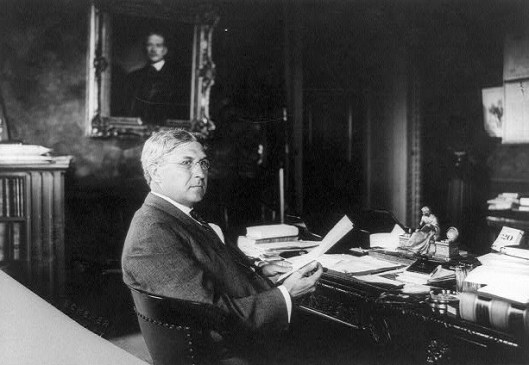
Garrison at his office in the State, War, and Navy Building

They have uploaded my article about the resignation of Lindley M. Garrison over at Roads to the Great War. Woodrow Wilson’s Secretary of War stepped down one hundred years ago today under intense pressure over a disagreement with the president about how best to prepare for American involvement in the First World War.

(image/Library of Congress)

Five years and counting

IMAG0082I received an email from WordPress this past Saturday informing me that I reached my fifth anniversary as a blogger. Five years is a fair chunk of change and I must say that in some respects it does seem like eons ago. I remember getting excited then that the 150th anniversary of First Bull Run was only five months ago. Yikes. I went back the other day and looked at random at a few posts I’ve done over the years, which is something I never do. Occasionally, such as I did with the Pearl Harbor post for a few years, I’ll re-post something. For the most part however, once I have completed a post I am on to the next thing. It’s really the only way. Some of the old posts make me wince. To take a line from George Carlin, I can’t believe the material I once got away with. Usually my weakest posts were those where I failed to stay true to myself. Still, I haven’t posted anything I am truly ashamed or embarrassed about. I guess it all leads up to where one is today.

It may seem that the subject matter has changed here at The Strawfoot, especially as we moved from the Civil War sesquicentennial to the 100th anniversary of the Great War. I myself have never seen it that way, and think I bring the same perspective I always did. There was a shift of emphasis when I began volunteering at the Theodore Roosevelt Birthplace in October 2013. I always knew a fair amount about both sides of the Roosevelt family, but going to the Roosevelt Birthplace every Saturday and writing regularly for the social media platforms. The TRB forced me to think harder.

I don’t know how much the blog says that is new or earth-shaking but I do like to believe it adds another perspective to the mix. I do know that some of you have been following along for several years now. It’s humbling to know that in the cacophony of modern life there are people out there who have made me part of their routine.

Sunday morning coffee

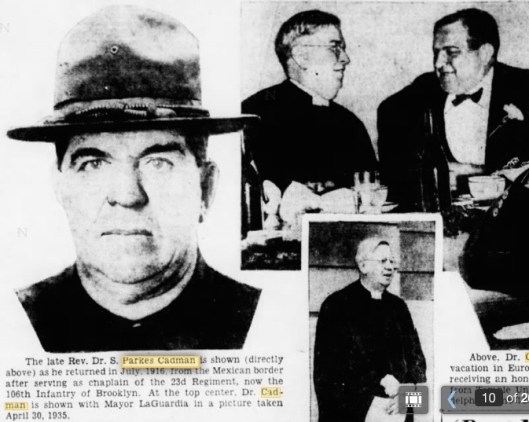
Three images of the Reverend S. Parkes Cadman from his Brooklyn Daily Eagle obituary

Three images of the Reverend S. Parkes Cadman from his Brooklyn Daily Eagle obituary, 13 July 1936

I’m sorry about the lack of posts this week. It was a hectic one with the start of classes, a meeting in the city toward mid-week, and the wrapping up of a blog post to appear elsewhere later this coming week at another site. I’ll post that when the time comes. The Learning Places class I am co-teaching is off to a good start. We had our first field trip to Cadman Plaza this past week. Before venturing out I spoke to the students about the Reverend S. Parkes Cadman, about whom I knew little before starting my prep for the class. I was making a comparison with Cadman to such figures as Babe Ruth, Jack Dempsey and Knute Rockne’s Four Horsemen, the point being that they all became public figures in the 1920s via the mass communication of radio. Twenty years earlier none of these individuals could have reached the masses in quite the same way that they did. Cadman’s sermons were broadcast nationally from his Central Congregational Church in Brooklyn every Sunday. It is strange that he so forgotten today.

I did not know until starting this thing that he served with the 23rd Infantry Regiment on the Mexican border during the Punitive Expedition. His papers are at the Brooklyn Historical Society and I am hoping 1-2 students pick up the baton and dig a little into why he may not have served a year later in the Great War. We shall see. He later became an outspoken opponent of Hitler and Mussolini. In some ways Cadman was the anti-Father Coughlin. Cadman died in July 1936 and so did not live to see the Second World War.

(image/Brooklyn Daily Eagle via Brooklyn Public Library, courtesy newspapers.com)

Winding down January 1916 at Governors Island

Theodore Roosevelt's friend and political ally Leonard Wood was a major advocate Preparedness while commanding at Governors Island.

Theodore Roosevelt’s friend and political ally Leonard Wood was a strong advocate of Preparedness while commanding at Governors Island. As January 1916 closed out he was planning for, and looking ahead to, the opening of the civilian training centers come summer.

In the digging I did for yesterday’s post for the anniversary of the birth of Franklin Delano Roosevelt I came across a vignette about Major General Leonard Wood. Wood was commanding the Department of the East on Governors Island at the time, and with talk about Preparedness coming from all sides–from Theodore and Franklin Roosevelt, Elihu Root, and now even President Wilson–Wood too was thinking about the possibility of American involvement overseas. That is why one hundred years ago this week General Wood publicized his plans for that coming summer’s Plattsburgh camps. As Wood described it there would be five camps in Plattsburgh itself and four at Fort Oglethorpe in Georgia. I believe choosing a base in Georgia was a conscious effort to bring North and South together in preparation for joining the Allied cause. That’s also why, when America really entered the war a year later, so many of the bases hastily springing up down South were named after Confederate officers. Remember that this is only a few years after the Gettysburg 50th anniversary.

In a bulletin Wood explained that the nine camps would be divided into senior and junior divisions. College graduate and men aged 23 – 45 would attend the senior encampments and undergraduates and age-qualifying high school senior would be in the junior ranks. The Eastern Department brass was envisioning 10,000 men participating. 1916–just like 2016–was an election year and the Plattsburgh Movement would play a greater role in the election as the months passed.

(image/The Miriam and Ira D. Wallach Division of Art, Prints and Photographs: Photography Collection, The New York Public Library. “Maj.-Gen. Leonard Wood, 1860-1927.” The New York Public Library Digital Collections. 1860 – 1920. http://digitalcollections.nypl.org/items/510d47db-1144-a3d9-e040-e00a18064a99)


Franklin Delano Roosevelt, 1882-1945

A youthful Franklin Roosevelt as he was circa 1916 in his mid-30s. He loved performing these types of duties as assistant secretary of the Navy

A youthful Franklin Roosevelt as he was circa 1916 while in his mid-30s. He loved performing these types of duties as assistant secretary of the Navy

Franklin Delano Roosevelt was born on this day in 1882. It’s interesting how we commemorate Washington and Lincoln’s birthdays and then it drops off from there. I suppose with Washington commemoration had much to do with binding the tenuous nation together through the early decades of the republic; Lincoln then joined pantheon as the first president to be assassinated. That’s pretty much it. I thought it would be interesting to see what FDR was doing a century ago. His tenure as assistant secretary of the Navy is one of the least studied periods of his life, probably because he was not making policy per se but carrying out the orders of Naval Secretary Josephus Daniels and President Wilson.

In January 1916 Roosevelt was campaigning hard for Preparedness. He gave a talk in Binghamton, New York 100 years ago this week in which he averred that the U.S. Navy should give up “not one dollar” in appropriations. He was in accord with Wilson in many respects; the sinking of the Lusitania that past May had hardened Wilson’s stance. What is more, Secretary of State William Jennings Bryan was gone by this time, having resigned over what he saw as Wilson’s belligerent stance. In many ways Franklin Roosevelt was making the case better and more forcefully than Wilson, whose appeals to Congress and elsewhere were largely met with skepticism from all sides. FDR’s cousins Theodore Roosevelt for one was not impressed with Wilson’s proposals and called them “half-preparedness.” Of course as a former president he had more leeway than his cousin did to call it as he saw it.

Franklin Roosevelt returned to Washington after his Binghamton speech to get back to work and attend to Eleanor and his kids. He needed to be close to home. He and Eleanor’s last child, John Aspinwall Roosevelt, would be born just six weeks later. It is lost on us how young he was when so much of this was going on.

(image/Library of Congress)

Brooklyn’s Daily Eagle and the Manhattan Pattern

Today marks an interesting day in Brooklyn history: the Daily Eagle published its last edition on this date in 1955. Students in my upcoming course will be studying the Brooklyn Daily Eagle and its significance to Brooklyn, New York City, and American history. The BDE dated back to the 1840s, when Walt Whitman was an editor for several years before leaving over political differences tied to his Free Soilist leanings. The Eagle seems to have been silent on Abraham Lincoln’s famous 1860 visit to Brooklyn’s Plymouth Church, where the soon-to-be presidential candidate attended services the day before his Cooper Union speech launched him to national prominence. The newspaper’s apparent silence on Lincoln’s visit is not surprising given its publisher’s Democratic leanings. The Eagle came into its own during the Gilded Age but took a blow with the consolidation of New York City in 1898. It was still a great paper–it lasted another half century and then some. Still, once Brooklyn was subsumed into Greater New York it could not compete with the papers across the East River.

The Brooklyn Daily Eagle building stood in what is now Cadman Plaza.

The Brooklyn Daily Eagle building stood in what is now Cadman Plaza.

The Eagle continued performing its yeoman service documenting local and national events. It was so successful that it eventually outgrew its original building and moved into a new facility in what is now Cadman Plaza. For those who know Brooklyn, the building you see above stood where the New York State Supreme Court building is today, across the street from the post office. The paper coverage was especially good during the Great War, which is fortunate given that the Brooklyn Navy Yard, Governors Island military base, and New Jersey piers shipping men and armaments across the Atlantic were all with a stone’s throw of Eagle offices. The paper continued doing well until, like the rest of Brooklyn, it became victim to Brooklyn’s decline and the mass exodus to the suburbs that took place after the Second World War. In its final edition the editors explained that the paper fell victim to the “Manhattan Pattern” that had been underway “since Brooklyn became part of New York City.” Indeed as the paper noted in that editorial sixty-one years ago today, the papers was always a step-child compared to Manhattan’s more privileged status within the municipal infrastructure. That’s true, but the Eagle’s demise was due also to trends taking place in the publishing industry at the time; many dailies were either going away or consolidating, a victim to the rise of television, frequent newspaper strikes, suburbanization, and other issues.

Brooklyn became a lesser place when the Eagle shut down. Even worse, the borough is saddled with the monstrous eyesore of a building that took its place when the Eagle building was then down. When the Brooklyn Dodgers finally broke through and won the World Series that October the Eagle was sadly not there to cover it. In a cruel irony, the iconographic headline “THIS IS NEXT YEAR” celebrating the Dodgers’ win appeared in the October 5, 1955 edition of the New York Daily News.

(image/Art and Picture Collection, The New York Public Library. “Brooklyn Daily Eagle.” The New York Public Library Digital Collections. 1903. http://digitalcollections.nypl.org/items/510d47e3-f806-a3d9-e040-e00a18064a99)


Sunday morning coffee

IMG_2888I hope everyone is safe after the Great Blizzard of 2016. I have not been out since Friday evening and so have not yet seen it, but we got dumped with about three feet here in New York City. I took advantage of the weather yesterday by preparing the syllabus for the class I will be co-teaching this semester. It’s about 30% done. There are some holes to fill but it’s coming along. As I said the other day, I’m nervous and excited in equal measure. There’s that feeling of working without a net.

The other day I posted about the obscure Lincoln tablet affixed to the north face of Borough Hall. That same day I took this image of the World War II memorial in Cadman Plaza. Ironically, despite its size many people miss this one too because it is in a seldom-visited part of the plaza. The reason why it is so seldom-visited is something out students will learn and write about over the term. The way I understand it Robert Moses constructed this memorial in the early 1950s in response to what he saw as the excessive number of World War I memorials that sprung up throughout the city in the wake of the Great War. As Mark Levitch, the founder of the World War I Memorial Inventory Project notes, there are something like 10,000 Great War monuments of all types and sizes across the country. Every park in the five boroughs seems to have its doughboy and Moses was apparently determined that this not repeat itself after VE and VJ days. There is so much history surrounding us as we go about our daily lives. I will be writing more about the WW2 memorial as the semester goes along. The snow will hopefully have disappeared by then too!