Sunday morning coffee

The supporting cast of Barney Miller in a 1975 publicity still

The supporting cast of Barney Miller in a 1975 publicity still

Because it has been  a long week we thought we would focus this Sunday morning on some lighter fare, this interview about 1970s television show Barney Miller. I have never understood why this show–which did last eight seasons–is not a greater part of our cultural memory. That it fell between genres–cop show, escapist sit com, socially relevant sit com–is the best I can come up with. One thing I think that hurt BM was being on ABC instead of CBS. The Tiffany Network, with its stable of Norman Lear shows such as All in the Family, Maude, One Day at a Time, and others, would have done a better job generating a following.

I have wanted to watch old episodes but alas BM is not available on either Amazon Prime or Streaming Netflix.

I had never thought about the idea that a show about a police precinct would itself be a statement coming after the social unrest of the 1960s. I know BM is in syndication and still watched by a large number of folks. I imagine though that its audience is primarily aging and watching for its nostalgia factor. It would be great if this show were rediscovered by a younger cohort in that “everything old is new again” vein in which popular culture operates.

Gettysburg’s Federal Building

Gettysburg Federal Building

Gettysburg Federal Building

As I sit here typing these words I can hear the snow and ice melting on the side of the house. Can spring be far behind? These last six weeks of cold and hibernation have gotten me thinking about summer, trying to calculate if and when were are going to go to Gettysburg. One thing I am still trying to process is last year’s Gettysburg sesquicentennial. There was so much to see, watch, and read that I’m still trying to sift through it all.

I am far from an expert on Gettysburg  but I have been there at least a half dozen times and know the history and memory of the campaign fairly well. I mentioned in a post awhile back that one of my Gettysburg turning points was when I no longer saw Gettysburg as a tourist destination or  historic site, but as a town. That is, as a place where people live, take their kids to Little League, cut the grass, and do all sorts of other mundane things. Ironically seeing Gettysburg in this context is what gave me a deeper understanding of the Gettysburg Campaign. It hit me hardest in the local cemetery.

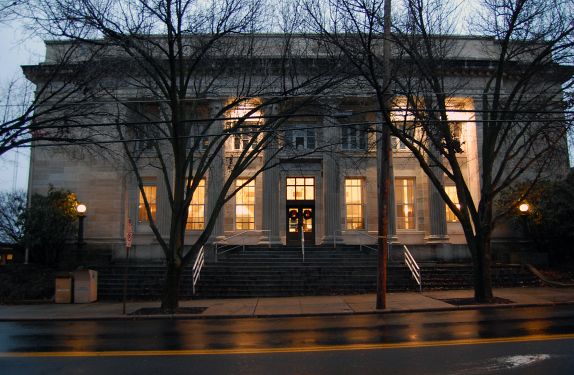
One of the neat buildings on Baltimore Street is one that most tourists never see, let alone set foot in: the Gettysburg Federal Building. As it turns out, the structure is celebrating its 100th anniversary next week. Howard Taft approved the building, which locals were hoping would be done in time for the 50th anniversary in 1913. If you do the math you will see that that is not what happened. The building was many things over the years, including a post office. It’s interesting how old post offices often had that strong, assertive pose. The building is a testimony to the town’s importance. Eisenhower kept an office there as well. Today it is the Adams County Public Library.

(image/Gettysburg Daily)

Theodore Roosevelt, New Yorker

TR2

Last night I finished Edward P. Kohn’s new book Heir to the Empire City: New York and the Making of Theodore Roosevelt. In my Interp at the TRB one of the things I stress is that it was New York City that most shaped Roosevelt. For starters he was the only president born in NYC, and his family traced traced its roots back to the original Dutch settlers of the seventeenth century. There are Roosevelts still living in New York City.

Roosevelt as New Yorker is an important point to make because the perception of him is that he is of the West. I guess when you write a four volume history called The Winning of the West that is bound to happen. And of course there was the ranching, the conservationism, and the mammoth bust carved into Mount Rushmore as well.

Part of these perceptions are the fault, if that is the right word, of Roosevelt himself, who as a national candidate had an interest in fostering a national image. Thus, he campaigned in, say, Kansas as a Westerner and in Georgia, the state of his mother’s birth, as a Southerner once removed. That’s what good candidates do.

That said, it was in New York State that TR took on Tammany Hall as an assemblyman, in New York City that he was police commissioner, and in Albany where he served in the executive mansion before becoming vice-president. As Kohn describes so well, the national policies he pursued through his Square Deal–immigration reform, the safety of our foods and drugs, labor negotiations & worker safety, government corruption–came from the challenges he faced here in the Empire State. It is something to remember.

(image/Library of Congress)

The origins of the monuments men

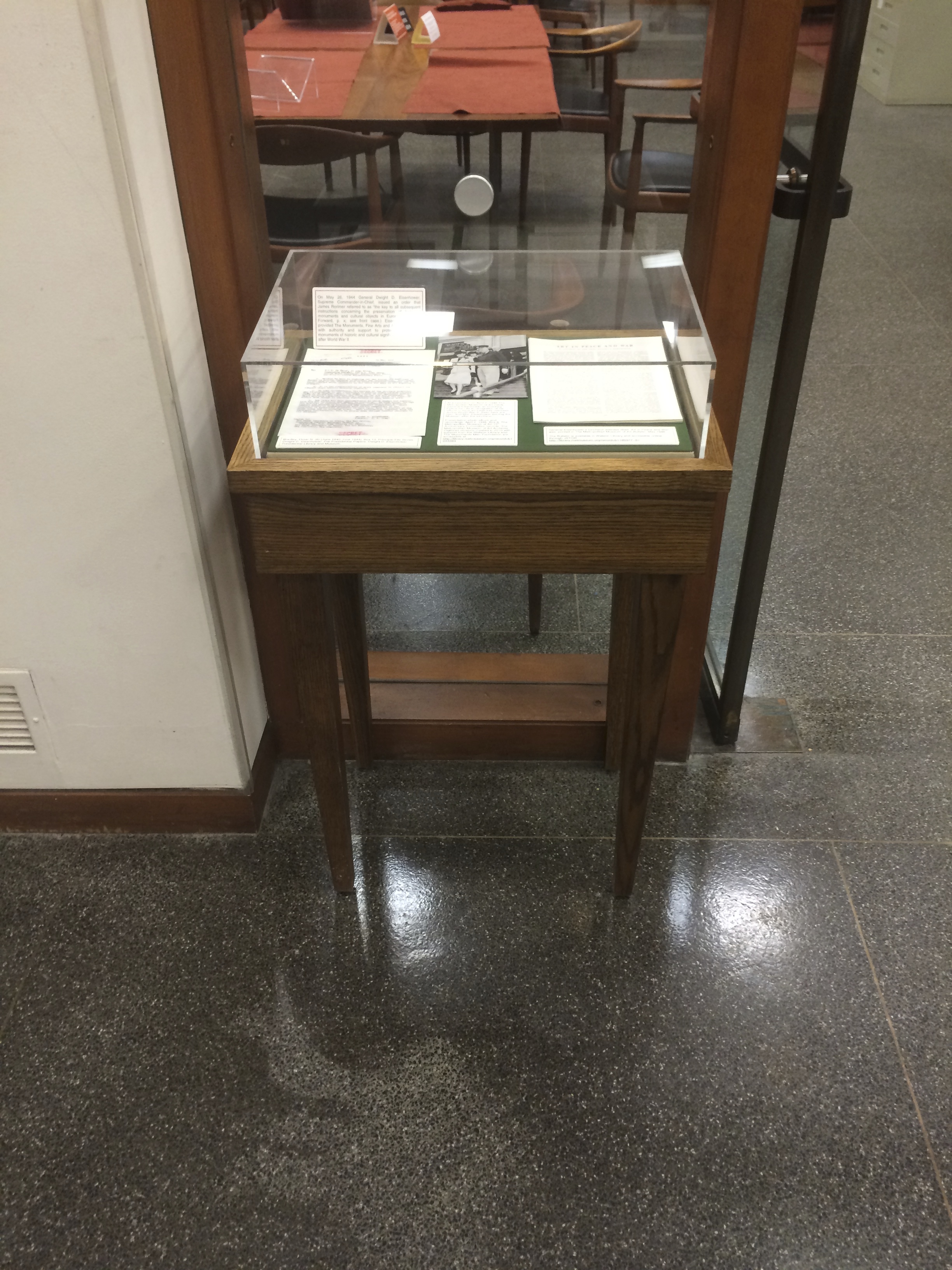
I was at the Metropolitan Museum of Art’s Watson Library doing some research today when I passed this display case.

IMG_0453

I did a double-take when I noticed this image of none other than Dwight Eisenhower himself. This is he and Mamie walking down the Met Museum steps familiar to New Yorkers for generations.

IMG_0448

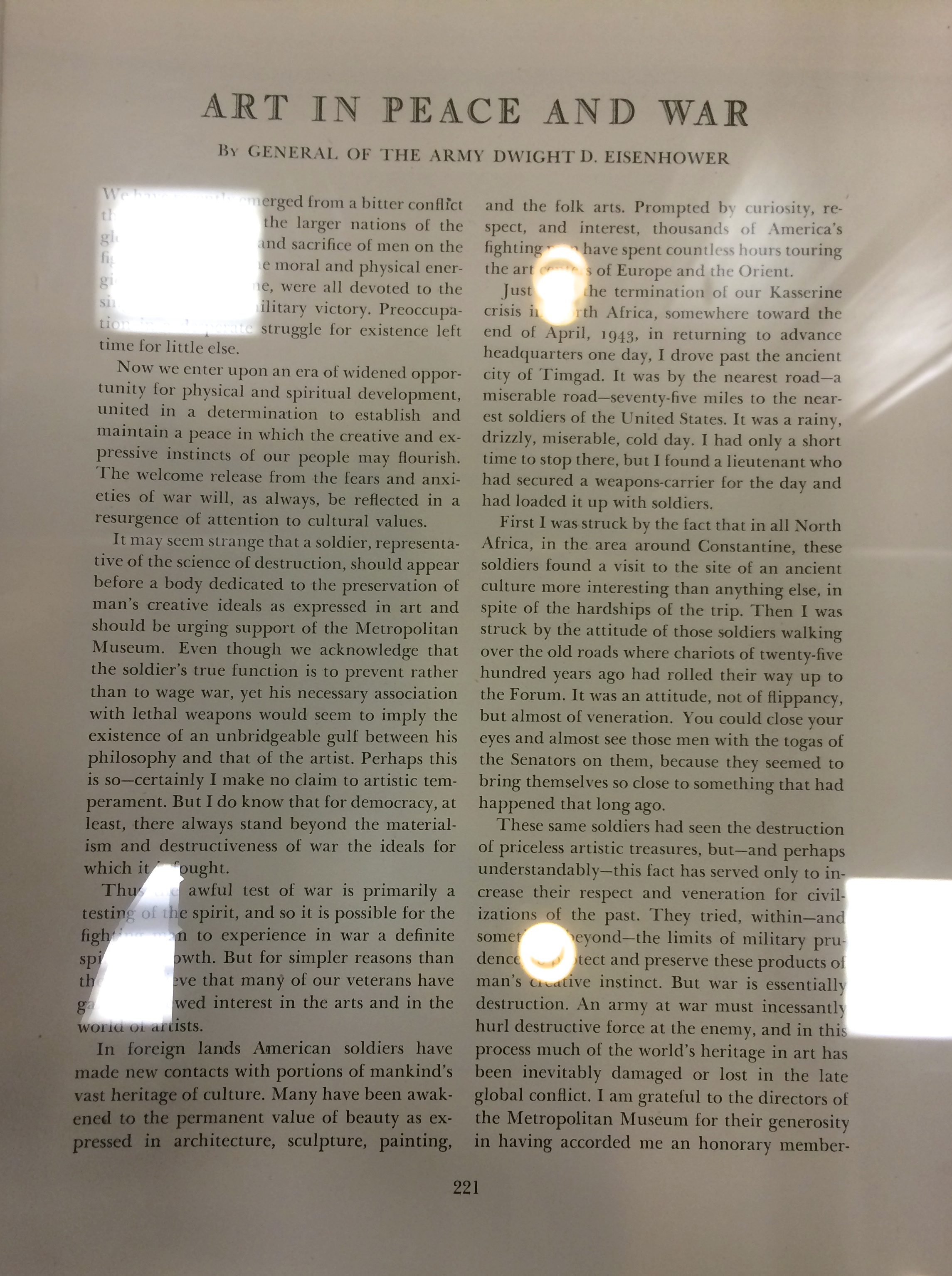
The date was 2 April 1946. That day the Met made Eisenhower an Honorary Fellow for Life for his role in saving European artworks during the Second World War. This is the first page of the address he gave that April day:

IMG_0444

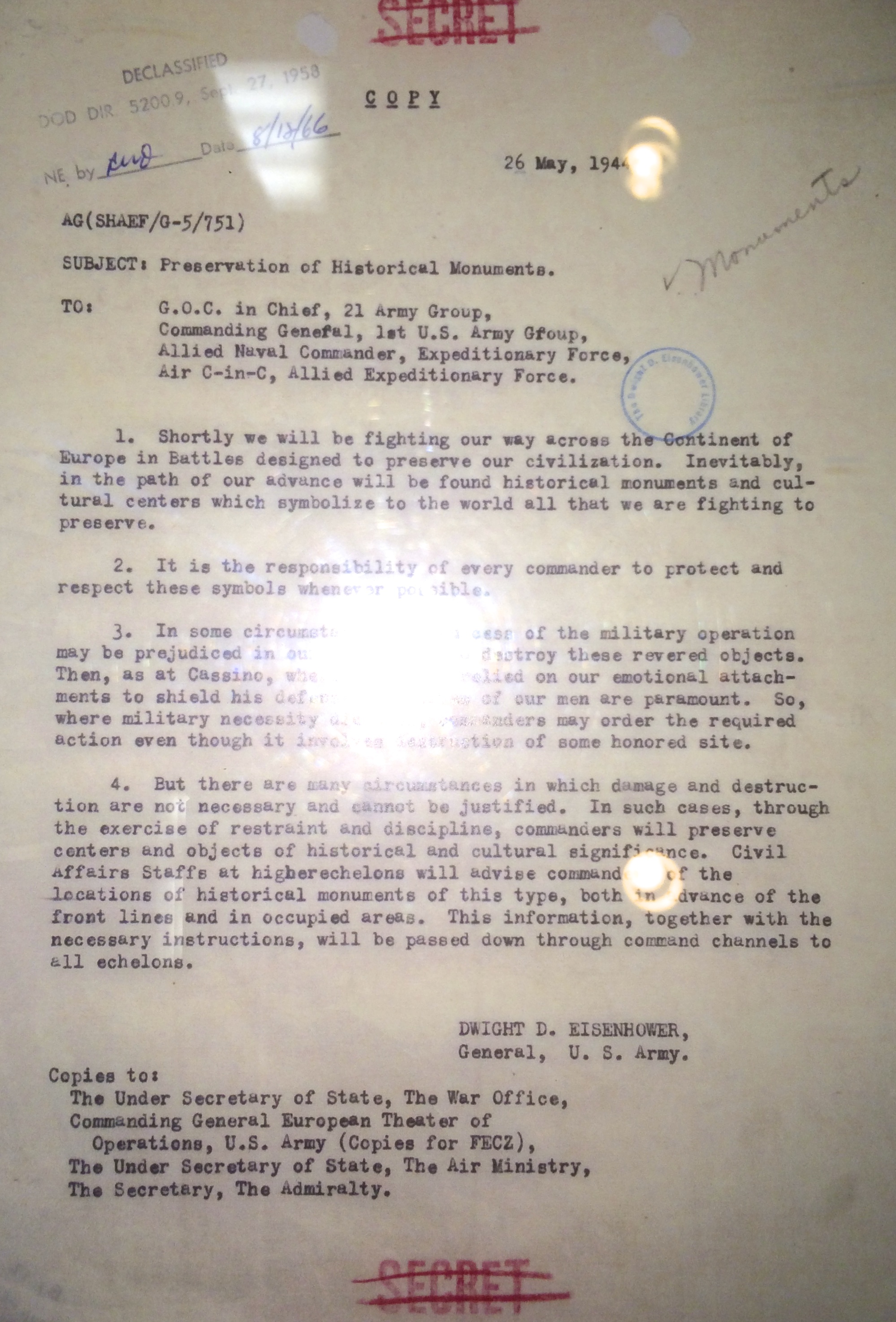
Here is the order he gave in May 1944, just a few weeks before D-Day. It is revealing that he would issue such an order even before the Normandy Invasion. He always said there was no contingency for failure. Thus, there were preparations for saving artworks even before a beachhead had been secured. Think about it.

IMG_0447

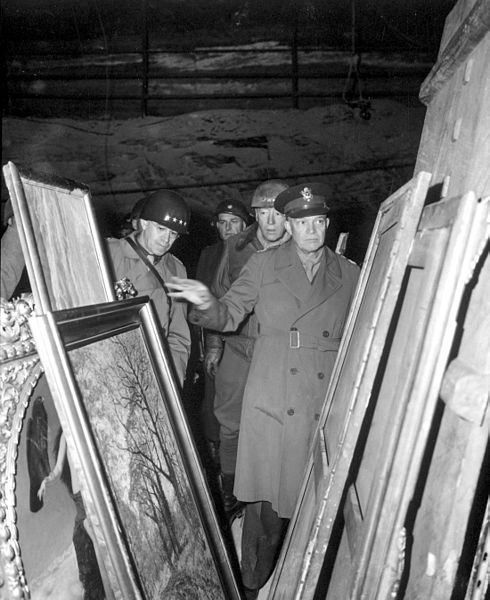
Here are Eisenhower, Patton, and Bradley. The photo was taken by a U.S. Army lieutenant in a German salt mine on 12 April 1945, a month before the war ended and a year before Ike spoke at the Met.

490px-Eisenhower,_Bradley_and_Patton_inspect_looted_art_HD-SN-99-02758

In a nice touch, the museum has a gallery itinerary in which one cane find artworks now in the Met that were saved by the Monuments Men. I had seen a few of these a number of times over the years without knowing their provenance.

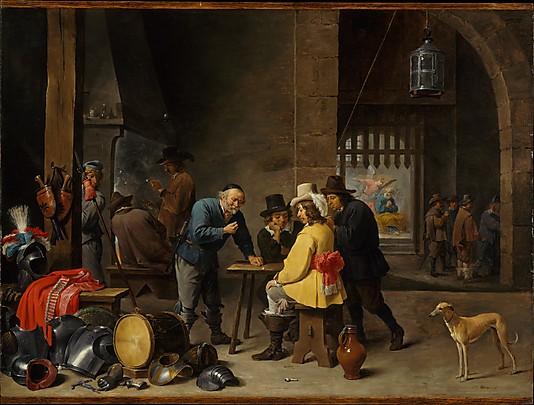
Here is one of those works.

Guardroom with the Deliverance of Saint Peter David Teniers the Younger, ca. 1645–47

Guardroom with the Deliverance of Saint Peter
David Teniers the Younger, ca. 1645–47

The painting was donated to the Met in 1964, half a century ago and only nineteen years after the war’s end.

(images/Ike et al, National Archives; Guardroom, Metropolitan Museum of Art)

February 13, 1905

Yesterday over at the TRB Facebook page I posted about Roosevelt’s 1909 speech in Hodgenville, Kentucky for the Lincoln centennial. Today we continue with the Roosevelt/Lincoln meme, turning our attention to 1905.

Reproductions of the menu and Roosevelt’s semi-extemporaneous remarks on behalf of Lincoln Memorial University

Reproductions of the menu and Roosevelt’s semi-extemporaneous remarks on behalf of Lincoln Memorial University

That month Roosevelt was excitedly preparing for his first elective term, his first 3 ½ years in office of course having come after the assassination of William McKinley. Roosevelt was here in New York City to give a talk at the Lincoln Dinner of Republican Club Dinner at the Waldorf-Astoria. It seems the dinner was held on the 13th and not the 12th because Lincoln’s Birthday had fallen on a Sunday that year.

One of the guests that evening was retired general Oliver O. Howard. After the Civil War Howard had been the leader of the Freedmen’s Bureau, and later the namesake of Howard University in Washington, DC. He had hoped Roosevelt would speak at a fundraiser that night for Lincoln Memorial University. The president was unable to do so, however, because of this engagement at the Waldorf. Still, Roosevelt agreed to plug the Lincoln Centennial Endowment Fund and invited Howard to come along. It was all very last minute.

The inaugural a few weeks later

The inaugural a few weeks later

Roosevelt and Howard were somewhat familiar. The previous year on Memorial Day he and Dan Sickles had given the president a tour of the Gettysburg battlefield. Howard had always been a TR man. He had campaigned for the McKinley-Roosevelt ticket in 1900, and stumped for Roosevelt in 1904 as well. He was especially grateful for Roosevelt’s efforts for Lincoln Memorial University at the Waldorf that night. Howard led a contingent of Civil War veterans at Roosevelt’s inaugural.

(Images/Library of Congress)

A Green-Wood Sunday

I ventured out on this crisp Sunday to go for a walk in Green-Wood Cemetery.

IMG_0319

IMG_0327

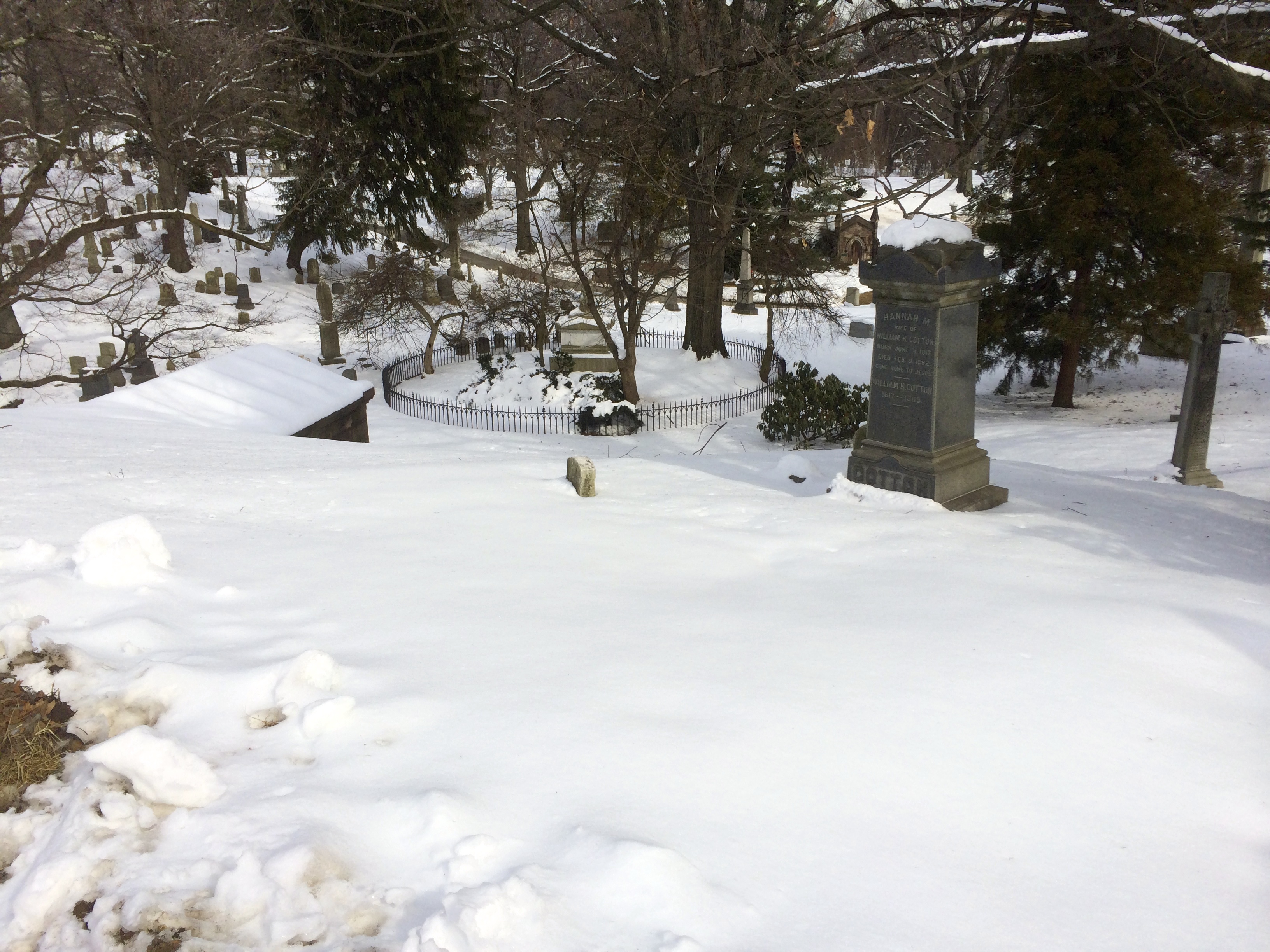
The images above give a sense of the extent of the snowfall in New York City this winter. There is a little tramping here, but for the most part the snow in the cemetery was still pristine. Today was sparkling with bright blue skies and frigid temperatures.

IMG_0329

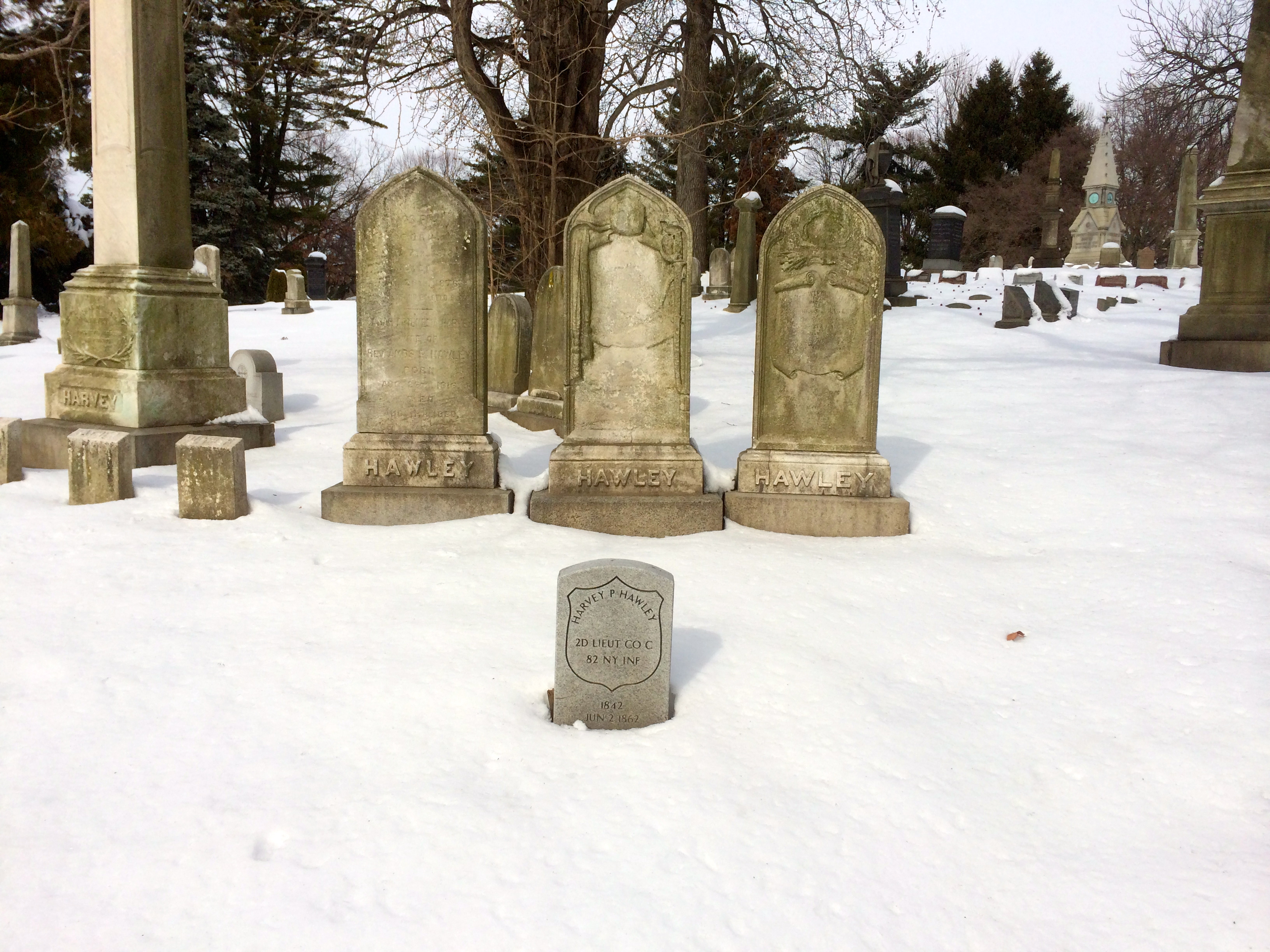
The Civil War headstones were visually arresting in the snow. Naturally I was drawn to this one for a Harvey P. Hawley. A quick internet search gives us this information from the 17 October 1865 New York Times:

HAWLEY. — Buried in Greenwood, on Saturday, Oct. 14, the remains of Lieut. HARVEY P. HAWLEY, 82d N.Y. Vols., (or 2d N.Y.S.M.,) who fell in the battle of Fair Oaks, May 31, 1862, aged 23 years, 2 months and 17 days — the first officer slain of that regiment whose glorious muster-rolls numbered nearly five thousand men.

Hawley was killed in the Battle of Seven Pines, the same battle in which  Joseph E. Johnston was wounded and soon replaced by Robert E. Lee. I am assuming he was initially buried in Virginia and reinterred here in Brooklyn after the war.

IMG_0326

An Ancestry search reveals that Captain Hoffman Atkinson of the First West Virginia Cavalry was made a full captain on 28 May 1862, three days before Hawley was killed at Fair Oaks. He died in 1901.

IMG_0333

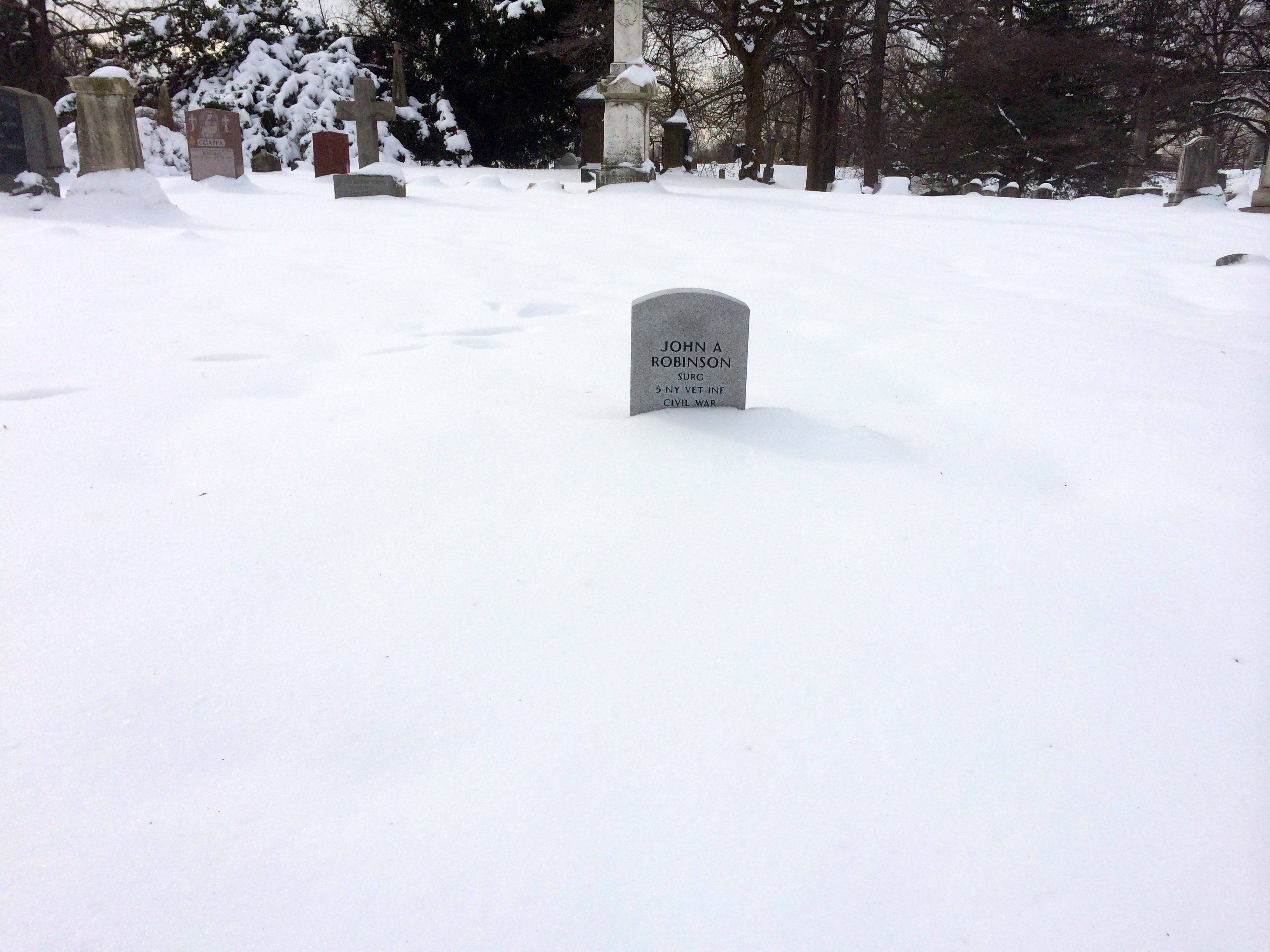
John A. Robinson was a surgeon in the 5th New York, also known as Duryée’s Zouaves. Many men of the 5th New York are laid to rest in Green-Wood. Colonel Abram Duryée’s himself is buried just around the corner from Robinson. I was going to go up and take a picture of Duryée’s grave atop the hill where it stands, but the snow was so high I decided against it.

Robinson died in 1885. Here is a record I found in Fold3. Attaching a story to a name on a headstone makes these men more real. We throw throw the numbers around a little too cavalierly.
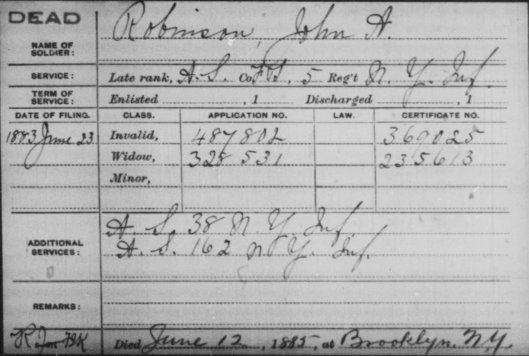
Robinson, John A

IMAG0045

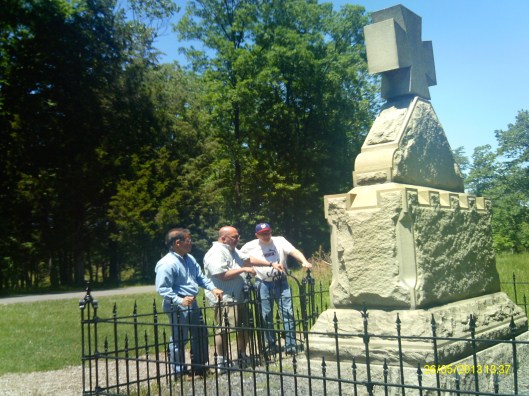
Above is a few of us at the 5th New York Volunteer Infantry monument at Manassas last summer. Way back in July 2011, on the 150th anniversary of First Bull Run, I posted about the New York memorials at Manassas. Robinson died a good thirty years before the monument was dedicated in 1906. The monument is for Second Bull Run.

IMG_0323

IMG_0322

For the most part I was meandering, but I went out of the way to visit the Roosevelt family plot. Theodore Roosevelt Senior died on the day in 1878. I wrote a small something about this for the Theodore Roosevelt Birthplace Facebook Page this morning, so I will not into it here. If you check it out, make sure to like the TRB page for more.

Walking in the steps of Black History

Nicodemus, Kansas

Nicodemus, Kansas

Two years ago I contacted a particular cultural institution here in New York City about setting up a walking tour of Lower Manhattan related to African-American history, especially nineteenth century African-American history. After showing great initial excitement, the individual with whom I was corresponding lost interest; I know this because he stopped returning my messages. I found the whole thing curious, especially because it was pretty clear I would do all the work, including the tours themselves. For free. Basically, the institution would have provided its imprimatur and done a little publicity on its website. Who it was I will never say.

Over the weekend I am going to write an encyclopedia entry about Nicodemus, the all-black Kansas town founded in the 1870s by individuals from Kentucky and Tennessee. Nicodemus is now a national historic site. I have been to Kansas before, but alas never to Nicodemus. It will someday be part of the Great Driving Tour of the Midwest the Hayfoot and I take in a few years. There is no substitute for going to the places where history is made.

For Black History Month the Civil War Trust has published its top ten list of African-American places to visit. A few of them I have been to; others are on my to-do list.  One need not wait for spring. Put your parka on and go.

(image/Library of Congress)