Marian McPartland, 1918-2013

I discovered last night that pianist Marian McPartland died in  August. Modern audiences will most remember McPartland for her NPR show Piano Jazz, which began broadcasting in 1978 and ran until she was well into her nineties. There was a reason why musicians loved sharing a stage and microphone with Marian; she knew everyone in the jazz world for three quarters of a century and was encyclopedia of knowledge. If you watch her scenes from the 1994 documentary A Great Day in Harlem, about the 1958 Art Kane photograph of the same name, you will see that.

One misconception of her, probably stemming from her intelligence and British accent, is that she was proper and genteel. In reality, Marian was tough as they came and could hold her own in a jazz world much different than the one we know today. It was less institutionalized, a world of dive night clubs, alcoholics, and late hours. People were tougher back in those days, less likely to speak in euphemism. They had, after all, lived through the Depression and the Second World War. Marian was unafraid to call something what it was. If feelings were hurt in the process, so be it.

The best known story of Marian McPartland is an exchange she had with Duke Ellington. Asked his thoughts after a performance, the Duke replied that “You play so many notes.” Initially she took this as a compliment to her technical prowess. Upon later reflection she realized it was an admonishment to curb her excesses. In music, as in life itself, it is what we leave out that often says the most. Thankfully for the rest of us Marian took Ellington’s advice to heart. Here is the proof.
Travelistas

The New York Times has an interesting piece about African American attendance at National Park sites. We have long known that black attendance at Civil War-related sites is considerably less than other ethnic groups. This is not surprising given the emphasis on the Lost Cause narrative that has held sway at Civil War parks since their creation starting in the 1890s. Recent shifts in Interpretation have caused an uptick in the stats, but I doubt seriously that African Americans will ever visit Gettysburg, Antietam, or elsewhere in significant numbers. Still, the problem of African American attendance at National Park sites runs deeper than that: numbers at nature parks such as Yellowstone and the Grand Canyon are lower–much lower–as well. Ranger Shelton Johnson of Yosemite addressed this very issue in the interview he did here at the Strawfoot this past March.  I urge you to read it if you have not already done so. I did not know until reading the New York Times piece that there is a growing movement afoot to attract minorities, especially young minorities, to our country’s natural and scenic wonders. I spent the past half hour checking out some of the websites these travelers have created and was impressed. As Ranger Johnson pointed out in the documentary The Way Home , this is the next chapter in the Civil Rights Movement. It could be the next chapter for the National Parks as well.

Aboard the Yankee

Earlier in the week I received an email from reader and fellow blogger Billie Elias. Billie blogs at All in Your Family, which I encourage you to check out. She wrote to tell me that she had recently toured the Yankee, the Ellis Island ferry recently repurposed as a cultural institution, and was wondering if she could comment on my recent post. Because comments had closed, I suggested something better: how about writing a guest spot at the Strawfoot. Graciously, she accepted. Here is her report:

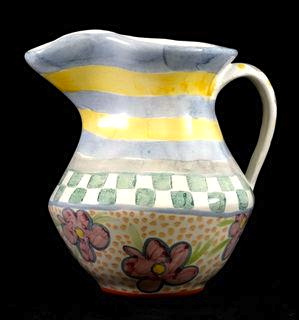
The first time I saw a MacKenzie-Childs piece of pottery was at my mother-in-law’s house. She had several pieces arranged in a group…one was a large pitcher that had stripes, checkerboard and flowers…a melange of varied patterns, all obviously hand-painted. How rustic, I thought…not really my taste.

Ceramic pot

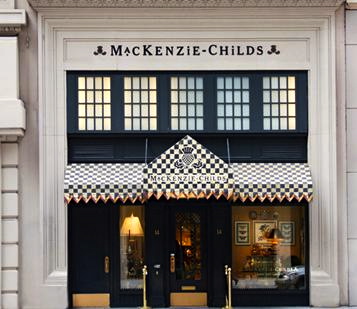
Then one day while strolling up Madison Avenue, I noticed a most unusual shoppe. It had an old-world feel to the outside, with striped awnings that reminded me of jesters costumes. Upon entering, you knew you were in a most unusual space. Everything was cramped and cozy, and there was a large chicken wire cage with live birds inside. Nooks and crannies were everywhere.  A narrow staircase carried you up to another level of retail, and yet another even more quaint stair took you to the teensie top, where there was a wall covered with rooms of a doll house, a la Windsor Castle. There was a tea room up there, too. Every square inch was covered by a tile or a tassel or a cushion or plates or some other creation of a magical couple named Victoria and Richard MacKenzie-Childs.

mackenziechilds2

It’s a style that can really grow on you, especially as the style evolved over the years to include lots of black and white stripes. (Black and White are my personal signature colors, especially as my hair has gone from jet black to salt and pepper).

What a surprise I had when a friend from Amsterdam told me she was going to interview the owner of a bed and breakfast situated on an old ferry boat docked on the Hudson River (since relocated to Red Hook in Brooklyn). I pride myself on being a New Yorker who has her finger on the pulse of cool stuff like this, so I was stunned that I didn’t know such a thing existed. My Google search netted the fact that MacKenzie-Childs were the brain-“childs” behind this. I begged to go along for the ride and she relented. That is how I came to meet the colorful and unusual Victoria.

Billie (right) aboard the Yankee

Billie (right) aboard the Yankee

Being welcomed into the parlor, we were regaled by stories of how the Yankee had ferried immigrants from their ships to Ellis Island and later served in WWI and WWII. Today she is listed on the National Register of Historic Places.  The couple is deeply committed to her preservation (not only of the ship, but of everything they touch…talk about reducing one’s footprint!). There’s a chicken coop with live chickens whose eggs are eaten by visitors and residents of the vessel, mounds of old steamer trunks and luggage repurposed for storage, and MacKenzie-Childs accoutrements and eye-candy everywhere the eye can see.

(images/Billie Elias)

Embracing complexity

Immigrants passing through Galveston's immigration depot might be held for further examination at the quarantine facility.

Immigrants passing through Galveston’s immigration depot might be held for further examination at the quarantine facility.

Once when I was a kid my grandfather on my mother’s side was telling me about his parents, both of whom were born in Italy and moved to the United States separately before meeting, marrying, and putting the family on the path that led to me. Despite my greatest efforts to corroborate this piece of family history, all my searching over the years has so far proved fruitless. I began having even greater doubts when I began as a volunteer at Ellis Island National Monument. Folks would come in and state confidently that “My great grandmother came through here in 1867,” or whatever version of their family story passed down to them. The trouble is, Ellis Island did not become an immigration station until 1892. And, even if one’s relatives did come to America between 1892-1924, there is still a good chance they passed through one of the many other immigration stations across the United States. Baltimore, Savannah, New Orleans, or in my great grandparents’ case Boston, are just a few of the other port cities through which the huddled masses were arriving in the nineteenth and twentieth centuries. I suppose people think “Ellis Island” because a) it was the largest and, b) it is now–quite properly–integral to our national story.

This came back to me a week or so ago when I forwarded this piece to some colleagues at work. It is about the 10,000 Jews who passed through Galveston Texas from 1907-1917 and eventually settled in the Lone Star State. Indeed many thousands from Eastern Europe had come before them. A spectacular exhibit on Galveston as an immigration station toured the country a few years ago, and made a stop at Ellis Island itself. Stories like this are important reminders that much of what we think we know is, at best, incomplete. Think “Immigrants, 1907” and the narrative shorthand in your head thinks “Lower East Side, tenements, crowded streets.” That is certainly part of the story, but as always the full story is more complicated and interesting. It is a scary proposition. Who wants to think that what they believe might be wrong? I know that fighting such simplifications is something a struggle with every day in my own writing and research. I saw Ellis Island visitors struggling with the same issue when processing that maybe their own history was not so simple. So what is one to do? There is not much to do but accept this and embrace complexity whatever the consequences.

(image/Library of Congress)

On genealogy and personal history

My grandmother's Navy Yard pass

My grandmother’s Navy Yard pass

I spent a part of my day today searching records on Ancestry and Fold3 for some upcoming oral history interviews at Governors Island. What makes GI so fascinating is that, given its location in New York Harbor and its longterm importance as a military installation, so much of American history can be traced back to it. The Revolution. 1812. The Civil War. The settling of the West. 1898. Both World Wars. Governors Island played a role in all of these, and I don’t mean tangentially; the island and the people who worked on it were central in all of them. One thing that gets lost on some people, including myself at times, is that the people who served on the island were just that, individuals. It is one thing to say that the First Minnesota rushed from Gettysburg to help put down the Draft Riots in 1863, or that the Big Red One left for Europe from the island after the United States entered WW1 in 1917. It is another thing to examine a Census or Pension record of a son or father who was part of it. That is why I love the oral history project so much, even though my role in it is not as large as some other volunteers’.

My growing interest in these projects runs hand-in-hand with my growing interest in tracing my own family history. Visiting the Frederick Douglass house in Anacostia last week intensified this interest. As I mentioned in a previous post, my mother lived in the neighborhood when she was a little girl. After seeing the Washington Navy Yard from the Douglass estate, I had to dig out the above pass that my grandmother once used to visit my grandfather, a civilian employee at the facility. An aunt had given it to me several years ago, along with some old family photos. My grandparents were originally from Boston but moved to DC during the Depression and stayed until 1945 when the Second World War was winding down. They had two daughters in the process before eventually moving back to New England and staying there for good. I would have gotten back to it eventually, but all this is what inspired me to-re-up my Ancestry account. Searching records has pretty much how I have spent my evenings over the past week. I have also emailed some distant relatives to see what they might be able to add. Thankfully, I have been able to answer questions they have as well.

I am old enough now (46) to realize that part of my interest in my family history is because my brother and sister and I were deprived of it. Taken by our parents from the Northeast to Florida when we were young kids, we lost touch with the extended clan. It was not hard to do in the 1970s and 1980s, when we all lived without the internet, cell phones, and everything else that makes the world more interconnected than it used to be. It is amazing how quickly you can strike up a conversation with family, even family you have never met before or seen in thirty years.

What I find most moving, when searching my own family or oral history subjects, is the capsulation of a life into a few documents. Half a decade ago this would not have meant so much to me. I had my perspective changed when my father died four years ago. You cannot helped being moved seeing the dash (e.g. 1938-2009) and wondering what the story was. Whoever we are, you are part of something bigger than ourselves.

The Frederick Douglass house

The other day I mentioned that the Hayfoot and I took a Civil War metro trip to the Frederick Douglass House in Washington DC.. Here are a few pics.

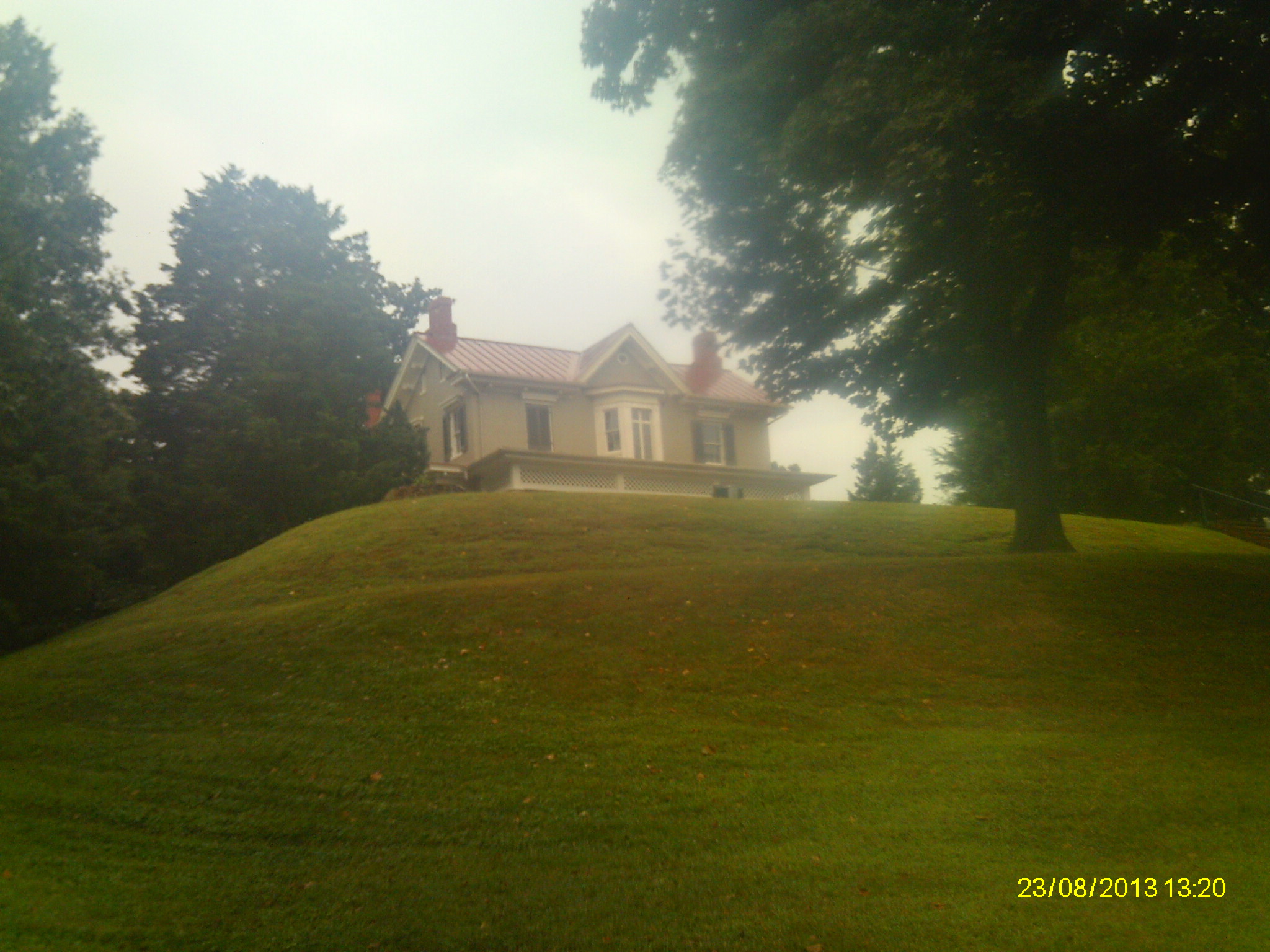
Cedar Hill, the home of Frederick Douglass

Cedar Hill, the home of Frederick Douglass

Fittingly given the man who lived in it, the house sits on this high ground. Douglass and his wife, Anne Murray, moved here in September 1877. Anne died and Frederick lived here with his second wife until his death in February 1895. He died in the house. The National Park Service gained jurisdiction of Cedar Hill in 1962 during the Civil War Centennial.

The Strawfoot at Cedar Hill

The Hayfoot has a knack for taking photos when I am unaware. The visit to the Douglass house bookended neatly with our visit to the Lincoln Cottage in late May. They were two of the highlights of the summer.

It takes some effort and perseverance to visit these more off-the-beaten-path places in the Capital. So many people just do the Mall and leave it at that. There is so much else to see if one is willing to put in the time and effort.

The Capitol Building from the front yard

The Capitol Building from the front yard

As at the Lincoln Cottage, one gets a view of the Capitol Building from the grounds.

It is best to get tickets in advance for either site to make sure you get the tour of the houses; the interiors ar accessible only by guided tour. At both places the interpretation was top notch. As a volunteer myself with the NPS, I can say that a good interpreter makes all the difference.

This was the view from the second story window. You can see part of the Anacostia neighborhood in the distance. This trip was doubly special because my mother was born in the neighborhood. My grandfather worked in the nearby Washington Navy Yard during the Depression and Second World War.

Visiting here had the added effect of getting me to renew my Ancestry account, which expired at the beginning of the summer. These past few nights I have been researching my family history while listening to the pennant races on MLB TV. I just loved that my mother lived so close to here.

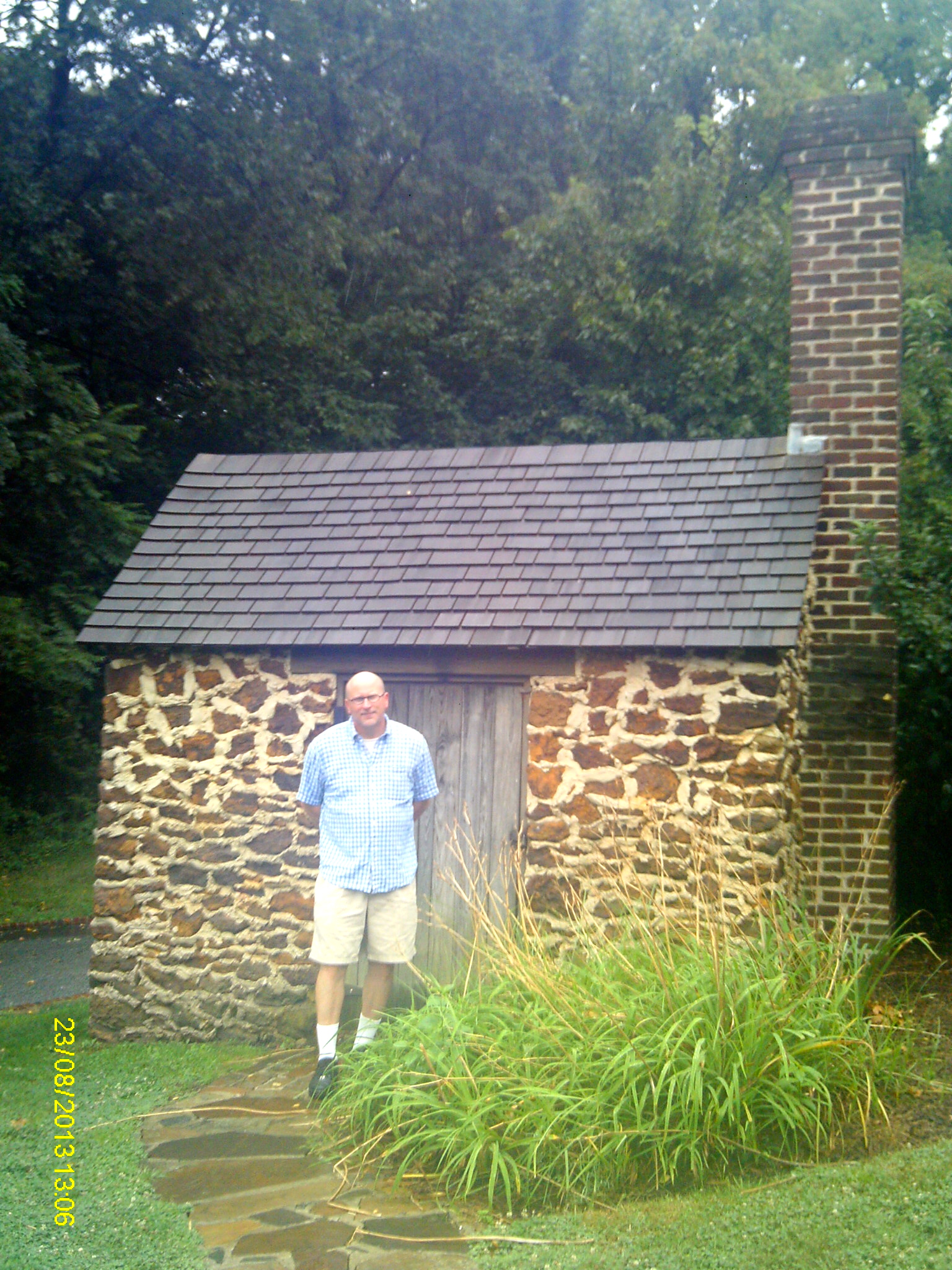
Douglass's man cave

Douglass’s man cave

This stone cabin out back is where the great human rights leader came to get away from the grandkids and endless line of visitors who hoped for an audience with him. There was an extensive personal library in the house as well. I don’t think I fully understood Douglass the Intellectual until coming here. There is no substitute for visiting historical sites.

the grounds

the grounds

This photograph in the rear gives a sense of the size of the grounds. For an African American to own such a property in the nineteenth century was remarkable.

Frederick Douglass, 1818-1895

Frederick Douglass, 1818-1895

This was inside the visitors center. The NPS staff was knowledgable and helpful. My one criticism is that the film, which appeared to be from the early 1980s, is a tad dated. Hopefully they will remedy that in the future. The Douglass bicentennial, a short five years away, seems a good opportunity to do so.

When I was a graduate student I was taking a course on the Gilded Age and asked the professor what he considered the best Douglass biographies. He said there were a few competent ones, but that an authoritative one is still waiting to be written. We will see what happens in the next few years.

Pic of the day

I just got back from the Mets game. Cliff Lee threw eight innings of one run ball before handing it off to Jonathan Papelbon for a Phillies save. The worst news of the night was not the Mets loss but that young phenom Matt Harvey is done for the year, and maybe next year, with a tear in his pitching elbow. One hates to see that with any player, let alone a twenty-four-year old.

Joan Whitney Payson plaque, Mets Hall of Fame

Joan Whitney Payson plaque, Mets Hall of Fame

Here is a trivia question sure to stump them around the water cooler:

What do Abraham Lincoln and the New York Mets have in common?

The answer is Joan Whitney Payson, the team’s co-founder and original owner. Payson was the daughter of Helen Julia Hay, which makes her the granddaughter of Lincoln’s personal secretary John Hay. Joan’s mother, Helen, married into the Whitney family at the turn of the twentieth century, bringing together two of the leading families of the era. Our tendency is to think these people lived in a far distant time, but Payson did not pass on until 1975. Her and her husbands personal effects were auctioned in 1984.

I had seen her plaque in the Mets Hall of Fame before, but had not known who she was until reading John Taliaferro’s All the Great Prizes: The Life of John Hay, from Lincoln to Roosevelt earlier this summer. Of course I had to have a friend snap the photo above prior to tonight’s game.

Sunday evening ramblings

MurrayI just got back from DC. It was good to get away for the week. The weather was glorious. We went to the Frederick Douglass house on Friday, which was something special. I intend to blog about it later in the week. Right now I am winding down with a cup of coffee and the Red Sox-Dodgers on the radio.

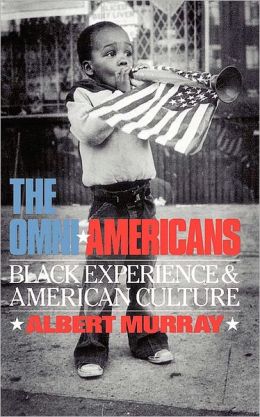
Going through the pile that is my in-box, the one thing that leaped out at me was the death last Sunday of the great Albert Murray. I intend to write more about Murray too, but am too exhausted at the moment to do so. I first heard of him when working on a project in library school about his great friend Duke Ellington. Coincidentally an article about Murray appeared in the September 1996 issue of American Heritage, a magazine I read avidly at the time and eventually outgrew. If nothing else it gave me an introduction to Murray and his ideas. It’s funny how things work that way sometimes. I once saw him in the Strand bookstore and he looked up at me with the mischievous smile. I did not say anything to him, but it was obvious that he knew I was aware of who he was. I will never forget it. I could go on but think I will save it. Obituaries here and here.

The future of heritage tourism

There has been a great deal of discussion in the blogosphere the last week or so about African American attendance at Civil War related sites. The hope leading into the Sesquicentennial was that the changes in scholarship and interpretation since the Centennial would lead to increased African American attendance at Civil War battlefields this time around. Now that we are two and a half years into the 150th anniversary it seems clear that this is not the case. It is something that my wife and I speak a lot about when at Gettysburg and elsewhere. Anecdotally I would say we have seen very few black folks at battlefields, and it is not something I see changing anytime soon for myriad reasons. One aspect of heritage tourism that has changed, though, is the increase in African American visitation at other historical sites and monuments. The increase is readily apparent on the National Mall and will increase exponentially when the African American Museum opens in 2015. It is not just there, though. Yesterday’s USA Today has more. It is important to acknowledge the progress that has been made.