• About

The Strawfoot

~ a New Yorker's American History blog

The Strawfoot

Author Archives: Keith Muchowski

250th post

07 Tuesday Feb 2012

Posted by Keith Muchowski in Writing

≈ 1 Comment

Hey everybody, this is the 250th post here at The Strawfoot. It is one of two milestones: I began the blog one year ago this past Saturday. It has been an enjoyable and rewarding experience. When I first began I was typing on an old pc and we did not yet have internet access or television in our home (still no tv). To get online I had to sit on a stool in the corner to piggyback off our neighbor’s wireless, with his knowledge and permission I hasten to add. Now I’m typing these words on my Mac Air as I sit here listening to Simon & Garfunkel with a cup of coffee beside me. Before I began I did not even know the elementary aspects of how to start a blog; I relied on the expertise of some colleagues at work. Learning more about technology was an explicit, if secondary, purpose for my blogging. I reached a point where I felt the world was starting to pass me by in some ways. I still have much to learn, but I feel I am getting there.

The main purpose of The Strawfoot was to engage more actively in the Civil War sesquicentennial. Blogging has forced me to think harder and examine my thoughts and presumptions. Friends and relatives will give us a pass when we misspeak or say something with which they disagree. Do that on the internet, especially about a subject as closely examined and emotionally charged as the American Civil War, and people will call you on it. There is very little comfort to be found in studying history, which is why some people prefer folktales to the truth. I have tried to be myself and to speak as honestly as I can without succumbing to bathos or narcissism. We owe it to the people who came before us.

The person who I owe the most to is my wife. The Strawfoot takes a great deal of time on a weekly basis and she has been patient and understanding through the entire process. It has been a lifestyle change and comes with its satisfactions. It’s been rewarding watching the statistics increase month by month. I know from reading people’s comments and emails that some readers have been following the entire time. It fills me with humility to know that people make a few out of their busy day to read what I may have to offer. I am looking forward to another fun and productive year.
A photograph is worth a thousand words

06 Monday Feb 2012

Posted by Keith Muchowski in Film, Sound, & Photography

≈ Comments Off on A photograph is worth a thousand words

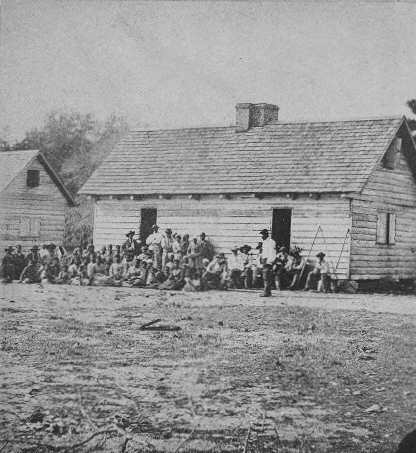
Slave quarters Smiths Plantation, Port Royal, South Carolina

In early December I noted the release of the Atlantic’s Civil War 150th anniversary commemoration issue, which can still be purchased on newsstands and through Amazon for your Kindle by the way. This week the magazine’s online version has posted what the editors believe are the fifty most powerful images from the commemorative issue. It is hard to disagree.

(image/Timothy H. O’Sullivan;Civil War Treasures from the New-York Historical Society)

Winter at Governors Island

03 Friday Feb 2012

Posted by Keith Muchowski in Governors Island

≈ Comments Off on Winter at Governors Island

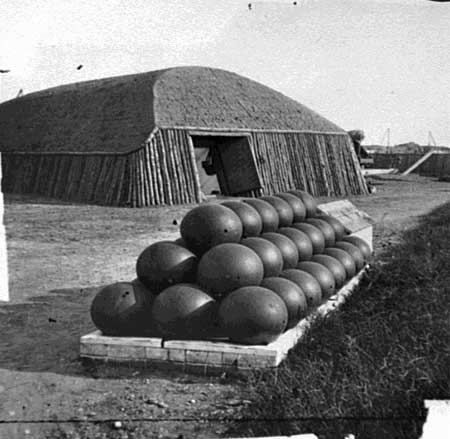
Civil War cannonballs at Battery Rodgers, Alexandria, Virginia

Governors Island is closed for the season, but there are still some goings on there even in the dead of winter. Here’s a little reminder that our national historic sites are not amusement parks but places where real people did true and amazing things: workers unearthed a 350 pound Civil War cannonball yesterday while doing some maintainence to the ferry landing . Here’s more from the Trust for Governors Island blog.

This is the real deal, folks. Hopefully we’ll see you at GOIS this summer.

(image/courtesy JK Brooks 85)

“There are not two sides to every story. There are 24.”

02 Thursday Feb 2012

Posted by Keith Muchowski in Writing

≈ Comments Off on “There are not two sides to every story. There are 24.”

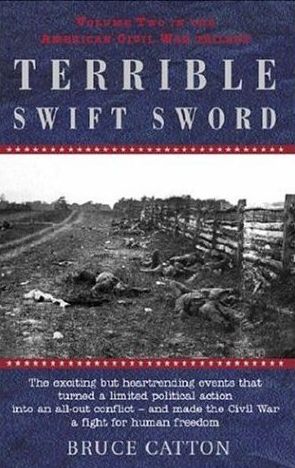
The name Sam Vaughan probably does not ring any bells, but regular readers of the Strawfoot are undoubtedly aware of the man’s work. Vaughan, who passed away earlier this week, edited Bruce Catton’s Centennial History of the Civil War (The Coming Fury, 1961; Terrible Swift Sword, 1963; Never Call Retreat, 1965) for Doubleday & Company. Civil War scholarship moved on in the ensuing five decades, but the unititated could do worse than Catton’s trilogy for an overview of the conflict. (Doubleday also published Catton’s Army of the Potomac series in the 1950s, but Vaughan had no hand in that project.)

Vaughan was a good friend of conservative pundit William F. Buckley. It was he who convinced Buckley to write his Bradford Oakes Cold War espionage novels. He also collaborated with Democratic senators and erstwhile presidential candidates Hubert Humphrey and Ed Muskie. In a cruel twist of fate, Muskie’s autobiography was released the same day the Mainer bowed out of the 1972 presidential race. (For those unfamiliar with the story, Muskie was forced out of the campaign when he was photographed with what were apparently snowflakes on his cheeks. It was reported that they were tears, and Muskie was branded too unmanly to be president.) Needless to say, Muskie’s offering did not reach the upper echelons of any best seller lists.

Vaughan began at Doubleday in 1951, and in 1970 he was crowned president and publisher. He had a distinguished career, but there were some misses as well. In the early 1960s Vaughn went to Gettysburg to edit Eisenhower’s presidential memoirs. Eisenhower’s financial security had been secured when Doubleday published his World War 2 memoir Crusade in Europe in 1948. The now former president teamed with Vaughan on the two volume White House series, Mandate for Change, 1953-1956 (1963) and Waging Peace, 1956-1961 (1965). If you are looking for examples of dry, less-than-revelatory presidential memoirs, these are exhibits A and B. I wrote my masters thesis on Eisenhower’s foreign policy and, while I admire the general and president in many ways, I can’t say I learned anything of value from these doorstops. Crusade was never going to be mistaken for Grant’s Memoirs, but at least there he had an excuse; in the late 1940s Ike was considering a bid for higher office and did not want to antagonize such figures as Churchill, de Gaulle, and Konrad Adenauer, with whom he might have to deal on the world stage. Crusade was a lesson in tact and diplomacy. By the time he left office in 1961, however, Eisenhower no longer had these concerns. He could have offered readers more insight into himself and the world he did so much to change, but did not. Vaughan might have pushed Eisenhower harder but, still only in his late 20s, was probably too intimidated.

In the 1970s Vaughan edited Duke Ellington’s memoir Music is My Mistress with similarly disappointing results. The Duke was known for his impenetrable public persona but even by his standards Mistress is a letdown. Ellington was an intensely private man and no one was expecting him to kiss and tell after fifty some odd years in show business. And make no mistake, after half a century of living the musician’s night life Ellington had done his share of, uh, kissing. Still, one would have hoped for more candor from a man in his seventies looking back on life. Here again Vaughan might have done more to draw a sense of who Ellington was but, frustratingly, either couldn’t or wouldn’t. Doubleday published Ellington’s memoir in 1973 and the composer died the following year.

Despite these failures, Vaughan had a long, distinguished career and many more successes than failures. That so few people know who he was, oddly enough, is a testament to his achievement.

(image/Open Library)

Winter reading

31 Tuesday Jan 2012

Posted by Keith Muchowski in Memory

≈ Comments Off on Winter reading

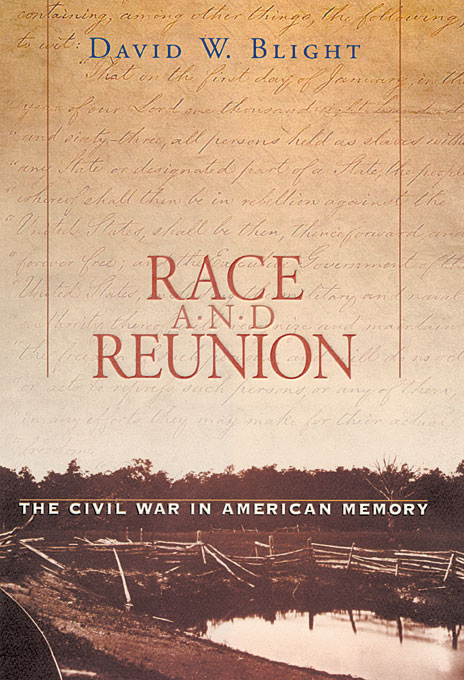
It doesn’t feel like a New York winter based on the temperature outside, but nonetheless the calendar still reads January. Today I finally began David Blight’s seminal Race and Reunion, which I had shamelessly pulled from the shelves of the library where I work several months ago and kept in my office all this time. I am not totally new to Blight’s work, having read American Oracle when it was released this past fall. And, of course, he is a fixture on the book talk show circuit. For those who may have missed it, the scholars at Emerging Civil War ran this series in October marking the 10th anniversary of the book’s release. I’m going into R&R with an open mind, but am aware of its premises and the counter-arguements against it. In yet another sign that I married the right woman, the Hayfoot came home from the public library a few months back with Gary Gallagher’s The Union War for me to read, finding all by herself on the New Arrivals shelf.

Memory has been a major component of contemporary historiography for well over a decade and this trend has only accelerated during the sesquicentennial. The first time I ever truly questioned my assumptions about the American Civil War was when I read Tony Horowitz’s Confederates in the Attic in 1998. In it he mentions the potential unreliability of such seemingly unimpeachable cornerstones of Civil War scholarship as the Official Records of the War of the Rebellion. Horowitz explains how figures on both sides provided details of the war in the OR and in their memoirs that were clouded by self-serving prejudices and faulty memories. Call me naive if you want; I was a lot younger then. It was the first time I had ever seen it put in those terms before, and it is still what I took away the most from Horowitz. That all, or even some, of your assumptions may be wrong is a very unsettling thought.

The following year I went to Shiloh for the first time. Seeing the monuments the veterans constructed to themselves in the years roughly from 1880-1910 I could not help but wonder how and why they came to be. Every June my wife and I visit Gettysburg and, if anything, the hows and whys are even more intriguing at the war’s High Water Mark. I’m looking forward to reading Blight’s work and will comment on it when I finish.

Bombay jazz

29 Sunday Jan 2012

Posted by Keith Muchowski in Jazz

≈ Comments Off on Bombay jazz

Jazz has been influential beyond America’s borders from its beginnings. I had always known, of course, of the music’s role in Parisian society after the Great War in the 1920s. Later, at the height of the Cold War, Eisenhower’s State Department sent Dizzy Gillespie, Duke Ellington, and others around the world on what turned out to be highly succesful goodwill tours. An underlying theme on these trips was the shared experience of African Americans with people of color in the Third World.  Most famously, Louis Armstrong toured Africa in 1957. The highlight was Satchmo’s performance celebrating Ghana’s independence that March. That the Little Rock desegregation crisis was reaching its climax at the same time was not lost on anyone. The wit and sophistication of these artists did much for America’s standing, even–especially–when they chided their country back home for not living up to its ideals.

What I did not know until the Hayfoot brought this to my attention the other was the role of jazz in India going back to the 1930s. The Raj was still going strong during these years but the movement seems to have been influential primarily on desi musicians. My favorite part is when author and narrator Naresh Fernandes mentions the jazz scene in Karachi, which is today in Paksitan due to partition.

Enjoy your Sunday.

(image/Eros Theater, Mumbai; Colin Rose)

Lincoln’s internet

28 Saturday Jan 2012

Posted by Keith Muchowski in Libraries

≈ Comments Off on Lincoln’s internet

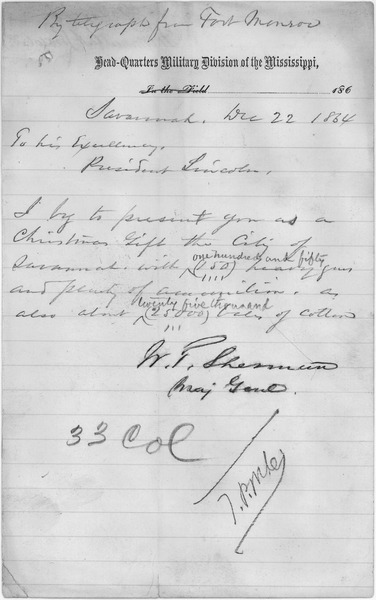
Sherman to Lincoln: Savannah has fallen, December 1864

The Huntington Library, owner of perhaps the best collection of Civil War regimental histories in existence, announced this week that it has acquired a sizable collection of Civil War telegrams thought to have been lost or destroyed decades ago. The World Wide Web has changed the way we have lived over the past twenty years. Hard as it is to imagine however, the telegraph transformed the lives of mid-nineteenth century Americans even more extensively. When Samuel Morse sent the first ever telegraphic message, from Washington, DC to Baltimore in May 1844, he altered people’s concepts of time and space. News that previously took months to arrive by ship or horse now travelled in real time. If Morse’s code had existed during the War of 1812 General Andrew Jackson would not have fought the British at New Orleans in January 1815, two weeks after the Treaty of Ghent ended the conflict.

The U.S. Army was quick to understand the signifiance of telegraphy and embraced the new technology quickly. (Not coincidentally, the military also understood the signifance of the internet after the Second World War and quickly embraced that technology as well.)  Unfortunately the various presidential administrations of the 1840s and 50s were less quick to adapt. When Lincoln was inaugurated and the war came he was reduced to leaving the White House and venturing to the War Department and elsewhere for war news. That would be the equivalent today of the president and White House staff having no internet access and leaving the grounds to get their news from sources who are better plugged in.

The telegrams are in several dozen leather binders and once belonged to Thomas T. Eckert, assistant general superintendent of the United States Military Telegraph. Prior to serving in this capacity Eckert served on McClellan’s staff. After the war he worked for railroad magnate Jay Gould. Gould also went on to acquire Western Union. Only a fraction of the correspondance has been previously published. Over 100 telegrams in the Eckert collection are by Lincoln himself. The Huntington will display a portion of the material in two exhibits later in the year. Hopefully they will digitize at least some of this material in the future as well.

(image/War Department, Office of the Military Telegraph; NARA)

Tippecanoe and Tyler too

26 Thursday Jan 2012

Posted by Keith Muchowski in Uncategorized

≈ Comments Off on Tippecanoe and Tyler too

The expression of a man who fathers fifteen children

In a small news story that serves as a reminder that the Civil War was not that long ago in the grand scheme of things, geneaologists announced this week that two of the grandsons of President John Tyler are still alive. The Virginian Tyler was the tenth president of the United States. He served from 1841 to 1845 and died in 1862. One of the Tyler grandsons served on the Virginia Civil War Centennial Commission from 1959-1963 and later received his PhD at Duke.

The Marshall House flag

25 Wednesday Jan 2012

Posted by Keith Muchowski in Museums

≈ Comments Off on The Marshall House flag

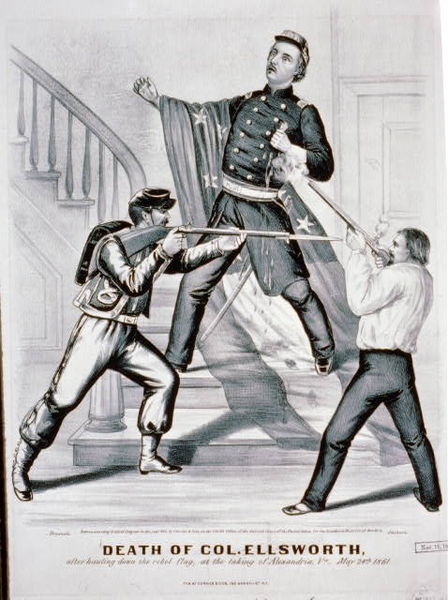
The New York State Military Museum has one of the most extensive collections of flags in the United States, going back two centuries to the War of 1812. Its collection of Civil War battle flags is the largest in the country, which should not be a surprise given the Empire State’s outsized role in bringing an end to the Late Unpleasantness. One of the crown jewels of the state’s collection is the Marshall Flag, the Confederate national banner which flew above the Marshall House hotel in Alexandria Virginia until taken down by Colonel Elmer Ellsworth in May 1861.

The Photographic History of the Civil War in Ten Volumes: Volume one, the Opening Battles

Virginia passed its Ordinance of Secession on May 23 and tensions were high in the capital and just across the Potomac in Virginia. The following day Ellsworth noted the flag flying atop the building and in a fit of bravado dashed to the roof and pulled down the stars and bars. When he got to the bottom of the stairs Ellsworth was shot by proprietor James Jackson. Jackson in turn was shot by one of Ellsworth’s men. Both died instantly.

Currier and Ives print from the collection of the Library of Congress

Ellsworth was a dashing figure and a favorite of President Lincoln. He had been the colonel of the 11th New York “Fire Zouaves,” whose men had spent much of 1861 parading with great fanfare to large, appreciative crowds across the North. Their showmanship had more in common with acrobatics and synchronization than military tactics, and their colorful uniforms only added to their popularity and mystique. Ellsworth’s death made him a martyr across the North. The gruesome and violent nature of his death, however, was also one of the first signals to Americans of what the war would entail. How could a man so handsome and young, so vibrant, so full of life and charisma be taken away in an instant? Such is the nature of war.

Envelope from the collection of the New-York Historical Society

The NYS Military Museum has spent the last several years conserving what is left of the Marshall House flag. Here is an overview.

Quote of the day

23 Monday Jan 2012

Posted by Keith Muchowski in Quote of the day, Walt Whitman

≈ Comments Off on Quote of the day

Thomas Eakins photograph of WW, April 1887

There will come a time here in Brooklyn and all over America, when nothing will be of more interest than authentic reminiscenses  of the past.       –Walt Whitman

(image/Beinecke Rare Books & Manuscript Library, Yale University)

← Older posts
Newer posts →

Enter your email address to subscribe to this blog and receive notifications of new posts by email.

Join 255 other subscribers

Categories

Archives

  • November 2023 (1)
  • October 2023 (3)
  • September 2023 (3)
  • August 2023 (4)
  • July 2023 (7)
  • June 2023 (10)
  • May 2023 (8)
  • April 2023 (6)
  • March 2023 (5)
  • February 2023 (4)
  • January 2023 (4)
  • December 2022 (4)
  • November 2022 (8)
  • October 2022 (2)
  • September 2022 (4)
  • June 2022 (1)
  • May 2022 (1)
  • April 2022 (13)
  • January 2022 (1)
  • December 2021 (2)
  • November 2021 (1)
  • October 2021 (3)
  • September 2021 (3)
  • August 2021 (5)
  • July 2021 (1)
  • June 2021 (1)
  • May 2021 (4)
  • April 2021 (3)
  • March 2021 (4)
  • February 2021 (7)
  • January 2021 (4)
  • December 2020 (4)
  • November 2020 (3)
  • October 2020 (4)
  • September 2020 (7)
  • August 2020 (5)
  • July 2020 (7)
  • June 2020 (11)
  • May 2020 (7)
  • April 2020 (9)
  • March 2020 (9)
  • February 2020 (7)
  • January 2020 (6)
  • December 2019 (7)
  • November 2019 (9)
  • October 2019 (4)
  • September 2019 (6)
  • August 2019 (10)
  • July 2019 (8)
  • June 2019 (6)
  • May 2019 (9)
  • April 2019 (8)
  • March 2019 (6)
  • February 2019 (8)
  • January 2019 (5)
  • December 2018 (10)
  • November 2018 (6)
  • October 2018 (9)
  • September 2018 (11)
  • August 2018 (11)
  • July 2018 (17)
  • June 2018 (10)
  • May 2018 (8)
  • April 2018 (9)
  • March 2018 (8)
  • February 2018 (5)
  • January 2018 (7)
  • December 2017 (11)
  • November 2017 (8)
  • October 2017 (9)
  • September 2017 (11)
  • August 2017 (12)
  • July 2017 (14)
  • June 2017 (18)
  • May 2017 (11)
  • April 2017 (10)
  • March 2017 (9)
  • February 2017 (11)
  • January 2017 (14)
  • December 2016 (7)
  • November 2016 (8)
  • October 2016 (8)
  • September 2016 (9)
  • August 2016 (6)
  • July 2016 (12)
  • June 2016 (8)
  • May 2016 (9)
  • April 2016 (6)
  • March 2016 (12)
  • February 2016 (10)
  • January 2016 (9)
  • December 2015 (9)
  • November 2015 (11)
  • October 2015 (8)
  • September 2015 (9)
  • August 2015 (13)
  • July 2015 (14)
  • June 2015 (11)
  • May 2015 (11)
  • April 2015 (18)
  • March 2015 (10)
  • February 2015 (8)
  • January 2015 (8)
  • December 2014 (12)
  • November 2014 (13)
  • October 2014 (16)
  • September 2014 (11)
  • August 2014 (16)
  • July 2014 (12)
  • June 2014 (13)
  • May 2014 (10)
  • April 2014 (10)
  • March 2014 (11)
  • February 2014 (12)
  • January 2014 (10)
  • December 2013 (11)
  • November 2013 (14)
  • October 2013 (14)
  • September 2013 (14)
  • August 2013 (13)
  • July 2013 (17)
  • June 2013 (9)
  • May 2013 (13)
  • April 2013 (13)
  • March 2013 (16)
  • February 2013 (15)
  • January 2013 (15)
  • December 2012 (18)
  • November 2012 (18)
  • October 2012 (21)
  • September 2012 (14)
  • August 2012 (16)
  • July 2012 (21)
  • June 2012 (22)
  • May 2012 (24)
  • April 2012 (20)
  • March 2012 (23)
  • February 2012 (22)
  • January 2012 (15)
  • December 2011 (23)
  • November 2011 (22)
  • October 2011 (23)
  • September 2011 (18)
  • August 2011 (19)
  • July 2011 (20)
  • June 2011 (29)
  • May 2011 (25)
  • April 2011 (18)
  • March 2011 (21)
  • February 2011 (11)

Meta

  • Create account
  • Log in
  • Entries feed
  • Comments feed
  • WordPress.com
Creative Commons License
This work is licensed under a Creative Commons Attribution-NonCommercial-ShareAlike 4.0 International License.

Enter your email address to subscribe to this blog and receive notifications of new posts by email.

Join 255 other subscribers

Categories

Archives

  • November 2023 (1)
  • October 2023 (3)
  • September 2023 (3)
  • August 2023 (4)
  • July 2023 (7)
  • June 2023 (10)
  • May 2023 (8)
  • April 2023 (6)
  • March 2023 (5)
  • February 2023 (4)
  • January 2023 (4)
  • December 2022 (4)
  • November 2022 (8)
  • October 2022 (2)
  • September 2022 (4)
  • June 2022 (1)
  • May 2022 (1)
  • April 2022 (13)
  • January 2022 (1)
  • December 2021 (2)
  • November 2021 (1)
  • October 2021 (3)
  • September 2021 (3)
  • August 2021 (5)
  • July 2021 (1)
  • June 2021 (1)
  • May 2021 (4)
  • April 2021 (3)
  • March 2021 (4)
  • February 2021 (7)
  • January 2021 (4)
  • December 2020 (4)
  • November 2020 (3)
  • October 2020 (4)
  • September 2020 (7)
  • August 2020 (5)
  • July 2020 (7)
  • June 2020 (11)
  • May 2020 (7)
  • April 2020 (9)
  • March 2020 (9)
  • February 2020 (7)
  • January 2020 (6)
  • December 2019 (7)
  • November 2019 (9)
  • October 2019 (4)
  • September 2019 (6)
  • August 2019 (10)
  • July 2019 (8)
  • June 2019 (6)
  • May 2019 (9)
  • April 2019 (8)
  • March 2019 (6)
  • February 2019 (8)
  • January 2019 (5)
  • December 2018 (10)
  • November 2018 (6)
  • October 2018 (9)
  • September 2018 (11)
  • August 2018 (11)
  • July 2018 (17)
  • June 2018 (10)
  • May 2018 (8)
  • April 2018 (9)
  • March 2018 (8)
  • February 2018 (5)
  • January 2018 (7)
  • December 2017 (11)
  • November 2017 (8)
  • October 2017 (9)
  • September 2017 (11)
  • August 2017 (12)
  • July 2017 (14)
  • June 2017 (18)
  • May 2017 (11)
  • April 2017 (10)
  • March 2017 (9)
  • February 2017 (11)
  • January 2017 (14)
  • December 2016 (7)
  • November 2016 (8)
  • October 2016 (8)
  • September 2016 (9)
  • August 2016 (6)
  • July 2016 (12)
  • June 2016 (8)
  • May 2016 (9)
  • April 2016 (6)
  • March 2016 (12)
  • February 2016 (10)
  • January 2016 (9)
  • December 2015 (9)
  • November 2015 (11)
  • October 2015 (8)
  • September 2015 (9)
  • August 2015 (13)
  • July 2015 (14)
  • June 2015 (11)
  • May 2015 (11)
  • April 2015 (18)
  • March 2015 (10)
  • February 2015 (8)
  • January 2015 (8)
  • December 2014 (12)
  • November 2014 (13)
  • October 2014 (16)
  • September 2014 (11)
  • August 2014 (16)
  • July 2014 (12)
  • June 2014 (13)
  • May 2014 (10)
  • April 2014 (10)
  • March 2014 (11)
  • February 2014 (12)
  • January 2014 (10)
  • December 2013 (11)
  • November 2013 (14)
  • October 2013 (14)
  • September 2013 (14)
  • August 2013 (13)
  • July 2013 (17)
  • June 2013 (9)
  • May 2013 (13)
  • April 2013 (13)
  • March 2013 (16)
  • February 2013 (15)
  • January 2013 (15)
  • December 2012 (18)
  • November 2012 (18)
  • October 2012 (21)
  • September 2012 (14)
  • August 2012 (16)
  • July 2012 (21)
  • June 2012 (22)
  • May 2012 (24)
  • April 2012 (20)
  • March 2012 (23)
  • February 2012 (22)
  • January 2012 (15)
  • December 2011 (23)
  • November 2011 (22)
  • October 2011 (23)
  • September 2011 (18)
  • August 2011 (19)
  • July 2011 (20)
  • June 2011 (29)
  • May 2011 (25)
  • April 2011 (18)
  • March 2011 (21)
  • February 2011 (11)

Meta

  • Create account
  • Log in
  • Entries feed
  • Comments feed
  • WordPress.com
Creative Commons License
This work is licensed under a Creative Commons Attribution-NonCommercial-ShareAlike 4.0 International License.

Enter your email address to subscribe to this blog and receive notifications of new posts by email.

Join 255 other subscribers

Categories

Archives

  • November 2023 (1)
  • October 2023 (3)
  • September 2023 (3)
  • August 2023 (4)
  • July 2023 (7)
  • June 2023 (10)
  • May 2023 (8)
  • April 2023 (6)
  • March 2023 (5)
  • February 2023 (4)
  • January 2023 (4)
  • December 2022 (4)
  • November 2022 (8)
  • October 2022 (2)
  • September 2022 (4)
  • June 2022 (1)
  • May 2022 (1)
  • April 2022 (13)
  • January 2022 (1)
  • December 2021 (2)
  • November 2021 (1)
  • October 2021 (3)
  • September 2021 (3)
  • August 2021 (5)
  • July 2021 (1)
  • June 2021 (1)
  • May 2021 (4)
  • April 2021 (3)
  • March 2021 (4)
  • February 2021 (7)
  • January 2021 (4)
  • December 2020 (4)
  • November 2020 (3)
  • October 2020 (4)
  • September 2020 (7)
  • August 2020 (5)
  • July 2020 (7)
  • June 2020 (11)
  • May 2020 (7)
  • April 2020 (9)
  • March 2020 (9)
  • February 2020 (7)
  • January 2020 (6)
  • December 2019 (7)
  • November 2019 (9)
  • October 2019 (4)
  • September 2019 (6)
  • August 2019 (10)
  • July 2019 (8)
  • June 2019 (6)
  • May 2019 (9)
  • April 2019 (8)
  • March 2019 (6)
  • February 2019 (8)
  • January 2019 (5)
  • December 2018 (10)
  • November 2018 (6)
  • October 2018 (9)
  • September 2018 (11)
  • August 2018 (11)
  • July 2018 (17)
  • June 2018 (10)
  • May 2018 (8)
  • April 2018 (9)
  • March 2018 (8)
  • February 2018 (5)
  • January 2018 (7)
  • December 2017 (11)
  • November 2017 (8)
  • October 2017 (9)
  • September 2017 (11)
  • August 2017 (12)
  • July 2017 (14)
  • June 2017 (18)
  • May 2017 (11)
  • April 2017 (10)
  • March 2017 (9)
  • February 2017 (11)
  • January 2017 (14)
  • December 2016 (7)
  • November 2016 (8)
  • October 2016 (8)
  • September 2016 (9)
  • August 2016 (6)
  • July 2016 (12)
  • June 2016 (8)
  • May 2016 (9)
  • April 2016 (6)
  • March 2016 (12)
  • February 2016 (10)
  • January 2016 (9)
  • December 2015 (9)
  • November 2015 (11)
  • October 2015 (8)
  • September 2015 (9)
  • August 2015 (13)
  • July 2015 (14)
  • June 2015 (11)
  • May 2015 (11)
  • April 2015 (18)
  • March 2015 (10)
  • February 2015 (8)
  • January 2015 (8)
  • December 2014 (12)
  • November 2014 (13)
  • October 2014 (16)
  • September 2014 (11)
  • August 2014 (16)
  • July 2014 (12)
  • June 2014 (13)
  • May 2014 (10)
  • April 2014 (10)
  • March 2014 (11)
  • February 2014 (12)
  • January 2014 (10)
  • December 2013 (11)
  • November 2013 (14)
  • October 2013 (14)
  • September 2013 (14)
  • August 2013 (13)
  • July 2013 (17)
  • June 2013 (9)
  • May 2013 (13)
  • April 2013 (13)
  • March 2013 (16)
  • February 2013 (15)
  • January 2013 (15)
  • December 2012 (18)
  • November 2012 (18)
  • October 2012 (21)
  • September 2012 (14)
  • August 2012 (16)
  • July 2012 (21)
  • June 2012 (22)
  • May 2012 (24)
  • April 2012 (20)
  • March 2012 (23)
  • February 2012 (22)
  • January 2012 (15)
  • December 2011 (23)
  • November 2011 (22)
  • October 2011 (23)
  • September 2011 (18)
  • August 2011 (19)
  • July 2011 (20)
  • June 2011 (29)
  • May 2011 (25)
  • April 2011 (18)
  • March 2011 (21)
  • February 2011 (11)

Meta

  • Create account
  • Log in
  • Entries feed
  • Comments feed
  • WordPress.com
Creative Commons License
This work is licensed under a Creative Commons Attribution-NonCommercial-ShareAlike 4.0 International License.

Blog at WordPress.com.

  • Subscribe Subscribed
    • The Strawfoot
    • Join 226 other subscribers
    • Already have a WordPress.com account? Log in now.
    • The Strawfoot
    • Subscribe Subscribed
    • Sign up
    • Log in
    • Report this content
    • View site in Reader
    • Manage subscriptions
    • Collapse this bar

Loading Comments...