• About

The Strawfoot

~ a New Yorker's American History blog

The Strawfoot

Category Archives: New York City

A World War One era Steinway

08 Monday Oct 2018

Posted by Keith Muchowski in New York City

≈ Comments Off on A World War One era Steinway

Now here is something you don’t see everyday, let alone in a thrift store: a 1917/1918 Steinway & Sons grand piano. I saw this in the city yesterday on 23rd Street. I was a little confused at the 1917/1918 designation. I would have thought it fairly easy to trace the provenance of such a thing; as I understand it Steinways come with serial numbers and other identifying information to track their provenance. Or, maybe due to the war they were producing models on something other than an annual basis? Whatever the reasons, one can’t blame the people in the thrift store for not knowing.

This century-old 1917/1918 Model M Steinway & Son piano is currently in a thrift store on Manhattan’s 23rd Street.

Whenever I see something like this, I wonder how it got there. Was it in someone’s New York City apartment for decades until said person either passed on or moved in to a smaller place? Did the family donate the thing to a thrift store during a house cleaning? What famous pianist might have played it along the way over the past century? There is no way to know. That is the wonderful mystery of such things.

I have passed the Steinway crypt in Green-Wood Cemetery dozens of times over the years. A Wikipedia search informs us that the company was founded by Heinrich Engelhard Steinweg in New York City in 1853. Steinweg had emigrated from Lower Saxony and come to the United States with his sons after the failed revolutions of 1848. It was a wise move; the family avoided much of the tumult of the next 75 years. Steinway the Elder died in 1871 in the middle of the Franco-Prussian War. By the time of the Great War the Steinways were part of the fabric of New York City life and it does not seem they suffered from the anti-German sentiments so common during the Great War. Steinweg himself had anglicized the family name when first coming to the New Country. Perhaps the less overtly Germanic “Steinway” saved the family such grief.

Steinway pianos then and now were made in Queens. During the war the city was building a Steinway tunnel to connect Queens to Manhattan via a new subway line. Frederick Loeser & Co., a Brooklyn-based department store, was one place to buy a Steinway, among dozens of other piano makes and models. Loeser newspaper ads from 1917 and 1918, the period in which the Model M we see above was manufactured, list the original price of a Steinway grand piano at around $1000, just over $18,600 in today’s currency. Loeser’s however was selling them at a steep discount. It would be interesting to know if such discounts were customary or due to the war.


Gertrude Vanderbilt Whitney’s Mitchel Square

12 Wednesday Sep 2018

Posted by Keith Muchowski in Great War centennial, John Purroy Mitchel, Monuments and Statuary, New York City, Quentin Roosevelt

≈ Comments Off on Gertrude Vanderbilt Whitney’s Mitchel Square

Yesterday I put the final touches on my upcoming talk this Sunday at Camp Doughboy on Governors Island about John Purroy Mitchel. Later I did a dry run for a friend in my department to work out the kinks. A dress rehearsal always helps with these things in turns of timing, avoiding ambiguity, and just making certain that are sufficiently clear. I am as ready as I am going to be.

Gertrude Vanderbilt Whitney sculpted this doughboy statue in Upper Manhattan in 1923 and later founded the Whitney Museum of Art. Quentin Roosevelt was engaged to her daughter when killed in an airfight in France in July 1918.

In part of the talk I discuss the ways the JP Mitchel is remembered in New York City. Mitchel Square at 168th and Broadway is just one memorial to the Boy Mayor. There too is this beautiful statue that we see above, which was not sculpted expressly for Mitchel himself but for the men on Washington Heights who fought in the war. I happened to be in northern Manhattan a few weeks ago on my way to somewhere else when I stumbled upon it. Yesterday after my walk through my friend and I were discussing Mitchel and breaking down some of the details of his life and times. Color me ignorant but I did not know that the statue in Mitchel Square was designed by Gertrude Vanderbilt Whitney. Gertrude was the mother of Flora Payne Whitney, Quentin Roosevelt’s fiancée. Of course Quentin himself died in a military plane incident above France just two weeks after Mitchel was killed in Louisiana two weeks earlier.

Check out the schedule for Camp Doughboy 2018 here.


John Mitchel, Irish nationalist

08 Saturday Sep 2018

Posted by Keith Muchowski in Governors Island, John Purroy Mitchel, New York City, Preparedness (WW1), Reconstruction, Ulysses S. Grant (General and President)

≈ 2 Comments

Irish nationalist John Mitchel was put on trial in 1848 and eventually sentenced to “transportation” to Tasmania. He escaped to New York City and eventually moved South to support the Confederate cause. Seventy years later his grandson would be killed in a military training exercise getting ready to go to France to fight in the First World War.

Over the past few days I have been drafting the outline for my talk at next week’s Camp Doughboy weekend on Governors Island about John Purroy Mitchel. When I have more details I will share them here. Some may recall that in early July I wrote a piece for Roads to the Great War for the 100th anniversary of his death. Space constraints prevented me from going deeper into the Mitchell family than I would have liked. JP Mitchel was the grandson and namesake of famed Irish nationalist John MItchel. Mitchel the Elder was born in 1815 and put on trial by the British in 1848 when Ireland was in turmoil during the failed European revolutions of that year. He was sentenced to exile–what at the time was called “transportation”–to the Australian outpost Van Diemen’s Land, what we today call Tasmania. There on the Van Diemen penal colony too was Thomas Francis Meagher.

Mitchel and Meagher independently escaped to New York City. Mitchel ended up Brooklyn, living on Union Street and working as a journalist when he wrote his memoir Jail Journal; or Five Years in British Prisons. As the secession crisis heat up he eventually took his family down south, first to Tennessee and as the war went on to Richmond. Mitchel is testimony to the notion that life and humans are complicated; throughout his life he remained engaged in the Irish freedom struggle but was a staunch defender of slavery and the Confederacy. Mitchel was all in for the Confederate cause and all three of his sons served. Ironically two of the boys fought against the Meagher’s Irish Brigade at Fredericksburg in December 1862. One of Mitchel’s sons was killed in Pickett’s Charge near the Codori farm and another died while commanding Fort Sumter in 1864. The third, James, was wounded several times and lost an arm. Mitchel worked as a journalist for several Southern papers supporting President Davis. Ulysses S. Grant because a frequent foil after the general moved east in 1864. As the war wound down Mitchel escaped Richmond with Jefferson Davis’s entourage but was eventually captured and held at Fort Monroe before being released late in 1865. He soon became an editor with Benjamin and Fernando Wood’s New York Daily News, a Democratic vehicle that had given Lincoln much grief during the war and afterward turned it wrath on Reconstruction.

Mayor John Purroy Mitchel (center in top hat) and Cardinal John Murphy Farley reviewing St Patrick’s Day parade, March 17, 1914

John Purroy Mitchell was born in the Bronx in 1879, four years after his grandfather’s death. For reasons that are not clear to me, JP Mitchel was raised Catholic whereas his grandfather had been a Presbyterian. These were not small matters in Irish and Irish-American communities. I am assuming the Catholicism came from his mother’s side; the Purroys were Catholics who had come to New York City from Venezuela. I’m not going to rehash the Mitchel story here, though I probably will go into it more over the coming week as we get closer to Camp Doughboy. By the time he became mayor of New York City in January 1914 John Purroy Mitchel was thoroughly engaged in the Reform movement to clean up government. When war came later that year he was one of the earliest advocated for American Preparedness. It is intriguing to think of Mitchel being so actively engaged in the Preparedness Movement. Many Irish and Irish-Americans supported the Germans because they were fighting the British.

Like his grandfather during the American Civil War however, John Purroy Mitchel was all in for the Allied cause, eventually giving his own life on that Louisiana air field in July 1918. The world is indeed a complicated place.

(top image from The Citizen uploaded to Wikimedia Commons by Domer48; bottom, Library of Congress)

The Atlantic Telegraph Jubilee, September 1, 1858

01 Saturday Sep 2018

Posted by Keith Muchowski in Film, Sound, & Photography, Media and Web 2.0, New York City, Philately

≈ Comments Off on The Atlantic Telegraph Jubilee, September 1, 1858

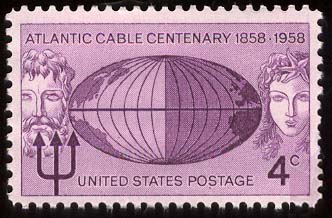
In the mid 1980s your humble writer, fresh out of high school, had a job for a year or so working in a survey crew in West Texas laying out the routes for fiber optic cable lines through the desert. Running parallel to these new lines were old ones consisting of copper coaxial cables, some of which remained and some of which got extricated to make make for the new digital. This all came back to me when reading the other day of the Atlantic Telegraph Jubilee of September 1, 1858. One hundred and sixty years ago today New Yorkers turned out by the thousands to celebrate the laying of the first cable crossing that ocean span. The work was that of Cyrus W. Field, owner of the Atlantic Telegraph Company. The first official transatlantic communication (after a test run to make certain things were in working order) had been sent two weeks earlier, when on August 16 Queen Victoria in London messaged President Buchanan, the former U.S. Ambassador to the Court of St. James’s, in Washington. There had been several attempts in the days before this that had failed for technical reasons.

A somewhat forgotten event today, the Atlantic Telegraph Jubilee was held in New York City on September 1, 1858. Transatlantic telegraphy did not come into its own until after the American Civil War and would be part of daily life well into the twentieth century.

Everyone understood the significance of the transatlantic cable. York City, for one, had only had running water for sixteen years at this point and was not unique in its lack of infrastructure and public utilities. Letters still took weeks to cross the ocean. The initial rate in August and early September 1858 to send a transatlantic message was $5 per word. By comparison: the average working man earned between $1-$2 per day. It took seventeen hours to transmit Queen Victoria’s fourteen-word message to Buchanan. Thousands turned out for the Atlantic Telegraph Jubilee but the event seems to have been largely forgotten over the ensuing decades and up to the present time. That is probably because the cable broke with a few short weeks and was essentially inoperable by early fall. Such failures are not unusual in these types of projects. Transatlantic communication did not come to full fruition until after the American Civil War. In 1866 Field managed to build the first true, permanent cable. By then, message time was down to about eight to fifteen words per minute.

The United States Post Office held the First Day Cover ceremony for the transatlantic cable centenary stamp at the Farley Post Office in Manhattan on Friday August 15, 1958. George Giusti, an Italian who fleed Europe in 1939 during the Second World War, was the designer.

The transatlantic cable was hugely important well into the twentieth century. By 1908, fifty years after the first cable massage, there were at least six companies and over a dozen lines crossing the ocean. Rates were down to four cents per word. Even with that there was much public talk about high rates and unfair trade practices. One way was to make it cheaper to send messages at night, just like cell phone companies encourage us today to use our phones on evenings and weekends by making calls less expensive. Consolidation soon followed. Transatlantic communication was hugely important during the Great War. Alexander Graham Bell invented the telephone in 1876, and indeed there was some telephone communication in the First World War, but like the airplane it was still in its infancy. Thus telegraphy’s continued significance.

Albeit anomalously, cable messaging continued even into the twenty-first century. It was not until February 2006 that Western Union sent its last telegram. I remember saying that to a class of technology students the day after that happened and the students responding with virtually no reaction.

(images/top, NYPL; bottom, U.S. Post Office)


Brooks Brothers, 1818-2018

11 Saturday Aug 2018

Posted by Keith Muchowski in Chester A. Arthur, Edwin D. Morgan, Incorporating New York (book manuscript project), New York City, Style

≈ Comments Off on Brooks Brothers, 1818-2018

I was in the city running a few errands and having a little fun yesterday, buying a chambray shirt, renewing my library card at NYPL, and taking in the Brooks Brothers exhibit on display through September 5 in Grand Central Terminal’s Vanderbilt Hall. Brooks Brothers began in 1818 on the more southern portion of Manhattan, where most New Yorkers still lived and worked. Grand Central opened in 1913 and Brooks Brothers opened its now-flagship store across the street at 346 Madison in 1915 to serve the commuting businessmen. It was fortunate for the Great War effort the the spacious train terminal was built when and where it was, accommodating as it did the mass influx of men and material on their way to France.

an October 24, 1861 letter from Assistant Quartermaster Chester A. Arthur letter to Brooks Brothers…

Taking in the Brooks Brothers exhibit was a journey in time and made me a little rueful at how far the once iconic temple of men’s style has fallen. Really it is not all Brooks’s fault; societal changes, many of them for the better, have rendered much of traditional men’s styling obsolete. That said, when they put me in charge of the world, jackets and repp ties will again be required for all men. There were many striking and iconic things to see but two that struck me the most were these. The first is a letter to Brooks Brothers from New York State Assistant Quartermaster Chester Alan Arthur requisitioning 300 overcoats. The letter is from October 24, 1861, three days after the Battle of Ball’s Bluff.

…and a contract signed by the four Brooks brothers and Governor Edwin D. Morgan on August 3, 1861, two weeks after First Bull Run. Note the fabric swabs in the upper right corner.

The second is a contract signed by Governor Edwin D. Morgan two month and a half months earlier. It is a mark of the great import of the transaction that all four actual Brooks brothers signed the document. This came at an important time in the war effort, just two after the fiasco at Bull Run. I write about this moment in the manuscript of Incorporating New York. By early August men like Morgan and Arthur were cleaning up the mess and preparing for what everyone now knew would be a long war. I know the images are not that great, having been taken through the glass in the display case, but note the red wax next to each signature marking it official. Governor Morgan’s is on top and then the four brother’s below. I don’t know for certain but my guess would be that the fabric swabs were included in the contract after earlier incidents of clothiers–including Brooks Brothers–providing the Army with inferior shoddy goods.

Prospect Park, 1966

04 Saturday Aug 2018

Posted by Keith Muchowski in Frederick Law Olmsted, New York City

≈ Comments Off on Prospect Park, 1966

Prospect Park centennial invitation, June 1966

These past two Fridays I visited the Brooklyn Historical Society, last week the new satellite facility on the waterfront and yesterday the main site in the Heights. If you live in New York City I cannot recommend the BHS strongly enough. The DUMBO facility, situated in an old warehouse, is quite striking. Their inaugural exhibition is a long-running (four year) exhibit discussing the significance of the waterfront. I found the snippets of oral histories with Rosie the Riveters to be poignant. I ruefully texted a friend noting that the interviews were mostly from the 1980s and 1990s and that the subjects were probably deceased by this time. It saddens me to see the end of the World War 2 generation.

Yesterday at Pierrepont Street I took in a small exhibit about Prospect Park. Part of it dealt with the 1966 centennial observation of the Olmsted and Vaux masterpiece. The two won the commission for the Brooklyn park on May 29, 1866, about six months after Olmsted returned from California after the Civil War. I had never heard of the 1966 Prospect Park commemoration and so did a bit of digging. I noticed that May 29, 1966 fell on a Sunday and am therefore curious as to why they did not have the event on the anniversary itself. Perhaps Sunday blue laws were still stringent enough to move it to another day; or, maybe a weekday was better to accommodate school groups. I’ll never know.

There was an 8-10 minute film from the period produced by the Brooklyn Union Gas Company, today part of National Grid, with wonderful images. The signage next to the plasma screen noted that Brooklyn Union had placed the film in a time capsule to be opened for Prospect Park’s bicentennial in 2066. Apparently they made a few copies and gave one to the BHS. Civil War veterans were a frequent sight at events like this in Prospect Park well into the 1930s. That is why they changed the name of Prospect Park Plaza to Grand Army Plaza in 1926. By 1966 they were of course all gone. I was a little surprised however not to see any Great War veterans, who were still very much around in significant number, at this time.

To read the old New York Times articles about this event is to see a Brooklyn that is no more. The borough had not yet hit rock bottom but the post-industrial decline and white flight are there for the observant to notice. A May 30, 1966 headline reads “Centennial Celebration Will Open Thursday for City Oasis, Now in Decline Attendance Falling off.” Still, there were signs of hope. Mayor Lindsay and Robert Moses were both on hand and addressed the park’s issues. Federal and local funds had already been appropriated to renovate the boathouse and other venues. The park would fall much farther over the next three decades before turning around in the mid-1990s but is heartening to know that there were people, some prominent, others less so, studiously holding the line and doing what they could in what was a difficult situation.

Sunday morning coffee

29 Sunday Jul 2018

Posted by Keith Muchowski in General Grant National Memorial (NPS), Jazz, New York City

≈ Comments Off on Sunday morning coffee

Grant’s Tomb from Sakura Park, July 2018

I took this photo last Sunday and thought I would share. From the view from my window right now it looks like it should be a beautiful if warm day. Today marks the start of Harlem Week. Apparently this event is also called A Great Day in Harlem, after the Art Kane photograph taken sixty years ago this August. The photo is actually called Harlem 58. If you have never seen it take a look at this Daily News article from a few years back.

When this photo was taken the Harlem Renaissance was still within living memory. Many of the musicians profiled probably played in Paris in this years just after the Great War. By the late 1950s New York City was already beginning its post-industrial decline, even if that was not readily apparent at the time. From the Daily News: “The world represented by those 57 men and women — a world of late-night clubs, of gents in suits and hats and ladies in gloves, of martinis and Lucky Strikes — was already vanishing in the rear-view mirror of popular culture.” It all sounds good to me, except for the martinis and Lucky Strikes. I remember when the documentary about the film shoot came out in the mid-1990s and even that seems like five eras ago. Many of the principals, like Dizzy Gillespie, were still alive to participate in the film. It is hard to believe Sonny Rollins and Benny Golson are the only two who remain.

Harlem Week began as Harlem Day in 1974. Someone was telling me that this event used to be more anarchic back in the wild years of the 1970s, 80s and early 90s, with people sleeping overnight on benches in Riverside Park and that type of thing. The beauty of this city is that it is constantly reinventing itself. Today Harlem Week stretches a month, through August 25 this year. Come to Harlem this Summer of 2018 and experience it for yourself.


Percy Grainger, 1882-1961

12 Thursday Jul 2018

Posted by Keith Muchowski in Governors Island, Guest Posts, Jazz, New York City, Those we remember

≈ Comments Off on Percy Grainger, 1882-1961

My good friend Molly Skardon, a fellow volunteer with the National Park Service here in New York City, wrote this guest piece about Percy Grainger, who was born this week in 1882. The musician and composer was already in his 30s when the war broke out in 1914. The next five years however would prove crucial in his personal and artistic development. Molly is uniquely suited to writing about Grainger. She has run the Oral History Project at Governors Island for many years and has interviewed many Army band musicians who were stationed on the island. She also works at Juilliard. New York City was the focal point for the American war effort, and even then becoming a nexus for the nascent jazz scene.

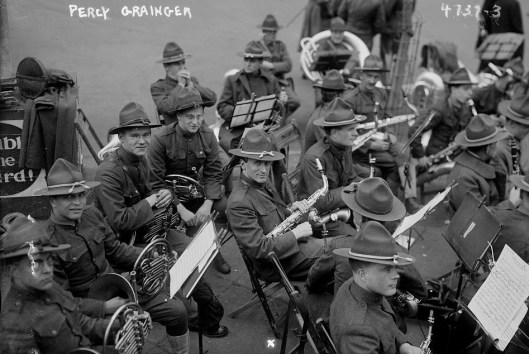
Happy Birthday to Australian musician Percy Grainger, born July 8, 1882. Grainger was pursuing an international career as a pianist and composer when the Great War began in Europe. Publicly criticized for not joining the British war effort, he sailed for America in 1915 and enlisted in the U.S. Army in June 1917, at age 34.

His first Army assignment was with the 15th Coast Artillery Band, stationed at Fort Hamilton, which is the ensemble pictured above. Grainger is the saxophonist in the center, above the small white X. Since it appears to have been chilly when the picture was taken, the time might be late 1917 or early 1918.

In June of 1918, Grainger came to Governors Island as an instructor in the program founded by the Institute of Musical Art (later part of what is now The Juilliard School) to train Army bandmasters and band musicians. Classroom instruction took place at the Institute, at Broadway and 122nd Street in Manhattan, and performing and conducting were taught on the Island.

Grainger was not particularly skilled on either the saxophone or the oboe, which he also played, but he was fascinated by wind, brass, and percussion instruments and wrote a great deal of music for them in various combinations, thus earning the gratitude of concert and military band players of succeeding generations. However, his most popularly known work is probably “Country Gardens,” an old English tune that he arranged for piano while at Fort Jay, as noted at the end of the published sheet music (“Written out, Fort Jay, Governor’s Island, N.Y., June 29, 1918”).

Grainger was discharged from the Army in 1919, and lived for the rest of his life in White Plains, New York just north of the city.

(image/Library of Congress Bain Collection)

JP Mitchel’s funeral, July 11, 1918

11 Wednesday Jul 2018

Posted by Keith Muchowski in Film, Sound, & Photography, John Purroy Mitchel, New York City, Theodore Roosevelt Jr (President), Woodrow Wilson

≈ 2 Comments

Here is some stunning footage of John Purroy Mitchell’s funeral at St. Patrick’s one hundred years ago today. Note Theodore Roosevelt and, I believe, Charles Evans Hughes, who ran against Wilson in 1916, walking behind the casket as the pallbearers take Mitchel into the cathedral.

John Purroy Mitchel, 1879-1918

06 Friday Jul 2018

Posted by Keith Muchowski in John Purroy Mitchel, Leonard Wood (General), Lusitania, Memory, New York City, Preparedness (WW1), Theodore Roosevelt Jr (President), Those we remember, Woodrow Wilson

≈ Comments Off on John Purroy Mitchel, 1879-1918

Major John Purroy Mitchel in pilot gear, 1918

The have my article up and running over at Roads to the Great War about the life, times, and death of John Purroy Mitchel. New York City’s Boy Mayor was all of thirty-four when he became mayor in 1914. Initially he was an ally of Woodrow Wilson, who in 1913 had appointed him Collector of the Port of New York. Men like Chester Arthur had previously held the collectorship. Mitchel and Wilson soon had a falling out over what the mayor saw as the president’s poor leadership during the war. Soon, Mitchel was very publicly allying with friends like Theodore Roosevelt and Leonard Wood advocating for Preparedness. When he lost his re-election bid, Mitchel became a military aviator. He died in a flight exercise in Louisiana on July 6, 1918, one hundred years ago today.

(image/courtesy of Margaret Maloney via Wikimedia Commons)


← Older posts
Newer posts →

Enter your email address to subscribe to this blog and receive notifications of new posts by email.

Join 258 other subscribers

Categories

Archives

  • November 2023 (1)
  • October 2023 (3)
  • September 2023 (3)
  • August 2023 (4)
  • July 2023 (7)
  • June 2023 (10)
  • May 2023 (8)
  • April 2023 (6)
  • March 2023 (5)
  • February 2023 (4)
  • January 2023 (4)
  • December 2022 (4)
  • November 2022 (8)
  • October 2022 (2)
  • September 2022 (4)
  • June 2022 (1)
  • May 2022 (1)
  • April 2022 (13)
  • January 2022 (1)
  • December 2021 (2)
  • November 2021 (1)
  • October 2021 (3)
  • September 2021 (3)
  • August 2021 (5)
  • July 2021 (1)
  • June 2021 (1)
  • May 2021 (4)
  • April 2021 (3)
  • March 2021 (4)
  • February 2021 (7)
  • January 2021 (4)
  • December 2020 (4)
  • November 2020 (3)
  • October 2020 (4)
  • September 2020 (7)
  • August 2020 (5)
  • July 2020 (7)
  • June 2020 (11)
  • May 2020 (7)
  • April 2020 (9)
  • March 2020 (9)
  • February 2020 (7)
  • January 2020 (6)
  • December 2019 (7)
  • November 2019 (9)
  • October 2019 (4)
  • September 2019 (6)
  • August 2019 (10)
  • July 2019 (8)
  • June 2019 (6)
  • May 2019 (9)
  • April 2019 (8)
  • March 2019 (6)
  • February 2019 (8)
  • January 2019 (5)
  • December 2018 (10)
  • November 2018 (6)
  • October 2018 (9)
  • September 2018 (11)
  • August 2018 (11)
  • July 2018 (17)
  • June 2018 (10)
  • May 2018 (8)
  • April 2018 (9)
  • March 2018 (8)
  • February 2018 (5)
  • January 2018 (7)
  • December 2017 (11)
  • November 2017 (8)
  • October 2017 (9)
  • September 2017 (11)
  • August 2017 (12)
  • July 2017 (14)
  • June 2017 (18)
  • May 2017 (11)
  • April 2017 (10)
  • March 2017 (9)
  • February 2017 (11)
  • January 2017 (14)
  • December 2016 (7)
  • November 2016 (8)
  • October 2016 (8)
  • September 2016 (9)
  • August 2016 (6)
  • July 2016 (12)
  • June 2016 (8)
  • May 2016 (9)
  • April 2016 (6)
  • March 2016 (12)
  • February 2016 (10)
  • January 2016 (9)
  • December 2015 (9)
  • November 2015 (11)
  • October 2015 (8)
  • September 2015 (9)
  • August 2015 (13)
  • July 2015 (14)
  • June 2015 (11)
  • May 2015 (11)
  • April 2015 (18)
  • March 2015 (10)
  • February 2015 (8)
  • January 2015 (8)
  • December 2014 (12)
  • November 2014 (13)
  • October 2014 (16)
  • September 2014 (11)
  • August 2014 (16)
  • July 2014 (12)
  • June 2014 (13)
  • May 2014 (10)
  • April 2014 (10)
  • March 2014 (11)
  • February 2014 (12)
  • January 2014 (10)
  • December 2013 (11)
  • November 2013 (14)
  • October 2013 (14)
  • September 2013 (14)
  • August 2013 (13)
  • July 2013 (17)
  • June 2013 (9)
  • May 2013 (13)
  • April 2013 (13)
  • March 2013 (16)
  • February 2013 (15)
  • January 2013 (15)
  • December 2012 (18)
  • November 2012 (18)
  • October 2012 (21)
  • September 2012 (14)
  • August 2012 (16)
  • July 2012 (21)
  • June 2012 (22)
  • May 2012 (24)
  • April 2012 (20)
  • March 2012 (23)
  • February 2012 (22)
  • January 2012 (15)
  • December 2011 (23)
  • November 2011 (22)
  • October 2011 (23)
  • September 2011 (18)
  • August 2011 (19)
  • July 2011 (20)
  • June 2011 (29)
  • May 2011 (25)
  • April 2011 (18)
  • March 2011 (21)
  • February 2011 (11)

Meta

  • Create account
  • Log in
  • Entries feed
  • Comments feed
  • WordPress.com
Creative Commons License
This work is licensed under a Creative Commons Attribution-NonCommercial-ShareAlike 4.0 International License.

Enter your email address to subscribe to this blog and receive notifications of new posts by email.

Join 258 other subscribers

Categories

Archives

  • November 2023 (1)
  • October 2023 (3)
  • September 2023 (3)
  • August 2023 (4)
  • July 2023 (7)
  • June 2023 (10)
  • May 2023 (8)
  • April 2023 (6)
  • March 2023 (5)
  • February 2023 (4)
  • January 2023 (4)
  • December 2022 (4)
  • November 2022 (8)
  • October 2022 (2)
  • September 2022 (4)
  • June 2022 (1)
  • May 2022 (1)
  • April 2022 (13)
  • January 2022 (1)
  • December 2021 (2)
  • November 2021 (1)
  • October 2021 (3)
  • September 2021 (3)
  • August 2021 (5)
  • July 2021 (1)
  • June 2021 (1)
  • May 2021 (4)
  • April 2021 (3)
  • March 2021 (4)
  • February 2021 (7)
  • January 2021 (4)
  • December 2020 (4)
  • November 2020 (3)
  • October 2020 (4)
  • September 2020 (7)
  • August 2020 (5)
  • July 2020 (7)
  • June 2020 (11)
  • May 2020 (7)
  • April 2020 (9)
  • March 2020 (9)
  • February 2020 (7)
  • January 2020 (6)
  • December 2019 (7)
  • November 2019 (9)
  • October 2019 (4)
  • September 2019 (6)
  • August 2019 (10)
  • July 2019 (8)
  • June 2019 (6)
  • May 2019 (9)
  • April 2019 (8)
  • March 2019 (6)
  • February 2019 (8)
  • January 2019 (5)
  • December 2018 (10)
  • November 2018 (6)
  • October 2018 (9)
  • September 2018 (11)
  • August 2018 (11)
  • July 2018 (17)
  • June 2018 (10)
  • May 2018 (8)
  • April 2018 (9)
  • March 2018 (8)
  • February 2018 (5)
  • January 2018 (7)
  • December 2017 (11)
  • November 2017 (8)
  • October 2017 (9)
  • September 2017 (11)
  • August 2017 (12)
  • July 2017 (14)
  • June 2017 (18)
  • May 2017 (11)
  • April 2017 (10)
  • March 2017 (9)
  • February 2017 (11)
  • January 2017 (14)
  • December 2016 (7)
  • November 2016 (8)
  • October 2016 (8)
  • September 2016 (9)
  • August 2016 (6)
  • July 2016 (12)
  • June 2016 (8)
  • May 2016 (9)
  • April 2016 (6)
  • March 2016 (12)
  • February 2016 (10)
  • January 2016 (9)
  • December 2015 (9)
  • November 2015 (11)
  • October 2015 (8)
  • September 2015 (9)
  • August 2015 (13)
  • July 2015 (14)
  • June 2015 (11)
  • May 2015 (11)
  • April 2015 (18)
  • March 2015 (10)
  • February 2015 (8)
  • January 2015 (8)
  • December 2014 (12)
  • November 2014 (13)
  • October 2014 (16)
  • September 2014 (11)
  • August 2014 (16)
  • July 2014 (12)
  • June 2014 (13)
  • May 2014 (10)
  • April 2014 (10)
  • March 2014 (11)
  • February 2014 (12)
  • January 2014 (10)
  • December 2013 (11)
  • November 2013 (14)
  • October 2013 (14)
  • September 2013 (14)
  • August 2013 (13)
  • July 2013 (17)
  • June 2013 (9)
  • May 2013 (13)
  • April 2013 (13)
  • March 2013 (16)
  • February 2013 (15)
  • January 2013 (15)
  • December 2012 (18)
  • November 2012 (18)
  • October 2012 (21)
  • September 2012 (14)
  • August 2012 (16)
  • July 2012 (21)
  • June 2012 (22)
  • May 2012 (24)
  • April 2012 (20)
  • March 2012 (23)
  • February 2012 (22)
  • January 2012 (15)
  • December 2011 (23)
  • November 2011 (22)
  • October 2011 (23)
  • September 2011 (18)
  • August 2011 (19)
  • July 2011 (20)
  • June 2011 (29)
  • May 2011 (25)
  • April 2011 (18)
  • March 2011 (21)
  • February 2011 (11)

Meta

  • Create account
  • Log in
  • Entries feed
  • Comments feed
  • WordPress.com
Creative Commons License
This work is licensed under a Creative Commons Attribution-NonCommercial-ShareAlike 4.0 International License.

Enter your email address to subscribe to this blog and receive notifications of new posts by email.

Join 258 other subscribers

Categories

Archives

  • November 2023 (1)
  • October 2023 (3)
  • September 2023 (3)
  • August 2023 (4)
  • July 2023 (7)
  • June 2023 (10)
  • May 2023 (8)
  • April 2023 (6)
  • March 2023 (5)
  • February 2023 (4)
  • January 2023 (4)
  • December 2022 (4)
  • November 2022 (8)
  • October 2022 (2)
  • September 2022 (4)
  • June 2022 (1)
  • May 2022 (1)
  • April 2022 (13)
  • January 2022 (1)
  • December 2021 (2)
  • November 2021 (1)
  • October 2021 (3)
  • September 2021 (3)
  • August 2021 (5)
  • July 2021 (1)
  • June 2021 (1)
  • May 2021 (4)
  • April 2021 (3)
  • March 2021 (4)
  • February 2021 (7)
  • January 2021 (4)
  • December 2020 (4)
  • November 2020 (3)
  • October 2020 (4)
  • September 2020 (7)
  • August 2020 (5)
  • July 2020 (7)
  • June 2020 (11)
  • May 2020 (7)
  • April 2020 (9)
  • March 2020 (9)
  • February 2020 (7)
  • January 2020 (6)
  • December 2019 (7)
  • November 2019 (9)
  • October 2019 (4)
  • September 2019 (6)
  • August 2019 (10)
  • July 2019 (8)
  • June 2019 (6)
  • May 2019 (9)
  • April 2019 (8)
  • March 2019 (6)
  • February 2019 (8)
  • January 2019 (5)
  • December 2018 (10)
  • November 2018 (6)
  • October 2018 (9)
  • September 2018 (11)
  • August 2018 (11)
  • July 2018 (17)
  • June 2018 (10)
  • May 2018 (8)
  • April 2018 (9)
  • March 2018 (8)
  • February 2018 (5)
  • January 2018 (7)
  • December 2017 (11)
  • November 2017 (8)
  • October 2017 (9)
  • September 2017 (11)
  • August 2017 (12)
  • July 2017 (14)
  • June 2017 (18)
  • May 2017 (11)
  • April 2017 (10)
  • March 2017 (9)
  • February 2017 (11)
  • January 2017 (14)
  • December 2016 (7)
  • November 2016 (8)
  • October 2016 (8)
  • September 2016 (9)
  • August 2016 (6)
  • July 2016 (12)
  • June 2016 (8)
  • May 2016 (9)
  • April 2016 (6)
  • March 2016 (12)
  • February 2016 (10)
  • January 2016 (9)
  • December 2015 (9)
  • November 2015 (11)
  • October 2015 (8)
  • September 2015 (9)
  • August 2015 (13)
  • July 2015 (14)
  • June 2015 (11)
  • May 2015 (11)
  • April 2015 (18)
  • March 2015 (10)
  • February 2015 (8)
  • January 2015 (8)
  • December 2014 (12)
  • November 2014 (13)
  • October 2014 (16)
  • September 2014 (11)
  • August 2014 (16)
  • July 2014 (12)
  • June 2014 (13)
  • May 2014 (10)
  • April 2014 (10)
  • March 2014 (11)
  • February 2014 (12)
  • January 2014 (10)
  • December 2013 (11)
  • November 2013 (14)
  • October 2013 (14)
  • September 2013 (14)
  • August 2013 (13)
  • July 2013 (17)
  • June 2013 (9)
  • May 2013 (13)
  • April 2013 (13)
  • March 2013 (16)
  • February 2013 (15)
  • January 2013 (15)
  • December 2012 (18)
  • November 2012 (18)
  • October 2012 (21)
  • September 2012 (14)
  • August 2012 (16)
  • July 2012 (21)
  • June 2012 (22)
  • May 2012 (24)
  • April 2012 (20)
  • March 2012 (23)
  • February 2012 (22)
  • January 2012 (15)
  • December 2011 (23)
  • November 2011 (22)
  • October 2011 (23)
  • September 2011 (18)
  • August 2011 (19)
  • July 2011 (20)
  • June 2011 (29)
  • May 2011 (25)
  • April 2011 (18)
  • March 2011 (21)
  • February 2011 (11)

Meta

  • Create account
  • Log in
  • Entries feed
  • Comments feed
  • WordPress.com
Creative Commons License
This work is licensed under a Creative Commons Attribution-NonCommercial-ShareAlike 4.0 International License.

Blog at WordPress.com.

  • Subscribe Subscribed
    • The Strawfoot
    • Join 229 other subscribers
    • Already have a WordPress.com account? Log in now.
    • The Strawfoot
    • Subscribe Subscribed
    • Sign up
    • Log in
    • Report this content
    • View site in Reader
    • Manage subscriptions
    • Collapse this bar
 

Loading Comments...