• About

The Strawfoot

~ a New Yorker's American History blog

The Strawfoot

Category Archives: Theodore Roosevelt Jr (President)

The ETO turns 75

08 Thursday Jun 2017

Posted by Keith Muchowski in Dwight D. Eisenhower, Franklin Delano Roosevelt, George C. Marshall, George S. Patton (General), John J. Pershing (General), Theodore Roosevelt Jr (President), William McKinley

≈ Comments Off on The ETO turns 75

Colonel N.A. Ryan, acting chief of transportation, U.S. Army European theater of operations, and Major General D.J. McMullen, D.S.O., C.B.E., director of transportation, British Army, Great Britain circa 1942

General Pershing’s arrival in first England and then France one hundred years ago this week is often understood to mark a turning point in American-European relations. The coming of the A.E.F. certainly signaled the arrival of the United States on the world stage, a process that had begun almost two decades earlier during the Spanish-American War. The evolving American relationship with Europe dates back to then too; it was John Hay, Secretary of State in the McKinley and Roosevelt Administration from 1898-1905 and, just prior to that, Ambassador to the Court of St. James, who had done so much to build the “special relationship” with Great Britain. Hay and Pershing laid the groundwork diplomatically and militarily for the Allied victory in the Second World War. Pershing’s protégés included George Marshall, George Patton, and Dwight Eisenhower. Today, 8 June 2017, marks another significant moment: the War Department created the European Theater of Operations on this date in 1942.

Dwight Eisenhower, at fifty-one now a major general, took over at director of the European Theater of Operations (ETO) in London on June 24. Joseph Stalin had been pressing for a second European front for some time, and now it appeared he would get that some time in 1942. That of course did not come to pass. Roosevelt and his planners decided to make North Africa the first Atlantic offensive. Two years later came the invasion of Normandy and V-E Day less than on year after that. Ike was now a hero and came home to assume the presidency of Columbia University. He was back in Europe as the head of NATO in 1950. For the past three quarters of a century we have taken the work of the U.S. Army in the European Theater of Operations granted. It was in Germany as part of the ETO where Elvis was stationed after getting drafted in the late 1950s.

We would do well to remember in our current moment that building alliances is much more arduous and time consuming than tearing them apart. Diplomacy is a funny thing: when done well one does not see it; when done poorly it is all one sees. I only saw one reference to the creation of the European Theater of Operations today. Here is to remembering the work that Roosevelt, Marshall, Eisenhower, and millions of anonymous American uniformed service persons have done over the past seventy-five years.

(image/Library of Congress)
Decoration Day 1917, cont’d

30 Tuesday May 2017

Posted by Keith Muchowski in Charles S. Whitman (Governor), J. Franklin Bell (General), John Purroy Mitchel, New York City, Preparedness (WW1), Theodore Roosevelt Jr (President)

≈ Comments Off on Decoration Day 1917, cont’d

Decoration Day, what we now call Memorial Day, originated in the years just after the American Civil War. In 1966, just after the Centennial, President Johnson and Congress pronounced somewhat dubiously that Waterloo, New York was the locale where Decoration Day had begun in 1866. In all likelihood it didn’t happen that way; citizens were showing up independently at local cemeteries throughout the North and South in that first full spring after the war’s end. Tending flowers on graves was timed with the planting season. Still, we do know that two years later John Logan, leader of the Grand Army of the Republic, called for all G.A.R. members to reserve 30 May 30 1868 as the official Decoration Day for members of the organization. This imprimatur added to the institutionalization of Decoration/Memorial Day. I say all this because it did not occur to me until yesterday that this made Decoration Day 1917 the 50th such observation. And yes, that means 2017 is the 150th.

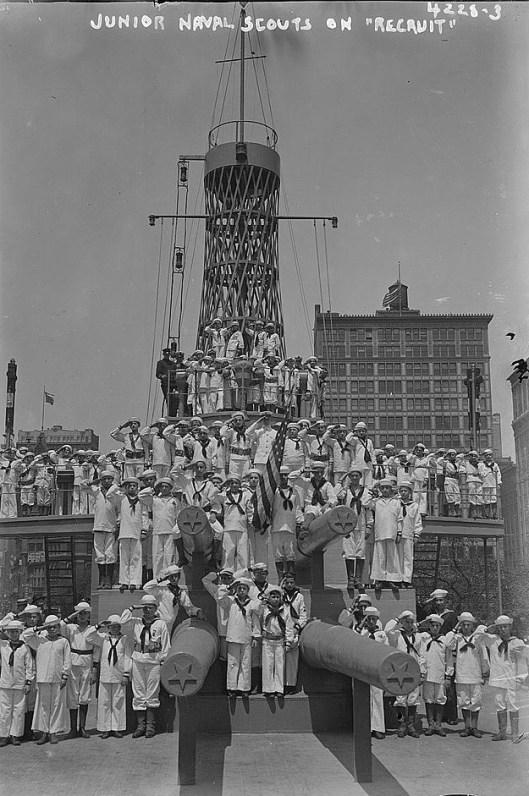
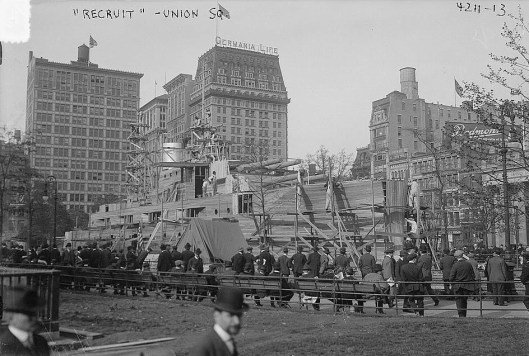
It is unclear if local, state, and federal leaders understood all this in May 1917 but, however coincidentally, it worked out well for the Great War effort. While Governor Whitman was reviewing troops with J. Franklin Bell uptown on 30 May 30 1917, Mayor John Purroy Mitchel was in Union Square christening the U.S.S. Recruit. The ship was just that, a scaled-down mock-up of a battleship built to promote recruiting for the Navy. Mayor Mitchel had long been a proponent of Preparedness and as such was an ally of Theodore Roosevelt, Leonard Wood, and Governor Whitman. Mitchel built the Recruit under the auspices of his Committee on National Defense. Decoration Day 1917 appears to have been something of a tag team affair, with Governor Whitman and General Bell reviewing the Army and National Guard troops uptown while the mayor focused on the Navy farther south. To be sure there was some Navy and Marine involvement in the uptown parade, but it was primarily an Army and Guard event.

New York’s ports were more important to the local economy than they are today–and the Brooklyn Navy Yard was still going strong–but the Navy was nonetheless small and removed from the daily lives of New Yorkers. Hence the idea for the Recruit. Remember, there was no television let alone internet in this era. To see what Navy personnel did–and how you might contribute yourself–the mayor and his allies figured a living model might be helpful. One could buy Liberty Bonds there as well. Here are a few images from that event one hundred years ago today.

(Note: all photographs are via the Library of Congress and were taken on 30 May 1917 with the possible exception of the top most image, which did not have a specific date. I included it to give a panoramic view of the U.S.S. Recruit, which ran about two hundred feet long and forty feet at its widest point.)


Augustus Peabody Gardner, part one

16 Tuesday May 2017

Posted by Keith Muchowski in Leonard Wood (General), Preparedness (WW1), Theodore Roosevelt Jr (President)

≈ Comments Off on Augustus Peabody Gardner, part one

Congressman Alexander Peabody Gardner (D-MA) was on the golf course in 1916 but back in a military uniform one year later. In May 1917 he was appointed a colonel in the Army.

In Sunday’s post I mentioned Theodore Roosevelt’s efforts to raise four divisions to fight the Germans in the Great War. Two of the major players in that episode were Senator Henry Cabot Lodge and his son-in-law Augustus Peabody Gardner. Lodge and Peabody were Boston Brahmins, part of a world that Roosevelt came to know in the late 1870s while attending Harvard. The names say it all: Lodge, Peabody, Gardner. I am not sure how Augustus is related to Isabella Stewart Gardner, the founder of the museum that bears her name, but the connection is there somewhere. I intend to do a deeper dive on A.P. Gardner later in the centennial, but today I wanted to pause and note something I found to be of great interest: it was one hundred years ago today that he left the United States House of Representative to return to military service.

Augustus Gardner had been a congressman for fifteen years. Before that he had served in the Spanish-American War. Gardner resigned on May 16 and returned immediately to the Officers’ Reserve Corps. Apparently the original plan was to join Major General Leonard Wood’s command in Charleston, South Carolina before going on to France. He was wasting no time. Less than ten days after stepping down, Gardner was stationed for the time being not in the Palmetto State but in New York Harbor at Governors Island. He wrote his wife on May 25 from the Department of the East explaining that he had a small billet in the officers club. He seemed eager to back in uniform but complained that the Army Band was having a soirée just outside. The noise chased him out of his quarters and back to the desk in the Adjutant’s office. Gardner was one of the earliest proponents of Preparedness and knew most of the major players in the movement, including obviously Wood and Roosevelt. With the United States officially in the war and the American military apparatus now gearing up, he was again in an officer’s uniform. He seemed eager to get down to it. In the letter to his better half he explained that he probably would not be leaving the island much because he wanted to focus on the tasks at hand.

(image/Library of Congress)

Roosevelt in May

14 Sunday May 2017

Posted by Keith Muchowski in Augustus Peabody Gardner, Henry Cabot Lodge, Newton D. Baker, Theodore Roosevelt Jr (President), Woodrow Wilson

≈ Comments Off on Roosevelt in May

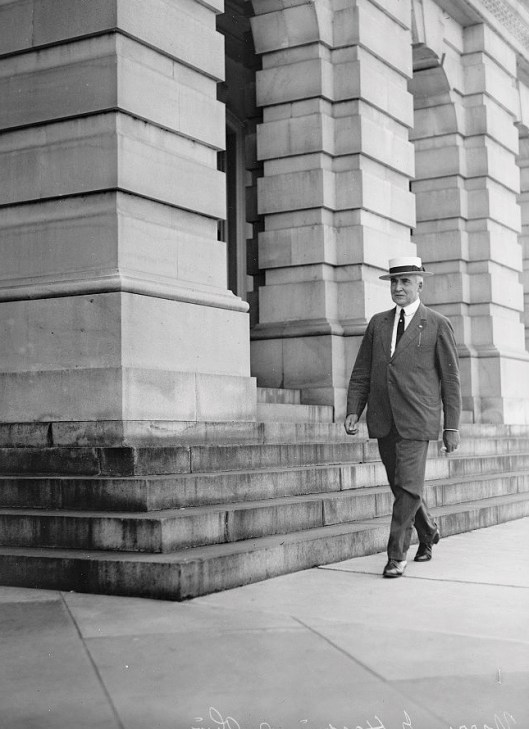
Senator Warren G. Harding (R-OH) was an advocate for Colonel Roosevelt during the Army Bill debates in April-May 1917.

By the second week of May 1917 Woodrow Wilson and both houses of Congress were furiously negotiating and ironing out the details on an Army Selective Service Bill that would institute a draft. It may surprise some to realize that almost a month and a half after the U.S. declaration of war Theodore Roosevelt’s plans for creating his own force were part of that process. In early May the Senate approved a Draft Bill, with an amendment that would have allowed the Rough Rider to create a volunteer force of up to four divisions. Roosevelt had powerful champions and detractors. Old friend and mentor Senator Henry Cabot Lodge was a reliable ally. Senator Warren G. Harding of  Ohio also backed Roosevelt’s wish to fight overseas. Lodge’s son-in-law, Congressman Augustus Peabody Gardner of Massachusetts, too was on board. Field Marshal Joseph Joffre, who was in the United States on a diplomatic and goodwill tour, also supported Roosevelt and his plan. Back in France, Clemenceau too wanted Roosevelt to join the fight. This is not surprising; the French were desperate and wanted as many boots on the ground as America could provide.

The situation reached a new phase when the House scheduled for May 12 a vote on the Army Bill. Roosevelt telegraphed Harding and Gardner on the 10th that he had not intended his division plan to impede the greater need for conscription. He could not help adding a dig, however, that had his wishes been granted a month ago things would not have come down to this. The situation was so tense because sentiment was so divided. Opponents of Roosevelt’s plan were equally powerful and included Secretary of War Newton D. Baker, most of the senior military leadership, and President Wilson himself. On May 12 the House of Representatives voted 215-178 to approve Roosevelt’s four division plan, sending the Army Bill back to conference where the House and Senate would further debate Roosevelt and the other complicated issues involved in raising the American forces needed to fight in the Great War.

(image/Library of Congress)

“Farm and Arm!”

28 Friday Apr 2017

Posted by Keith Muchowski in Great War centennial, Theodore Roosevelt Jr (President)

≈ Comments Off on “Farm and Arm!”

In January 2016 I wrote a piece for Mike Hanlon’s Roads to the Great War about how the Great War’s grain crisis was one of the immediate causes of Prohibition. Advocates for Temperance had been active for decades dating back to the mid-nineteenth century, but their moment arrived with the coming of the war in Europe. Herbert Hoover had bee active in feeding the starving masses Over There for years before America joined the Allied cause. When war finally came for the Americans in April 1917, the call for conserving American grain became only louder. One man leading that charge was Colonel Theodore Roosevelt.

At a gathering of the Long Island Farmers’ Club on April 21 Roosevelt stressed the importance of prohibiting the use of grains in distilled sprits for the duration of the war. Roosevelt had powerful like-minded allies. Senator Albert B. Cummins, a Republican from the breadbasket of Iowa no less, initiated a measure in Congress that same day that would have done that very thing. For the time being however, things remained as they were.

Europeans had been working on the problem on their own for some time. One day prior to all this, authorities in London announced that 850,000 acres of land had been repurposed over the past year across Great Britain for the planting of grains. Everyone knew the consequences. Just weeks earlier German mines and torpedoes had sunk the Belgian Relief Commission vessels the Anna Fosteness and Trevier, sending thousands of tons of grain and other foodstuffs to the ocean floor just off the coast of the Netherlands. These were only two of the most recent German attacks, which were coming almost weekly by now.

One hundred years ago today, 28 April 1917, Theodore Roosevelt was speaking to an audience of thousands at the Chicago Stock Yards. His message was much the same as it had been in Mineola when speaking to the Long Island farmers the previous week. He could not have spoken more clearly, imploring his audience to “Farm and Arm” for the fight against the Kaiser. It was not a coincidence that the Colonel had ventured to Chicago. The West had been much more apathetic to Preparedness in the leadup to America’s entry into the war. Most internationalists resided in the Northeast, where of course Roosevelt himself lived.

(image/U.S. National Archives and Records Administration)


Archie Roosevelt’s wedding

14 Friday Apr 2017

Posted by Keith Muchowski in Archibald (Archie) Roosevelt, Theodore Roosevelt Jr (President)

≈ Comments Off on Archie Roosevelt’s wedding

Boston’s Emmanuel Church was where Archie Roosevelt married Grace Lockwood one hundred years ago today.

Archibald Bulloch Roosevelt married Grace Stackpole Lockwood one hundred years ago today at Emmanuel Episcopal Church on Newbury Street in Boston. It was a quick betrothal for Archie and Grace; he proposed on April 6, not coincidentally the day Congress declared war on Germany. Theirs was just one of literally thousands of such engagements that April; in the two weeks after the declaration of war there were over 6,200 marriage licenses issued in the five boroughs of New York City alone. Many of these young newlywed men were hoping for deferments, which as it turned out were not forthcoming; the War Department would announce on April 19 that married men of draft age would not be exempt from conscription, should it indeed come to pass.

His mother and father, Edith and Theodore Roosevelt, stayed at the Hotel Victoria (the larger building). Most of Archie’s siblings and spouses too stayed the Victoria.

A deferment was not the objective for Archie Roosevelt. Like his three brothers, he was eager to join the Allied fight. Even their father Theodore Roosevelt, as we have been discussing the past few days, was hoping to join the Allied fight. It is interesting that he married a Boston girl. Presumably he met her while a students at Harvard, which is how his father met his first wife in the 1870s. Theodore, Edith and other family had taken the train from New York the evening before and ensconced themselves in a group of suites at the Hotel Victoria. The Colonel was still waiting on Wilson’s decision regrading his division.

Archie was Theodore’s third son and in some ways the most troubled. He had been expelled from Groton while a teenager. In April 1916 he was almost expelled from Harvard itself in a curious incident involving an unpaid $5 lab fee that with fines came to $15 before the thing was resolved. Reading between the lines, one can only speculate if there was more to the threatened Harvard expulsion than became publicly known. In October 1916 he had a speeding incident in Long Island in which he led a policeman on a minor police chase before pulling over and accepting his ticket and a court appointment to explain himself.. With the war on now however, all these things were in the past. Archie Roosevelt and Grace Lockwood’s wedding took place at noon. It seems to have been a quiet affair with just the immediate families in attendance. Quentin Roosevelt was the best man.

(images/Boston Public Library)

Wilson hears out Roosevelt

11 Tuesday Apr 2017

Posted by Keith Muchowski in Theodore Roosevelt Jr (President), Woodrow Wilson

≈ Comments Off on Wilson hears out Roosevelt

Last week I mentioned Theodore Roosevelt’s brief stopover in Washington DC on his way back to Oyster Bay from Florida. Roosevelt was in the capital for all of a few hours to wish Woodrow Wilson good tidings after the president’s call for war. Congress of course declared hostilities on Germany four days later, on April 6. As I noted, Roosevelt did not get his audience with the overburdened commander-in-chief and headed quickly back to New York. Four days after the declaration of war on Germany however Roosevelt was back in Washington determined to meet with the man against whom he had run for the presidency (along with the other two candidates Taft and Debs) just five years earlier. Roosevelt was determined to push his proposal for a division–to be organized and led by the one time Rough Rider himself–that would fight in France. He and Wilson met for about forty-five minutes at around 11:00 on the morning of Tuesday April 10.

Wilson was polite but noncommittal. The president had a number of competing concerns already on his mind, not least an Army Bill that would allow for a Selective Service draft. Wilson was wary of Roosevelt–how could he not be after everything The Colonel had said about the Administration since the start of the war 2 1/2 years earlier?–but understood the need to at least hear his predecessor out. For one thing Roosevelt was a champion of universal conscription, the measure for which Wilson was now most advocating. After the meeting Roosevelt made clear to the several dozen reporters gathered on the White House lawn that his division would be in addition to any American troops raised via a draft. What is more, Roosevelt declared, the men of his division would fall outside any age, marital or other criteria established by the War Department.

Roosevelt averred that he could equip his division and have it ready for transport to France within two months. This was wildly optimistic, especially given Roosevelt’s experience cooling his heals in Tampa waiting for bureaucratic snafus to be worked before he and the Rough Riders could sail for Cuba during the Spanish-American War. Any American Expeditionary Force sent to Europe would be significantly larger than the fighting force sent ninety miles off the coast of Florida to fight the Spanish. Roosevelt may have forgotten those lessons but he proved prescient about what it would take to field an American Army and have it battlefield ready. Speaking to reporters back in New York the following day, April 11, 1917, he predicted it would take the War Department a full twelve months at a minimum.


Roosevelt passes through Washington

03 Monday Apr 2017

Posted by Keith Muchowski in Theodore Roosevelt Jr (President), Washington, D.C., Woodrow Wilson

≈ Comments Off on Roosevelt passes through Washington

Theodore Roosevelt and Russell J. Coles in Florida, March 1917. This Library of Congress image is misdated 16 March 1917 in the LOC record. Roosevelt however did not leave for Florida until the 23rd of that month.

Theodore Roosevelt was at the White House briefly on this date one hundred years ago. He was trying to gain an audience with President Wilson, who intentionally or not snubbed his predecessor by claiming to be too busy with Cabinet meetings in the wake of his speech to Congress the afternoon before. Wilson likely knew what Roosevelt was there to propose: that he, Roosevelt, be allowed to raise a division and then fight in France in the war. The Colonel had been talking about it ever since diplomatic relations had been severed with Germany some week before. Roosevelt had made plans in late winter to travel to Florida with scientist Russell J. Coles and fish for shark and devilfish. When Wilson called for Congress to convene a special session for April 2 Roosevelt felt no reason to revise his plans, reasoning that there was little he could do in the meantime. And so Roosevelt boarded a train on March 23 and traveled south to fish both the Atlantic and Gulf Coasts of Florida. Roosevelt harpooned two large devilfish, one of them nearly a seventeen footer that was the second largest ever caught.

Like much of America Roosevelt was watching the news intently in those late March and early April days. Roosevelt did not gain an audience with Wilson on April 3, and he missed seeing his friend and confidante Henry Cabot Lodge as well. Roosevelt’s DC excursion must have caught official Washington off guard; Lodge certainly would have made himself available had he known Roosevelt was to be in town. At the White House Roosevelt left a flattering note for Wilson, which may or may not have been genuine, The 26th president had certainly campaigned for Preparedness and war since 1914 and so would have approved of Wilson’s call to arms; on the other hand both he and Lodge disliked Wilson intensely and the note may have been little more than an attempt to get on the president’s good side pending any decision on Roosevelt’s desire to fight in the war. Either way, Roosevelt left Washington in the late afternoon and was back in New York City by 9:00 pm, eager to see his sons and discuss the matters at hand.

(image/Library of Congress)
Hagedorn’s ‘Challenge’

10 Friday Mar 2017

Posted by Keith Muchowski in Theodore Roosevelt Jr (President), WW1

≈ Comments Off on Hagedorn’s ‘Challenge’

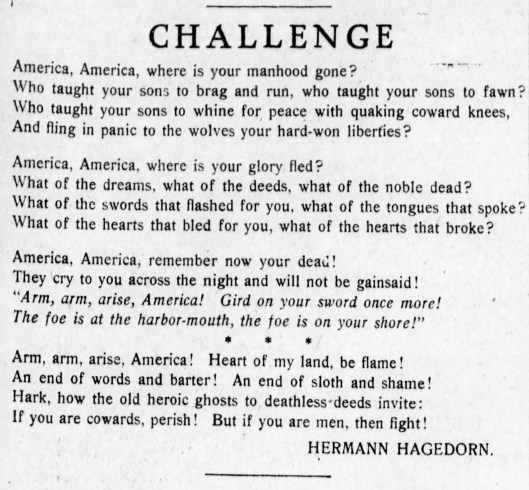
Brooklyn Daily Eagle, 10 March 1917

One hundred years ago the Brooklyn Daily Eagle published a number of readers’ poems related to the escalating war situation. As it turns out one of the submissions was by none other than Hermann Hagedorn. When Theodore Roosevelt died two years later Hagedorn became the secretary of the Roosevelt Memorial Association. He later became the director, a position he held until 1957. For more check out this post I did in 2014 on the 50th anniversary of Hagedorn’s death.

Hagedorn was a longtime acquaintance of Roosevelt. As the son of a German immigrant he was helpful in Roosevelt’s campaign against “hyphenated Americanism” in the lead-up to American involvement in the Great War. It is important to remember that Roosevelt himself had had a strong attachment to Germany prior to the war; for starters he had traveled through the country with his family as a youth, and while he was president his daughter Alice christened the kaiser’s yacht. Hagedorn believed passionately that Americans of German origin should embrace their new nation. Still, the relationship between the two was more than that. Like Roosevelt Hagedorn was a man of letters who appreciated the written word. It is safe to guess that “Challenge’ did not win any literary awards, but the poem is a fascinating look at that moment just before the United States became involved in the First World War.

“Federal Reserve Students”

02 Thursday Mar 2017

Posted by Keith Muchowski in Governors Island, Preparedness (WW1), Theodore Roosevelt Jr (President)

≈ Comments Off on “Federal Reserve Students”

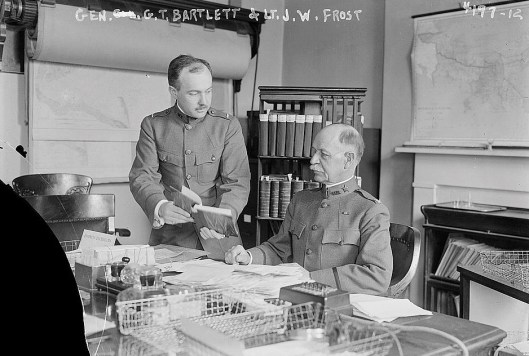
George True Blood, seen here on Governors Island in 1917 after his promotion to brigadier general, was responsible to the tens of thousands of applications pouring in to the Eastern Department that winter just before America joined the war.

George True Blood, seen here on Governors Island later in 1917 after his promotion to brigadier general, was responsible fro the tens of thousands of applications pouring in to the Eastern Department that winter just before America joined the war.

Americans were watching with increasing anxiety as the winter of 1917 moved along. Everyone was wondering what would happen with the German u-boat attacks and looking ahead to what spring and summer might bring. No one of course knew that the United Sates would enter the war the first week of April. The first week of March 1917 officials were predicting that 50,000 men and 10,000 young males between 15-18 would registeri to attend the Military Training Camps for civilians in Plattsburg, New York and elsewhere before they opened that June. They were to be called “Federal Reserve Students.”

Things had changed a great deal since the first camps in 1913; as pf summer 1917 the civilian camps were to officially be under the auspices of the Army. This had a number of implications. For one thing in previous years the men had paid their own way, which explains why most Plattsburg men came from upper class families, usually from the Northeast where interventionist sentiment was stronger than in the South and West. The Army would pay for uniforms, food, arms, and travel expenses. The duty of processing the letters of interest fell to Leonard Wood and his staff at the department of the East on Governors Island. He tasked his chief of staff Colonel George True Bartlett to take care of it.

Theodore Roosevelt was watching it all closely and was never happier than when he heard that his eighteen-year-old nephew, William Sheffield Cowles Jr., his sister Anna’s only son, was intending to attend. As it turned out, neither Cowles nor the other 60,000 boys and men attended the civilian training camps that winter. When war indeed came, the Army prioritized the camps at Plattsburg and elsewhere exclusively for military use alone.

(image/Library of Congress)
← Older posts
Newer posts →

Enter your email address to subscribe to this blog and receive notifications of new posts by email.

Join 258 other subscribers

Categories

Archives

  • November 2023 (1)
  • October 2023 (3)
  • September 2023 (3)
  • August 2023 (4)
  • July 2023 (7)
  • June 2023 (10)
  • May 2023 (8)
  • April 2023 (6)
  • March 2023 (5)
  • February 2023 (4)
  • January 2023 (4)
  • December 2022 (4)
  • November 2022 (8)
  • October 2022 (2)
  • September 2022 (4)
  • June 2022 (1)
  • May 2022 (1)
  • April 2022 (13)
  • January 2022 (1)
  • December 2021 (2)
  • November 2021 (1)
  • October 2021 (3)
  • September 2021 (3)
  • August 2021 (5)
  • July 2021 (1)
  • June 2021 (1)
  • May 2021 (4)
  • April 2021 (3)
  • March 2021 (4)
  • February 2021 (7)
  • January 2021 (4)
  • December 2020 (4)
  • November 2020 (3)
  • October 2020 (4)
  • September 2020 (7)
  • August 2020 (5)
  • July 2020 (7)
  • June 2020 (11)
  • May 2020 (7)
  • April 2020 (9)
  • March 2020 (9)
  • February 2020 (7)
  • January 2020 (6)
  • December 2019 (7)
  • November 2019 (9)
  • October 2019 (4)
  • September 2019 (6)
  • August 2019 (10)
  • July 2019 (8)
  • June 2019 (6)
  • May 2019 (9)
  • April 2019 (8)
  • March 2019 (6)
  • February 2019 (8)
  • January 2019 (5)
  • December 2018 (10)
  • November 2018 (6)
  • October 2018 (9)
  • September 2018 (11)
  • August 2018 (11)
  • July 2018 (17)
  • June 2018 (10)
  • May 2018 (8)
  • April 2018 (9)
  • March 2018 (8)
  • February 2018 (5)
  • January 2018 (7)
  • December 2017 (11)
  • November 2017 (8)
  • October 2017 (9)
  • September 2017 (11)
  • August 2017 (12)
  • July 2017 (14)
  • June 2017 (18)
  • May 2017 (11)
  • April 2017 (10)
  • March 2017 (9)
  • February 2017 (11)
  • January 2017 (14)
  • December 2016 (7)
  • November 2016 (8)
  • October 2016 (8)
  • September 2016 (9)
  • August 2016 (6)
  • July 2016 (12)
  • June 2016 (8)
  • May 2016 (9)
  • April 2016 (6)
  • March 2016 (12)
  • February 2016 (10)
  • January 2016 (9)
  • December 2015 (9)
  • November 2015 (11)
  • October 2015 (8)
  • September 2015 (9)
  • August 2015 (13)
  • July 2015 (14)
  • June 2015 (11)
  • May 2015 (11)
  • April 2015 (18)
  • March 2015 (10)
  • February 2015 (8)
  • January 2015 (8)
  • December 2014 (12)
  • November 2014 (13)
  • October 2014 (16)
  • September 2014 (11)
  • August 2014 (16)
  • July 2014 (12)
  • June 2014 (13)
  • May 2014 (10)
  • April 2014 (10)
  • March 2014 (11)
  • February 2014 (12)
  • January 2014 (10)
  • December 2013 (11)
  • November 2013 (14)
  • October 2013 (14)
  • September 2013 (14)
  • August 2013 (13)
  • July 2013 (17)
  • June 2013 (9)
  • May 2013 (13)
  • April 2013 (13)
  • March 2013 (16)
  • February 2013 (15)
  • January 2013 (15)
  • December 2012 (18)
  • November 2012 (18)
  • October 2012 (21)
  • September 2012 (14)
  • August 2012 (16)
  • July 2012 (21)
  • June 2012 (22)
  • May 2012 (24)
  • April 2012 (20)
  • March 2012 (23)
  • February 2012 (22)
  • January 2012 (15)
  • December 2011 (23)
  • November 2011 (22)
  • October 2011 (23)
  • September 2011 (18)
  • August 2011 (19)
  • July 2011 (20)
  • June 2011 (29)
  • May 2011 (25)
  • April 2011 (18)
  • March 2011 (21)
  • February 2011 (11)

Meta

  • Create account
  • Log in
  • Entries feed
  • Comments feed
  • WordPress.com
Creative Commons License
This work is licensed under a Creative Commons Attribution-NonCommercial-ShareAlike 4.0 International License.

Enter your email address to subscribe to this blog and receive notifications of new posts by email.

Join 258 other subscribers

Categories

Archives

  • November 2023 (1)
  • October 2023 (3)
  • September 2023 (3)
  • August 2023 (4)
  • July 2023 (7)
  • June 2023 (10)
  • May 2023 (8)
  • April 2023 (6)
  • March 2023 (5)
  • February 2023 (4)
  • January 2023 (4)
  • December 2022 (4)
  • November 2022 (8)
  • October 2022 (2)
  • September 2022 (4)
  • June 2022 (1)
  • May 2022 (1)
  • April 2022 (13)
  • January 2022 (1)
  • December 2021 (2)
  • November 2021 (1)
  • October 2021 (3)
  • September 2021 (3)
  • August 2021 (5)
  • July 2021 (1)
  • June 2021 (1)
  • May 2021 (4)
  • April 2021 (3)
  • March 2021 (4)
  • February 2021 (7)
  • January 2021 (4)
  • December 2020 (4)
  • November 2020 (3)
  • October 2020 (4)
  • September 2020 (7)
  • August 2020 (5)
  • July 2020 (7)
  • June 2020 (11)
  • May 2020 (7)
  • April 2020 (9)
  • March 2020 (9)
  • February 2020 (7)
  • January 2020 (6)
  • December 2019 (7)
  • November 2019 (9)
  • October 2019 (4)
  • September 2019 (6)
  • August 2019 (10)
  • July 2019 (8)
  • June 2019 (6)
  • May 2019 (9)
  • April 2019 (8)
  • March 2019 (6)
  • February 2019 (8)
  • January 2019 (5)
  • December 2018 (10)
  • November 2018 (6)
  • October 2018 (9)
  • September 2018 (11)
  • August 2018 (11)
  • July 2018 (17)
  • June 2018 (10)
  • May 2018 (8)
  • April 2018 (9)
  • March 2018 (8)
  • February 2018 (5)
  • January 2018 (7)
  • December 2017 (11)
  • November 2017 (8)
  • October 2017 (9)
  • September 2017 (11)
  • August 2017 (12)
  • July 2017 (14)
  • June 2017 (18)
  • May 2017 (11)
  • April 2017 (10)
  • March 2017 (9)
  • February 2017 (11)
  • January 2017 (14)
  • December 2016 (7)
  • November 2016 (8)
  • October 2016 (8)
  • September 2016 (9)
  • August 2016 (6)
  • July 2016 (12)
  • June 2016 (8)
  • May 2016 (9)
  • April 2016 (6)
  • March 2016 (12)
  • February 2016 (10)
  • January 2016 (9)
  • December 2015 (9)
  • November 2015 (11)
  • October 2015 (8)
  • September 2015 (9)
  • August 2015 (13)
  • July 2015 (14)
  • June 2015 (11)
  • May 2015 (11)
  • April 2015 (18)
  • March 2015 (10)
  • February 2015 (8)
  • January 2015 (8)
  • December 2014 (12)
  • November 2014 (13)
  • October 2014 (16)
  • September 2014 (11)
  • August 2014 (16)
  • July 2014 (12)
  • June 2014 (13)
  • May 2014 (10)
  • April 2014 (10)
  • March 2014 (11)
  • February 2014 (12)
  • January 2014 (10)
  • December 2013 (11)
  • November 2013 (14)
  • October 2013 (14)
  • September 2013 (14)
  • August 2013 (13)
  • July 2013 (17)
  • June 2013 (9)
  • May 2013 (13)
  • April 2013 (13)
  • March 2013 (16)
  • February 2013 (15)
  • January 2013 (15)
  • December 2012 (18)
  • November 2012 (18)
  • October 2012 (21)
  • September 2012 (14)
  • August 2012 (16)
  • July 2012 (21)
  • June 2012 (22)
  • May 2012 (24)
  • April 2012 (20)
  • March 2012 (23)
  • February 2012 (22)
  • January 2012 (15)
  • December 2011 (23)
  • November 2011 (22)
  • October 2011 (23)
  • September 2011 (18)
  • August 2011 (19)
  • July 2011 (20)
  • June 2011 (29)
  • May 2011 (25)
  • April 2011 (18)
  • March 2011 (21)
  • February 2011 (11)

Meta

  • Create account
  • Log in
  • Entries feed
  • Comments feed
  • WordPress.com
Creative Commons License
This work is licensed under a Creative Commons Attribution-NonCommercial-ShareAlike 4.0 International License.

Enter your email address to subscribe to this blog and receive notifications of new posts by email.

Join 258 other subscribers

Categories

Archives

  • November 2023 (1)
  • October 2023 (3)
  • September 2023 (3)
  • August 2023 (4)
  • July 2023 (7)
  • June 2023 (10)
  • May 2023 (8)
  • April 2023 (6)
  • March 2023 (5)
  • February 2023 (4)
  • January 2023 (4)
  • December 2022 (4)
  • November 2022 (8)
  • October 2022 (2)
  • September 2022 (4)
  • June 2022 (1)
  • May 2022 (1)
  • April 2022 (13)
  • January 2022 (1)
  • December 2021 (2)
  • November 2021 (1)
  • October 2021 (3)
  • September 2021 (3)
  • August 2021 (5)
  • July 2021 (1)
  • June 2021 (1)
  • May 2021 (4)
  • April 2021 (3)
  • March 2021 (4)
  • February 2021 (7)
  • January 2021 (4)
  • December 2020 (4)
  • November 2020 (3)
  • October 2020 (4)
  • September 2020 (7)
  • August 2020 (5)
  • July 2020 (7)
  • June 2020 (11)
  • May 2020 (7)
  • April 2020 (9)
  • March 2020 (9)
  • February 2020 (7)
  • January 2020 (6)
  • December 2019 (7)
  • November 2019 (9)
  • October 2019 (4)
  • September 2019 (6)
  • August 2019 (10)
  • July 2019 (8)
  • June 2019 (6)
  • May 2019 (9)
  • April 2019 (8)
  • March 2019 (6)
  • February 2019 (8)
  • January 2019 (5)
  • December 2018 (10)
  • November 2018 (6)
  • October 2018 (9)
  • September 2018 (11)
  • August 2018 (11)
  • July 2018 (17)
  • June 2018 (10)
  • May 2018 (8)
  • April 2018 (9)
  • March 2018 (8)
  • February 2018 (5)
  • January 2018 (7)
  • December 2017 (11)
  • November 2017 (8)
  • October 2017 (9)
  • September 2017 (11)
  • August 2017 (12)
  • July 2017 (14)
  • June 2017 (18)
  • May 2017 (11)
  • April 2017 (10)
  • March 2017 (9)
  • February 2017 (11)
  • January 2017 (14)
  • December 2016 (7)
  • November 2016 (8)
  • October 2016 (8)
  • September 2016 (9)
  • August 2016 (6)
  • July 2016 (12)
  • June 2016 (8)
  • May 2016 (9)
  • April 2016 (6)
  • March 2016 (12)
  • February 2016 (10)
  • January 2016 (9)
  • December 2015 (9)
  • November 2015 (11)
  • October 2015 (8)
  • September 2015 (9)
  • August 2015 (13)
  • July 2015 (14)
  • June 2015 (11)
  • May 2015 (11)
  • April 2015 (18)
  • March 2015 (10)
  • February 2015 (8)
  • January 2015 (8)
  • December 2014 (12)
  • November 2014 (13)
  • October 2014 (16)
  • September 2014 (11)
  • August 2014 (16)
  • July 2014 (12)
  • June 2014 (13)
  • May 2014 (10)
  • April 2014 (10)
  • March 2014 (11)
  • February 2014 (12)
  • January 2014 (10)
  • December 2013 (11)
  • November 2013 (14)
  • October 2013 (14)
  • September 2013 (14)
  • August 2013 (13)
  • July 2013 (17)
  • June 2013 (9)
  • May 2013 (13)
  • April 2013 (13)
  • March 2013 (16)
  • February 2013 (15)
  • January 2013 (15)
  • December 2012 (18)
  • November 2012 (18)
  • October 2012 (21)
  • September 2012 (14)
  • August 2012 (16)
  • July 2012 (21)
  • June 2012 (22)
  • May 2012 (24)
  • April 2012 (20)
  • March 2012 (23)
  • February 2012 (22)
  • January 2012 (15)
  • December 2011 (23)
  • November 2011 (22)
  • October 2011 (23)
  • September 2011 (18)
  • August 2011 (19)
  • July 2011 (20)
  • June 2011 (29)
  • May 2011 (25)
  • April 2011 (18)
  • March 2011 (21)
  • February 2011 (11)

Meta

  • Create account
  • Log in
  • Entries feed
  • Comments feed
  • WordPress.com
Creative Commons License
This work is licensed under a Creative Commons Attribution-NonCommercial-ShareAlike 4.0 International License.

Blog at WordPress.com.

  • Subscribe Subscribed
    • The Strawfoot
    • Join 229 other subscribers
    • Already have a WordPress.com account? Log in now.
    • The Strawfoot
    • Subscribe Subscribed
    • Sign up
    • Log in
    • Report this content
    • View site in Reader
    • Manage subscriptions
    • Collapse this bar
 

Loading Comments...