
Posted by Keith Muchowski | Filed under Uncategorized
≈ Comments Off on Happy President’s Day

16 Monday Feb 2015
12 Thursday Feb 2015
Posted in Uncategorized

The USA-USSR medal game: 22 February 1980
Last night for the second evening in a row I watched the ESPN 30 for 30 documentary Of Miracles and Men. The film recounts the history and aftermath of the 1980 Olympic hockey match between the United States and the Soviet Union from the Soviet players’ perspective. It is an especially moving film and one that you can watch online at least for the time being.
Because I grew up in South Florida hockey was never much on my radar. I do vividly remember the game though, including some incidents that many people forgot or never knew. First of all, as ESPN anchor Bob Ley reminds us in a tie-in, the game was not live on American television. It was shown on tape delay a few hours later. Also—and I don’t recall the film mentioning this—the underdog Americans did not beat the powerful Soviets for the gold medal. The Olympic hockey tournament at this time was a round robin contest in which each of the teams that made the medal round played each other once. The US-USSR game was the penultimate match. If the Americans had lost to Finland in the final game and the Soviets defeated the Swedes by a certain margin the United States would not have medaled in the tournament. Think about it.
This is the second of two documentaries about Soviet hockey that have been released in the past several weeks. I still have yet to see Red Army, which has been playing at festivals and on big screens in some cities. From what I understand that film too uses Slava Fetisov as its main protagonist. I don’t know much about Fetisov—again, I grew up far removed from hockey—but in this film he comes across as thoughtful and courageous. He had to be; Fetisov was one of the first players from the Soviet national team to play in the NHL. The generals and politicians, not to mention coach Viktor Tikhonov, did everything they could to prevent that. Fetisov nonetheless paved the way and eventually won two Stanley Cups with the Detroit Red Wings as part of the Russian Five.
The other hero was original Soviet hockey coach Anatoli Tarasov. The Soviets came to power after the First World War and Russian Civil War. When the country emerged as a full-blown superpower in 1945 the Soviet leadership tasked Tarasov to create a hockey program. The thing was, the game had never been played in the USSR. Starting from the ground up, Tarasov built a program based as much on chess and the Russian ballet as it was hockey. He intentionally avoided watching game film from the U.S. and Canada because he wanted to create a program based on his own vision. He succeeded beyond anyone’s wildest imagination and then, for political reasons, it was all cruelly taken away from him in 1972. Tarasov was only fifty-four.
The worst thing that happened to the Soviets—other than that 4-3 loss in Lake Placid—was their 10-3 win over the same American squad in Madison Square Garden just two weeks before. The New York Daily News uploaded the original article a few days ago. The Soviets arrived in upstate New York overconfident. Still things were going well until that match with the Americans. Many still see Coach Tikhonov’s decision to take goalie Vladislav Tretiak out of the USA-USSR medal game as an act of panic and desperation. I always thought it demonstrated his arrogance. Tikhonov believed the whole time that his team would beat the Americans with or without Tretiak. If he could teach the great goalie a lesson at the same time so much the better. Tikhonov’s putting back-up Vladimir Myshkin in the net makes the Seahawks’ decision to pass from the one-yard line look trivial.
It is hard to believe the Miracle on Ice was thirty-five years ago. So much has changed in the world since then. These winter days are a good time to look back on that era that now seems so far away.
(image/Henry Zbyszynski)
28 Sunday Dec 2014
Posted in Uncategorized
≈ Comments Off on Sunday evening coffee
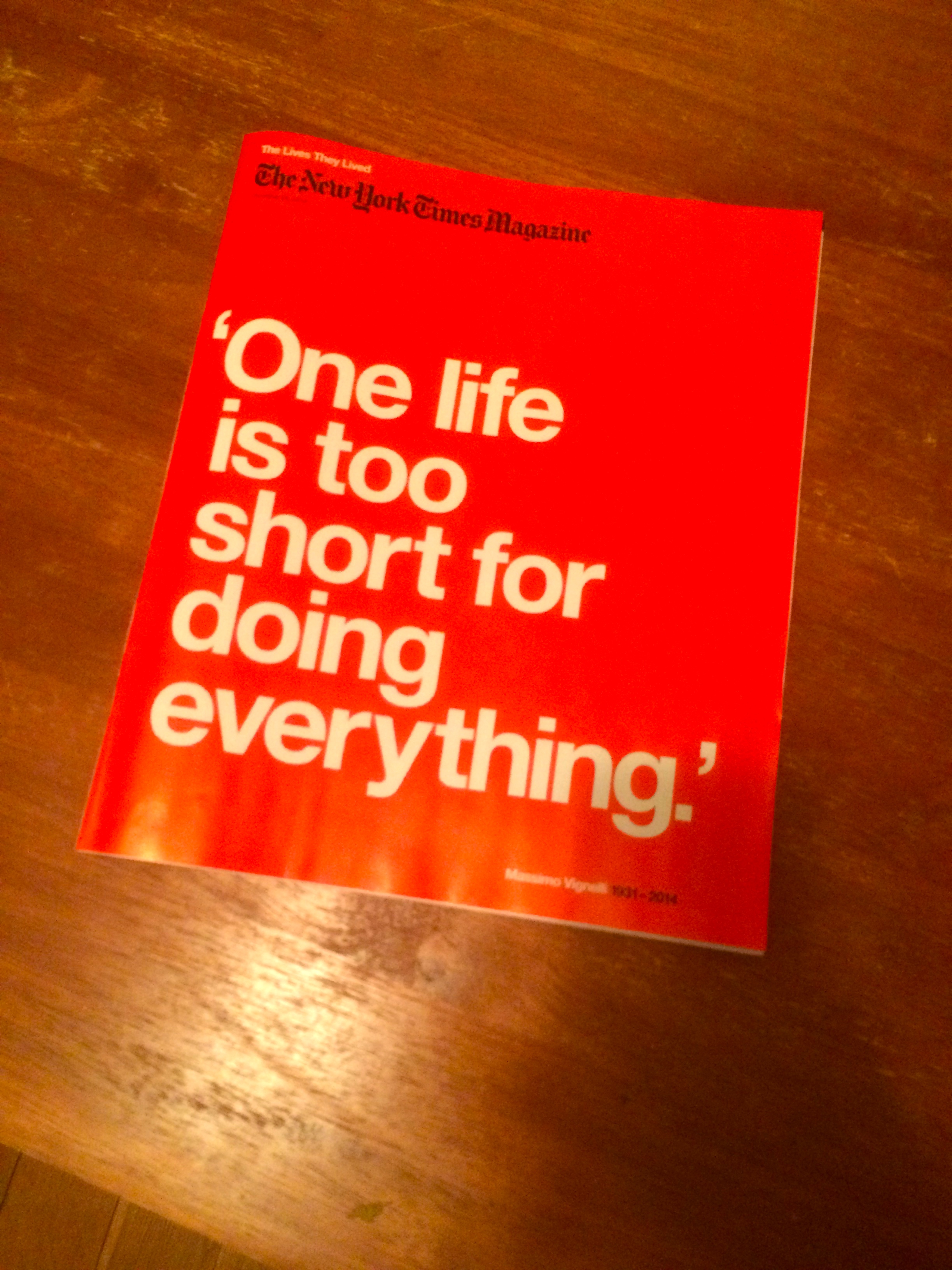
You know New Years is close when The Lives They Lived hits the stands.
I hope everyone had a good holiday. Posting will continue to be light between now and the first of the new year. A friend from outside the country was visiting us these past few days. After he left for the airport I walked up to the newsstand to get the Sunday Times. Because it is the final Sunday of the year the magazine has its annual The Lives They Lived edition. I have written about this before and so will not go into the details again. Looking quickly through the contents I see that they have covered Red Klotz, the owner of the Washington Generals; Tony Gwynn, and together Casey Kasem and Don Pardo. As I get older the end of the year is increasingly a time of introspection. This is especially true since my father and father-in-law died. At their best the vignettes in the Times end of the year special evoke moments and worlds that no longer exist. The strangest thing is that I am now old enough to remember many of them. I suppose it was ever thus.
Details will be forthcoming if it comes to pass, but I am trying to get Park Service permission to write and conduct a program for the sesquicentennial of the Lincoln assassination. The next step is to write the outline and explain the scope and parameters. I am really hoping this comes to pass. If it does I will announce it here. It is hard to believe the Civil War sesquicentennial will be coming to an end in April. The Hayfoot and I began marking the 150th over five years ago with the anniversary of John Brown’s raid. The Roosevelt Sr. books proceeding apace. I have what I think are some good ideas for the Great War centennial.
Enjoy the rest of your holiday season.
25 Thursday Dec 2014
Posted in Uncategorized
≈ Comments Off on The USS Jason’s Christmas voyage

Workers and volunteers in Brooklyn pack the last of the toys donated to the children of Europe rendered homeless in the early months of the Great War, 14 November 1914
Millions of children in Europe had at least a semblance of Christmas a century ago today in part due to the people of the United States. The USS Jason left Brooklyn’s Bush Terminal on 14 November 1914 en route to Europe. Its mission was to deliver six million toys to the children of war-ravaged Europe. The Jason was the first Christmas ship of the Great War. It left so early because it had many stops to make. British torpedo boats escorted the Jason into Devonport England in late November. The toy project maintained strict neutrality. After unloading toys for the children of England, the Jason sailed to Holland to drop off a shipment for the Belgians. Then it was on to Genoa Italy in mid-December for a final unloading intended for the children of Germany, Russia, and Austro-Hungary.
(image/Library of Congress)
25 Thursday Dec 2014
Posted in Uncategorized
≈ Comments Off on Merry Christmas
17 Monday Nov 2014
Posted in Uncategorized
≈ Comments Off on Armistice Day 1938
The World War One Centennial Commission has posted my article about the 1938 Armistice Day on its Facebook page. If so inclined, be sure to like the page to receive regular updates via the Commission. I can tell you that they are doing a lot of worthwhile things for the anniversary of the Great War.

A parade was part of the dedication of the New York Fair’s Court of Peace, 11 November 1938

Clergymen of different denominations shared the stage with military and political dignitaries.
(images/NYPL)
14 Friday Nov 2014
Posted in Uncategorized
≈ Comments Off on The Great Was as impediment to human progress
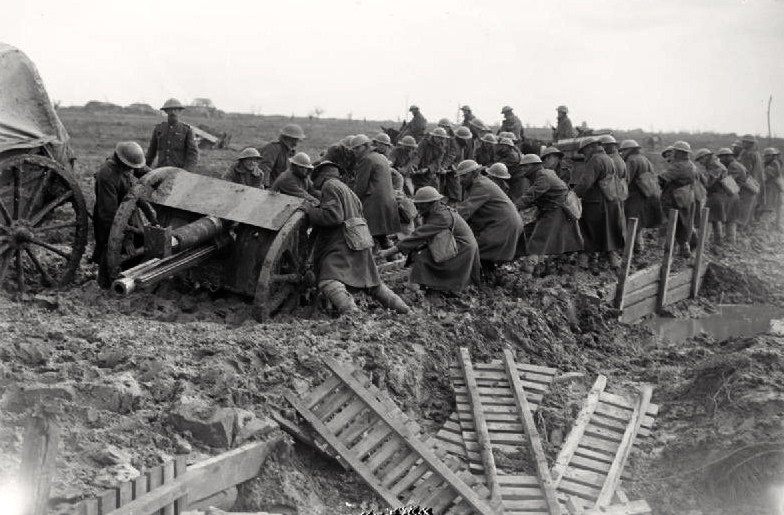
British Tommies toil in the mud at Third Ypres, October 1917
This article is a little dense but I wanted to pass along Wilfred M. McClay’s article about the First World War and what it did to the notion of human progress. I remember being in graduate school 10+ years ago and having this discussion with my professor in a class on Modernity. One of the most fascinating aspects of World War One is that it came at a moment when two opposing notions were running parallel to each other. Never was Europe stronger; never did it control so much of the earth’s surface; never did the future, with its rationalism and idea of scientific progress, seems so limitless. Yet things were tenuous underneath–and not so far underneath–the surface. Reactionary monarchies ruling over unwieldy constituencies. Social strife. Nascent colonial independence movements. Jim Crowism and racial unrest here in the United States. These were all there as well. How these problems might have been resolved had the war not come we will never know.
As McClay notes, there is still an odd duality in our consciousness. On one side there is the hand-ringing and the postmodern nihilism that says we can never find objective truth; at the same time many in the West still believe it is possible to intercede and improve the world’s lot through thoughtful effort. Think of Bill Gates’s work on eradicating West Nile virus. It could be that one needs the notion of Progress in order to move forward. Still, the idea can have disastrous results and unintended consequences. Think about current events from our own recent past.
(image/Imperial War Museum)
11 Tuesday Nov 2014
Posted in Uncategorized
≈ Comments Off on The Armistice’s fifth anniversary
Today is Veterans Day, or what used to be called Armistice Day because the day was reserved to remember the end of the fighting on 11 November 1918. One of the major figures in the early memory of the Great War was Ted Roosevelt, the oldest son of 26th president. Roosevelt had been an officer in the 26th Regiment of the FIrst Infantry Division during the war. After, he co-founded the American Legion. Roosevelt also served as Assistant Secretary of the Navy. This was the position once held by his father and later by his cousin Franklin. As Assistant Navy Secretary he was part of the Harding and then Coolidge Administrations. Here he is with Silent Cal at the Tomb of the Unknown Soldier on Armistice Day 1923, five years after the guns fell silent.

Ted Roosevelt (second from right) with President Coolidge (hand toward face) and Secretary of War John Weeks, 11 November 1923
This was a crucial time in 20th century history. The New York Times reported the day before the photo above was taken that “a sign painter from Austria” with “a gift for demagogic oratory” was causing trouble in Munich. This was Adolf Hitler’s Beer Hall Putsch. Others noted the fragile nature of the peace. The day the Times reported on Hitler, Woodrow Wilson gave a radio address in which he discussed the fragile peace. The following day 15,000 people showed up at his house on S Street in Washington to see him in person. Wilson’s health was fragile; he died less than three months later. Wilson had cause for concern. It was not just Hitler. The Brooklyn Daily Eagle noted with concern on 12 November that many of Europe’s “wisest statesman” were calling also calling for dictatorship. Even an American, a graduate of the Harvard class of 1909, had participated in Hitler’s attempted takeover.
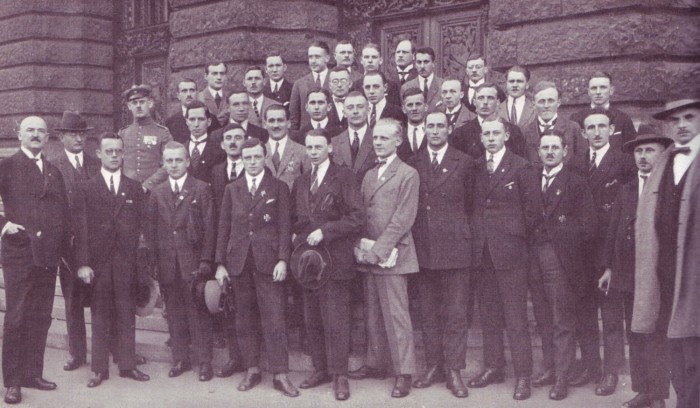
Defendants in Hitler’s Beer Hall Putsch at their trial in Munch, April 1924. The putsch took place a few days before the fifth anniversary of the armistice that ended the First World War.
No one understood the dangers more that Ted Roosevelt. He resumed his civilian life in the 1920s and 1930s, but returned to military service when the Second World War began. Again a member of the First Infantry he served in North Africa, Italy, and Europe. He was the only American general to land on the beach of Normandy on 6 June 1944. Ted Roosevelt died of a heart attack the following month, the day before he was to be promoted to major general.
(images/top, Library of Congress; bottom, Berlin Document Center)
09 Sunday Nov 2014
Posted in Uncategorized
I had an exhausting and exhilarating day today. It was day one of The Center for Jewish History’s Conference on World War 1 and the Jews. It will take me weeks, months really, to absorb and digest everything I learned. I took copious notes. It is amazing to live in New York City and attend these types of events and then walk back onto the street where people are going about their day. I am too tired to share much right now, but one neat thing did happen. After one of the sessions the moderator invited the audience to check out the two exhibits that opened this weekend. These are The Kaiser’s Call to Arms: Jewish Expression in the Great War and German Jews at the Eastern Front in WW1: Modernism Meets Tradition.
Many people were looking at the displays when I noticed a woman paying close attention to one case. Incredibly she was comparing the war medals of one Carl Rosenwald with those of her grandfather. As you might imagine this drew considerable interest from many of the guests. Here are a few photos.

The Great War medals of Carl Rosenwald (left, in display case) and Ernst Backarach (right, on top of case)
The medals of the two men are not all the same, but you will note that a few of them are. Both men appear to have been from Munich; they each received the Bavarian Military Merit Cross. There is a King Ludwig Cross in each set as well. Then there are the Prince Luitpold medals. It was extraordinary to see these after listening to such authoritative speakers talking about the war and its causes and consequences.
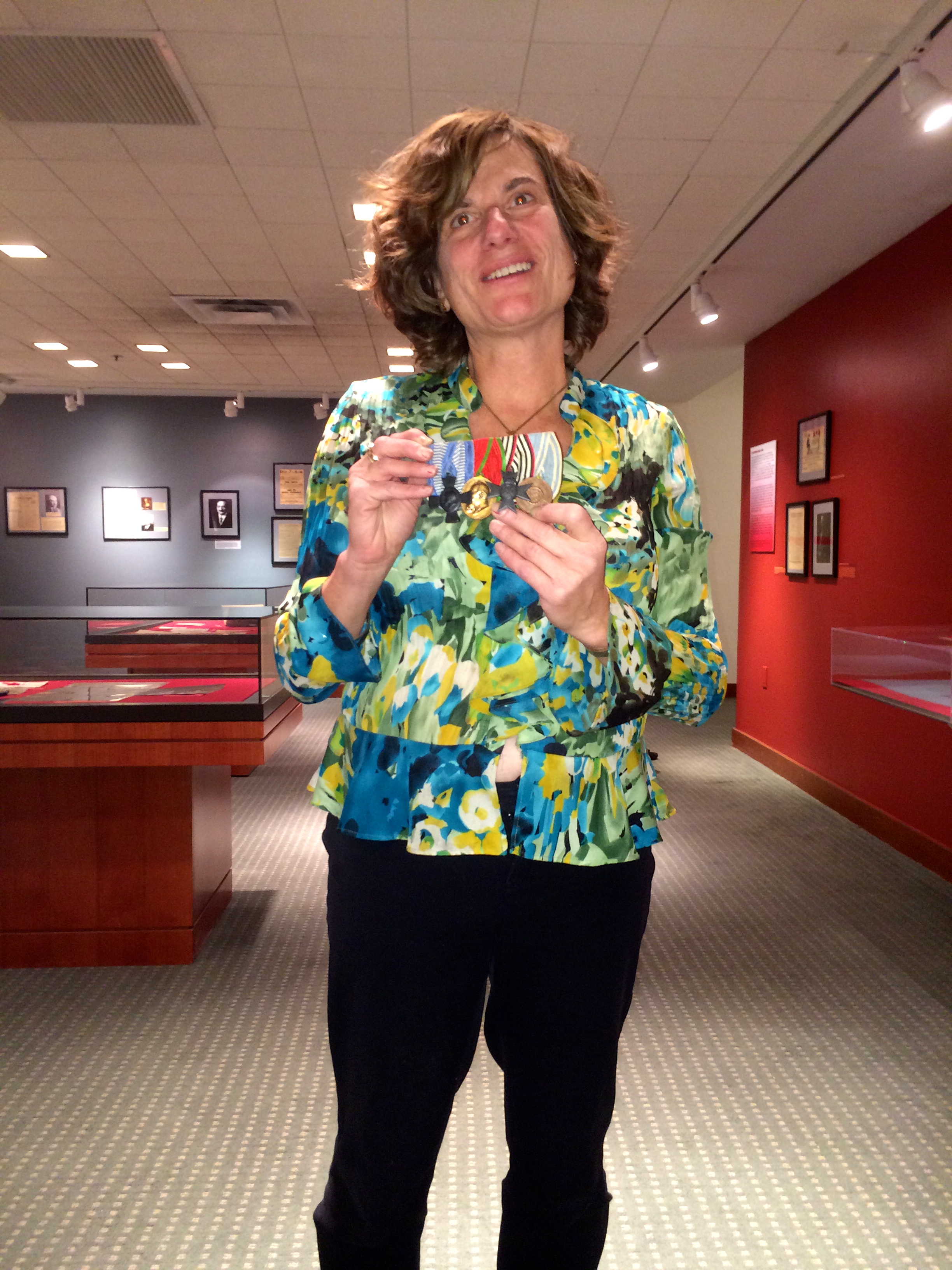
Ernst Bacharach’s granddaughter shows the medals he earned during the Great War. Bacharach came to the United States at the start of the Second World War.

As one might imagine public interest in Bacharach’s story was keen. There is nothing like making a tangible connection to history.
31 Friday Oct 2014
Posted in Uncategorized
≈ Comments Off on Happy Halloween

Green-Wood Cemetery mausoleum, October 2014
 The Strawfoot