• About

The Strawfoot

~ a New Yorker's American History blog

The Strawfoot

Category Archives: WW1

Looking forward at the end of the year

30 Friday Dec 2016

Posted by Keith Muchowski in New York City, WW1

≈ Comments Off on Looking forward at the end of the year

In doing the research for the posts this past week on the USS New York and the fleet review of December 1918 I came across sobering articles about a riot involving African-American troops from the Bush Terminal in late 1918. Really it was just one in a number of racial and other disturbances throughout the city, indeed throughout the country, during and immediately after the war. This one involved some men denied service at a saloon on DeKalb Avenue and quickly escalated into a scene with 2000 lookers-on and 150 military and civilian police. Shots were fired but no one was killed or injured. Incidents like these are part of why the Great War plays a smaller role in the imaginations of most Americans than other of our conflicts. Expectations so high in America and around the world in those heady days after the Armistice soon became mired in complexity and dashed hopes.

Brooklyn's Bush Army Terminal was integral to the war effort.

Brooklyn’s Bush Terminal was integral to the war effort.

Troops began coming home in that final week of 1918, a process that would continue in February and March of 1919. The end of our own year right now has me reflective on what happened in this heady months just after the Armistice. Temperance and suffragism were two goals of the Progressive Movement that came to fruition after the fighting stopped. What eventually came to be called the New Negro Movement was also coalescing. Scholars like W.E.B. DuBois believed that African-American soldiers returning from the Great War would comprise a vanguard that would end Jim Crow. That came partially true in cultural movements such as the Harlem Renaissance. In the meantime there were incidents like the bloody Red Summer of 1919. The relatively minor incident at a bar in Brooklyn was just a precursor. These are all topics to be explored as the Great War Centennial continues.

(image/Library of Congress)
The Christmas Ship

24 Saturday Dec 2016

Posted by Keith Muchowski in New York City, WW1

≈ 6 Comments

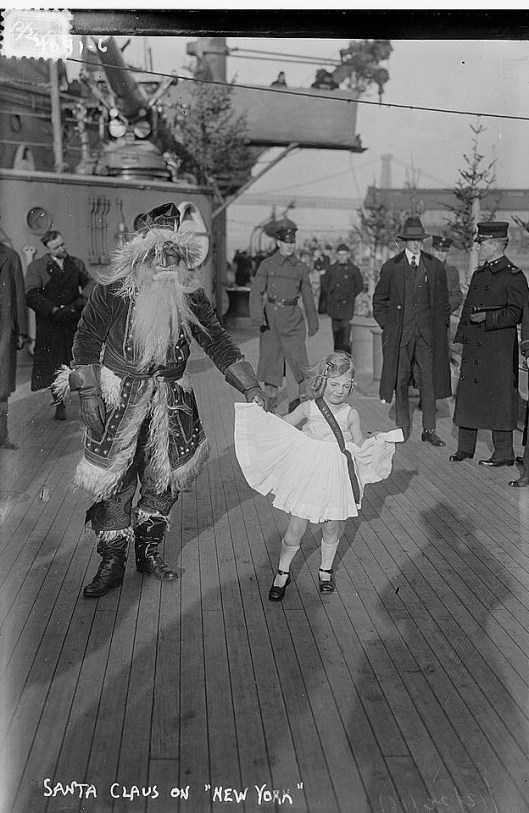
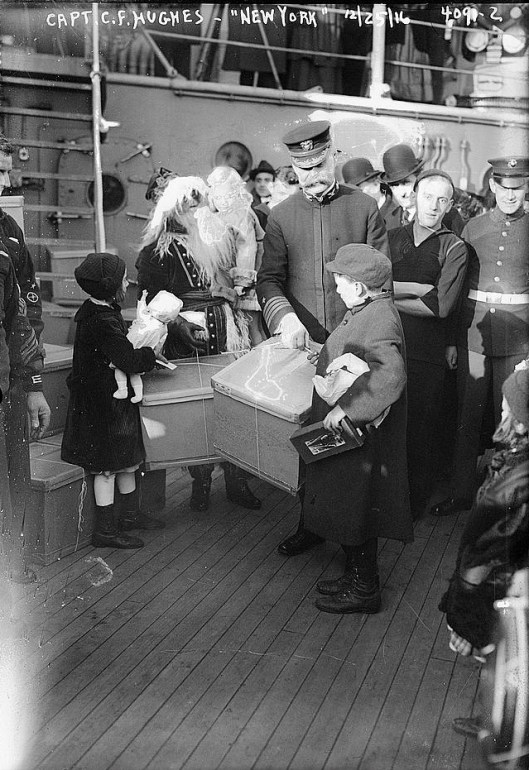
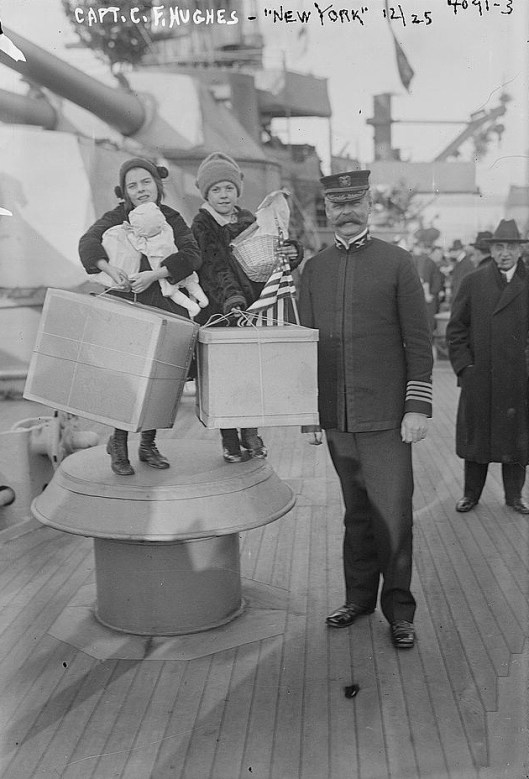
It is a rainy Christmas Eve morning here in Brooklyn. Listening to the rain is quite relaxing. I just wrapped up and emailed off a small project that hopefully will see the light of day in the next few weeks. I don’t want to give too much away for the moment but I will say here that it is about the USS New York. Yesterday I came across these incredible images at the Library of Congress Prints and Images website and thought I would share them today. They were taken aboard the New York in the Brooklyn Navy Yard one hundred years ago, on Christmas Day 1916.

I am submitting them with little comment but will note that the funds for the gifts and toys were provided by the crew. On his own dime the ship photographer printed 1917 calendars with images of Captain Hughes and others, which he then sold for 30 cents apiece. The ship tailor raffled off a custom made suit, and so forth. For its endeavor, which it had begun the year before after returning from the blockade of Veracruz, the New York became known as the Christmas Ship. For Christmas 1916 they raised $1000–over $22,000 in today’s currency–and provided toys and Christmas dinner to 500 needy New York children. One year after these images were taken the United States was in the Great War and the dreadnought was attached to Britain’s Grand Fleet, keeping the Germans in check in the North Sea.

A few things: notice the Williamsburg Bridge in the background of some of the images; also note the stamps in some of the images, which I intentionally did not crop out. I could not tell if these were revenue stamps, and if so why they would be necessary. If anyone knows, I’d be interested to learn.

Merry Christmas, everyone.

23483v

23486v

23484r

23489r

23482v

Josephus Daniels looks back on 1916

19 Monday Dec 2016

Posted by Keith Muchowski in Franklin Delano Roosevelt, Woodrow Wilson, WW1

≈ 2 Comments

With the election over and the year winding down Naval Secretary Josephus Daniels issued his annual report in December 1916.

With the election over and the year winding down Naval Secretary Josephus Daniels issued his annual report in December 1916.

Woodrow Wilson had won re-election by the time his Secretary of the Navy, Josephus Daniels, submitted his annual report on the state of the Navy in December 1916. In his communiqué Daniels singled out the Brooklyn Navy Yard for distinction. It was a busy era at the facility on the East River across from Manhattan; everyone knew that ships would be increasingly important with the coming completion of the Panama Canal. Construction of the USS New York and Florida had begun even before the outbreak of the Great War, and the Arizona came soon after.

During the hot summer of 1916 Daniels pushed for a greater expansion of the Navy, advocating for 100+ new ships. This was good news to Daniels’s assistant, the rising politico, Preparedness advocate, and avid amateur naval historian Franklin Delano Roosevelt. FDR had personally attended the laying of the keel for the USS Arizona in March 1914, the same month Wilson entered the White House. Now, 2 1/2 years later, Secretary Daniels wrote that the Brooklyn Navy Yard had “demonstrated an increase of efficiency in new construction” and added that “the actual cost” of the Arizona in real dollars was much lower when compared with that of those even slightly older ships. The cost per ton of the Florida had been $286, of the New York $233, and of the Arizona $211.

(image/Library of Congress)

1939: another generation for the American Field Service

26 Saturday Nov 2016

Posted by Keith Muchowski in WW1, WW2

≈ Comments Off on 1939: another generation for the American Field Service

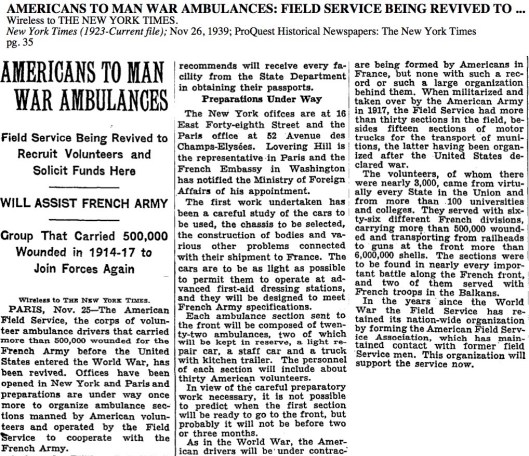
an excerpt from the New York Times article about American drivers leaving for Europe in 1939

an excerpt from the New York Times article about American drivers leaving for Europe in November 1939

Yesterday I was working on a small project that hopefully will come to pass in 2017. I don’t want to go too much into the details just yet; we’ll see how things go. I did come across something I thought worth sharing: this 26 November 1939 New York Times article about the next generation of American Field Service ambulance drivers heading off for Europe. This is the cohort that would serve in the Second World War. Oddly enough, their departure fell between Franksgiving on the 23rd and Thanksgiving on the 30th. The AFS story began in 1914 when idealistic young men, usually from America’s finest universities, left their campuses for the field hospitals of Flanders, Italy and elsewhere. We had a reconstructed WW1 AFS ambulance at Governors Island on Doughboy Day this past September which drew large crowds.

When war came to Europe again in September 1939, the AFS picked up where it left off after the Armistice and Treaty of Versailles twenty years earlier. It’s interesting to note the initial centers were Paris and New York City, as they were during the First World War. November 1939 was of course six months prior to the German occupation of Paris. I imagine that by summer 1940 the Parisian offices had relocated either to Vichy France or to another European city.

Plus ça change . . .

08 Tuesday Mar 2016

Posted by Keith Muchowski in WW1

≈ Comments Off on Plus ça change . . .

Baruch during the Great War

WIB Chairman Baruch during the Great War

Last week the Pentagon announced that it has appointed former Google CEO Eric Schmidt to lead a new Defense Innovation Advisory Board. What the Defense Department hopes Schmidt can do is update its aging information technology infrastructure, which like most of our government bureaucracies’ it infrastructure is woefully inadequate. Hopefully Schmidt and his colleagues can do something about that. Not least are the hacking threats to which the outdated systems are suseptible. Esquire’s Charles Pierce notes that this is not the first time the American military has turned to C-level talent to fix its problems. During the First World War Bernard Baruch ran the War Industries Board to bring the woefully unprepared American Expeditionary Force up to speed for its task at hand.

(image/Library of Congress)

Secretary Garrison resigns

10 Wednesday Feb 2016

Posted by Keith Muchowski in Woodrow Wilson, WW1

≈ Comments Off on Secretary Garrison resigns

at his office in the State, War, and Navy Building

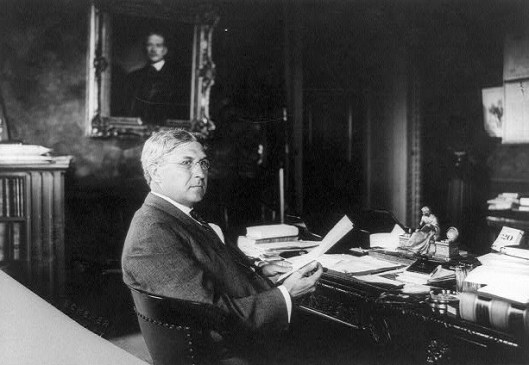
Garrison at his office in the State, War, and Navy Building

They have uploaded my article about the resignation of Lindley M. Garrison over at Roads to the Great War. Woodrow Wilson’s Secretary of War stepped down one hundred years ago today under intense pressure over a disagreement with the president about how best to prepare for American involvement in the First World War.

(image/Library of Congress)
Sunday morning coffee

03 Sunday Jan 2016

Posted by Keith Muchowski in Herbert Hoover, Woodrow Wilson, WW1

≈ 2 Comments

3g10020vYesterday Mike Hanlon over at Roads to the Great War posted my article about the grain crisis and Prohibition. In a nutshell, the drys used the food shortage as a means to further their goal of passing the Eighteenth Amendment. Anti-Irish and, especially, anti-German sentiments were also part of the equation. Please read the whole piece. It’s a fascinating topic, and Hoover and Wilson found themselves unfortunately stuck in the middle.

On a more general note, if you have not done so already please check out Mike’s website worldwar1.com for extensive coverage of the WW1 centennial. For years now he and his staff have been maintaining several web platforms relating to the conflict. They do a great job discussing the war in all its complexity. The Great War centennial is an opportune time to take a fresh look at these events that did so much to shape the world we live in today.

(image/Library of Congress)
Remembering Millard Fillmore Cook

29 Tuesday Dec 2015

Posted by Keith Muchowski in Governors Island, Those we remember, WW1

≈ Comments Off on Remembering Millard Fillmore Cook

Millard Fillmore Cook served under General Pershing on the Mexican border in 1916. The following year he was discharged from the 106th (23rd) due to a broken leg. He served forty-one in the New York State militia.

Millard Fillmore Cook served under General Pershing on the Mexican border in 1916. The following year he was discharged from the 106th (23rd) Regiment due to a broken leg. He served forty-one years in the New York State militia.

This month marks one of the smaller but nonetheless poignant moments in the early months of America’s involvement in the Great War. Millard F. Cook was discharged from the 106th Infantry Regiment in December 1917. The 106th was the  designation for the old 23rd New York Infantry Regiment before its calling into national service for eventual deployment to France. Millard F. Cook had joined the 23rd in December 1876 and by time of the American declaration of war in April 1917 was the oldest officer in the entire New York State National Guard. Corporal Cook was in the militia during the Great Railroad Strike in 1877 and was an officer as part of the Punitive Expedition on the Mexican border in 1916.

One sees the two calls to national service. New York Governor John A. Dix appointed Cook a brevet captain in 1912. Five years later a Governors Island medical board recommended his honorable discharge on medical grounds.

One sees the two calls to national service. New York Governor John A. Dix also appointed Cook a brevet captain in 1912. Five years later a Governors Island medical board recommended Lieutenant Cook’s honorable discharge on medical grounds.

Cook (1855-1934) was born during the Franklin Pierce Administration six years prior to the onset of the Civil War.

Cook (1855-1934) was born during the Franklin Pierce Administration six years prior to the onset of the Civil War.

Cook was born in Detroit in 1855 but moved to Brooklyn, NY with his family as a young child. He apparently believed in commitment and longevity; Cook was an accountant with the New York Sun for sixty-two years, a national guardsmen for forty-one, and a church musician and musical director for much of that same time. Newspaper accounts show him directing such efforts as Gilbert and Sullivan’s H.M.S Pinafore, the Haydn Vocal Society of Brooklyn, and numerous congregational musical groups for decades. Cook was elected secretary of the 23rd Infantry’s Council of Officers in February 1917. However when the Great War came he was not destined to go to Europe with the men of his unit. The 23rd was nationalized as the 106th that spring, but Cook broke his leg in a car accident during a training exercise in Upstate New York on May 16. The recovery did not go well and he was eventually examined at Governors Island on December 5. Before the end of the year a panel of four physicians at Fort Jay recommended Lieutenant William F. Cook be honorably discharged. He is buried today in Uniondale, Long Island’s Greenfield Cemetery.

(top images via Ancestry.com and bottom from the Brooklyn Daily Eagle courtesy of Newspapers.com)

George Marshall and the Atomic Age

04 Tuesday Aug 2015

Posted by Keith Muchowski in Franklin Delano Roosevelt, Preparedness (WW1), Theodore Roosevelt Jr (President), WW1, WW2

≈ Comments Off on George Marshall and the Atomic Age

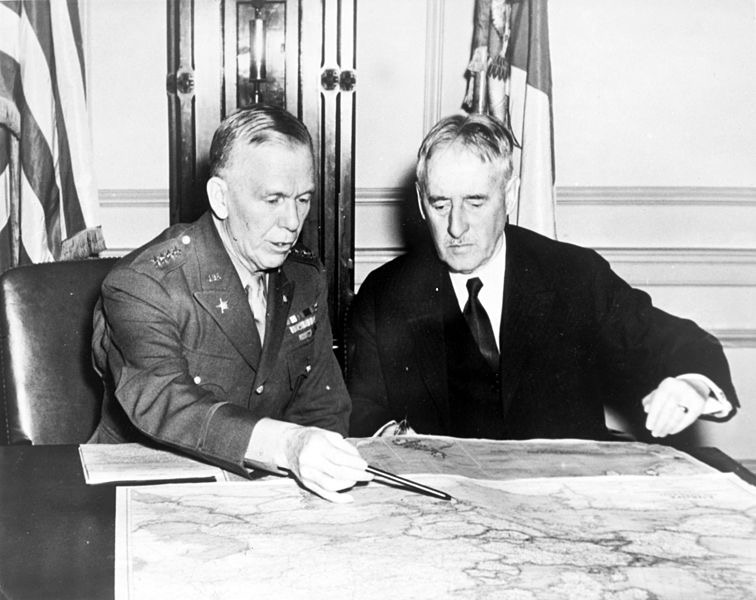
Here is an upcoming event I wish I could attend: the George C. Marshall Foundation in Lexington, Virginia is hosting chemistry professor and author Frank Settle this coming Thursday, August 6. That is of course the 70th anniversary of the dropping of the atomic bomb on Hiroshima. Dr. Settle is the author of the forthcoming General George C. Marshall and the Atomic Bomb. As this article from the Richmond Times-Dispatch makes clear historians have largely overlooked Marshall’s outsized role in the planning and construction of the Bomb. The undertaking lasted several years and involved over half a million military and civilian personnel at a cost of $30 billion in today’s dollars. This was all taking place in secret while he and Secretary of War Henry Stimson were carrying out a two-front war in Europe and the Pacific.

Amy Chief of Staff Marshall and Secretary of War Henry Stimson confer in early 1942. The two WW1 veterans were instrumental in the creation of the Manhattan Project ushering in the Atomic Age.

Army Chief of Staff Marshall and Secretary of War Henry Stimson confer in early 1942. The two WW1 veterans were instrumental in the creation and implementation of the Manhattan Project ushering in the Atomic Age. Both men served as Secretary of State at different points in their careers.

It is incredible the way the senior leadership in the Second World War had multiple careers that stretched all the way back to the First. Stimson was Secretary of War in the Taft Administration and part of the Preparedness Movement along with such individuals as Theodore and Franklin Roosevelt, who at the time was assistant secretary of the navy in the Wilson Administration. It is no wonder FDR picked Stimson to be his own Secretary of War several decades later, even though he was in the opposition party. In the 1910s Marshall, then as always, kept his mouth shut while doing so much to get the Army ready for the fighting in France. This was no small task given the sitting start from which A.E.F. began the war. Thirty years later the Manhattan Project would test Marshall’s mettle on an even vaster scale.

Here are the details for Thursday’s discussion should one happen to be in the area.

(image by the U.S. Army Signal Corps, Library of Congress via Wikimedia Commons)


Harry Vardon, 1870-1937

19 Sunday Jul 2015

Posted by Keith Muchowski in Those we remember, WW1

≈ 2 Comments

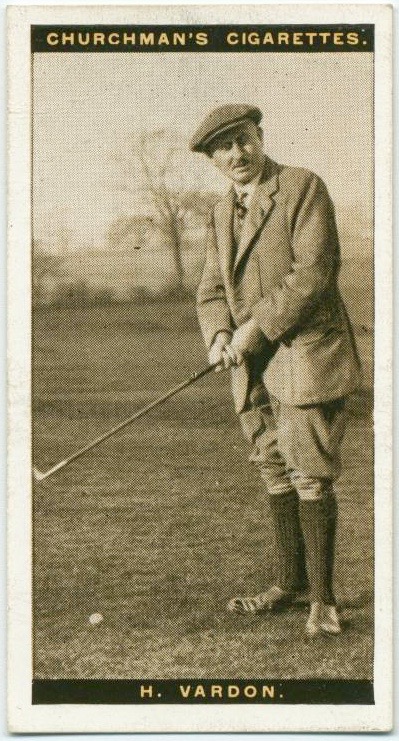
Best known today for the Vardon Grip, the overlapping technique commonly used today, Harry Vardon won six Open Championship prior to the First World War.

Best known today for his Vardon Grip, the overlapping technique commonly used today, Harry Vardon won six Open Championships prior to the First World War.

Watching Tom Watson finish out at his final British Open on Friday got me thinking about the only man to have won more Open Championships. That would be Harry Vardon, who captured his sixth Open title in June 1914 just prior to the onset of the Great War. (Three others are tied with Watson with five titles.) Vardon is less well-known today than Bobby Jones and Walter Hagen, much like tennis star Tony Wilding is less well-known than Bill Tilden and René Lacoste, but he deserves a better place in our consciousness. I suspect the reason men like these don’t get the credit they deserve is that the world they inhabited was swept away by the cataclysm of the Great War. Figures like Tilden, Lacoste, Jones, and Babe Ruth captured the zeitgeist of the Roaring Twenties and became superstars on a level unimaginable before the war. From the perspective of, say, 1924, everything that happened prior to the assassination of the Archduke Ferdinand must have seemed remote.

Vardon was a poor kid, a gardener’s son, from the island of Jersey. He, James Braid, and John Henry Taylor comprised the Great Triumvirate that ruled golf in the Victorian and Edwardian eras when the game was still centered in the British Isles. Braid and Taylor are two of the men tied with Tom Watson. All of their Open victories, like Vardon’s, came prior to the Great War. (Australian Peter Thomson is the fourth of the golfers with five Open titles, his victories coming in the 1950s and 60s.)

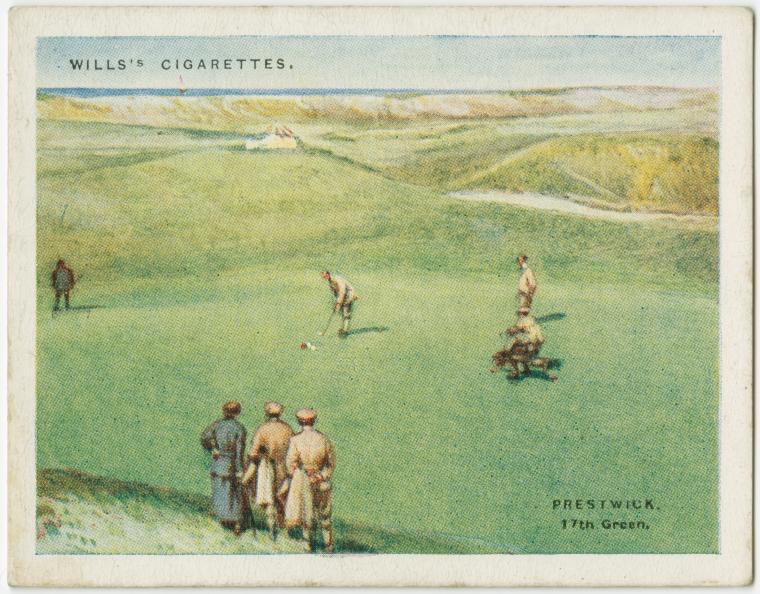
Today no longer part of the Open rotation, Prestwick was the scene of Vardon's 1914 Open victory.

Today no longer part of the Open rotation, Prestwick was the scene of Vardon’s 1914 Open victory.

Signs of change were in the air. The twenty year old American Francis Ouimet famously defeated Vardon in a playoff at the 1913 U.S. Open at The Country Club in Brookline, Massachusetts. It was a stunning and very public defeat. Still, Vardon rebounded. When he won at Prestwick in 1914, Ouimet finished well off the leaderboard in 56th place. In June 1914, the very month he won that sixth Open, Vardon was confident enough to pen an article for Everybody’s Magazine titled “What’s Wrong with American Golf?”

When Franz Ferdinand was killed at Sarajevo one week later Europe went on enjoying its golden summer. They played the French Open over the first week of July as if nothing had happened. Vardon finished in second in that tournament. The guns of August inevitably came and when they did the center of golf shifted to the United States. The subtitle of a March 1915 New York Times article captured the moment: “War puts the Game Back in Great Britain—Look to America.” They would not play the British or French Open again until 1920. Vardon and others kept busy, even playing in charity events at the front in Flanders in July 1917.

The Great War crippled British golf, at least for a time. Americans won eleven of the next fourteen Open Championships. The British rebounded during the Depression until the Second World War brought on another golf moratorium. By the late 1940s and early 1950s the transfer was complete. Americans Byron Nelson, Ben Hogan, and Same Snead were the golf world’s new Trio.

(images courtesy of the George Arents Collection, The New York Public Library Digital Collections:

“Harry Vardon.” http://digitalcollections.nypl.org/items/510d47e2-4666-a3d9-e040-e00a18064a99

“Prestwick.” http://digitalcollections.nypl.org/items/510d47e4-0e36-a3d9-e040-e00a18064a99)

← Older posts
Newer posts →

Enter your email address to subscribe to this blog and receive notifications of new posts by email.

Join 258 other subscribers

Categories

Archives

  • November 2023 (1)
  • October 2023 (3)
  • September 2023 (3)
  • August 2023 (4)
  • July 2023 (7)
  • June 2023 (10)
  • May 2023 (8)
  • April 2023 (6)
  • March 2023 (5)
  • February 2023 (4)
  • January 2023 (4)
  • December 2022 (4)
  • November 2022 (8)
  • October 2022 (2)
  • September 2022 (4)
  • June 2022 (1)
  • May 2022 (1)
  • April 2022 (13)
  • January 2022 (1)
  • December 2021 (2)
  • November 2021 (1)
  • October 2021 (3)
  • September 2021 (3)
  • August 2021 (5)
  • July 2021 (1)
  • June 2021 (1)
  • May 2021 (4)
  • April 2021 (3)
  • March 2021 (4)
  • February 2021 (7)
  • January 2021 (4)
  • December 2020 (4)
  • November 2020 (3)
  • October 2020 (4)
  • September 2020 (7)
  • August 2020 (5)
  • July 2020 (7)
  • June 2020 (11)
  • May 2020 (7)
  • April 2020 (9)
  • March 2020 (9)
  • February 2020 (7)
  • January 2020 (6)
  • December 2019 (7)
  • November 2019 (9)
  • October 2019 (4)
  • September 2019 (6)
  • August 2019 (10)
  • July 2019 (8)
  • June 2019 (6)
  • May 2019 (9)
  • April 2019 (8)
  • March 2019 (6)
  • February 2019 (8)
  • January 2019 (5)
  • December 2018 (10)
  • November 2018 (6)
  • October 2018 (9)
  • September 2018 (11)
  • August 2018 (11)
  • July 2018 (17)
  • June 2018 (10)
  • May 2018 (8)
  • April 2018 (9)
  • March 2018 (8)
  • February 2018 (5)
  • January 2018 (7)
  • December 2017 (11)
  • November 2017 (8)
  • October 2017 (9)
  • September 2017 (11)
  • August 2017 (12)
  • July 2017 (14)
  • June 2017 (18)
  • May 2017 (11)
  • April 2017 (10)
  • March 2017 (9)
  • February 2017 (11)
  • January 2017 (14)
  • December 2016 (7)
  • November 2016 (8)
  • October 2016 (8)
  • September 2016 (9)
  • August 2016 (6)
  • July 2016 (12)
  • June 2016 (8)
  • May 2016 (9)
  • April 2016 (6)
  • March 2016 (12)
  • February 2016 (10)
  • January 2016 (9)
  • December 2015 (9)
  • November 2015 (11)
  • October 2015 (8)
  • September 2015 (9)
  • August 2015 (13)
  • July 2015 (14)
  • June 2015 (11)
  • May 2015 (11)
  • April 2015 (18)
  • March 2015 (10)
  • February 2015 (8)
  • January 2015 (8)
  • December 2014 (12)
  • November 2014 (13)
  • October 2014 (16)
  • September 2014 (11)
  • August 2014 (16)
  • July 2014 (12)
  • June 2014 (13)
  • May 2014 (10)
  • April 2014 (10)
  • March 2014 (11)
  • February 2014 (12)
  • January 2014 (10)
  • December 2013 (11)
  • November 2013 (14)
  • October 2013 (14)
  • September 2013 (14)
  • August 2013 (13)
  • July 2013 (17)
  • June 2013 (9)
  • May 2013 (13)
  • April 2013 (13)
  • March 2013 (16)
  • February 2013 (15)
  • January 2013 (15)
  • December 2012 (18)
  • November 2012 (18)
  • October 2012 (21)
  • September 2012 (14)
  • August 2012 (16)
  • July 2012 (21)
  • June 2012 (22)
  • May 2012 (24)
  • April 2012 (20)
  • March 2012 (23)
  • February 2012 (22)
  • January 2012 (15)
  • December 2011 (23)
  • November 2011 (22)
  • October 2011 (23)
  • September 2011 (18)
  • August 2011 (19)
  • July 2011 (20)
  • June 2011 (29)
  • May 2011 (25)
  • April 2011 (18)
  • March 2011 (21)
  • February 2011 (11)

Meta

  • Create account
  • Log in
  • Entries feed
  • Comments feed
  • WordPress.com
Creative Commons License
This work is licensed under a Creative Commons Attribution-NonCommercial-ShareAlike 4.0 International License.

Enter your email address to subscribe to this blog and receive notifications of new posts by email.

Join 258 other subscribers

Categories

Archives

  • November 2023 (1)
  • October 2023 (3)
  • September 2023 (3)
  • August 2023 (4)
  • July 2023 (7)
  • June 2023 (10)
  • May 2023 (8)
  • April 2023 (6)
  • March 2023 (5)
  • February 2023 (4)
  • January 2023 (4)
  • December 2022 (4)
  • November 2022 (8)
  • October 2022 (2)
  • September 2022 (4)
  • June 2022 (1)
  • May 2022 (1)
  • April 2022 (13)
  • January 2022 (1)
  • December 2021 (2)
  • November 2021 (1)
  • October 2021 (3)
  • September 2021 (3)
  • August 2021 (5)
  • July 2021 (1)
  • June 2021 (1)
  • May 2021 (4)
  • April 2021 (3)
  • March 2021 (4)
  • February 2021 (7)
  • January 2021 (4)
  • December 2020 (4)
  • November 2020 (3)
  • October 2020 (4)
  • September 2020 (7)
  • August 2020 (5)
  • July 2020 (7)
  • June 2020 (11)
  • May 2020 (7)
  • April 2020 (9)
  • March 2020 (9)
  • February 2020 (7)
  • January 2020 (6)
  • December 2019 (7)
  • November 2019 (9)
  • October 2019 (4)
  • September 2019 (6)
  • August 2019 (10)
  • July 2019 (8)
  • June 2019 (6)
  • May 2019 (9)
  • April 2019 (8)
  • March 2019 (6)
  • February 2019 (8)
  • January 2019 (5)
  • December 2018 (10)
  • November 2018 (6)
  • October 2018 (9)
  • September 2018 (11)
  • August 2018 (11)
  • July 2018 (17)
  • June 2018 (10)
  • May 2018 (8)
  • April 2018 (9)
  • March 2018 (8)
  • February 2018 (5)
  • January 2018 (7)
  • December 2017 (11)
  • November 2017 (8)
  • October 2017 (9)
  • September 2017 (11)
  • August 2017 (12)
  • July 2017 (14)
  • June 2017 (18)
  • May 2017 (11)
  • April 2017 (10)
  • March 2017 (9)
  • February 2017 (11)
  • January 2017 (14)
  • December 2016 (7)
  • November 2016 (8)
  • October 2016 (8)
  • September 2016 (9)
  • August 2016 (6)
  • July 2016 (12)
  • June 2016 (8)
  • May 2016 (9)
  • April 2016 (6)
  • March 2016 (12)
  • February 2016 (10)
  • January 2016 (9)
  • December 2015 (9)
  • November 2015 (11)
  • October 2015 (8)
  • September 2015 (9)
  • August 2015 (13)
  • July 2015 (14)
  • June 2015 (11)
  • May 2015 (11)
  • April 2015 (18)
  • March 2015 (10)
  • February 2015 (8)
  • January 2015 (8)
  • December 2014 (12)
  • November 2014 (13)
  • October 2014 (16)
  • September 2014 (11)
  • August 2014 (16)
  • July 2014 (12)
  • June 2014 (13)
  • May 2014 (10)
  • April 2014 (10)
  • March 2014 (11)
  • February 2014 (12)
  • January 2014 (10)
  • December 2013 (11)
  • November 2013 (14)
  • October 2013 (14)
  • September 2013 (14)
  • August 2013 (13)
  • July 2013 (17)
  • June 2013 (9)
  • May 2013 (13)
  • April 2013 (13)
  • March 2013 (16)
  • February 2013 (15)
  • January 2013 (15)
  • December 2012 (18)
  • November 2012 (18)
  • October 2012 (21)
  • September 2012 (14)
  • August 2012 (16)
  • July 2012 (21)
  • June 2012 (22)
  • May 2012 (24)
  • April 2012 (20)
  • March 2012 (23)
  • February 2012 (22)
  • January 2012 (15)
  • December 2011 (23)
  • November 2011 (22)
  • October 2011 (23)
  • September 2011 (18)
  • August 2011 (19)
  • July 2011 (20)
  • June 2011 (29)
  • May 2011 (25)
  • April 2011 (18)
  • March 2011 (21)
  • February 2011 (11)

Meta

  • Create account
  • Log in
  • Entries feed
  • Comments feed
  • WordPress.com
Creative Commons License
This work is licensed under a Creative Commons Attribution-NonCommercial-ShareAlike 4.0 International License.

Enter your email address to subscribe to this blog and receive notifications of new posts by email.

Join 258 other subscribers

Categories

Archives

  • November 2023 (1)
  • October 2023 (3)
  • September 2023 (3)
  • August 2023 (4)
  • July 2023 (7)
  • June 2023 (10)
  • May 2023 (8)
  • April 2023 (6)
  • March 2023 (5)
  • February 2023 (4)
  • January 2023 (4)
  • December 2022 (4)
  • November 2022 (8)
  • October 2022 (2)
  • September 2022 (4)
  • June 2022 (1)
  • May 2022 (1)
  • April 2022 (13)
  • January 2022 (1)
  • December 2021 (2)
  • November 2021 (1)
  • October 2021 (3)
  • September 2021 (3)
  • August 2021 (5)
  • July 2021 (1)
  • June 2021 (1)
  • May 2021 (4)
  • April 2021 (3)
  • March 2021 (4)
  • February 2021 (7)
  • January 2021 (4)
  • December 2020 (4)
  • November 2020 (3)
  • October 2020 (4)
  • September 2020 (7)
  • August 2020 (5)
  • July 2020 (7)
  • June 2020 (11)
  • May 2020 (7)
  • April 2020 (9)
  • March 2020 (9)
  • February 2020 (7)
  • January 2020 (6)
  • December 2019 (7)
  • November 2019 (9)
  • October 2019 (4)
  • September 2019 (6)
  • August 2019 (10)
  • July 2019 (8)
  • June 2019 (6)
  • May 2019 (9)
  • April 2019 (8)
  • March 2019 (6)
  • February 2019 (8)
  • January 2019 (5)
  • December 2018 (10)
  • November 2018 (6)
  • October 2018 (9)
  • September 2018 (11)
  • August 2018 (11)
  • July 2018 (17)
  • June 2018 (10)
  • May 2018 (8)
  • April 2018 (9)
  • March 2018 (8)
  • February 2018 (5)
  • January 2018 (7)
  • December 2017 (11)
  • November 2017 (8)
  • October 2017 (9)
  • September 2017 (11)
  • August 2017 (12)
  • July 2017 (14)
  • June 2017 (18)
  • May 2017 (11)
  • April 2017 (10)
  • March 2017 (9)
  • February 2017 (11)
  • January 2017 (14)
  • December 2016 (7)
  • November 2016 (8)
  • October 2016 (8)
  • September 2016 (9)
  • August 2016 (6)
  • July 2016 (12)
  • June 2016 (8)
  • May 2016 (9)
  • April 2016 (6)
  • March 2016 (12)
  • February 2016 (10)
  • January 2016 (9)
  • December 2015 (9)
  • November 2015 (11)
  • October 2015 (8)
  • September 2015 (9)
  • August 2015 (13)
  • July 2015 (14)
  • June 2015 (11)
  • May 2015 (11)
  • April 2015 (18)
  • March 2015 (10)
  • February 2015 (8)
  • January 2015 (8)
  • December 2014 (12)
  • November 2014 (13)
  • October 2014 (16)
  • September 2014 (11)
  • August 2014 (16)
  • July 2014 (12)
  • June 2014 (13)
  • May 2014 (10)
  • April 2014 (10)
  • March 2014 (11)
  • February 2014 (12)
  • January 2014 (10)
  • December 2013 (11)
  • November 2013 (14)
  • October 2013 (14)
  • September 2013 (14)
  • August 2013 (13)
  • July 2013 (17)
  • June 2013 (9)
  • May 2013 (13)
  • April 2013 (13)
  • March 2013 (16)
  • February 2013 (15)
  • January 2013 (15)
  • December 2012 (18)
  • November 2012 (18)
  • October 2012 (21)
  • September 2012 (14)
  • August 2012 (16)
  • July 2012 (21)
  • June 2012 (22)
  • May 2012 (24)
  • April 2012 (20)
  • March 2012 (23)
  • February 2012 (22)
  • January 2012 (15)
  • December 2011 (23)
  • November 2011 (22)
  • October 2011 (23)
  • September 2011 (18)
  • August 2011 (19)
  • July 2011 (20)
  • June 2011 (29)
  • May 2011 (25)
  • April 2011 (18)
  • March 2011 (21)
  • February 2011 (11)

Meta

  • Create account
  • Log in
  • Entries feed
  • Comments feed
  • WordPress.com
Creative Commons License
This work is licensed under a Creative Commons Attribution-NonCommercial-ShareAlike 4.0 International License.

Blog at WordPress.com.

  • Subscribe Subscribed
    • The Strawfoot
    • Join 229 other subscribers
    • Already have a WordPress.com account? Log in now.
    • The Strawfoot
    • Subscribe Subscribed
    • Sign up
    • Log in
    • Report this content
    • View site in Reader
    • Manage subscriptions
    • Collapse this bar
 

Loading Comments...