Jazz for a winter’s night

Two of the coolest things out of the 1950s and 60s were Rod Serling and jazz man George Russell. I am not sure what the two have in common with each other–the song does not appear in the episode–but someone in France recently spliced this vignette of Twilight Zone segment “Five Characters in Search of an Exit” to George Russell’s version of “Beast Blues.” Russell played frequently at the Five Spot nightclub, which was on St. Marks Place directly across the street from Cooper Union. Maybe I’m reading too much into it, but I have always loved that the jazz club stood next to where Lincoln gave one of his most famous speeches. “Beast Blues” comes from an album pianist Russell  recorded there in 1960; the existentialist “Five Characters” aired on December 22, 1961. TZ sometimes used stock footage (as it did in “Five Characters”) though it did often incorporate original music into its scores. Bernard Herrmann, who scored many of Alfred Hitchcock’s films, wrote much of the TZ music. Again, Russell’s work is not part of the original episode, though they do complement each other effectively. Enjoy.

Weekend reading

The votes are in and Steven Spielberg’s Lincoln has been nominated for no less than twelve Academy awards. I have never thought too much about such things–don’t get me started on the less than useless Grammies, which are too irrelevant to get worked up about anyway. Still, to the extent that these things matter it seems right that Lincoln should sweep the nominations. One of the nominees is Tony Kushner, for Best Adapted Screenplay. Kushner is deserving; whatever else one might say about him, he is a fine playwright and screenwriter. Those following closely know that the book Kushner is credited with adapting into film is Doris Kearns Goodwin’s Team of Rivals. I never understood this because the film focuses upon the tiniest fraction of Goodwin’s 800+ page monograph. I say this not as criticism. She certainly advised Kushner here-and-there along the way as he prepared the manuscript. The film is better for this. It just seemed that the relationship between the film and book was tenuous. The New Republic’s Timothy Noah informs us that the book most directly responsible for Spielberg & Kushner’s Lincoln is in all likelihood Michael Vorenberg’s Final Freedom: The Civil War, The Abolition of Slavery, and the Thirteenth Amendment. Noah’s article is a reminder that politics, including passage of the 13th Amendment, is a messier process than even can ever be depicted  on celluloid. And yes, if you have not seen Lincoln you should do so before it leaves the big screen.

Quote of the day

Harriet Ward Foote Hawley

Harriet Ward Foote Hawley

I do not believe we shall ever conquer till we proclaim emancipation; and yet I suppose there are people in the world who think President Lincoln knows more than Mrs. Hawley.

–Mrs. Harriet Ward Foote Hawley, outspoken wife of Joseph Hawley in a private letter; July 3, 1862

(image/Harriet Beecher Stowe Center)

Remembering Emancipation

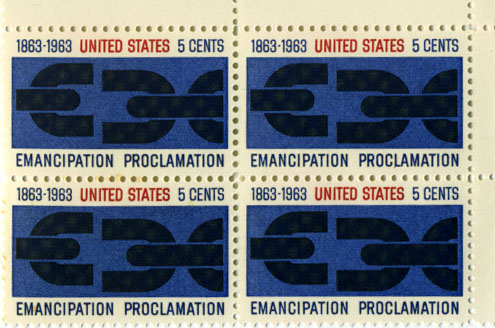
1963 proclamation stamp
Regular readers of the Strawfoot know that we have been following the U.S. Postal Service’s commemoration of the sesquicentennial with great interest. As it did in the early 1960s during the centennial, the USPS has done a fine job marking the Civil War’s 150 anniversary. I was in Florida visiting my mother over New Year’s and so missed the coverage of the January 1st ceremony at the National Archives marking the release of Emancipation Proclamation stamp. The new stamp has a classic look that is worthy of the event it commemorates. Patrons have until March 1, 2013 to send for first day of issue covers. Send your self addressed stamped postcards and envelopes to:

Emancipation Proclamation Stamp

Special Cancellations

P.O. Box 92282

Washington, DC 20090-2282

Here is video of the program held last week. This is one of the great events of the Civil War sesquicentennial.

A journey of a thousand miles

Joseph Roswell Hawley, 1826-1905

Joseph Roswell Hawley, 1826-1905

It is very much in the nascent stages–for starters I have no agent or publisher just yet–but now that 2013 is off-and-running I am about to begin a project I have been thinking about for the past several months: writing a book. Specifically, I will be writing a biography of Civil War general Joseph Roswell Hawley. Hawley was an officer is the 7th Connecticut and eventually became a division commander and brevet major general in the X Corps. Among other places, Hawley fought at First Bull Run (in the 1st Connecticut), Port Royal and Fort Pulaski, Olustee, and the Siege of Petersberg. He and his men also served under Benjamin Butler, guarding the polling places in New York City during the November 1864 presidential election between Lincoln and McClellan.

Hawley was so much more than a military man, however. He founded the newspaper that eventually became the Hartford Courant, and helped organize the Republican Party in Connecticut in the 1850s. He was also an abolitionist who put his money where his mouth was, becoming one of the first to volunteer when war came in April 1861. Some believe he was the first man to volunteer from his home state. After the war he was governor, congressman, and senator of the Constitution State. He also ran the 1876 Centennial Exposition in Philadelphia. His wife, Harriet Ward Foote, was a first cousin of the Beecher family. Yes, that Beecher family. Mark Twain was a family friend. Hawley was active as a public and private citizen in veterans affairs, including commemorations, in the decades after the war. He died in 1905.

If I do my job correctly I will tell Joseph Hawley’s story in all its fullness and not just offer a drum and bugle chronicle of his military career. I believe it is a story worth telling.

I spent the last few months of 2012 outlining the project and seeing which repositories and libraries will have the materials I will need to consult. Over the next 3-4 years I will be spending time in Hartford, Washington, South Carolina, and northern Florida. I am a little nervous but it feels good to finally be starting. To be continued.

(image by Levin Corbin Handy for Brady Studio, Library of Congress)

A winter walk

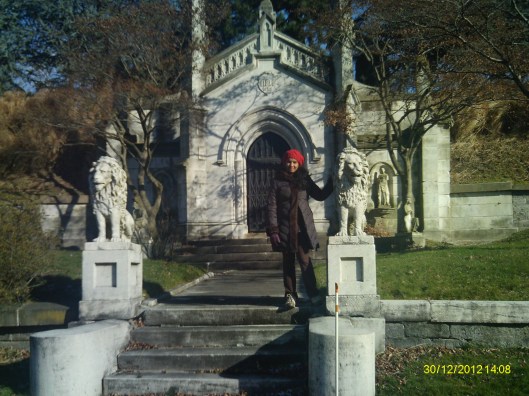
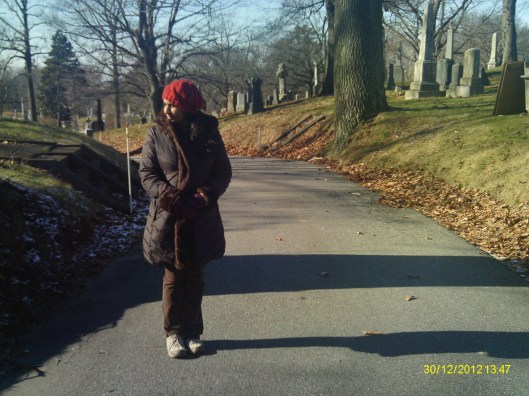
The Hayfoot and I took advantage of the weather to take a walk on the penultimate day of the year.

Mausoleum

Mausoleum

Snowy stump

Snowy stump

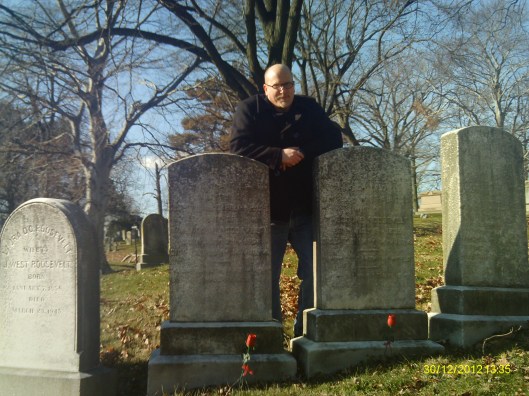
Theodore Roosevelt Sr., his wife, and Theodore (Teddy) Roosevelt Jr's first wife Alice Hathaway Lee Roosevelt. Teddy is buried in Oyster Bay with his second wife. Oddly, Teddy Roosevelt's first spouse and mother died on the same day, February 14, 1884.

Theodore Roosevelt Sr., his wife, and Theodore (Teddy) Roosevelt Jr’s first wife Alice Hathaway Lee Roosevelt. Teddy is buried in Oyster Bay with his second spouse. Oddly, Teddy’s first wife and mother died on the same day, February 14, 1884. Note the roses.

The headstones are quite faded but can be discerned if you know what you are looking for.

The headstones are quite faded, but can be discerned if you know what you are looking for.

That the family circle is incomplete is quite touching.

That the family circle is incomplete is quite moving. The Roosevelts are scattered as far away as Hyde Park, Long Island, Washington, DC, Alaska, and elsewhere.

The gate is a nice touch.

The gate is a nice touch.

It was cold and windy, just the right feel for a December walk in a cemetery.

It was cold and windy, just the right feel for a December walk in a cemetery.

Old gate

Old gate

The holly tree added a touch of color.

The holly tree added a touch of color.

Enjoying our holidays.

Happy New Year

Hey everybody, I hope you are enjoying your holiday season. The Hayfoot and I have been relaxing and watching The Rockford Files on our iPad. Posting will continue to be light at best between now and January 6th. This is the time of year when I put the Civil War aside for a spell and recharge the batteries. I have some interesting projects I will be working on in 2013 which I will explain in full when the holidays are over.

Last week on his invaluable Civil War Memory blog Kevin Levin asked people to chime in on what they read in 2012. I posted a comment and thought I would expand it a bit more at the Strawfoot. Here is the short list of books I most profited from in 2012, along with a few I am looking forward to in 2013:

Dark Horse: the Surprise Election and Political Murder of President James A. Garfield–I had heard about this when it first came out, but was intrigued about Garfield only after reading Adam Goodheart’s 1861: The Civil War Awakening. We underestimate the lives of the Gilded Age presidents and leaders at our own expense.

The Devil’s Own Work: The Civil War Draft Riots and the Fight to Reconstruct America–Barnet Schecter covers so much more than the turmoil in July 1863. This title helped me a great deal with my volunteer work at Governors Island. One of my intellectual goals is to become an authority on role New York City and State during the Civil War period.
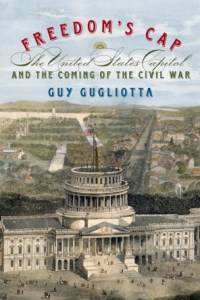
CapSeward: Lincoln’s Indispensable Man–The Secretary of State gets his due. There’s a lot on the antebellum period, including figures such as William Henry Harrison and Millard Fillmore. Again, the tendency is to dismiss such figures because they don’t fit into the popular narrative of our nation’s history. I finished this and started Freedom’s Cap: The United States Capitol and the Coming of the Civil War immediately afterward, which covers the same period and gave me a greater understanding of the 1850s. Too many people read about just the war–I suppose because they think the battles are “fun”–but don’t look into the causes and consequences of the conflict. This is, to put it charitably, short-sighted.

Last Train to Memphis: The Rise of Elvis Presley–I don’t understand why people read those piece of shit Elvis biographies when Peter Guralnick explains his rise and fall so movingly.

On the list for early 2013:

Sick from Freedom: African-American Illness and Suffering during the Civil War and Reconstruction, by Jim Downs

The Peninsula Campaign and the Necessity of Emancipation: African Americans and the Fight for Freedom, by Glenn David Brasher

I’m going to read the two above back-to-back.

John Quincy Adams, by Harlow Giles Unger–My interest comes from the numerous trips we have taken to the National Portrait Gallery over the past few years. You can’t walk the halls of the NPG and not become intrigued with the people behind the canvases.

All the Great Prizes: The Life of John Hay, from Lincoln to Roosevelt, by John Taliaferro—This comes out in May. Hay was of course Lincoln’s secretary (with John Nicolay). Less well-known is that he became a big player in the second half of the nineteenth century.

Careless Love: The Unmaking of Elvis Presley—Volume two in the Guralnick portrayal

Lots to look forward to in the coming twelve months. I hope you have a healthy, happy, and productive New Year.

The Trial of Stephen Ambrose

Stephen_AmbroseI remember having coffee with a friend from work in 2002 just a few days after the death of Stephen Ambrose. Specifically I was defending Ambrose against the plagiarism charges that had been leveled against him in the later years of his life. Like many I was using the Fame Defense, the notion that when Ambrose evolved from an academic to a popular historian he became careless. The plagiarism, in this argument, was a product of this carelessness. I had taken his post-1994 output (the year his D-Day oral history was released) with a grain of salt anyway. I never thought much of the Greatest Generation tribute books and films; Flags of Our FathersSaving Private Ryan, etc. were and are roughly akin to the regimental monuments Civil War veterans built in their own later years: celebrations and tributes to a cohort rapidly moving on. I never thought there was anything wrong with such tributes; it is just that one must see them for what they are. And Ambrose for good and ill was the dean of the genre.

Well, the Fame Defense just became considerably more difficult to mount after reading David Frum’s indictment of Ambrose and his scholarship, including his work prior to the fame and fortune he later acquired. Rule # 1: Don’t fabricate interactions with a sitting or retired President of the United States. People are keeping track–and record–of where they are every day. Ambrose is ultimately hoisted on his own petard. Not a happy story, but one that cannot be ignored.

(image by Jim Wallace for the Smithsonian Institution)

The Hidden Hand in action

One of my favorite places in the city of Gettysburg is Eisenhower’s Farm. I wrote my masters thesis on Eisenhower and know a fair amount about the president and general. Ike’s ties to the town go all the way back to Great War, when the then junior officer trained troops at Gettysburg’s Camp Colt. Many people do not know that one of the primary purposes of the national military parks was–and is–to train American service personnel in military and leadership strategy. Eisenhower trained members of the nascent U.S. Tank Corps at Camp Colt. It was 1917, just four years after the 50th anniversary Blue-Grey reunion.

After the Second World War Ike and Mamie purchased a farm in Gettysburg, from which one gets a spectacular view of Little Round Top. The farm was a staging ground for Pickett’s Charge. Among other things Eisenhower raised prize-winning Angus cattle at his farm, and took the task pretty seriously. He entered his cattle in numerous competitions, often anonymously to avoid favoritism, and won a fair amount of the time. During his White House years Eisenhower used the Gettysburg farm to relax with his family, attend to his gentleman farming, and also–no small thing–charm foreign dignitaries. Eisenhower had formidable interpersonal skills and, for good reason, believed he could win just about anybody over if he could spend time with them in both formal and informal situations. This is where the Angus cattle came in; Ike loved taking other heads-of-state out to the barn to show them his prize-winning bulls, have a photo op, and then discuss world affairs in the tranquil setting once the press had been dispatched. A few who got the hidden hand treatment in such a manner included India’s Jawaharlal Nehru (December 1956), West German Chancellor Konrad Adenauer (May 1957), Nehru nemesis Winston Churchill (May 1959, after he left Downing Street), Nikita Khrushchev (September 1959), and Eisenhower nemesis Charles de Gaulle (April 1960), among others.

Gloria Hertley donating sign to the Eisenhower National Historic Site. Note the photograph of  Ike and Nehru, partially obscured in the upper right corner above the ranger's head.

Gloria Hertley donating sign to the Eisenhower National Historic Site. Note photograph of Ike and Nehru, partially obscured in the upper right corner.

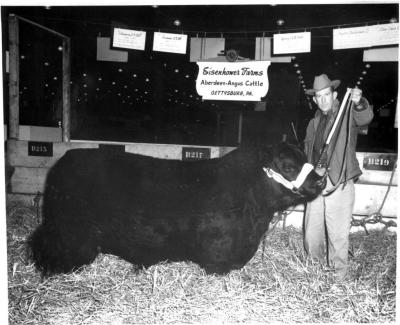
In a lighter news story, the farm’s heritage became a bit more complete this month when Gloria Hartley, widow of herdsman and farm manager  Bob Hartley, donated the original Eisenhower Farms sign to the National Park Service. Preserving small details of our national heritage such as this is something the Park Service does well.

Bob Hartley with Angus bull at show, Chicago 1961. Note sign in background.

Bob Hartley with Angus bull at show, Chicago 1961. Note sign in background.

(images: top, NPS; bottom, Hanover, PA Evening Sun)