Cyclorama Building on the move?, cont’d

Update: The Park Service has released its environmental assessment of the cyclorama building. There will be a meeting at Gettysburg National Military Park on September 6, 2012 for discussion and public comment.  I hope they can resolve this once and for all. The building has turned into an eyesore. Here is the url: http://parkplanning.nps.gov/cycloramaea.

Original posting (below) August 23, 2011

Authorities at Gettysburg National Military Park announced that they are exploring the feasibility of relocating Richard Neutra’s Cyclorama Building to a less conspicuous location.   This may be the least bad option given the possibility that the Park Service may never be granted the authority to demolish the site.
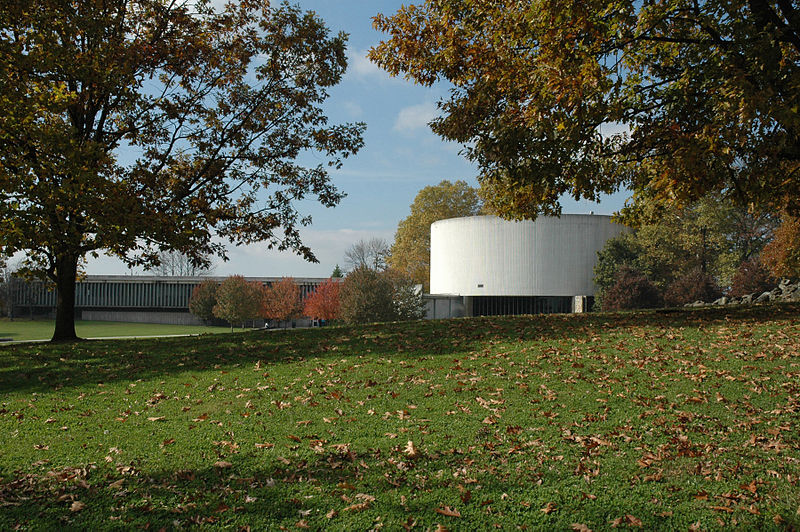
Gettysburg Cyclorama Building; photo/Don Wiles

I am always sympathetic to the arguments of architectural historians and preservationists that we are losing too much of our cultural heritage.  Every time I walk through the travesty that is the current Penn Station I rue the loss of the magisterial original.  It is fair to argue, too, that Neutra’s Gettysburg building is now itself part of the history of the evolution of the park, part of the Mission 66 project and designed to reflect the stature of the United States during the Cold War and Space Age.  Still, despite the nostalgia that many feel for the building they visited during their youth, the fact remains that the building never worked.  For one thing the Modernist structure sits incongruously atop Ziegler’s Grove on Cemetery Ridge, the site of some of the hardest fighting on Day 3 of the battle.  It was also structurally unsound, leaking frequently, and responsible for a great deal of the damage the Cyclorama incurred in the decades it was housed in the building.  Besides, there are plenty of representative Neutra buildings still standing.

Neutra’s Miller House, Palm Springs; photo/Ilpo’s Sojourn

Whatever happens, a permanent solution to the Cyclorama Building issue will hopefully be forthcoming in the intermediate future.  Stay tuned.
Reenacting: A short meditation

Those who know me know that reenacting is not my thing. Still, I have met living historians who have thought deeply about the Civil War’s causes and consequences, not just the ins and outs of blanket rolling and tent folding. The folks have Thrash Lab have made this film based on a trip to a reenactment in California.

Old Brooklyn

I have lived and worked in Brooklyn for fifteen years now and still very much consider myself a new Brooklynite. Pete Hamill. He’s and old school Brooklynite. Then there is a Brooklyn that goes back even farther than spaldeens, egg creams, and the Dodgers. This Saturday in Fort Greene the Society of Old Brooklynites will be having its 104th annual memorial tribute to the patriots of the Revolutionary War. I will be at Governors Island this day and unfortunately will miss the ceremonies. I do intend to work it in to my activities throughout the day, nonetheless. It will not be difficult, being that the island harbors (sorry, couldn’t resist) so much colonial history. The Battle of Brooklyn is just one slice of the story. One could be forgiven for not knowing any of this, being as New York did a poor job marketing this aspect of its history in the early twentieth century when Virginia and Massachusetts were doing just the opposite. When we think Revolutionary War we think Boston and Yorktown, not New York City. There are some 11,500 Revolutionary War dead buried in Fort Green Park, many of whom had perished on the infamous prison ships in Wallabout Bay. The 104th annual tribute to these individuals should make for an memorable day.

Mississippi’s sesquicentennial

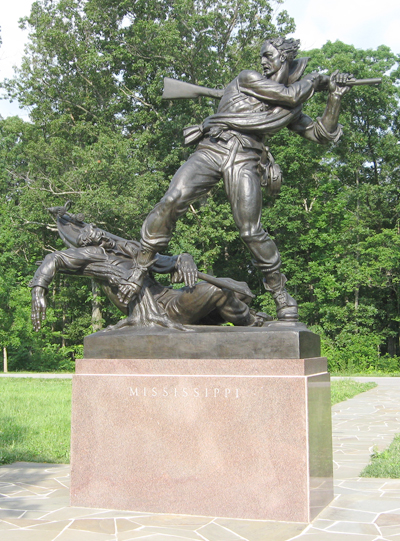
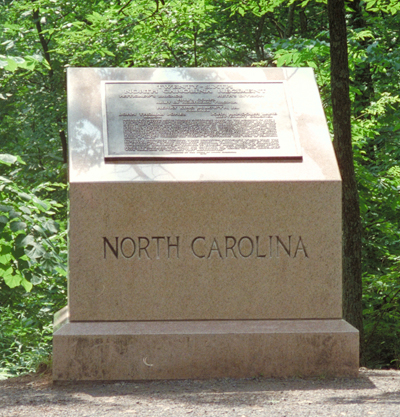
The issues won’t be new to anyone who has been following the sesquicentennial the past few years, but this article captures the mood of the 150th Civil War commemoration in Mississippi. I am always struck when visiting battlefields by both how recent some of the monuments are and by the ethos expressed in some of them. Gettysburg is filled with monuments laid in the early 1960s, during the Centennial, which express the sentimental notions of the war felt by previous generations. This isn’t so surprising. In the early 1960s the war was still recent history; many at the time had grandparents–or even parents–who had fought from 1861-65 and they wanted to remember their ancestors in a certain light. It was also the moment, just prior to and during the Civil Rights Movement, before African-Americans became part of the narrative. Some monuments though are from later, even much later. The 26th North Carolina shown here is one of two placed in 1985. The Mississippi state monument below it is from 1973.

(images/Stone Sentinels)

Elvis Presley, 1935-1977

That was Elvis’ mark–he conveyed his spirituality without being able, or needing, to express it. And all these adults with their more complicated lives and dreams and passions and hopes looked for themselves in his simplicity.

–Peter Guralnick, Last Train to Memphis: The Rise of Elvis Presley

Today is the 35th anniversary of Elvis’s death. I remember the day vividly. My parents had divorced two years earlier and my dad visited us every Tuesday and Saturday. August 16, 1977 was a Tuesday, and as you might imagine that was a large chunk of the conversation that evening. Neither my mom or dad were that into the King, or even rock ‘n roll for that matter. People reached adulthood much younger during their time and they missed the phenomenom by a few years.

I am a third of the way through Last Train to Memphis. What I love is the way Guralnick stays out of the way and lets the story tell itself. He is not writing about a myth or cultural artifact, but about a person. This is something too often forgotten when we discuss the life of Elvis Presley. I attached “Polk Salad Annie” because my favorite Elvis songs have always been the ones with which we are less familiar. Enjoy.

Johnny Pesky, 1919-2012

Johnny Pesky, rear holding cane

In sad but not unexpected news, Johnny Pesky has died. I am glad he lived long enough to see the Red Sox end their drought and win two World Series. Watching him raise the World Series flag with Carl Yastrzemski in April 2005 was something special. What I loved the most about Pesky was his innate kindness, the way he always had something positive to say. Pesky spent 73 years in professional baseball.

(image/Andrew Malone)

Checking out a museum, literally

I have been a librarian for fifteen years now. In fact I received  my Masters in Library Science fifteen years ago this week. I graduated in August 1997, interviewed at the public library in New York in September, and moved to to the city that October. The profession has changed more in the past decade and a half than at any time in its history. I still struggle  to grasp some of these changes, particularly  the rapidly changing information technology that is now part and parcel of the profession. If you told me in the late 90s that someday I would be able to check out and download a book to something called an ereader–from the comfort of my living room–I may or may not have believed it. It is a fascinating field in which I learn something every day. Libraries in New Jersey have embarked on a project to make it easier for people to visit area museums, even museums outside the Garden State. They are buying memberships to cultural institutions and making admission available to patrons for checkout.

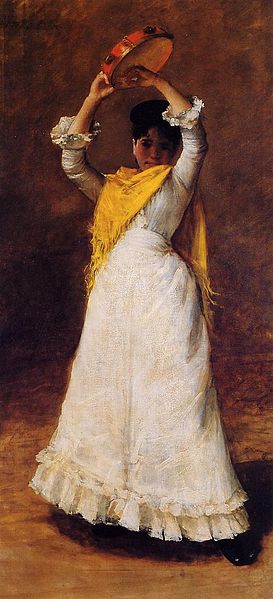
(Image/William Merritt Chase’s The Tamborine Girl, Montclair Art Museum)

A rainy Friday

Fittingly it is raining today; the past few years this has become one of the more melancholic days on my calendar. For over a decade until he died three years ago it was on the second Friday in August that I made my annual trip to see my father and step-mother in Arkansas. This day hits me harder than the anniversary of his death, probably because the routine had become so…routine…that I know instinctively how today would have played out were he still here. I would have gotten the six a.m. flight out of LaGuardia, transferred in either Memphis or St. Louis, been met at the Little Rock airport by the two of them, gone for lunch, and then taken the hour drive back the house where I unpacked my small suitcase to settle in for the week. Somewhere in the week we would have taken a sidetrip to Memphis, the Mississippi Delta, Shiloh, or some other place. It was a pattern that began in the late 1990s and continued throughout the 2000s as I passed from the last stages of my youth into full blown middle age. The rhythms were so set that they eventually became unspoken. The one consolation is that my soon-to-be-wife was able to make the trip in 2009 and see, if just for that brief time, a part of my life that is now gone. We take what we can get.

Coincidentally, my trip always coincided with Elvis Week in Memphis. Three years ago I took the Hayfoot to Graceland. Were we there this week, we may have returned to Memphis to see some other sites. Last night I began Peter Guralnick’s Last Train to Memphis: The Rise of Elvis Presley, which had sat unread on my shelf for a number of years. This week seemed the appropriate time to get around to it. It makes me feel a little closer to what are rapidly turning into the “old days.”

The best way we can remember and pay tribute to someone is to live happily and productively. Tomorrow begins Civil War Weekend at Governors Island. It will be a fun time, not least because the Hayfoot will be turning out on one of the days. I won’t be dwelling on it every minute, but somewhere along the way I’ll stop and think of those Arkansas Augusts and the times we shared there and then.

“1950s Mayberry in the middle of New York”

Last week I mentioned the reunion of Coast Guard brats held this past weekend on Governors Island. I took the opportunity to talk to as many of these folks as I could and it was a priviledge. Many had not been back on the island since the 1960s and they were conspicuous on the ferry ride. They were the ones soaking it all in from the bow. Reunionites had come from as far as Portland and Seattle to be part of the weekend’s events,and without exception they were quite approachable and happy to share their stories.. I committed the faux pas of asking one if he and others were doing the “tourist thing” in the city. His answer was that he wasn’t a tourist, but coming home. A few told stories of having Girl Scout meetings in the casemates of Castle Williams, something I had read about but never heard discussed in the first person until last Saturday. I had always wondered what it was like attending a Boy Scout/Girl Scout meeting, teen dance, or Halloween party in a Second System fortification built just prior to the War of 1812. Did the participants find it strange? Unsettling? Mordant, but perhaps in a vaguely pleasurable way? The answer is that, even as young children living on the base with their military dads and families, they understood and appreciated the uniqueness of their situation. They understood how special it was even as it was going on, which is quite a gift. A brother and sister mentioned living with their family in one of the houses in Nolan Park back in the day. Another watched the original World Trade Center buildings rising across the harbor from her living room in the late 1960s and early 1970s. Some were old enough to have attended the 1964-65 World’s Fair. It was everything you volunteer for. The New York Times was on hand.