Cherokee slaves

I would love to know the full story behind this:

One of the nation’s largest American Indian tribes has sent letters to about 2,800 descendants of slaves once owned by its members, revoking their citizenship and cutting their medical care, food stipends, low-income homeowners’ assistance and other services.  The Cherokee Nation acted this week after its Supreme Court upheld the results of a 2007 special vote to amend the Cherokee constitution and remove the slaves’ descendants and other non-Indians from tribal rolls.  The 300,000-member tribe is the biggest in Oklahoma, although many of its members live elsewhere.

Moving Midway

Midway Plantation

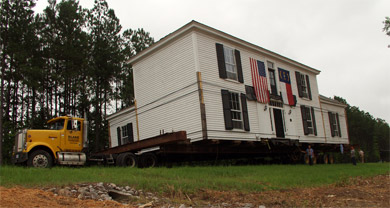
My wife and I watched an extraordinary film last night called Moving Midway.  Midway is a plantation built in 1848 on land bequeathed to the Hinton family of North Carolina decades prior to the American Revolution.  Concerns over urban sprawl led the current owner, Charles Hinton Silver, to a dramatic decision in 2003: he would literally lift the house from its foundation and move it several miles across country to a more secluded spot.  The undertaking is documented by his cousin Godfrey Cheshire, a New York film critic who grew up in a Raleigh and cherishes the memories of his boyhood visits to the place his mother called “out home.”

Cheshire discovered something unexpected halfway through the project—he has over one hundred African American relatives.  Here the film takes a dramatic turn.

Cheshire is aided by Robert Hinton, a professor of Africana Studies who also grew up in Raleigh and whose ancestors were slaves on Midway Plantation.  The two did not meet until the relocation project was underway but share an immediate rapport.  Struggling to make sense of it all Hinton confesses to Cheshire that, “This would be easier if didn’t like you.”  Still, the underlying tension is at times palpable.  Robert and Godfrey do not appear to be themselves related.

Both men struggle with their identity.  Professor Hinton explains that he has always been conflicted between his African American and Southern identities, with the Southern often winning out.  He also recounts that as a young college student in the 1960s he felt more comfortable in the presence of white graduate students than the Black Power crowd he briefly embraced.  Cheshire’s struggles are only beginning, as he explores the implications of the complicated story for himself, his family, the region, and even the nation itself.  He concludes that the only way to see the South today is as a mixed race society.

Moving Midway is many things: a meditation on the meaning of home; an exploration of family; an examination of American history; and even a short course on cinematic history.  (As a film critic Cheshire is well positioned to examine the Moonlight and Magnolias version of the Plantation South offered up by Hollywood during the years of the Studio System.)  Above all it is an example of what some call courage history, the willingness to look closely even at the people and things we love and ask the difficult questions.

I could go on but won’t.  Moving Midway is available on dvd.

A panoramic convention

I have been to Gettysburg each of the past four summers and what I find endlessly compelling is the number of approaches one can take to studying the events that took place there.  Obviously there is the military aspect of the battle itself.  Then there is how the battle fits into the larger scheme of the war.  Next comes the history of the park as a place of memory and forgetting.  To me, the myths and meanings of the battle—and of the war itself—are the most interesting.  The uses and misuses of personal narrative (by the veterans) and of history (by everyone who comes after) are especially compelling now during the sesquicentennial, when so many of our assumptions about the war are under scrutiny.  Another aspect of Gettysburg that is often overlooked is its art.  Gettysburg holds one of the largest collections of outdoor sculpture in the world.  Artistically they have a great deal to tell us.  And of course there is the Cyclorama.  Later this month Gettysburg National Military Park will host the 2011 International Panorama Conference.

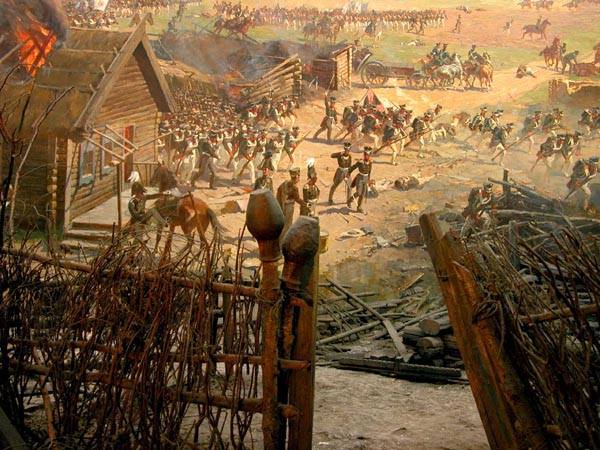
Detail of Franz Roubaud’s Battle of Borodino panorama/Moscow Poklonnaya Hill museum

Panoramas (or cyclormas, as they are called here in the United States) were a popular entertainment in the late eighteenth and early nineteenth century.  Before the advent of moving images they offered viewers a chance to experience an event multidimensionally, all for a mere dime, franc, or ruble.  Like historical movies, panoramas were not always true to real life. Nonetheless, they are beautiful works of art to be appreciated for their own merits.  This is only the third time the conference is being held in the United States.  Should you be in Gettysburg September 14-17, here are the details.

Happy Labor Day

I hope you have been enjoying your Labor Day weekend.  As I said yesterday we have been taking it easy.  In a little while we’re going to Little India with friends to have lunch and do some shopping.  I needed a few days to just relax and not think about the Civil War too much.  On Saturday David Blight’s American Oracle arrived in the mail from Ye Olde Online Book Shoppe. I am going to start it tomorrow.  Later this week I’m also going to submit proposals for an article and a conference paper.  This weekend, though, is just about relaxation.

One of my things this year has been buying Civil War Centennial tschoskes online. This is all going to be fodder for a future post, but one of my favorite acquisitions is a baseball card of General Grant from Topps’s Civil War News series.  The graphic nature of some of the cards is jarring.  Here is a short video.

Enjoy your day.

Tenure

My tenure became official today.  It was a long process—nearly ten years—that included a return to graduate school.  My second interview was on September 10, 2001.  The next day was 9/11; a few weeks later I had made the move from public to academic librarianship at a campus in downtown Brooklyn nearly within sight of downtown Manhattan.

A decade is a pretty good slice of life.  When I began here I was single; now I am married and my father passed away in the meantime.  Last November I walked my acceptance of tenure letter down to the administrative office on what would have been his seventy-first birthday.  I’ve gotten a lot of help and advice from friends and colleagues over the years.  I have been especially fortunate to have a department chair who has supported me throughout the process.

It’s a beginning as much as an end.  The work goes on.  The new academic year started this week and I already have a number of projects in the works, which I will share on the blog.  Now is an interesting time with the sesquicentennial in full swing.  We will see what the future brings.

Earthquake damage, DC

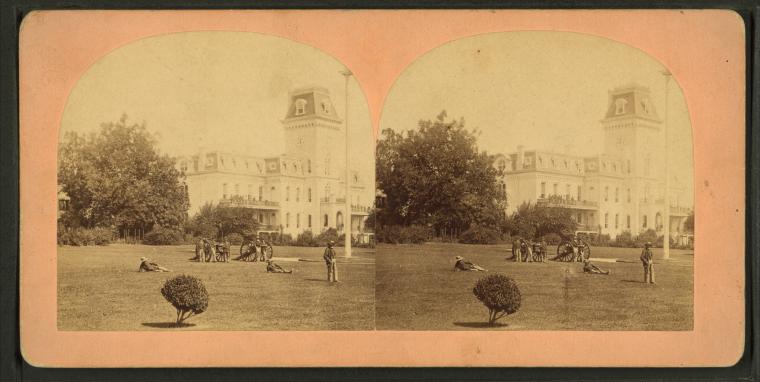
(Stereoscopic image/NYPL)

Inspectors have concluded that the Sherman Building at the Armed Forces Retirement Home in Washington suffered significant damage in last week’s earthquake.  The Sherman Building is part of the facility that houses the Lincoln Cottage.  President Lincoln rarely left the District during the war and he often retreated to the cottage that now bears his name to enjoy the solitude and escape the miserable heat and humidity of downtown DC.  The Sherman Building was built in the picturesque style of architecture, which incorporated classic building features into a modern, nineteenth century sensibility emphasizing the surrounding natural environment.  The Sherman Building was originally named the Scott Building in honor of General Winfield Scott, who devised the plan to build the Soldiers’ Home after the Mexican War.  In one of those ironies you come across when studying the American Civil War, it was Senator Jefferson Davis who steered the legislation creating the Soldiers’ Home through Congress in 1851.

Irene Report

We had our water…

and our candles.

We had our small torch and reading lights in case of a power outage.

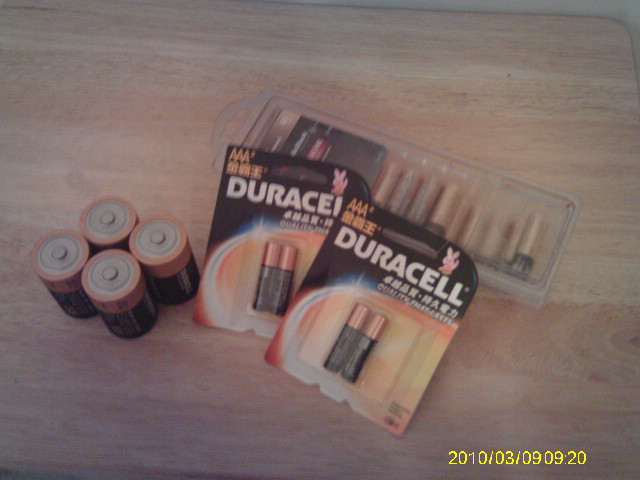
We double-checked the batteries.

We had stocked up earlier, but this was the bread aisle at the local supermarket.

For the first time I believe in history, the New York City subway system–all 722 miles–was shut down in its entirety due to natural causes.  The city did a remarkable job throughout the storm.

We never lost power and used the time to rewatch Abraham and Mary.

Thankfully we had the Iron Brigade on our side throughout the worst of it.

By late Sunday morning we were finally able to get out and get some fresh air.

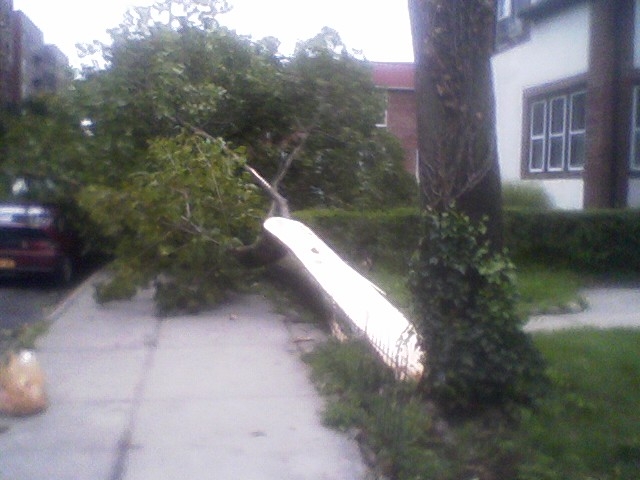
There were many branches knocked down but this was the worst of it.

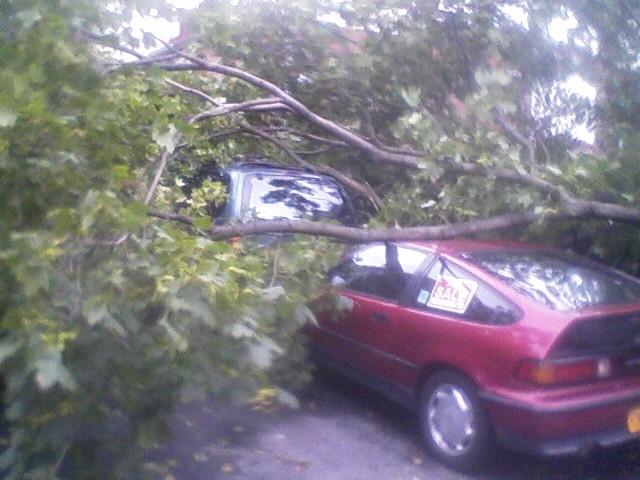
The automobiles were not damaged in any serious way.

All told we consider ourselves fortunate.  Wherever you are, if you were touched by the storm we hope you are as well.

Hello Irene

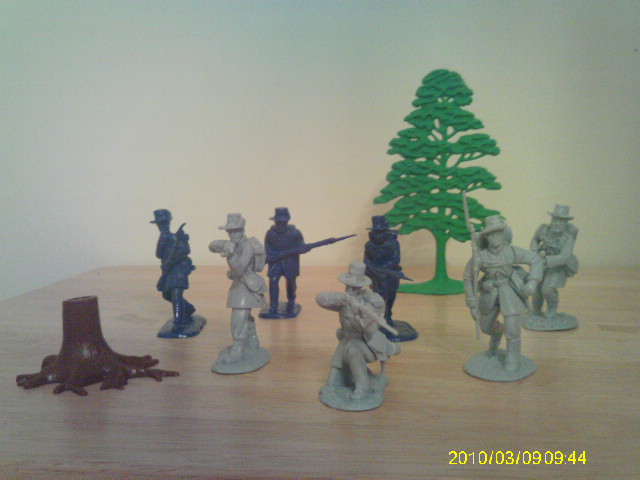
Hey everybody, it is the calm before the storm here in Gotham.  Everything is shutting down and the Hayfoot and I are going to ride the storm out at home. Sunday is going to be the Big Day.  I for one am going to catch up on some reading and probably break out some 54mm regiments in Blue and Gray on the living room floor.  I am somewhat at ease going into the storm because I turned in the draft of a small writing project earlier this evening.  I was going to put the final touches on it next week but with the storm coming I wanted to get it done.  One less thing to worry about.  Have a good weekend and I will back on Monday.

America’s Best Idea turns 95

Image courtesy Chris Light

Today is the 95th anniversary of President Woodrow Wilson’s signing of the Organic Act, the legislation that created the National Park Service.  Like all large organizations the NPS is not perfect.  Still, our nation would be a smaller place culturally and intellectually were it not for the existence of our national parks and the people who work in them.  Right now rangers are working harder than ever to ensure that visitors have a rewarding and meaningful experience.  Nowhere is this truer than at the Civil War battlefields and dozens of other sites related to the War of the Rebellion and the era.  It remains to be seen how the country’s economic problems will effect the parks in the long term.  Given the serious challenges we face today it is unlikely that the NPS will be able to undertake the types of projects it did in the 1950s and 1960s as it prepared for its 50th anniversary in 1966.  The parks are especially vulnerable because they are not seen as essential services necessary in the course of our daily lives.  Still, there are encouraging signs.  Visitation has never been higher at the Civil War related sites and is only expected to grow in the next few years.  The Park has also embraced social media, such as podcasting, in a big way.  We will see what the future brings.  One thing seems certain: the best way to protect our parks is to visit them.

Jerry Leiber, 1933-2011

Jerry Leiber, one half of the songwriting team that gave us such hits as “Hound Dog, “King Creole,” and “Jailhouse Rock,” to name a very few, has died.  What you notice when people such as he pass on is how young they were.  Leiber had been in the business for almost six decades and was still only seventy eight when he passed on.  More on the creative tension between various songwriting duos here.

(Image/Library of Congress)