Your next Civil War road trip

As I think you know The Strawfoot is more than a clearinghouse for information about Civil War sesquicentennial events.  That said, with so many things already underway—and a tsunami of programs, memorials, and unveilings to come before all is said-and-done in 2015—I thought it would be helpful to offer a few words.

By definition the hundreds of events that will take place around the United States in the next four years will be of uneven quality, as the means, talent, enthusiasm, and imagination of museum personnel, heritage groups, and state & local agencies will vary widely.  When we are fortunate enough to experience a worthwhile endeavor, we should recognize the invaluable work these organizations are doing and enjoy and learn from what they offer (and maybe drop a buck or two in the collection box). The exhibit at the county museum and the “living history” program put on by the local reenacting unit can teach us a lot about the war and the home front.  Still, there is one organization that has the scope, resources, and institutional memory to examine the war in all its complexity: the National Park Service.

As I write these words the NPS is in the midst of a nine-state, sixteen-city reenactment of President-elect Lincoln’s journey from Springfield, IL to Washington D.C. for his first inaugural.  (Unfortunately, I myself was unaware of the event held at Grant’s Tomb until it was too late.)  And that’s just for starters.  A highly random, hardly exhaustive perusal of the NPS sesquicentennial website informs us that within just the next few weeks the following are taking place:

The “Baltimore Plot” against President-Elect Lincoln– Ford’s Theater National Historic Site, Washington D.C.; February 22 & 23

The War Begins – 1861 Lecture Series–Gettysburg National Military Park Museum and Visitor Center, PA; February 26

Soldier Camp Life of the United States Colored Troops program– Petersburg National Battlefield, VA; March 5

Film in honor of women soldiers of the Civil War–Fort Donelson National Battlefield, TN; March 10

Archeology on America’s Bloodiest Day–Antietam National Battlefield, MD; March 20

That’s five programs on five very different subjects in five states.  And as I said, I pulled these off the NPS calendar highly at random.

The National Park Service covers the Civil War so exhaustively because it can.  It maintains over seventy sites pertaining at least in part to the conflict.  These are found in places you would expect, such as Virginia, Pennsylvania, and Maryland; and a few areas you would not, including California, New Mexico, and Key West, Florida.  Don’t believe me?  Check it out for yourself:

Whether your next Civil Road road trip is to your branch library for a book discussion or to Little Round Top, I hope you have a fun and informative time.

Thanks for checking in.

Keith

Dancing about architecture

As I said when I began The Strawfoot the primary focus of the blog is the American Civil War.  I say primary because life is too large to focus exclusively on any one thing, even if that “one thing” is our nation’s seminal event.  In this post I turn our attention to Old Blue Eyes.

Not long ago something came in the mail from Ye Olde Online Retailer.  It was the Frank Sinatra: Concert Collection.  The seven dvd set is the gift that keeps on giving with over fourteen hours of concert and television material and a forty-three page booklet.

Sinatra had been on television almost since the medium’s beginning.  His first ever appearance on the small screen came as a guest on Bob Hope’s vaudevillian Star Spangled Revue.  During his wilderness years in the early 1950s Sinatra had his own show on CBS called, appropriately enough, The Frank Sinatra Show.  A decade later, after The Comeback, there was the Frank Sinatra-Timex Show on ABC.  It was here that Sinatra scored his coup with the “Welcome Home Elvis” special in 1960.  Welcoming The King home may have been the Chairman of the Board’s only highlight as a regular television host.  Sinatra and television were just never a good fit.  Gone on the small screen were the grace and confidence he commanded while on stage with a microphone in his hand.  And his attempts at comedy?  I won’t go there.

Thankfully none of this is present in the Concert Collection.  It’s all about the music.  And what music it is.

The set was produced by the folks at Shout! Factory, a company begun in 2003 by some guys who had worked previously at Rhino Records.  In its short history Shout! Factory has produced sets on Second City Television (SCTV), Lenny Bruce, and the wonderful Dick Cavett Show—Rock Icons, among other things.  With Sinatra they have outdone even themselves.

There are no stilted skits or cringe-inducing monologues here.  The focus is on Sinatra’s day job.  Here in one place are the “Man and His Music” specials of the 1960s.  The first special was in 1965, when Sinatra was on the cusp of turning fifty.  Sinatra produced such specials annually for the next few years, jamming with artists as disparate as Antonio Carlos Jobim, Ella Fitzgerald, the 5th Dimension, and Diahann Carroll.  These affairs were so special precisely because they were so rare.  Released from the burden of creating content regularly, Sinatra and his guests exude an energy missing from his previous television efforts.

Then there is the concert footage.  Most of the live sets come from the 1970s and 80s, when Sinatra was recording less but touring frequently in front of rapt audiences.  There are many highlights but my favorite is The Main Event from 1974.  Sinatra always had a tad more energy when playing for a New York audience and this is apparent here on this set.  He enters Madison Square Garden with the grace of a seasoned prize fighter.  The set is worth the money just to hear the introduction by Howard Cosell.

There is even more but I won’t go on.  Sinatra’s art speaks for itself.

Thanks for checking in.

Keith

Calling young scholars

Something came through my inbox yesterday that I thought I’d pass along.

The National Park Service has a new project aimed at high school students throughout the country.  It’s the National Park Memory Trail.  The hope is to get students, working under the guidance of their teachers and local librarians, involved in the Civil War sesquicentennial.  The Memory Trail is designed to allow students to do real research on their own communities and create digital narratives which will then be posted on the National Park Service website.  Students can research what life was like in their local community in the early months of 1861.  Or, they might explore how the war’s centennial coincided with the Civil Rights Movement.  Finally, they might reflect on their own place in our nation’s history and where this awareness might lead them in the future.  It’s called the Memory Trail because viewers will be able to click on a map of the U.S. and read the narrative of each participating locale.

You may be asking yourself, what did my little town have to do with the American Civil War?

The answer is, probably more than you think.

Over three million soldiers fought in the American Civil War.  Some were city slickers from Atlanta, Philadelphia, and Manhattan’s Bowery; others were rubes from hamlets too tiny to be found on any map.  Then there were the parents, wives, children, sweethearts, and other loved ones left behind to cope as best they could.  The war reached into every household in America, including undoubtedly the town where you live today.

I’ve worked in small museums and libraries throughout the country and can tell you that much of the most interesting scholarship is done at the local level.  There is the genealogists maintaining funeral records of the town’s ancestors in a small office in her own home, the archivist at the local historical society safeguarding (usually on a shoestring) the town’s collection of artifacts, and the librarian conserving old newspaper clippings and one-of-a-kind ephemera in the library’s now seldom used Vertical File.  There is a great deal of material out there to work with.  Photographs, letters, oral histories, maps, postcards, and old advertisements are a few examples of things today’s young researcher might use for her narrative.

To find out more, go here:

Thanks for checking in.

Keith

Ellis Island National Monument

Hey everybody,

As I mentioned in my welcome post, it is my privilege to be a volunteer in the Interpretation Division at Ellis Island National Monument.  I confess that at first I thought I was settling because I would have preferred to have been at a Civil War site.  Now I wouldn’t have it any other way.  I never tire of hearing stories of the 12 million brave souls who passed through the Golden Door.

Each of our national parks is a treasure and it is the NPS rangers who make it so.  If you were to take a tour of Ellis with each ranger, you’d have a solid grasp of Ellis Island’s history and its place in our national memory.

This past weekend was my first anniversary at the island.  I thought I’d share a few pics from the past year:

This is the Main Building. I took this last spring. The immigrants arrived at the same ferry slip visitors use today. I often wonder what they were thinking when they approached.

One Friday last July a senior ranger received permission to take a small group of rangers and this volunteer to islands 2 and 3. What an honor this was.

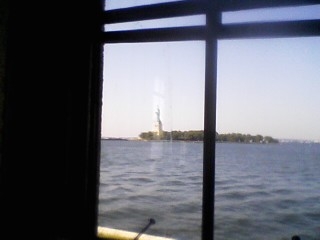
This is Lady Liberty from one of the old buildings on island number 3. You can practically feel the ghosts.

The million dollar views of the city are an added bonus. I took this on a rainy day last fall from the second floor of the museum.

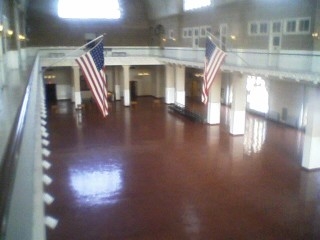
This is the Great Hall, or Registry Room. One of my small pleasures is to take a few quiet minutes here before the crowds arrive.

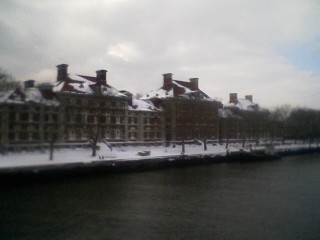
January 2011: This is island number 2 (the hospital) after the recent snowstorm.

One year and counting…

Keith

The Gray Nirvana

The war will never be over.  Let minié balls corrode, Confederate money crumble, and imitation battle flags rot.  As long as there is a tear-jerking poem to be read, a droll statue to be unveiled, a cannon ball to be unearthed, a fast buck to be made—then there will always be a Confederacy.  Grant, Sheridan, Sherman—they could whip Marse Robert Lee and Retreating Joe Johnston.  But they will never whip that long gray line of genealogists, antique dealers, historians, promoters, and roundtable buffs—marching to the Gray Nirvana.

Hey everybody,

The above is from a little gem of a book I read today, Will Success Spoil Jeff Davis?: The Last Book about the Civil War, by T. Lawrence Connelly.  Published in 1963, the 100th anniversary of the Battle of Gettysburg among other important events, the book is a gentle—sometimes not-so-gentle—spoof of the Civil War Centennial.

Thomas Connelly was uniquely positioned to satirize the war and the mythology surrounding it; at the time of the book’s publication he was chair of the History department at Presbyterian College in fire-eating South Carolina.  Today Professor Connelly is justly renowned as author of The Marble Man: Robert E. Lee and His Image in American Society, his 1977 book examining the hagiography of the Confederate general.

In Jeff Davis Connelly recounts the efforts of the Sobbing Sisters of the Southern Secession—or S.S. for short—to tell their version of the War Between the States.  He also urges us to check out the mechanical Abraham Lincoln (Insert a quarter and Abe splits a rail; Insert a dollar and he saves the Union) on our next Civil War road trip.  I’m going to look for it the next time I’m on Steinwehr Avenue.

Re-enactors, souvenir hucksters, and Lost Causers aren’t the only ones who come in for the ribbing that they deserve though.  One of the book’s many high points is when the constipated professor from the State College drones on and on from his latest paper, “Symbolism and Poetic Imagery in Confederate Field Battle Reports” at a public event. Then there are the (fictitious) dissertations:

“Saddle Soap Usage in Southwestern Virginia, 1861-1865” and

“Confederate Hymn Book Production in East Mississippi.”

Apparently portentous prose and over-specialization are not unique to the modern academy.

Equally important as the text are the illustrations by Campbell Grant.  I may be mistaken, but I believe this is the same Campbell Grant who worked for Disney and illustrated Fantasia, Snow White, Pinocchio, and other classics for the studio.

Alas, Jeff Davis is out of print.  Being the good librarian I am, I interlibrary loaned a copy from another school.  It would seem that republishing this knowing little tome, perhaps in a 50th anniversary edition with a new introduction by one of today’s historians, would be an opportunity for some small press focusing on Civil War titles.  Until then, thankfully, you can get it here:

Thanks for checking in.

Keith

Henry Ward Beecher

Hey everybody,

I took this pic during my lunch hour today.  This is in downtown Brooklyn.

One of the best things about living in the Big Apple is that the Civil War is a constant presence in the lives of those New Yorkers willing to look for it.  It seems that every few blocks there is a statue for this regimental colonel or that Union general.  Down the street from our house is Green-Wood Cemetery, the final resting place of over 3,000 Civil War soldiers, including Union General-in-Chief Henry Halleck and one Confederate general.  (I’d love to know that story.)

This particular statue was designed by John Quincy Adams Ward and dedicated in 1891, 120 years ago.

As I’m sure many of you know, the Reverend Beecher was leader of Plymouth Congregational Church here in Brooklyn, which was then its own city and not part of New York.  Soon-to-be presidential candidate Abraham Lincoln attended services at Plymouth Church in February 1860.  The following day his speech at Cooper Union launched him to national prominence.  The rest, as they say, is history.

Five years later Reverend Beecher gave an emotional sermon for the assassinated sixteenth president.

(Cooper Union has an extra special place for me; it was in the coffee shop across the street where I met the woman who would later become my wife.)

I often wonder when passing Beecher every day how many people know who he was and the role his church played in the Civil War and the abolition movement.  History is all around us, if we just slow down enough to look.

Thanks for checking in.

Keith

Lessons Learned

As I mentioned in my introductory post, the primary reason I started The Strawfoot is the Civil War sesquicentennial.  I’ve always been fascinated by the American Civil War and am now trying to understand the period in a deeper, more meaningful way.  The 150th anniversary of the conflict seems an opportune time to do this.  Not long ago I read Robert J. Cook’s Troubled Commemoration: The American Civil War, 1961-1965.  Cook, a British historian, has written a jargon-free, well-researched account of the events that derailed the Centennial in the early 1960s.  In a nutshell, the organizers of the United States Civil War Centennial Commission found it increasingly difficult to keep the Civil War relevant in the face of the Civil Rights Movement.

President Eisenhower signed the legislation creating the Centennial Commission on September 7, 1957, just two weeks before he sent the 101st Airborne to Arkansas to integrate Little Rock Central High School.  Over the next few years preparation for the Civil War anniversary was virtually an all-white affair.  Many Americans, North and South, wanted to concentrate on the minutiae of uniforms and weaponry; attend reenactments such as the one at First Bull Run in July 1961; and focus on the valor of Johnny Reb and Billy Yank.  With lunch counter sit-ins and other Civil Rights protests becoming more frequent, white Southerners began incorporating the language of the 1850s and 1860s into their “massive resistance” to integration.  They also incorporated the symbols and imagery of the Civil War, most obviously the Confederate battle flag, into their campaign against desegregation.  Under this strain it was inevitable that most Americans would lose interest in celebrating the “pageantry” of the war that took the lives of 620,000 Americans.  And indeed, most Americans did lose interest.  That’s not to say that the Civil War Centennial was a total wash.  Allan Nevins, James I. Robertson Jr., Bruce Catton, and Bell Irvin Wiley, among others, did their best to commemorate the war in a dignified and meaningful manner.  Still, despite some modest successes, results were mixed at best.

This brings me to the sesquicentennial.  Fast forward half a century and we are looking at a totally different picture.  Over the past several decades there has been a sea change in Civil War scholarship.  The rise of African- and Women’s Studies, coupled with the prevalence today of social history over the Great Man theory of scholarship, have given us new ways of looking at our Civil War.  That’s what makes today so fascinating.  Historians, bloggers, National Park Service rangers, and journalists have incorporated these changes into their work and are giving us a more nuanced and thoughtful understanding of our country’s greatest catastrophe.  We see that today every time we walk one our battlefields, visit our museums, log onto the internet, and read the newspapers.  That’s why I’m looking forward to the next four years and seeing what they bring.  It makes me wonder, too, what they’ll say about us when they write the book on the sesquicentennial fifty short years from now.

Thanks for checking in.

Keith

Welcome

Hey everyone, welcome to my blog, The Strawfoot.  They say that behind every good man is a good woman telling him what to do, and nowhere is it truer than on this blog.  My wife, The Hayfoot, was behind me the whole time saying, “Click here.  Point there.”

I am a librarian at a college in New York City and a volunteer in the Interpretation Division at Ellis Island National Monument, part of the National Park Service.  I hasten to add that the opinions expressed here are mine alone and not those of the various institutions where I render my services.

The primary focus of this blog will be the American Civil War, but I also intend to right about the myriad other passions in my life.

Much (all) of this is new to me.  I ask for your patience and thank you for checking in.

Stay tuned,

Keith Muchowski