One Wednesday morning

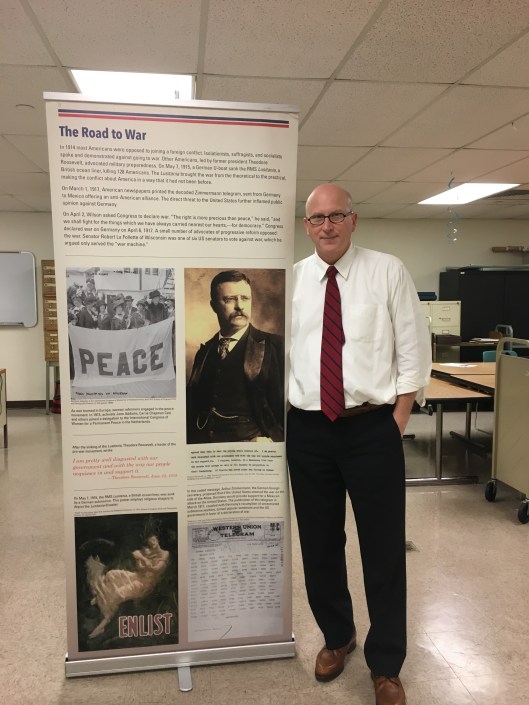
Yesterday morning a colleague and I opened and assembled a six-panel exhibit our library received from the Gilder Lehrman Institute of American History. We had to inspect it to ensure that there was no damage in transit. This morning we are going to install the panels in our exhibit space. I also intend to create a screen roll of related photographs that will run on a loop on a large screen computer. It has been a privilege to collaborate with The Library of America and Gilder Lehrman Institute these past two years.

Gertrude Vanderbilt Whitney’s Mitchel Square

Yesterday I put the final touches on my upcoming talk this Sunday at Camp Doughboy on Governors Island about John Purroy Mitchel. Later I did a dry run for a friend in my department to work out the kinks. A dress rehearsal always helps with these things in turns of timing, avoiding ambiguity, and just making certain that are sufficiently clear. I am as ready as I am going to be.

Gertrude Vanderbilt Whitney sculpted this doughboy statue in Upper Manhattan in 1923 and later founded the Whitney Museum of Art. Quentin Roosevelt was engaged to her daughter when killed in an airfight in France in July 1918.

In part of the talk I discuss the ways the JP Mitchel is remembered in New York City. Mitchel Square at 168th and Broadway is just one memorial to the Boy Mayor. There too is this beautiful statue that we see above, which was not sculpted expressly for Mitchel himself but for the men on Washington Heights who fought in the war. I happened to be in northern Manhattan a few weeks ago on my way to somewhere else when I stumbled upon it. Yesterday after my walk through my friend and I were discussing Mitchel and breaking down some of the details of his life and times. Color me ignorant but I did not know that the statue in Mitchel Square was designed by Gertrude Vanderbilt Whitney. Gertrude was the mother of Flora Payne Whitney, Quentin Roosevelt’s fiancée. Of course Quentin himself died in a military plane incident above France just two weeks after Mitchel was killed in Louisiana two weeks earlier.

Check out the schedule for Camp Doughboy 2018 here.


Sunday morning coffee

I am having my coffee and a bite to eat before heading off to the Tomb. I see it is raining. It is too early to tell how it might effect the event at Sakura Park that runs from 12:00 – 8:00. I am watching the progress of Hurricane Florence as well. In addition to the terrible havoc it might unleash on many lives and communities, it may effect next week’s Camp Doughboy weekend on Governors Island. We will keep our fingers crossed that the Florence, and the storm building behind it, do not turn into major tragedies.

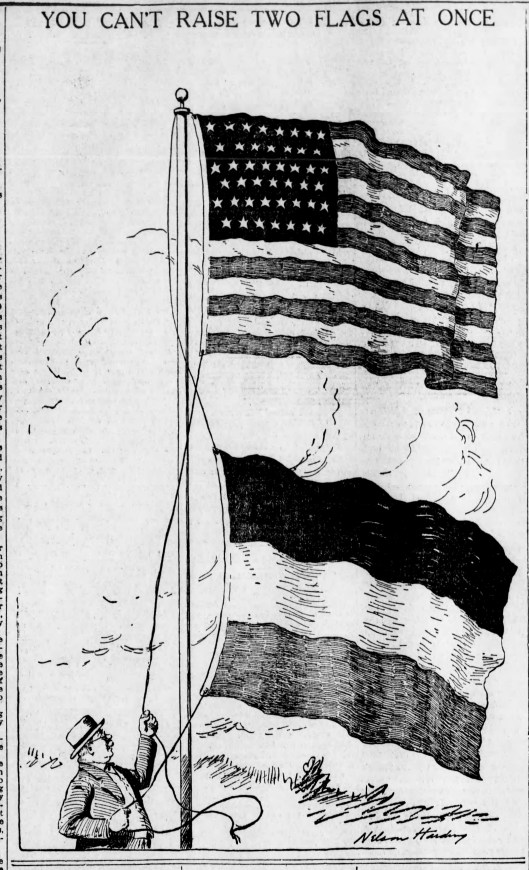
You Can’t Raise Two Flags at Once, Brooklyn Daily Eagle August 9, 1915

I was gathering my notes yesterday for next week’s talk about John Purroy Mitchel and came across this political cartoon which I thought I would quickly share. It is from the August 9, 1915 Brooklyn Daily Eagle and, coincidentally or not, is positioned next to an article about Mitchel’s participation in the Plattsburg training camp that summer. The cartoon shows Theodore Roosevelt explaining the dangers of what he and his supporters called hyphenated-Americanism during the Great War. The United States was not yet in the war when this cartoon was published. This was, however, just three months after the sinking of the Lusitania. The tension between Roosevelt, General Leonard Wood, Mayor Mitchel and other Preparedness advocates against President Wilson was building.

Just a few weeks after this cartoon appeared Roosevelt gave a controversial speech at Plattsburg taking the Wilson Administration to task for what he saw as its poor response to the war. General Wood was in attendance in Plattsburg with Roosevelt and later reprimanded by Secretary of War Lindley Garrison.

John Mitchel, Irish nationalist

Irish nationalist John Mitchel was put on trial in 1848 and eventually sentenced to “transportation” to Tasmania. He escaped to New York City and eventually moved South to support the Confederate cause. Seventy years later his grandson would be killed in a military training exercise getting ready to go to France to fight in the First World War.

Over the past few days I have been drafting the outline for my talk at next week’s Camp Doughboy weekend on Governors Island about John Purroy Mitchel. When I have more details I will share them here. Some may recall that in early July I wrote a piece for Roads to the Great War for the 100th anniversary of his death. Space constraints prevented me from going deeper into the Mitchell family than I would have liked. JP Mitchel was the grandson and namesake of famed Irish nationalist John MItchel. Mitchel the Elder was born in 1815 and put on trial by the British in 1848 when Ireland was in turmoil during the failed European revolutions of that year. He was sentenced to exile–what at the time was called “transportation”–to the Australian outpost Van Diemen’s Land, what we today call Tasmania. There on the Van Diemen penal colony too was Thomas Francis Meagher.

Mitchel and Meagher independently escaped to New York City. Mitchel ended up Brooklyn, living on Union Street and working as a journalist when he wrote his memoir Jail Journal; or Five Years in British Prisons. As the secession crisis heat up he eventually took his family down south, first to Tennessee and as the war went on to Richmond. Mitchel is testimony to the notion that life and humans are complicated; throughout his life he remained engaged in the Irish freedom struggle but was a staunch defender of slavery and the Confederacy. Mitchel was all in for the Confederate cause and all three of his sons served. Ironically two of the boys fought against the Meagher’s Irish Brigade at Fredericksburg in December 1862. One of Mitchel’s sons was killed in Pickett’s Charge near the Codori farm and another died while commanding Fort Sumter in 1864. The third, James, was wounded several times and lost an arm. Mitchel worked as a journalist for several Southern papers supporting President Davis. Ulysses S. Grant because a frequent foil after the general moved east in 1864. As the war wound down Mitchel escaped Richmond with Jefferson Davis’s entourage but was eventually captured and held at Fort Monroe before being released late in 1865. He soon became an editor with Benjamin and Fernando Wood’s New York Daily News, a Democratic vehicle that had given Lincoln much grief during the war and afterward turned it wrath on Reconstruction.

Mayor John Purroy Mitchel (center in top hat) and Cardinal John Murphy Farley reviewing St Patrick’s Day parade, March 17, 1914

John Purroy Mitchell was born in the Bronx in 1879, four years after his grandfather’s death. For reasons that are not clear to me, JP Mitchel was raised Catholic whereas his grandfather had been a Presbyterian. These were not small matters in Irish and Irish-American communities. I am assuming the Catholicism came from his mother’s side; the Purroys were Catholics who had come to New York City from Venezuela. I’m not going to rehash the Mitchel story here, though I probably will go into it more over the coming week as we get closer to Camp Doughboy. By the time he became mayor of New York City in January 1914 John Purroy Mitchel was thoroughly engaged in the Reform movement to clean up government. When war came later that year he was one of the earliest advocated for American Preparedness. It is intriguing to think of Mitchel being so actively engaged in the Preparedness Movement. Many Irish and Irish-Americans supported the Germans because they were fighting the British.

Like his grandfather during the American Civil War however, John Purroy Mitchel was all in for the Allied cause, eventually giving his own life on that Louisiana air field in July 1918. The world is indeed a complicated place.

(top image from The Citizen uploaded to Wikimedia Commons by Domer48; bottom, Library of Congress)

A floating Picasso

I hope everyone had a good weekend. I rested up yesterday in preparation for what will now be a busy week. It is supposed to be in the mid 90s here in New York City today also. I’m ready for autumn days.

This video could have been much longer but here is a small piece from the Smithsonian about the dazzle art used on ships during World War One. Remember that the 1913 Armory Show was held in New York City (and reviewed reasonably favorably by none other than Theodore Roosevelt) in 1913, the year before the war’s start. We and some friends and are hoping to take a ride on one of the contemporary WW1-inspired dazzle ships here in the city this fall. Modern art inspired the camouflage worn by soldiers in uniform. The Allied navies incorporated The same principles were used on vessels as well. Cubism in particular into the camouflage painted onto ships. I have never seen such as this one however, where instead of zebra-like colors and angles the innards of the ship art painted on the outside.

Sunday morning coffee

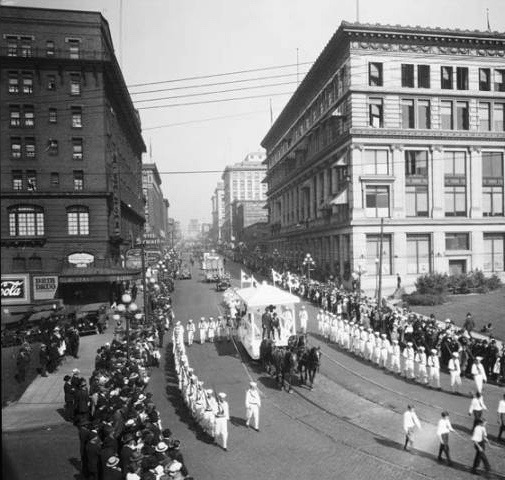
I hope everyone’s Labor Day Weekend is going well. It has been good to have a three day weekend after the long, hard push of the first week of the academic year. I am off to Grant’s Tomb in a little bit and am running a tad late, but wanted to quickly share this photograph. This was Labor Day 1918 in Seattle. Here we see sailors marching around and behind a Red Cross float. The War Industries Board and other governmental and quasi-governmental organizations did much to quell civil unrest during the Great War but there were still a surprising number of strikes. Here is a list I found in a very cursory search, which I am sure it is hardly a complete tally. Franklin D. Roosevelt was Assistant Secretary of the Navy in the Wilson Administration and would consciously do all he could as president during World War 2 to ensure labor peace. Still, strikes did occur during the Second World War as well.

Labor Day 1918 fell on Monday September 2. It also marked the end of the Major League Baseball regular season. Teams did not play a regular 154-game schedule but were limited to about 130 games, depending on how many they had gotten in by Labor Day. There were a large number of double-headers that day to squeeze in as much as they could.

Enjoy your weekend, all.

(image/Museum of History & Industry, Seattle)


The Atlantic Telegraph Jubilee, September 1, 1858

In the mid 1980s your humble writer, fresh out of high school, had a job for a year or so working in a survey crew in West Texas laying out the routes for fiber optic cable lines through the desert. Running parallel to these new lines were old ones consisting of copper coaxial cables, some of which remained and some of which got extricated to make make for the new digital. This all came back to me when reading the other day of the Atlantic Telegraph Jubilee of September 1, 1858. One hundred and sixty years ago today New Yorkers turned out by the thousands to celebrate the laying of the first cable crossing that ocean span. The work was that of Cyrus W. Field, owner of the Atlantic Telegraph Company. The first official transatlantic communication (after a test run to make certain things were in working order) had been sent two weeks earlier, when on August 16 Queen Victoria in London messaged President Buchanan, the former U.S. Ambassador to the Court of St. James’s, in Washington. There had been several attempts in the days before this that had failed for technical reasons.

A somewhat forgotten event today, the Atlantic Telegraph Jubilee was held in New York City on September 1, 1858. Transatlantic telegraphy did not come into its own until after the American Civil War and would be part of daily life well into the twentieth century.

Everyone understood the significance of the transatlantic cable. York City, for one, had only had running water for sixteen years at this point and was not unique in its lack of infrastructure and public utilities. Letters still took weeks to cross the ocean. The initial rate in August and early September 1858 to send a transatlantic message was $5 per word. By comparison: the average working man earned between $1-$2 per day. It took seventeen hours to transmit Queen Victoria’s fourteen-word message to Buchanan. Thousands turned out for the Atlantic Telegraph Jubilee but the event seems to have been largely forgotten over the ensuing decades and up to the present time. That is probably because the cable broke with a few short weeks and was essentially inoperable by early fall. Such failures are not unusual in these types of projects. Transatlantic communication did not come to full fruition until after the American Civil War. In 1866 Field managed to build the first true, permanent cable. By then, message time was down to about eight to fifteen words per minute.

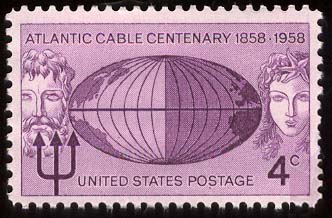
The United States Post Office held the First Day Cover ceremony for the transatlantic cable centenary stamp at the Farley Post Office in Manhattan on Friday August 15, 1958. George Giusti, an Italian who fleed Europe in 1939 during the Second World War, was the designer.

The transatlantic cable was hugely important well into the twentieth century. By 1908, fifty years after the first cable massage, there were at least six companies and over a dozen lines crossing the ocean. Rates were down to four cents per word. Even with that there was much public talk about high rates and unfair trade practices. One way was to make it cheaper to send messages at night, just like cell phone companies encourage us today to use our phones on evenings and weekends by making calls less expensive. Consolidation soon followed. Transatlantic communication was hugely important during the Great War. Alexander Graham Bell invented the telephone in 1876, and indeed there was some telephone communication in the First World War, but like the airplane it was still in its infancy. Thus telegraphy’s continued significance.

Albeit anomalously, cable messaging continued even into the twenty-first century. It was not until February 2006 that Western Union sent its last telegram. I remember saying that to a class of technology students the day after that happened and the students responding with virtually no reaction.

(images/top, NYPL; bottom, U.S. Post Office)


Ulysses S. Grant III, 1881-1968

Ulysses S. Grant III died fifty years ssgo today. To put his long life in some perspective: Grant was present at Mount McGregor when his grandfather died in July 1885; graduated with Douglas MacArthur in the West Point Class of 1903; worked as a White House aid in the Theodore Roosevelt Administration; married Secretary of State Elihu Root’s daughter in 1907; served in the Pacific and Caribbean during the Philippine and Cuban Insurrections, at Veracruz and on the Mexican Border during the Punitive Expedition, in France during the Great War, and in Paris after the Armistice where he helped write the Treaty of Versailles. All before his fortieth birthday.

The 1907 Root-Grant wedding was a major event in Washington society and covered by newspapers across the country.

A few weeks ago at the Tomb I chanced upon a well-known figure from the Civil War blogosphere who grimaced when I mentioned that this month marks the anniversary of Grant III’s death. I wasn’t surprised and cannot say I blame him; Grant is today best known as the first chairman of the doomed United States Civil War Centennial Commission. Many readers will know that the Civil War centennial did not proceed smoothly, coming as it did—not coincidentally—during the Civil Rights Movement. President Eisenhower signed the enabling paperwork creating the Centennial Commission in 1957, the same year that Little Rock High School was desegregated. Grant turned seventy-six the year he assumed the chairmanship of the organization he led for the next four tumultuous years. His reputation, for all he had done over his long career, has never recovered.

Writing in his 2012 book American Oracle David Blight offers a scathing indictment of Grant as “a staunchly conservative superpatriot and racist.” When one looks at U.S. Grant III’s life from a certain perspective it is difficult to argue with Blight’s assessment and I won’t defend Grant or his record in their entirety here. That said, a more charitable interpretation might be that Grant, born in 1881, reflected the views and attitudes of most white Americans born in his era. He toiled for decades in a U.S. Army officered with the sons and grandsons of many of the men who had once fought against his grandfather. Who among us can say with certainty what we would have done had we lived in another place and time?

After the Great War and Versailles Peace Conference Grant held numerous military posts in the 1920s, oversaw part of the Civil Conservation Corps in the early years of the Franklin Roosevelt Administration, and quietly prepared for war with other officers of the Second Corps Area on Governors Island in the late 1930s while Germany and Japan rattled their sabers. Too old for combat service when Pearl Harbor finally came, he coordinated civil defense for the continental United States during the Second World War. Grant’s aptitude as a civil engineer and apparent interest in urban planning led him over this long career to many other positions, including a stint after World War II as a member of the National Capital Park and Planning Commission in Washington D.C. and president of the American Planning and Civic Association.

All of these accomplishments were in the end tarnished by that 1957-61 stint as Centennial Commission chairman. Had Grant and his allies had their way, the Civil War centennial would have been filled with Civil War rrenactments emphasizing the courage  and fighting spirit of Union and Confederate men and officers while studiously avoiding the war’s causes, consequences and unfinished business. The controversies are too detailed to go into here. Things began escalating however until in 1961 New Jersey officials publicly called on Grant to resign. There was pressure from other quarters as well. Grant held on for several months until eventually submitting his resignation to President Kennedy in September 1961. The pretense was his wife Edith Root Grant’s health and indeed Mrs. Root had been ailing for some time, confined now to the family summer house in Clinton, New York for many months as her health deteriorated. General Grant was sincere in his concern for his wife, but the public pressure regarding the Centennial Commission was intense and growing. Mrs. Grant died in 1962 and her widower husband carried on for six more years.
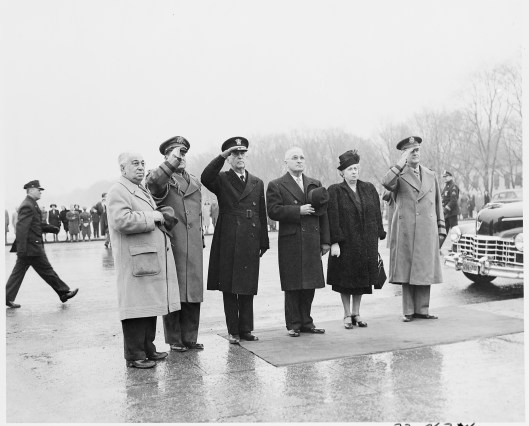
President and Bess Truman with Ulysses S. Grant III (far right), Admiral William Leahy (third from left) and others at the Lincoln Memorial, February 12, 1948.

His grandfather, General and President Ulysses S. Grant, in a very real sense had died at the right time in 1885; with the war over for two decades, Americans, especially white Americans, were eager to move on. Reconstruction had ended eight years previously and General Grant’s funeral was the reconciliationist event that organizer Winfield Scott Hancock, the 60,000 marchers, hundreds of thousands of attendees, and millions of other Americans had wanted it to be. President Grant, try though he did, was unable to heal the nation’s wounds during his administration; the intransigence he faced was just too great. Ironically it was the failures of Grant and the country that contributed to his grandson’s resignation nearly a century later.

Ulysses S. Grant too died during a decisive moment in American history. His passing came on the third day of the 1968 Democratic National Convention, when the party met in the tense August heat of Chicago. With the Vietnam War going poorly and after the many assassinations and riots that had already taken place that year, civil unrest was almost inevitable. We still face the fallout from those tragic days. Much of the worst of it came on August 28, when police and protesters clashed in a violent conflict broadcast on network television and watched live by tens of millions people. Ulysses S. Grant III died at the family home in Clinton, New York the following day.

(images/top, Library of Congress; bottom, National Archives)

No more of those hideous monuments!

Puck magazine, August 19, 1885

I hope everyone is having a good weekend. Blogging will continue to be light for the next week as I squeeze out some last days of R&R before the academic year begins a week from tomorrow. We visited the Newseum in Washington yesterday. I will have more to say about it when I get back from vacation. Today I wanted to share this centerfold from the August 19, 1885 edition of Puck magazine. Grant had died three weeks previously and his funeral was now eleven days in the past when this hit the newsstands. Literally within hours after his death, discussion had begun about the size, location and type of monument he might receive. There was no shortage of ideas; suggestions ranging from the sublime to the surreal were pouring in from across the country.

It is difficult to tell how cheeky or sincere the Puck editors are being here with their recommendation in the lower right hand corner. My favorite part of the cartoon is the statue of William Seward on the left. The statue still stands where it was dedicated in Madison Square Park in 1876. President Grant himself donated to the construction of the statue. Chester Arthur, Grant’s appointee as Collector of the Port of New York, and Winfield Scott Hancock both attended the Seward dedication and also participated in Grant’s funeral nine years later, a few weeks before this Puck cartoon’s release. Arthur himself was the first leader of the Grant Monument Association but, like Hancock, died in 1886 the year after Grant did. The Grant Monument Association and American people would spend the next twelve years hashing out the scope and design of what became Grant’s Tomb.

(image/Library of Congress)