Oyster Bay’s Kaiser Wilhelm II

Back in December I wrote about a portrait of Kaiser Wilhelm II in the collection of the Brooklyn Museum of Art that was saved from destruction during the anti-German hysteria of the First World War. Six months later in July and August 1918 the fate of another portrait of the Kaiser ended differently. This event took place in Oyster Bay, Long Island not far from Brooklyn.

Carl Henry Pollitz’s WW1 draft card. Mr. Pollitz remained in Oyster Bay after the incident and lived until 1966.
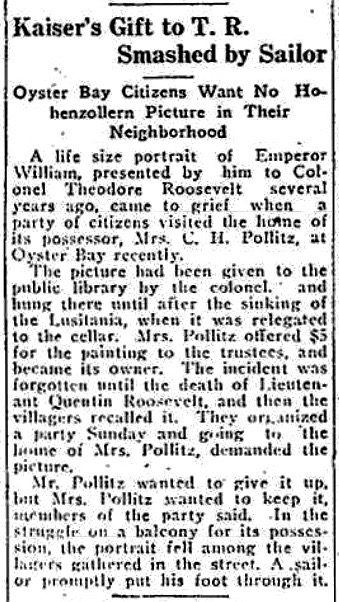
The destruction of the painting was covered in the German diaspora press. This article appeared in the Drumheller (Alberta) Mail on 19 September 1918.

Apparently during Theodore Roosevelt’s presidency (the exact date is unclear), the German ruler gave the American president an autographed portrait of himself. Colonel Roosevelt eventually donated the painting to the Oyster Bay Public Library, which had the likeness on display until the sinking of the Lusitania in 1915. Old newspaper accounts vary slightly in the details, but the painting eventually came into the possession of one Carl Henry Pollitz and his wife Matilda. Mr. and Mrs. Pollitz were both naturalized Americans born in Germany. They owned the painting for three years until early on the morning of Sunday 28 July 1918 an angry mob gathered outside their home demanding the portrait. The couple had escaped to the roof with the painting and eventually handed it down. A sailor quickly put his foot through the Kaiser’s face. Similar events had taken place around the country but apparently the immediate cause of this one was the recent death of Quentin Roosevelt and the anger it caused.

Secret servicemen were dispatched to look into the matter and Mr. Pollitz, who said he knew some of the perpetrators, demanded action. That is where things stood for a few tense days until on Thursday 1 August an angry gathering of 1500 turned out in the public square. The painting was displayed on the tip of an old Revolutionary War musket bayonet for the angry crowd to see. They also sang the “Star Spangled Banner” and various anti-German songs. Eventually they doused the painting in gasoline and burned it.
 

The Adventures of Albert Smith Bickmore

Last night I completed what are for now the final edits on the manuscript for the book project whose working title is “Incorporating New York: Gotham’s Civil War Generation and the Creation of the Modern City.” I say “for now” because if and when it gets picked up by a publisher it will need a reading from a professional proofreader in addition to a final review by myself to spot any errors that certainly are there in the weeds. Two readers have read and commented earlier in the spring and I have spent much of the summer making their suggested revisions and corrections. Last night I also spent a considerable chunk of time (while listening to the Astros game and watching the rain) adding the references into Zotero. That is where the citations stand as of now. I have not incorporated them into the text because I do not know what format a prospective publisher might want and so am not going to create potential double work for myself.

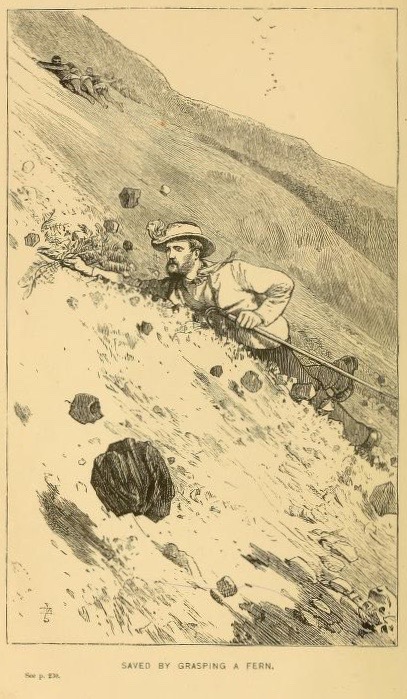
Albert Smith Bickmore as depicted in the 1869 American edition of Travels in the East Indian Archipelago

I thought I would share the above image that comes from the 1869 American edition of Albert Smith Bickmore’s Travels in the East Indian Archipelago. The book was originally published in London the year before. As a student at Harvard just prior to the war Bickmore worked in Louis Agassiz’s Zoological Museum before joining the Forty-Fourth Massachusetts Volunteers after Fort Sumter. When the regiment was discharged in 1863 he studied in Europe, and after Appomattox returned to the United States briefly before taking this scientific voyage. When he returned from that, he came to Manhattan and spoke to people like William E. Dodge Jr. and Theodore Roosevelt Sr. about creating a natural history museum for New York City. By April 1869 it was done, with the charter ratified in the Roosevelt home on East 20th Street.

Ulysses S. Grant, 1822-1885

excerpt from July 23, 1885 Brooklyn Daily Eagle on Grant’s death

What a special day it was yesterday at General Grant National Memorial (Grant’s Tomb) as we remembered the life and memory of the general and eighteenth president. It was an honor to read the Whitman poem and participate in the wreath laying and placement of the white roses. Frank Scaturro gave a very informative talk in the visitor center afterward. This event gets bigger every year and I am sure will continue to grow as the 2022 bicentennial of Grant’s birth gets closer and closer in the coming years.

Ulysses S. Grant Jr., 1852-1929

Julia Dent Grant with Frederick and Ulysses Jr. in St. Louis, 1854. Lieutenant Grant was in the Pacific Northwest at the time and had not yet met his second son. This daguerreotype was discovered in 2016 and sold at auction in Cincinnati for $18,000.

Ulysses S. Grant Jr., Buck to the family, was born on this day in 1852. By this time his father was on his way to California with the 4th Infantry Regiment and a party of about seven hundred wives and children. The 4th was stationed briefly at Fort Columbus on Governors Island before their trip. Quartermaster Grant went briefly to the District of Columbia to see about supplies. While he was in Washington, Henry Clay—the Great Compromiser—died there, bringing things to a standstill. An empty-handed Grant returned to New York City and the regiment sailed for Panama on July 5.

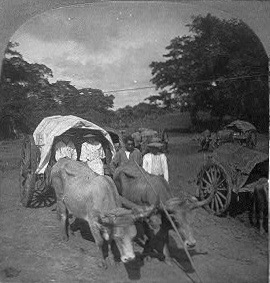
This photograph of travelers crossing the Isthmus of Panama was taken in the early 1900s. The 4th Infantry crossed in much the same way over half a century earlier. One out of seven who made that trip died of cholera. This danger is why Ulysses and Julia decided the family would instead go to Bethel and then St. Louis.

Remember, the canal did not come into being until Theodore Roosevelt picked up where the French had failed. The Panama Canal opened in August 1914 at almost the same moment the Great War was starting. Instead travelers crossed the Isthmus by mule and wagon. To say that it was a hazardous journey would be an understatement. That is why Ulysses and Julia decided she and young Frederick, just two, would not make the voyage. Instead, they would go to Bethel, Ohio and then Missouri. It is a good thing they didn’t; one hundred people in the 4th Infantry’s party died of cholera. The pregnant Julia and the toddler Frederick might well have become two more victims. Instead Julia gave birth to young Ulysses in Bethel. Lieutenant Grant did not learn this until the mail finally reached the 4th Infantry at Fort Vancouver (Columbia Barracks) just before the new year.

(images/top, unknown photographer, taken in St. Louis (Cowan’s Auctions) [Public domain], via Wikimedia Commons; bottom, Library of Congress)

Remembering Brooklyn’s G.A.R. Post 327

G.A.R. Post 327 marker, Brooklyn’s Green-Wood Cemetery

The Grand Army of the Republic was the premier fraternal organization for Union Civil War veterans. Returning soldiers founded the GAR just after the war and over the next several decades hundreds of thousands of men who had worn the Union blue joined posts across the nation to socialize, perform charitable works, and advocate for medical care and military pensions. One of the most active was Post 327 of Brooklyn, New York. Post 327 included men from such regiments as the 14th Brooklyn that fought at Antietam, Gettysburg, and elsewhere. The 327 also included many men who had served under Grant and Meade in the Overland Campaign and Siege of Petersburg, some of the toughest engagements of the war. These veterans marched and spoke regularly at Decoration Day commemorations, Fourth of July picnics, and other events, sometimes with Grant in attendance.

At Mount McGgregor on the morning of July 24, 1885, the day after the general died, representatives told Frederick Dent Grant that the post was changing its name to U.S. Grant Post 327 in tribute to their former commander. They were also in Mount McGregor to provide escort for General Grant as he made his way to his final resting place in Manhattan. Not surprisingly, men of U.S. Grant Post 327 participated in General Grant‘s funeral in 1885 and again at the dedication of the Tomb in 1897.

U.S. Grant Post 327 was still going strong in the early decades of the twentieth century, speaking to children at schools, marching in parades and, increasingly, symbolizing the passing of an era. As with other posts across the nation, their numbers were dwindling quickly until finally in the 1920s and 30s just a few remained. Many Civil War veterans who joined Post 327 are today buried in Brooklyn’s Green-Wood Cemetery. Often these soldiers’ headstones are marked with circular tablets like the one we see here. I was in Green-Wood recently and wanted to share this image I took of a tablet marking a Union soldier’s headstone. Some of these markers are over a century old but, as we can see, are still quite legible. Note General Grant‘s likeness in the center of the tablet.

Sunday morning coffee

I’m listening to it rain as I have my coffee and get ready to start the day.

A few weeks back at the Grant’s’ Tomb visitor’s center a patron asked me where the Amiable Child monument was. I had to confess that I did not know. When I asked one of the rangers they said it was abut 100 yards north on the west side of Riverside Drive. Last week I took a different path to the subway and lo and behold there it was. I found this to be a striking monument, especially when juxtaposed with the imposing Grant’s Tomb just down the street. Apparently this is one of only three private graves in New York City. That this four year old who died in 1797 is down the street from resting place of the 18th president makes the monument more poignant.

I imagine many walkers along Riverside who pass this every day during their daily constitutional think of this as “their” monument, so remote and tucked out of the way as it is. I wonder how many will notice today that the date on it is July 15, 1797.

Enjoy your Sunday.

The funeral of General Ted Roosevelt, July 14, 1944

General Theodore Roosevelt funeral, July 14, 1944

For reasons that I and others have discussed today, July 14 is an important date in Roosevelt family history. Less well-known than the fact that Quentin was killed in France on Bastille Day 1918 is that General Ted Roosevelt was buried on this day in 1944. General Theodore Roosevelt died of a heart attack in France on July 12, five weeks after landing on the beaches of Normandy. I would go more into the story of General Roosevelt’s burial but we already have the narrative as told by the photographer who took the images we see above and below. PFC Sidney Gutelewitz happened to have his camera on his person when he saw Omar Bradley, George Patton and at least four more (other article say at least eight more) generals marching solemnly in the funeral. As Gutelewitz tell it, he did not know it was the funeral of General Roosevelt for another decade. Thankfully the images survived. The photographer turned them over to the United States Army Center of Military History.

General Omar Bradley attends the funeral of General Theodore Roosevelt, July 14, 1944. The Brooklyn Daily Eagle said: “The funeral procession was awe-inspiring for its solemnity and military simplicity.”

One note: many articles discussing Mr. Gutelewitz and his photographs have the funeral as happening in July 13, 1944, To the best of my knowledge–and I researched it pretty closely to check the discrepency–that is almost certainly incorrect. All of the contemporary accounts I read and watched have the funeral as happening on the evening of July 14. It is a lesson in always checking these types of details and not taking them at face value. Apparently twenty-six images of the funeral exist. I have only seen 5-6 online. Maybe next year they will do more with this for the seventy-fifth anniversary of General Roosevelt’s death.

(images/US Army Pfc. Sidney Gutelewitz)

More on Quentin

Quentin Roosevelt stone marker, Sagamore Hill

Quentin Roosevelt stone, Sagamore Hill

Thankfully there has been a great deal of interest in the life and times of Quentin Roosevelt this summer. Sagamore Hill for one is hosting a number of events and exhibits in this anniversary year of his death. Margaret Porter Griffin, author of The Amazing Bird Collection of Young Mr. Roosevelt, has a piece out today about the significance of Quentin. Above is the marker that Margaret mentions in her article. I took these photographs at the Theodore Roosevelt Association conference in October 2016.


Percy Grainger, 1882-1961

My good friend Molly Skardon, a fellow volunteer with the National Park Service here in New York City, wrote this guest piece about Percy Grainger, who was born this week in 1882. The musician and composer was already in his 30s when the war broke out in 1914. The next five years however would prove crucial in his personal and artistic development. Molly is uniquely suited to writing about Grainger. She has run the Oral History Project at Governors Island for many years and has interviewed many Army band musicians who were stationed on the island. She also works at Juilliard. New York City was the focal point for the American war effort, and even then becoming a nexus for the nascent jazz scene.

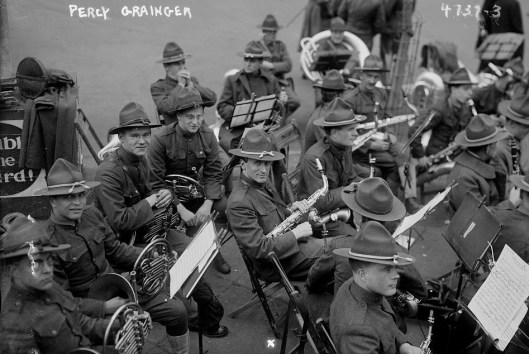
Happy Birthday to Australian musician Percy Grainger, born July 8, 1882. Grainger was pursuing an international career as a pianist and composer when the Great War began in Europe. Publicly criticized for not joining the British war effort, he sailed for America in 1915 and enlisted in the U.S. Army in June 1917, at age 34.

His first Army assignment was with the 15th Coast Artillery Band, stationed at Fort Hamilton, which is the ensemble pictured above. Grainger is the saxophonist in the center, above the small white X. Since it appears to have been chilly when the picture was taken, the time might be late 1917 or early 1918.

In June of 1918, Grainger came to Governors Island as an instructor in the program founded by the Institute of Musical Art (later part of what is now The Juilliard School) to train Army bandmasters and band musicians. Classroom instruction took place at the Institute, at Broadway and 122nd Street in Manhattan, and performing and conducting were taught on the Island.

Grainger was not particularly skilled on either the saxophone or the oboe, which he also played, but he was fascinated by wind, brass, and percussion instruments and wrote a great deal of music for them in various combinations, thus earning the gratitude of concert and military band players of succeeding generations. However, his most popularly known work is probably “Country Gardens,” an old English tune that he arranged for piano while at Fort Jay, as noted at the end of the published sheet music (“Written out, Fort Jay, Governor’s Island, N.Y., June 29, 1918”).

Grainger was discharged from the Army in 1919, and lived for the rest of his life in White Plains, New York just north of the city.

(image/Library of Congress Bain Collection)